Last week, we held a board meeting of the Ernest Buckler Literary Event Society (EBLES) at Lunn’s Mill beer company in Lawrencetown. The society supports biennial events in celebration of local writers. Afterwards, the topic of the Morse Estate in Paradise came up, and whether it was the model for the ‘secluded country guesthouse’ described in Buckler’s book The Cruelest Month.
This set me on a quest. 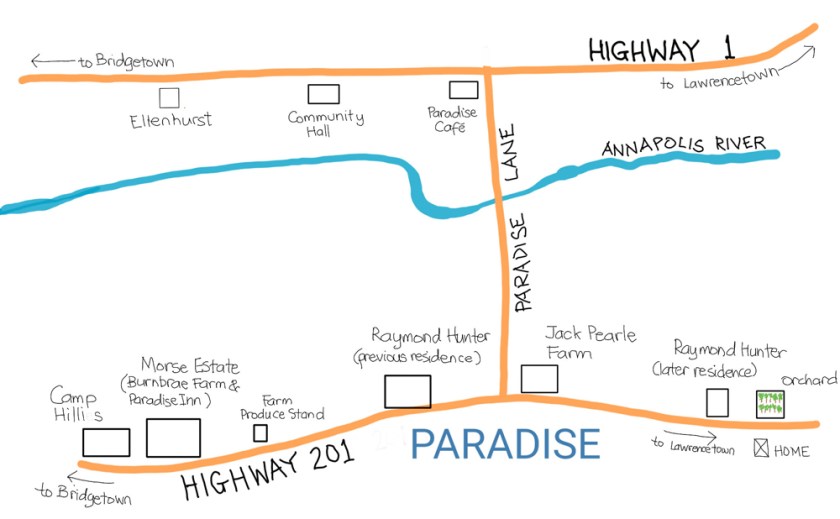
The Morse Estate has been renamed Burnbrae Farm and Paradise Inn. Consequently, I dropped in, to meet the owners: Erik and Simone Wasiliew. They run it as a Bed and Breakfast. Recently, they have also purchased the adjacent Camp Hillis, a residential facility from the provincial government, and plan to integrate it back into the estate.
From my visit, I learned some of the histories of the Morse Estate, as well as an appreciation of the vision of the new owners.
In the book, one of the characters is Morse Halliday (perhaps a clue). The guesthouse is called ‘Endlaw’, an anagram of Thoreau’s Walden.
Clearly, Paradise is changing. Across the Annapolis River, we find the new Paradise Cafe. Jack Pearle, who farms on Paradise Lane, has a new produce stand on the Highway #201.
To learn more about the history of the houses in Paradise, stop at the Community Hall. For each house, there is a short history, photograph and ownership information. This year also sees the establishment of the Paradise Historical Society. Every August, the Hankinsons at Ellenhurst, stage the Moonlight concert.
My link to the village of Paradise is through Raymond Hunter. Raymond and Rona lived on the corner of Paradise Lane, opposite Jack Pearle. Later, they moved east along Highway #201 towards Lawrencetown, where Raymond planted an organic orchard. That is where we enter the story. We are picking the orchard and maintaining its organic status
 It is awesome to imagine an event at Burnbrae Farm and Paradise Inn that looks at Buckler’s book The Cruelest Month in its modern context. Ideally, in April, which Buckler defined as the cruelest month. Now, its time to re-read the book.
Acknowledgements
Anne Crossman and Jane Borecky, both Board members of EBLES, for their conversation and support. To Erik and Simone Wasiliew, Burnbrae Farm for their hospitality. Sandra Barry for sending me the link to the Elizabeth Bishop poem, The Map. https://www.poemhunter.com/best-poems/elizabeth-bishop/the-map/. And Edward Wedler for his illustration.
References
Ernest Buckler. 1963. The Cruelest Month. McClelland and Stewart Ltd.
Burnbrae Farm/Paradise Inn. go to http://www.burnbraeparadise.ca
Footnote
Through the Annapolis Valley Regional Library Interlibrary loan service, I have received a copy of Elizabeth Bishop’s book Geography III. It includes ten of her poems, published in 1976. The frontispiece makes reference to ‘First Lessons in Geography’. Monteith’s Geographical Series. Published by A.S. Barnes & Co. 1884. Lesson VI: What is Geography ? Lesson X: What is a Map ? Bishop was familiar with this book in her childhood.
Answers. A description of the Earth’s surface. A picture of the whole or part of the Earth’s surface. Check the link above, to read Elizabeth Bishop’s poem The Map.

 Ernest Blair Experiment