At the COGS Industry Expo, there were presentations on both AI and GIS. These two technologies form a significant part of the curriculum in Lawrencetown. In my mind, it raised the question whether the human resource and technology was being shared with municipal government and businesses in the Annapolis Valley. I had noted that Adam Kemp, Valley REN presented at the Expo.
Meanwhile, Edward Wedler has been having a chat session with Gemini AI on the value of having a Nova Scotia conference on Geospatial AI for RENs and Counties in Nova Scotia.
Edward also shared a link to an Esri video on Geospatial AI.
The next steps.
Are the COGS faculty and students interested in hosting a conference on Geospatial AI for the RENs and Counties in Nova Scotia? Are the RENs and Counties interested in attracting businesses to the region, and accessing the human and technology resource at COGS?
The answer to these questions lie with the NSCC (COGS) and the Valley REN. My role, here, is as an engaged, somewhat informed (on GIS) citizen.
This week I picked up tickets to the Banff Mountain Film Festival at Kings Theatre, Annapolis Royal. Because of the weather, it has now been rescheduled to Sunday, March 1st ,2 pm. C’est la vie!
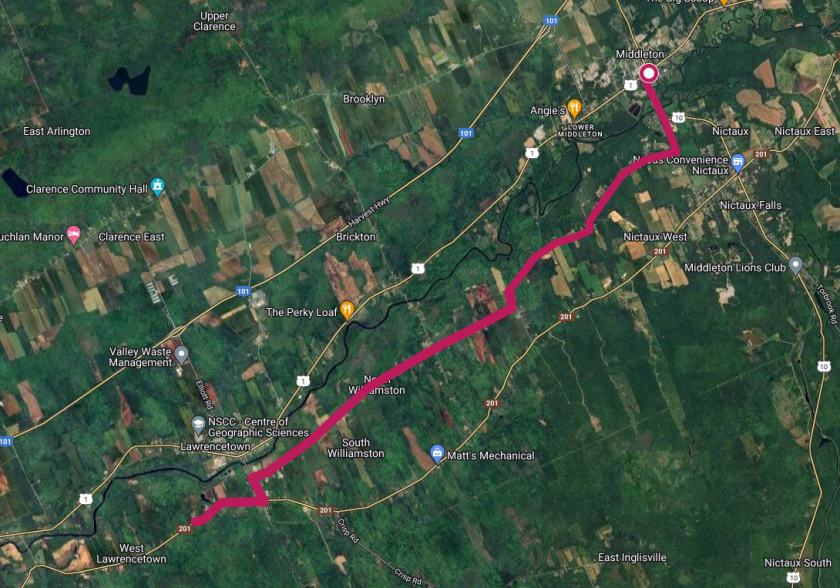
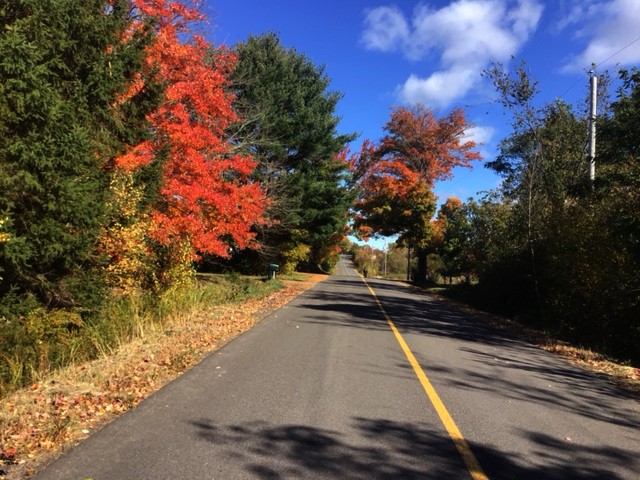
Yesterday, Heather and I extended our walk around Middleton Riverside Park to include the rails to trails loop back to Highway #1. Fortunately, the occasional snowmobile has compressed the snow on the trail.
The knowledge of AI from Edward Wedler is critical.
Reference
Esri video on Geospatial Information Systems, including commentary from visionary leaders, such as economist, Columbia University professor, and former Director of The Earth Institute, Jeffrey D Sachs.
POSTSCRIPT SUMMARY FROM AN ONLINE INQUIRY INTO COGS AND AI
The Centre of Geographic Sciences (COGS) at Nova Scotia Community College (NSCC) in Lawrencetown is increasingly integrating Artificial Intelligence (AI) into its specialized geomatics and geospatial training programs. As Canada’s largest geomatics-focused institution, COGS is adapting its curriculum to include machine learning, remote sensing, and advanced data analytics.
Here is an overview of AI at COGS and within the broader Nova Scotia Community College (NSCC) system:
AI in Geomatics at COGS
Industry Connection: COGS hosts industry expos and partners with organizations that are increasingly leveraging AI in GIS, such as Esri Canada.
Integrating AI with Geospatial Data: Instructors at COGS are exploring the potential of AI, particularly concerning geomatics and geographic sciences, to enhance analysis of geospatial data.
Programs: The Geospatial Data Analytics program focuses heavily on modern data, and students may work with AI-related technologies.
Projects: Students and faculty are looking into “geospatial moonshots” where AI is used for analyzing and interpreting complex geographic information.
NOTE Artificial Intelligence is making GIS more powerful, transforming operations, decision making, efficiency, and growth. Check out this short Geospatial AI introductory video from Esri.
Today (Monday) was the first day of the Industry Expo. This is normally a two day event. First day, includes presentations from industry employers, and Day 2 is for the industry representatives to interview current students.
It is an excellent opportunity to obtain an update on the Geomatics industry needs in the region, as well as to hear about changes in technology and teaching at COGS (see Industry Expo posts 2025, 2024).
COGS Display window during 2024 Industry Expo
Today, the weather intervened. Rather than presentations in the AV room, presentations were online, using the Microsoft Teams environment.
I was able to stay home in Middleton and hear the presentations from Caltech, UNB, Mitacs. In the afternoon, I enjoyed the keynote ‘Charting Career pathways in GeoSpatial Artificial Intelligence’ by Steven Edwards, COGS faculty, and two guests from Esri Canada.
The biggest challenge for me was my lack of familiarity with the Microsoft Teams software. This served to illustrate the changes in the learning environment. It also illustrated that keeping on top of new educational tools, on the fly, is not the best idea for a retired Geographer. Perhaps the presentations can be provided in a simpler, more accessible format, after the event.
Acknowledgements
Thanks to Monica Lloyd and David MacLean. Without their support, I would have felt quite lost on a Winter storm day. Good luck tomorrow to the current students in their interviews. Edward, thanks for the video link etc. It’s very powerful.
Today ( Friday), we were able to return to our CORAH classes: Men’s strength and fitness for me, and Chair Yoga for Heather (check out previous post A Geographic Proposal and Community Mapping Plans).
Checking my calendar, I realized that the last class was on December 5th. The NSCC campus in Middleton was closed over Christmas and New Year. It is unfortunate that these classes are not available over the holiday. I can feel the difference.
The upside is that I was able to pick up the program flier for February. I found three talks of interest.
“Love where you live: community mapping with purpose“. This is hosted by Ed Symons Geomatics instructor and his students, and includes mapping local resources and identifying local challenges.
‘New Year, New Page : an Intro to Bullet Journaling“. This interests me because I am curious how it overlaps with blog writing. Offered by Elizabeth Garcin.
Deb MacBean offers “Wired Wisdom: Tech Talk Trivia“. This is of interest because changes in technology occur all the time. Without institutional technical support, there are endless small changes that arrive on your iPad or cellphone.
The CORAH message is that WE ALL NEED TO BELONG TO A COMMUNITY.
Access to these educational resources is critical to quality of life in rural Nova Scotia, especially within the context of “rural aging and health“.
I also noted that Howard Selig of Valley Flaxflour Ltd. (see Buy Local and Support Local) is giving a talk entitled ‘Nourish and Flourish : delicious healthy cooking, for one or a few“. Sounds good !
Acknowledgements
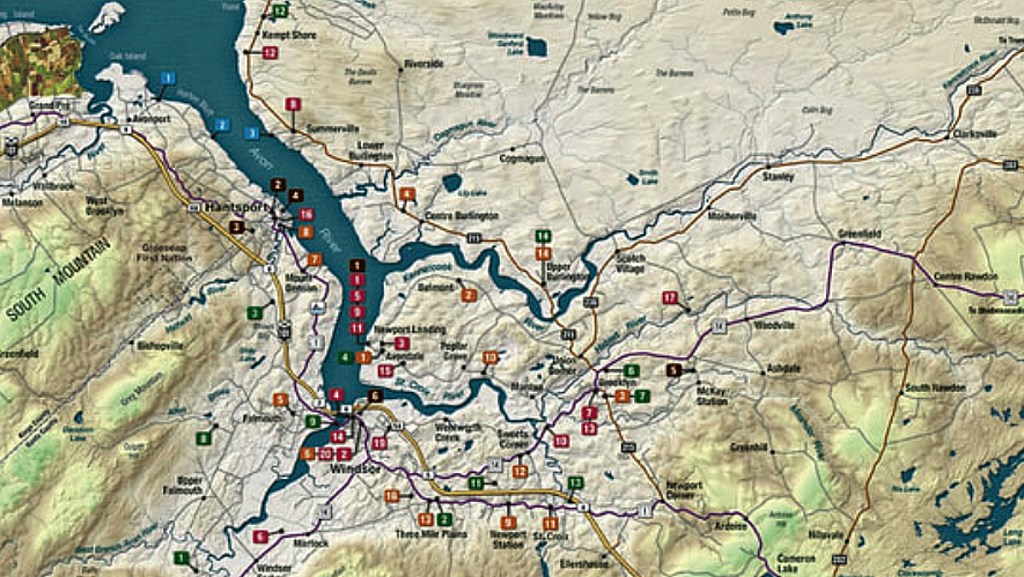
Thanks to Jaime and Jennifer at CORAH. They offer an efficient, empathetic learning environment for everyone. Edward added the graphics, the map and the links.
This morning, I received an email from Digby Print and Promo (see previous post A Drive to Digby). They had produced Volume 10 – 2025 of my blog. It provided the opportunity to make a return trip to Digby. There was snow on the wind. The drive simply reinforced how infrequently we take Highway 101, beyond Annapolis Royal.
In contrast, this morning Anne and Edward Wedler strolled Paper Mill Lake in Bedford’s early morning’s sun under a blue sky, with not a snowflake falling
With my blogs in a hard copy format, I can reflect on previous blogs from one year to the next. For example, January 8, 2025 ‘Home Place’.
‘Moving onto this week, the media has been full of Justin Trudeau, Donald Trump and Elon Musk. I tried to turn it off by watching ‘North to North’.
Here we are, it is January 21, 2026.
‘Ultimately, life is about landscape, and how we share it with friends and family; embedded within the local geography: climate, ecology. Unlike the newsmaker/politicians, it is not a resource to be traded for personal gain.’
In particular, I enjoy the drive across the dykes from Wolfville. Even though we checked the open hours online, we discovered they are closed until March.
One of my early January tasks is to arrange for the printing (hard copy) of my blog posts from the previous year. This is usually undertaken by Integrity Printing, Bridgetown. Unfortunately, they closed down in 2025.
Instead, I contacted Digby Print and Promo. It seems like years since we made the run to Digby.
They will produce for me, Volume 10 – 2025. This gives me ten years of hard copy. Time, again, to consider a review of the underlying themes.
On our return journey, we stopped at Endless Shores in Bridgetown. I wanted to see if they still sell Rural Delivery.
2026 is the fiftieth year of this publication by Dirk van Loon. The reason for my interest is that John Wightman had loaned me Volumes 50 #5 and 50 #6. No luck ! Time to consider a subscription renewal.
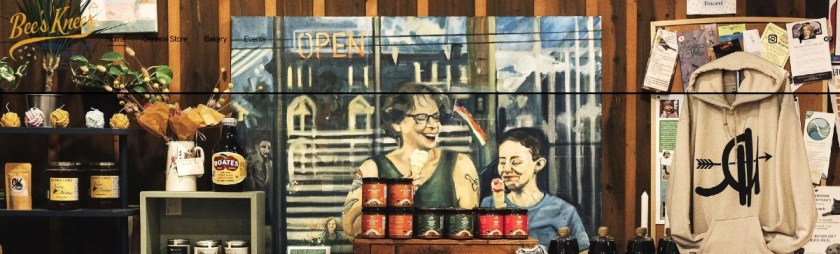
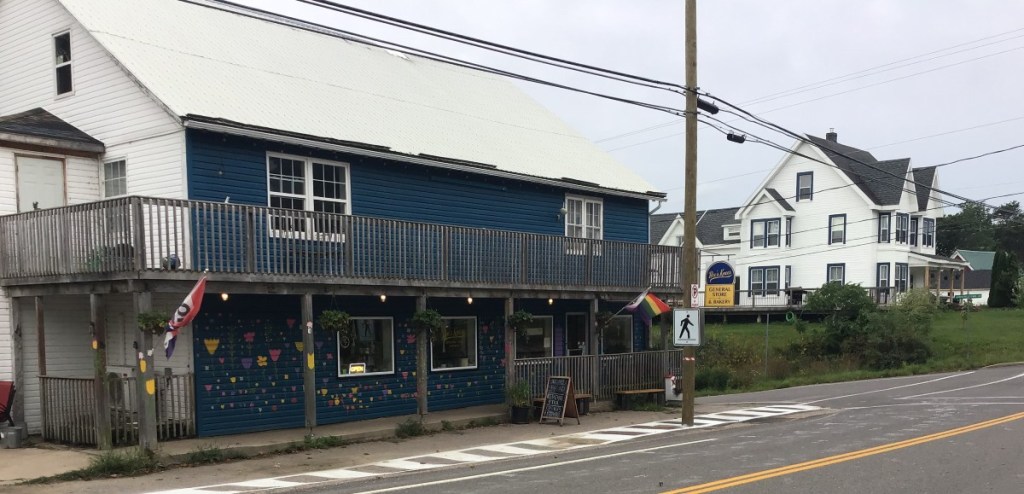
After a week away in Pictou County, we were happy to return to Annapolis County. On Saturday afternoon, we stopped at Bee’s Knees in Lawrencetown. Besides the coffee and sausage rolls, we found that there was live music.
The store has an excellent reputation for its bakery. It also offers books by local writers, and crafts by local artists (see posts Local Geography and Wild Mind/ Wild Earth).
Today, I picked up a copy of the Annapolis Valley Register (Thursday, December 18, 2025). I wanted to read Anne Crossman’s last official column.
To my surprise, I found an article on ‘Student housing stock growing’ (p. A4). It caught my eye, with an aerial photograph of the NSCC (COGS) campus. It showed two multi-unit apartment buildings, next to the campus’.
‘Student Housing Nova Scotia purchased four buildings in Lawrencetown and three in Kingston with $6.9 m in loan from the province Community Housing Acquisition Program and $530,000 from the national Community Housing Capital Fund’ (see Gemini AI inquiry HERE and Four-Campus NSCC Housing Construction article HERE).
NSCC Ivany campus student housing under construction in October 2023. Credit: NSCC
These investments in Lawrencetown and Kingston to support student accommodation at the NSCC campuses in Lawrencetown, Middleton and Kentville raise a number of questions.
As a retired faculty member from both the Lawrencetown campus and the Middleton campus, my interests concern both technical education and applied research .
A few years ago the 38-bed residence at COGS that opened in 2022 was designed to support short industry-led courses in Geomatics and Geographic Information Sciences. Is that still true? I think not.
Years ago, students came from other parts of Canada and also from overseas. Of the programs offered at COGS how many of of the courses require a residency requirement? How many can be delivered online?
Given the reputation of the COGS campus, the Middleton campus and the Kentville campus, what programs are planned? What is the market demand for well-trained technically skilled graduates? Historically, we had three departments at COGS: Surveying, Cartography and Planning, Computer Programming.
What exists today (2026)? What can be delivered online?
At the Middleton campus, we established the Applied Geomatics Research Group (AGRG). What has been the impact of new technology (eg. drones, Lidar, AI)?
Access to student accommodation is important in rural Nova Scotia, for students and the community. Likewise important is access to ‘state of the art’ technology. The NSCC (COGS) has a long tradition of working with global suppliers of geographic technologies.
May that tradition continue.
Interestingly, Jason Clark is NSCC Principal for all three campuses: Lawrencetown, Middleton and Kentville. May we look forward to a comprehensive and integrated approach to technical education at the NSCC in the Annapolis Valley?
Over Christmas, Heather and I were in New Glasgow and Pictou.
For “light reading” about place, I picked up Rankin MacSween’s book, “The Search for a New Way” at Cole’s in the Highland Mall.
It is the story of New Dawn Enterprises in Cape Breton.
With that in mind, we decided to visit the DeCoste Centre and Library in Pictou. At the Centre, there was a remarkable display of quilts by Deb Plestid. This led to a request at the Library desk. I was able to sign out Sheree Fitch “Sing in the Spring !“, with artwork by Deb Plestid.
Afterwards, I was able to sign out two other books, both by Roland Sherwood, “Pictou’s Past” and “Pictou Pioneers”. Because of the excellent library system in Nova Scotia, I can return the books to my local library in the Annapolis Valley.
After the DeCoste Centre, we stopped for a coffee at Mrs MacGregor’s Shortbreads on Water Street. For our grandchildren, we picked up two books illustrated by Teresa MacKenzie “Pictou Town” and “A Pictou Christmas“. Pictou Town is a souvenir edition.
“To honour the 250th Hector Anniversary, The Pictou Bee Press is proud to publish Teresa MacKenzie “Pictou Town”. Teresa MacKenzie is curator of the McCulloch House and Genealogy Centre in Pictou.“
“Rankin MacSween examines New Dawn’s decades-long search for a better, more humane, more truthful way to build local communities and regional economies through people-centred community development.‘’ MacSween provides the most thorough history ever written of Canada’s oldest community-development corporation.
The search continues today, in Cape Breton, Pictou County, as well as in the Annapolis Valley.
References
Rankin MacSween, 2023, The Search for a New Way: The Story of New Dawn Enterprises, Nimbus Publishing. Sheree Fitch, 2022, Sing in the Spring, Nimbus Publishing. Roland Sherwood, 1973, Pictou Pioneers, Lancelot Press. Roland Sherwood, 1988, Pictou’s Past, Lancelot Press. Teresa MacKenzie, 2023, Pictou Town, Pictou Bee Press, Pictou, NS. Laurie Stanley-Blackwell, 2023, A Pictou Christmas, Pictou Bee Press, Pictou, NS. Illustrated by Teresa Mackenzie.
My Nova Scotia Plein Air Map is focused on only THREE outdoor art groups in Nova Scotia yet has now over 38,000+ map views. Imagine if this can be scaled to all art groups globally!
The Plein Air Art and Urban Sketching movements are described as the largest in art history, with participants ranging from casual hobbyists to professionals. A reasonable, though unverified, estimate for the combined global community of regular plein air painters and urban sketchers is likely in the hundreds of thousands (ref Gemini AI).
Since retirement, I have chosen to spend much of my time painting outdoors in watercolours — en plein air. Here is a selection of nine paintings I created in 2025.
TOP (l to r) The Pink Piano (Lower Sackville, NS). The Hydrostone (Halifax, NS). Planters Ridge (Annapolis Valley, NS) MIDDLE (l to r) Farrell Estuary (Parrsboro, NS). Cochrane Rd Trail (Port Greville, NS). Fisherman’s Cove (Eastern Passage, NS) BOTTOM (l to r) Joshua Citrus (Arcadia, FL). Prospect (NS). Fox River Estuary (Fox River, NS)
My painting partner, Anne, has selected her nine oil paintings for this 2025 matrix.
Top (l to r) Still Life (Lunenburg, NS). Planters Ridge (Annapolis Valley, NS). Manatee Mangrove (Palmetto, FL). Middle (l to r) Celery Fields (Sarasota, FL). Herring Cove (NS). Carmel (PEI). Bottom (l to r) Twin Oaks Road (Middleton, NS). Bear River (NS). French River (PEI).
As a plein air painter who is also interested in the geography of art and its related GIS opportunities, I await a benefactor (ESRI?) to join and help create a global map — a global map that, together, addresses regional interests and a map that bypasses the many limitations of Google’s My Maps.
My Google Maps (a work in progress): Plein Air Map (updated annually) Footsteps East (includes the geography of Canada’s “Group of Seven” artists)