Posted in Art, Event Review

Plein Air Paint-Out Map for 2023

Our Nova Scotia plein air art map grows with community user input. It currently has 19,000+ map views.
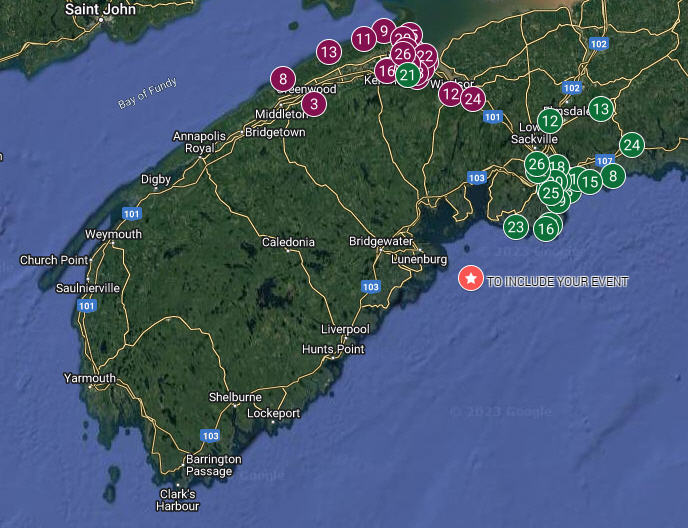
The map shows paint-out locations for the upcoming, outdoor (en plein air) painting season.

According to Plein Air Magazine, the plein-air painting movement is the fastest-growing movement in the art world today.

Editor, Eric Rhoads, calls it “the new golf”. Many tens of thousands of artists, worldwide, are involved in this movement.

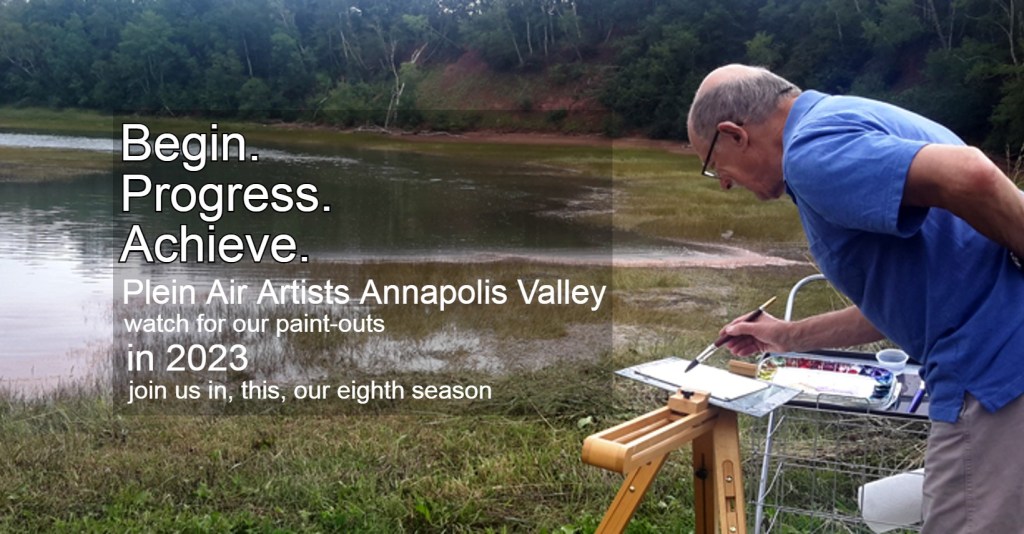
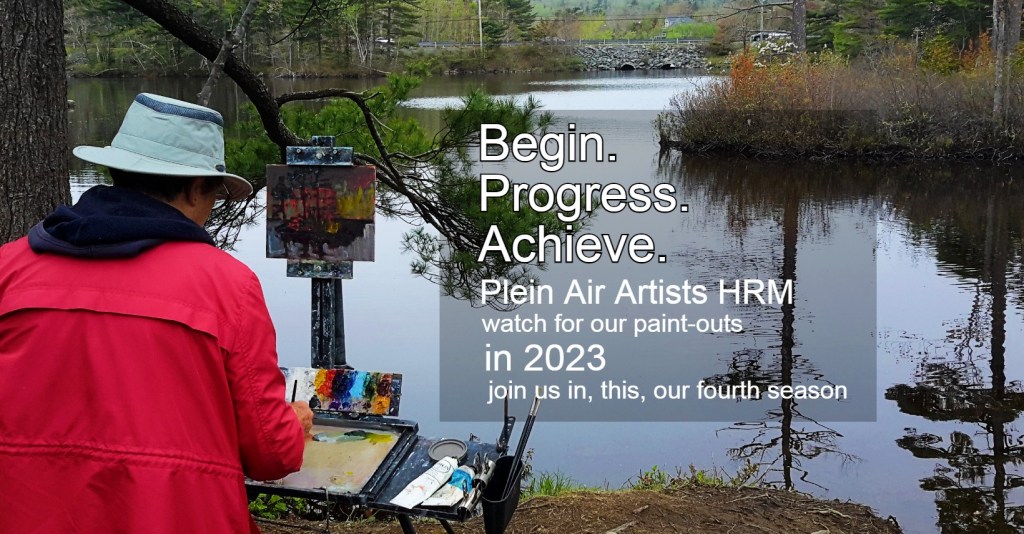
Anne and I have founded two groups in Nova Scotia (Plein Air Artists of the Annapolis Valley, PAAAV in 2016, and Plein Air Artists HRM, PAAHRM in 2019).

We participate in a third group, Halifax Urban Sketchers, HUSk, and have collaborated with the Nova Scotia Association of Architects to hold sketch-outs.
The map, and associated schedules, keep member artists, event organizers, art lovers, collectors, residents, and out-of-Province tourists aware of what, when, and where events are held. We have had visitors from Europe, across Canada and the USA join us based on this knowledge. Last year I created an icon on the map to allow others to place their event on the map. It’s crude (using Google Forms) but it works.


I use the Google Map platform because it is popular, and well-integrated with its suite of products (Google Sheets, Google Docs, Google Forms, Google Calendar, YouTube, etc.). Such a platform forms the basis of another map I am building for “Footsteps East”.

Our Footsteps East map tells the story of our 6,000+ km tenting and painting trek that Anne and I are undertaking from Nova Scotia to Lake Superior, and back. This organic, interactive map grows with text, and links to YouTube, Spotify, a Calendar, and sketches as we camp at each paint-out site. Anne looks after Instagram, Facebook, and Google Calendar.

On a final note, I’d like to say there are a number of improvements that would make such maps more valuable and scalable (and be monetized). If there is anyone out there who’d love to work with me on this let me know or refer me to some Google Map developers.

References

Link: Plein Air Map (tinyurl.com/PleinAirMap)
Link: 2023 Paint-Out Schedule PAAAV (https://bit.ly/3ZvR5Zz)
Link: 2023 Paint-Out Schedule PAAHRM (https://bit.ly/3ZvR5Zz)
Link: “Footsteps East Launch Pad(https://www.wedlerfineart.com/page/36519/footsteps-east-launch-pad)

Acknowledgments

Dr. Bob Maher as our Footsteps East Geographer Mentor and Advisor
Jesse Millican as our Footsteps East field video and audio recording Advisor
Techert Gallery as our host venue for the Footsteps East original art exhibition, September 2023
A global community of artists supporting and following us on our Footsteps East trek.

POSTSCRIPT
A recent plein air oil painting created by Anne in Florida.

Posted in Art

Artists’ view of the landscape.

Unlike photographers, geographers or geologists, landscape artists see their world as collections of lines, contours, shapes, colours, light and shadows. Identifying features is secondary.

pleinair_tupperville_10may16_90dpi_edwardwedler
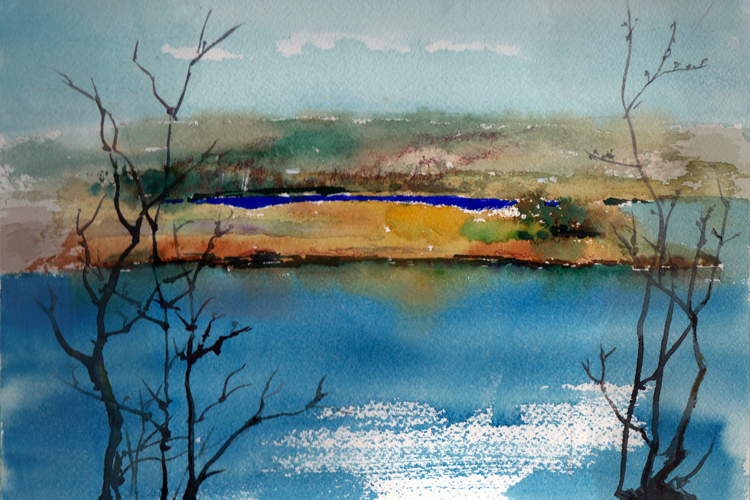
“Annapolis River at Tupperville, Nova Scotia” (watercolour by Edward Wedler)

A geographer tries to make sense of the landscape,  looking at relationships between features to explain where things are, how they came to be, how they evolve and change over time, and how they interact with us. A geologist examines the makeup of landscape to understand how it formed over millennia and how it may change in future. They want to understand how the landscape works. A photographer captures the visual character of a landscape under different lighting and weather conditions at a particular point in time on photosensitive material.

The “en plein air artist” paints on location, mostly outdoors. Each artist pulls out their materials and tools and begins to work quickly. It’s like speed dating with light and shadow. The artist will look for one or two focal points. They will look at distant, mid-ground and foreground features to figure out what to highlight and what to suppress. Often they will add to or remove elements from the scene for aesthetic/design reasons. Their view of the landscape is an interpretation perhaps in oils, watercolours, acrylics, pastels, pen and ink, or graphite. The plein air artist also seeks to elicit an emotional response to the art of their immediate environment. I consider the geography of the plein air artist as the geography of perception.

The Annapolis Valley Plein Air Art group, to which I belong, paints landscapes throughout our area — towns, farmlands, and coastal waterways. Each week we assemble at a different “paint-out” site. At the one site, some will paint details of rocks in a stream bed. Some will paint tourists enjoying the sunshine on benches along a path. Some will paint distant hills framed by woodlots. The landscape becomes a collection of deeply personal, visual expressions and no two paintings or sketches are the same.

What can we learn from interpreting the landscape through artists’ eyes? One of my mentors, Vlad Yeliseyev, is often heard to “rant” to plein air artists, “Don’t paint a photograph. Paint a story.” Local Digby artist, Poppy Balser states in her profile “Watercolour is the perfect medium for me to capture the atmosphere and light of my local environment.” In his book “Interpreting the Landscape in Watercolor”, Don Andrews illustrates the magic of linking light, shadow and colour”. For me one artist may see a tree as blue, nestled in the cold shadows. Another may see the same tree as olive green, absorbing scant rays of sunshine peaking through breaks in the clouds.

Unlike the photographer, geographer, or geologist, the artist is the landscape’s chorister; composing a visual libretto.