
“If you have a library and a garden, you want for nothing else”: British saying.
From Chapter 4. What we can learn from the British, Mark Cullen and Ben Cullen’s Escape to Reality: how the world is changing gardening and gardening is changing the world.

I found in the COGS Library Alice Sparberg Alexiou’s biography Jane Jacobs: Urban Visionary.
Chapter 10, Economist without Portfolio, starts with the question ” Why do some places get rich, but not others ?” (p 169).
In ‘On the Mechanics of Economic Development’, Robert Lucas, who would win the Nobel Prize for Economics in 1995, argued that places that thrive do so mostly as a result of what economists call ‘human capital’ (p169). When Lucas was developing his hypothesis, he read Jacob’s 1969 book The Economy of Cities. Her book, Lucas realized, was all about the external effects of human capital, and it helped his ideas take shape (p 170).
“As Jacobs had rightly emphasized and illustrated with hundreds of concrete examples, much of economic life is ‘creative’ in much the same way as ‘art’ or ‘science’ (p 171).
“All economic growth since the industrial revolution is due to ideas,” Lucas says ” But growth theory for years ignored the force of ideas. For Jacobs, this question is the centre of everything’. ” Jacobs, he says “shows that most of the ideas come from the ground, not R & D departments” (p 171).
From Jacobs, ” I think we are misled by universities … into thinking that there actually are separate fields of knowledge. But no, they link up … everything is a seamless web … and its a very functional thing, not just a poetic expression.”
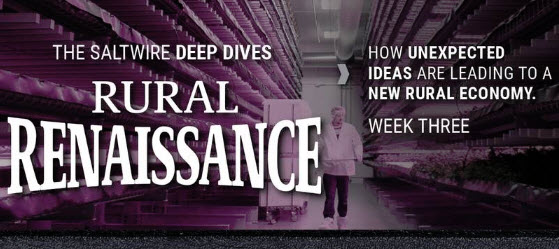 Combine these observations by Jacobs with the Chronicle Herald article on the new rural economy. The PLACE model of Community Development comes from seven years of research on Fogo Island by Memorial University in partnership with the Shorefast Foundation.
Promote community champions
Link Insiders and Outsiders
Assess local capacities
Convey compelling narratives
Engage both/and thinking
‘It is through a commitment to place, and principles of PLACE, that champions muster the energy, creativity and other resources to renew a community’s economy and sense of purpose.’
Further to my conversations with Brian Arnott (see my earlier blog) Jane Jacobs can be considered both an urban visionary and a rural visionary.
Postscript
This week, we settled on the format for the Local Authors Question and Answer session at the EBLES event on June 29th. Bob Bent, Marilyn Jones and Dianne LeGard, all members of Authors Ink, will discuss their work. They will address the question: Why do I write? What do I like to write about? How is my writing published? How to market my book(s)?
Acknowledgements
Brian Arnott for his thoughts on economic development in rural communities. Edward Wedler for his graphics contribution.
References
Alice Sparberg Alexiou. 2006. Jane Jacobs: Urban Visionary. Harper Collins Publishing.
Mark Cullen and Ben Cullen. 2018. Escape to Reality. How the World is changing Gardening and how Gardening is changing the World. Nimbus Books.
Barbara Dean-Simmons. Chronicle Herald. Friday, May 24,2019. How unexpected ideas are leading to a new rural economy. Part 3. Taking the Past into the Future. p A8-A9.

 Ernest Blair Experiment
One thought on “Jane Jacobs Biography”