Anne and I recently spent a week travelling through picturesque Cape Breton, Nova Scotia, taking in the popular sites, such as the Fortress of Louisbourg, and discovering some underrated nooks and crannies.

We couldn’t help but notice the various ways people move through and note the landscape. As artists, we spent several hours documenting specific sites en plein air — Anne with her oils and me with my watercolours. Spending time at each location lets us absorb the landscape with all our senses. Our recall for detail is heightened.
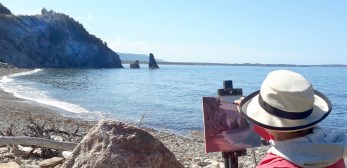 While painting Pillar Rock from Presqu-île, near the southern part of the Cape Breton Highlands National Park, we noted dozens of visitors come for a few minutes to snap photos then move on. Did they see the otters swim the nearby pond? Did they note how the sun lit up the rocky shoreline as it rose above Jerome mountain? Did they hear the high-pitched piping notes of the eagle?
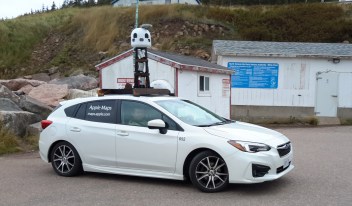 At the other extreme, we were greeted several times by the “Apple Map vehicle” taking rapid-fire snapshots of the landscape as it motored throughout the Cape Breton Highlands. We were surprised to see it in the small northern community of White Point. It had a different purpose — to engorge its databanks with a future, retrievable, online, photo and map record of the region.
Whether painting, hiking, photographing, video-recording or “apple-mapping” we all move through the landscape at different rates and with different pursuits in mind. How do you move through the landscape? How much do you absorb from your travels? What record do you log and keep?
ACKNOWLEDGEMENTS
Anne Wedler for being my supportive, painting buddy. All those Cape Breton visitors we met attached to their iPhones and smartphones.

 Ernest Blair Experiment