“We abuse the land because we regard it as a commodity belonging to us. When we see land as a community to which we belong, we may begin to use it with love and respect”. Aldo Leopold. A Sand County Almanac. 1949.

These last two days we have been supporting Alex Cole and his team: Silas, Chris, Rick and Gord produce charcoal from the leftovers of the coppicing of red maple. The coppicing produces poles for yurt construction.
This community collaboration reminded me of David Orr’s essay on Re-Ruralizing Education. It emphasizes practical woodland skills for managing the land. The products provide materials for nomadic shelters. In some way, not dissimilar to the Mi’kmaq dwellings used for their movement through the landscape. The charcoal can form the basis of biochar that adds fertility to our gardens, at home and in the forest.
At the Climate Summit last weekend, Danny Bruce, an organic farmer from Centrelea stated:
“There are lots of skills that we could relearn and use to forward us. I think maybe we can do it a little simpler than our grandmothers did, but it’s all possible.”
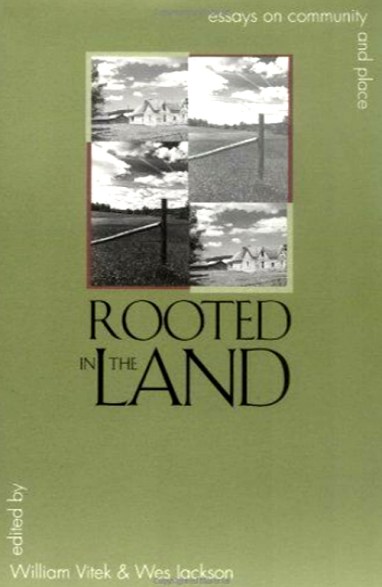 Another concept, from Rooted in the Land essay by Susan Witt and Robert Swann is the Community Land Trust (CLT) concept developed by the Schumacher Society.
“A community land trust is a not-for-profit organization with membership open to any resident of the geographical region or bioregion where it is located. Its purpose is to create a democratic institution to hold land and to retain the use-value of the land for the benefit of the community.”
It appears that we are seeing a new ‘back to the land’ movement. Or as Heather Stewart, astutely observes ‘back to the land with green $$$’ (money). The Annapolis Valley is well situated to be part of this creative rural economy, at a time of climate crisis.
Talking last night, we speculated whether the proposed Gordonstoun Nova Scotia school would adopt this type of rural curriculum.
Lawrencetown inter-library loan service has delivered Wilding by Isabella Tree. First glance shows the fascinating history of land use and farming at Knepp in West Sussex. ‘The Knepp ‘wilding’ project is a vitally important experiment for working out what we can do to let nature back into our farmed landscapes’.
Acknowledgements
To Alex Cole and his work crew of Silas and Chris, supplemented by the expertise of Rick and Gord for the charcoal making event. Heather for her insights and enthusiasms. John Wightman for his thoughts on the Gordonstoun school. Edward Wedler for graphics contribution.
References
From Rooted in the Land edited by William Vitek and Wes Jackson,
David Orr. Re-ruralizing Education. p.226-234.
Susan Witt and Robert Swann. Land: challenge and opportunity. p.244-252.
Handbook on establishing a Community Land Trust can be obtained from the Schumacher Center for New Economics. https://centerforneweconomics.org

 Ernest Blair Experiment
One thought on “Rural Curriculum”