I had intended to review, “A Sense of Humus” but Heather was looking for some light reading this week. Her review suggests that it will be a worthwhile read.
 Meanwhile, I went to the bookcase and found “Beginning Again: People and Nature in the New Millennium” by David Ehrenfeld. While written in 1993, looking towards 2000, it holds true in 2020, looking towards a post-COVID world.
I think it was Tuesday. I was preparing the bed to transplant some tomato plants from the greenhouse and discovered a common toad.
Ehrenfeld’s second essay is titled ‘The Roots of Prophecy: Orwell and Nature”.
What was Nature to George Orwell?
Ehrenfeld lists three qualities:
- honesty
- reliability/continuity/durability/resilience
- beauty and serenity
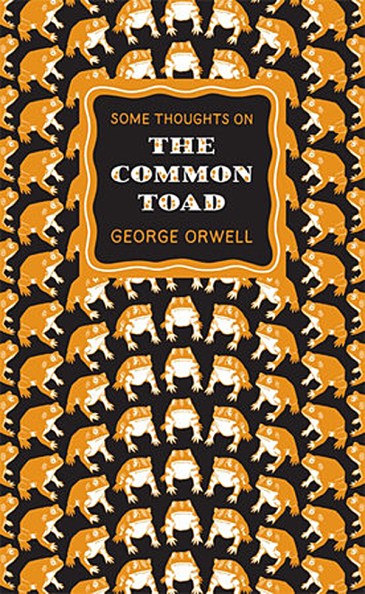 He also makes reference to Orwell’s thoughts on the common toad’. For example,
“At any rate, Spring is here, even in London N1 and they can’t stop you enjoying it. This is a satisfying reflection. How many a time have I stood watching the toads mating, or a pair of hares having a boxing match in the young corn, and thought of all the important persons who would stop me enjoying this if they could. But luckily they can’t. So long as you are not actually ill, hungry, frightened or immured in a prison or a holiday camp, spring is still spring. The atom bombs are piling up at the factories, the police are prowling through the cities, the lies are streaming from the loudspeakers, but the earth is still going round the sun, and neither dictators nor bureaucrats, deeply as they disapprove of the process, are able to prevent it”. p.6
Here is my second observation. Heather feeds the kitchen vegetable waste to her worms in the basement. We use the worm castings to add to our soil in the greenhouse. One of the by-products from the worm humus is that it is full of tomato seeds. The seeds and skins are separated in the making of tomato sauce. Those are the tomato plants which I transplanted into the garden, under the watchful eye of the common toad.
This raises a larger question. What are the memories of earlier lives and events that build up the human humus? Time to read Bertha Damon.
(It is interesting to note that George Orwell was born in 1903 and died in 1950, aged 47 years. He saw the end of the Second World War).
Returning to Ehrenfeld:
“If this alternative way of living grows and prospers, I doubt that it will do so by some master plan or protocol…..
“Nature will have entered their lives at an early age and will remain as a source of joy and as a measure of their best and worst efforts. They will welcome the challenge that Orwell hoped for, a simpler, harder world in which machines, like their inventors, are understood to be limited. They will devote their first energies to the places where they live. They will come to authority not by violence but by their evident ability to replace a crumbling system with something better’.” p.193
Acknowledgements
Heather for her commitment to life and Nature. Edward for his collaboration and creativity. Jane for starting this conversation.
References
David Ehrenfeld, 1993. Beginning Again: People and Nature in the New Millennium. Oxford University Press.
George Orwell, 2010. Some Thoughts on the Common Toad. PenguinRandomHouse Books. Great Ideas #99.
Bertha Damon, 1943. A Sense of Humus. Simon & Schuster.

 Ernest Blair Experiment