As promised, I have read Bertha Damon’s book, shared by Jane Nicholson.

At the beginning of Chapter 9.
“The importance of humus in human economy seldom receives sufficient emphasis. Suffice it to say that it probably represents the most important source of human wealth on this planet” p.95.
Damon published the book in 1943 during the Second World War. It is a collection of twenty-two chapters. Besides Humus, other topics include Spring Doings, Plowing and Planting, In Defence of Weeds, Apples Old Style.
“To have a sense of humus is to have an appreciation of the past, to realize that to discard the achievements and virtues slowly built up through long periods of human society and to attempt to live solely in the present is like throwing away humus and trying to exist in more or less inorganic hardpan.”
“One who works much with humus sees it to be a symbol of democracy, in which many work for the good of one, and one works for the good of many.” p.101.
From Apples Old Style, Chapter 21.
“I have found that at least twenty two different varieties, well enough known to get into books, originated in New Hampshire.” p.230.
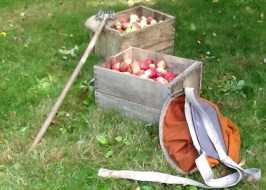 This compares with the four varieties in our small orchard: NovaMac, NovaSpy, Liberty, MacFree.
After my earlier blog post, Brian Arnott made the comment.
“Is the mind a kind of compost pit? Do we break down ideas to create more potent matter? Yes, probably.”
On Friday afternoon, I had the opportunity to meet with both Roger Mosher and John Wightman. John kindly lent me two books by Thomas Raddall, “The Dreamers” and “Halifax: Warden of the North” as well as Will Bird’s, “Off-Trail in Nova Scotia”.
In these COVID times, books serve as a medium for sharing ideas, to add to the ‘compost pit’.
Postscript
Having a sense of humus, reminds me of the important role of elders in our society, without them, we are left with the inorganic hardpan. I also think of the work by Maria Popova and her web site, Brain Pickings. Check it out.
 This led to the following exchange with Edward Wedler.
”If society sees elders as simply ‘old people’ then we are missing out on the opportunity to harvest/apply this mental humus.”
Edward replied “There exist many cultures that value elders (Japanese and Canadian indigenous communities come to mind). David Suzuki once co-authored a book ‘Wisdom of the Elders’ where he explored this question.”
Acknowledgements
Brian Arnott, Roger Mosher and John Wightman for their contributions. Jane Nicholson for sowing the seed. Heather for her help in the garden. Edward for his feedback.
References
Bertha Damon, 1943. A Sense of Humus. Simon and Schuster.
Thomas H. Raddall, 1986. The Dreamers. Pottersfield Press.
Thomas H. Raddall, 2007. Halifax, Warden of the North. Nimbus Publishing.
Will R. Bird, 1956. Off-Trail in Nova Scotia. McGraw-Hill Ryerson.
David Suzuki and Peter Knudtson, 1993. Wisdom of the Elders. PenguinRandomHouse.

 Ernest Blair Experiment