If you want to discover stories about maps, a good starting point is the Library at COGS. Speak to the Librarian, Andrew Hannam. In my case, I recalled a book on the History of GIS. Instead, I found two other books.
Joan Dawson, The Mapmakers’ Legacy.
Anne Knowles, Placing History

The book by Dawson provided me with a context for the Church maps. Chapter 4, Natural Resources : minerals, wood and water, highlights the geology of Gesner and Dawson, as well as Church’s mineral map.
The second book, edited by Anne Knowles for Esri Press, contains essays in historical GIS.
Brian Donahue ‘Mapping husbandry in Concord: GIS as a tool for Environmental History’.
”GIS mapping can help build a complex, productive engagement between people and the places they inhabit. It can pull together the layers of environmental history to inform how we care for our land today.” p.175.
Michael Goodchild ‘Combining space and time: new potential for temporal GIS’.
”In short, the transition to object-oriented data modeling in GIS has solved some basic problems, allowing a rapid expansion of interest in the use of GIS to improve our understanding of historical and other time-dependent phenomena.” p.196.
While at COGS, I wanted to check out the Walter Morrison Map Collection.
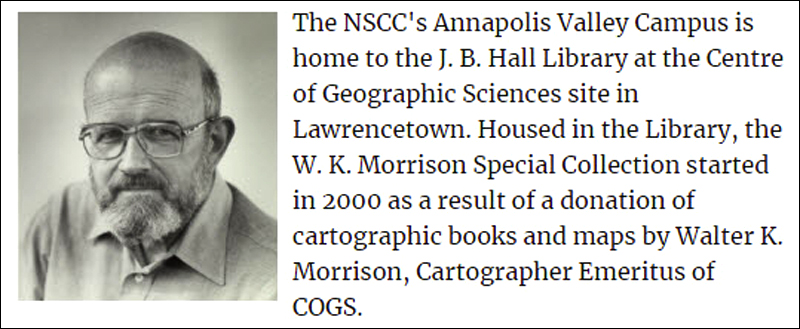
Because of COVID, things were closed up, however I was able to find a listing of the maps online. I will have to return another day to take a closer look at the Church maps.
It remains remarkable that I can find these resources, locally available in Lawrencetown, and to find Cartographer Monica Lloyd responsible for the site.
The Church maps give us a picture of settlement in Nova Scotia from the mid-nineteenth century. What we need is a picture of the landscape from the pre-settlement (colonial) period to the twenty-first century (2021).
If we could look at landscape change, in Nova Scotia, in terms of forest cover, agricultural land use, mineral exploitation over time, we would have a better understanding of the impact of today’s land use management decisions.
What resources exist to map these changes? Within a historical GIS (see an upcoming blog post)?
Postscript
The Esri Press book was published 2008. What is the status of Historical GIS in 2021? We shall find out!
Acknowledgements
Andrew Hannam and Monica Loyd at COGS. David Raymond, Michael Goodchild and Brent Hall for their intellectual companionship. Edward Wedler added the graphics and links.
References
Joan Dawson, 2007, The Mapmakers’ Legacy. Nineteenth-century Nova Scotia through Maps, Nimbus Publishing.
Anne Knowles (Ed), 2008, Placing History. How maps, spatial data and GIS are changing historical scholarship, Esri Press.

 Ernest Blair Experiment