This week, as part of my Ernest Blair experiment, I arranged for an interview with Natasha Prosser at Nova Scotia Works.  My interest was two-fold. I wanted to challenge myself and find out what would be the process if I decided to return to work ( I retired in 2011). Secondly, I wanted to understand the nature of the employment hub in Middleton www.peopleworx.ca. The result was a one-on-one interview with Natasha challenging me to define this new person post-traditional employment. In my case, I had been working within different institutions, either government or education.
On the same day, I noted an article by Sandra Martin in The Walrus (September 2018) on Aging: the baby boomers’ last revolution.
“Boomers have grabbed so much of life’s riches and adventures. Now it is time for us to give back: not only for ourselves but for the sake of our children and the generations to come. Fixing pharmacare and home care could be our final and most significant campaign – if we are up for one last struggle.” p.53.
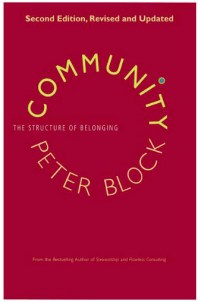 Another connection, that appeared in my email box that day, was from Axiom News. It describes the work of Peter Block and the second edition of his book Community: The Structure of Belonging
“whatever it is that you care about, it takes a group of people to learn to trust each other and choose to cooperate for a larger purpose to make the difference that you seek.”
Hence my blog title is a play on words. Rather than think about Nova Scotia Works, let us imagine a social enterprise called Nova Scotia Retires. What would it look like? What issues would it address? Could it address the issues covered by Sandra Martin? Would it be designed along the lines suggested by Peter Block?
From various statistics, it would appear that Nova Scotia has a wealth of talent to support such an agency. It could be a world leader. Rather than addressing these questions, after the fact, we could create a culture that understands at a deep level, the transition from work to retirement. What activities, infrastructure are needed in support of this natural progression? Some of these structures exist today. Others may not exist anywhere. We need to experiment with different arrangements to see what can or will work in the future. That’s pretty exciting stuff. It could change our relationship to each other, as well as our relationship with our community and the landscape.
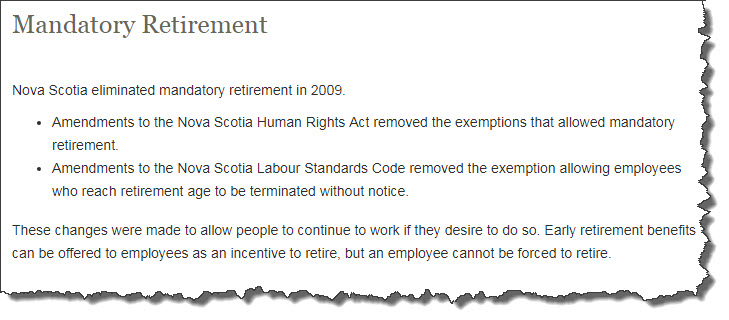
Thanks to Natasha Prosser and Edward Wedler for their continued support.
References
Sandra Martin. 2018. The New Old Age. The Walrus September. p.46-53
Peter Block 2018. Community: the Structure of Belonging. 2nd edition.
Axiom News.August 2nd 2018. Engaging Wisdom Councils and Uniting for Common Good.

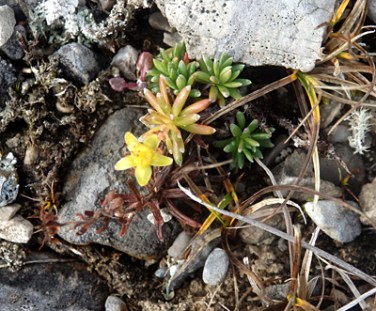 We had many personal realizations. While we had studied the plants in the National Park, visiting the serpentine Tablelands and the barrens on the top of Gros Morne, we had not gone North of the park. Over the last forty years, scientists have rediscovered the geology and biology of the Great Northern peninsula, in particular the uniqueness of the limestone barrens.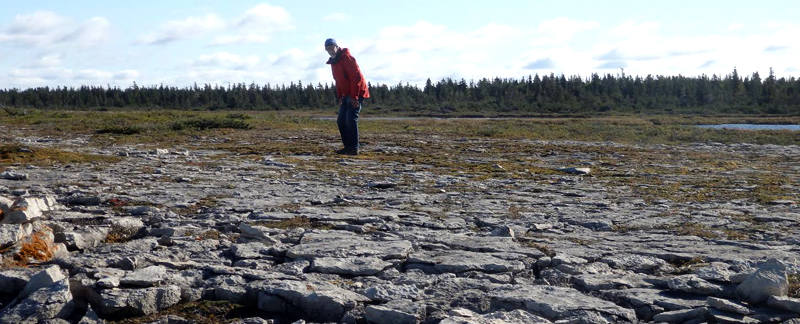
 First, there was the news that the tenant was moving from Andrew’s farm house across the road. This meant screening a number of possible new tenants. Meanwhile, there was a significant number of ‘to do’ tasks while Heather was away. They included chain sawing several cords of firewood, painting outbuildings, and getting organized for this year’s apple harvest in the orchard. Apple picking demands moving full apple bins with the fork lift on the tractor. Ah yes, this requires fixing the ‘soft’ tire on the tractor.
 Afterwards, I was driving my son’s tractor to bush hog the lower field on his property. Last week, I had discovered that the PTO (power take off ) was not driving the mowing unit. Over $1400 later, I had an operational unit. This was the test.
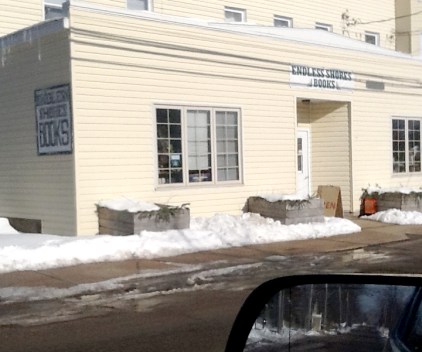 Yesterday, the ‘Learn to Run’ club met in Bridgetown at 10 am. They meet three times per week. The program goes from January to April each year. Afterwards, we went to Endless Shores Books. We were looking for second-hand children books to take to grandchildren in Iqaluit next week. We found a great selection. I also found a number of local, new books, including Geoff Butler ‘Our own Little World’. Geoff is from Granville Ferry. His books are a combination of paintings and poetry, with a sense of humour.
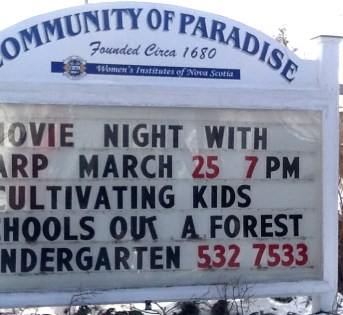 On Saturday evening, CARP hosted a movie night at the Paradise Community Hall on ‘Forest Schools’.It was a good turn out. We had the chance to watch documentary on experiential environmental education in Switzerland and to hear about a similar new initiative underway in the Greenwood area.
 If we want to change our attitude towards the earth, it’s resources and our place on its surface, we must become more informed about our ‘geography’; not simply latitude and longitude, but rather ourselves and the processes that affect our behaviour. Geography, in an holistic sense, is physical, biological, economic and social. It is spatial and temporal: neighbourhoods, regions, countries and global; hours, days, years, decades, centuries, lifetimes and beyond.
 Ernest Blair Experiment