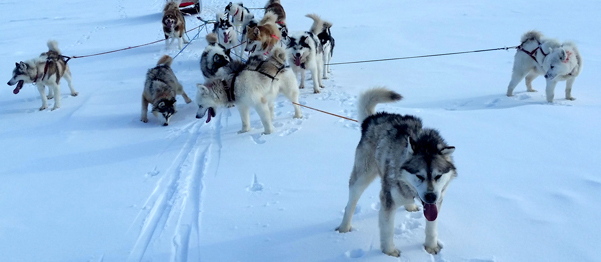
 For the last few years, every Summer, we have provided a holiday camp for two retired Inuit sled dogs: Uke and Siq Siq. They were part of a litter born in Pond Inlet, Nunavut about twelve years ago, under the watchful eye of my son, Andrew. Later, they went to Prince George, where they provided Patrick, my eldest son, with the pulling power for ski-joring. They arrive in Paradise, in May and usually return home by early September.
While they are in our care, we get used to their howling at night with the local coyotes, living on the floodplain along the Annapolis River. Or they howl in response to the sirens from emergency response vehicles.
Yesterday, they returned to their permanent home. This year it is to Petawawa in the Ottawa Valley. Today, it feels very strange to pass by their pen, and not to receive a welcome or reaction.
We have now entered apple harvesting season. 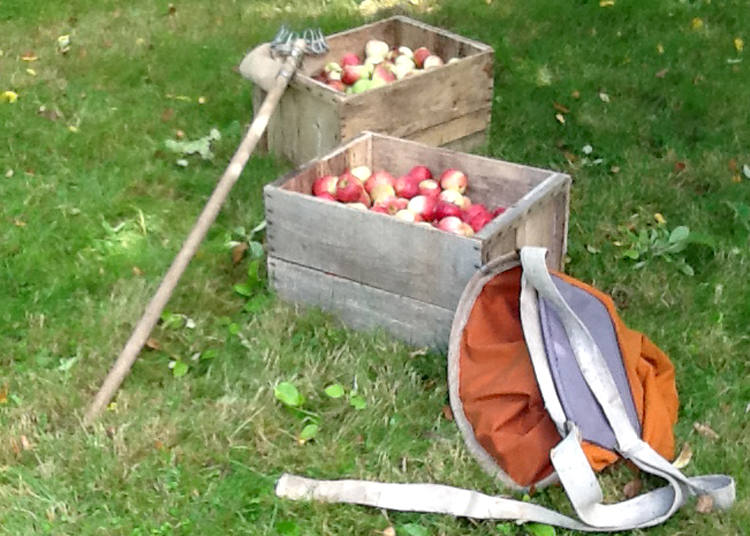 In the Valley, a late frost in early June impacted many of the apple growers in the region. Fortunately, for us, Raymond Hunter planted his trees in a tree protected area. This has allowed us to ship the early drops to Brian Boates in Woodville. Now we have started picking directly from the trees. The first cycle will be the Nova Mac variety, to be followed later, by the Mac Free. All of these organic apples will be juiced at Boates cider mill and then transported to Ironworks Distillery, Lunenburg as a key ingredient in their apple brandy. If we have a spell without too much rain, we should be able to pick a couple of bins per day. (note: one bin can hold between 18-20 bushel boxes).
For most Nova Scotians, September is ‘return to school’. That no longer applies for Heather and myself. Instead, it is a time when we miss the sound and companionship of the retired sled dogs. It is also a time of physical labour, as we climb the apple ladders, fill the bushel boxes and then load into the larger bins. The tractor, with its forklift, comes out of the barn to load the bins onto a flat-bed truck for transportation.
Other signs of change found in the media include comments on the Lahey report. In particular, I recommend Raymond Plourde, Ecology Action Centre. He has an online opinion piece in the Chronicle Herald, September 8th Lahey Forestry report; the good, the bad and the missing.
Or take a look at the poster produced by the Valley REN for the Devour Festival, this October. It promotes the unique qualities of living and working in the Annapolis Valley.
Acknowledgements
I want to acknowledge my monthly conversations at the End of the Line pub with Frank Fox and Paul Colville. They encourage me to keep writing my blog. Thanks, as usual, to Edward for his graphics, and to Heather for sharing the workload.
References
Raymond Plourde. Chronicle Herald September 8, 2018. Opinions. Lahey Forestry report: the good, the bad and the missing.
Deborah Dennis. Valley REN. Forwarded a new poster for the Devour Festival. September 11,2018.
 My interest was two-fold. I wanted to challenge myself and find out what would be the process if I decided to return to work ( I retired in 2011). Secondly, I wanted to understand the nature of the employment hub in Middleton
  Another connection, that appeared in my email box that day, was from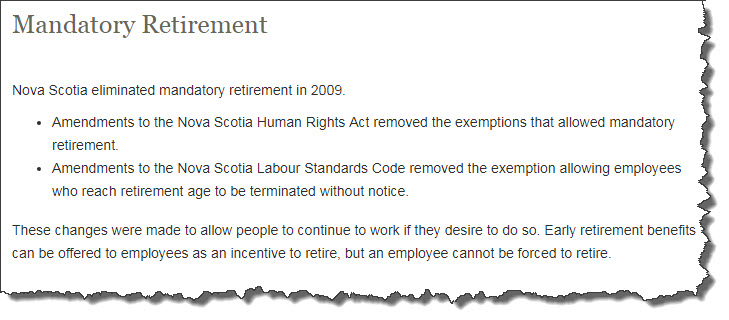

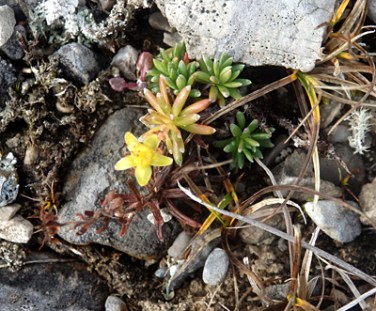 We had many personal realizations. While we had studied the plants in the National Park, visiting the serpentine Tablelands and the barrens on the top of Gros Morne, we had not gone North of the park. Over the last forty years, scientists have rediscovered the geology and biology of the Great Northern peninsula, in particular the uniqueness of the limestone barrens.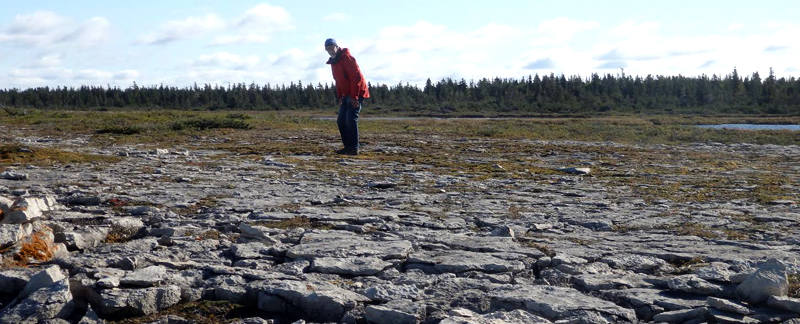
 First, there was the news that the tenant was moving from Andrew’s farm house across the road. This meant screening a number of possible new tenants. Meanwhile, there was a significant number of ‘to do’ tasks while Heather was away. They included chain sawing several cords of firewood, painting outbuildings, and getting organized for this year’s apple harvest in the orchard. Apple picking demands moving full apple bins with the fork lift on the tractor. Ah yes, this requires fixing the ‘soft’ tire on the tractor.
 Afterwards, I was driving my son’s tractor to bush hog the lower field on his property. Last week, I had discovered that the PTO (power take off ) was not driving the mowing unit. Over $1400 later, I had an operational unit. This was the test.
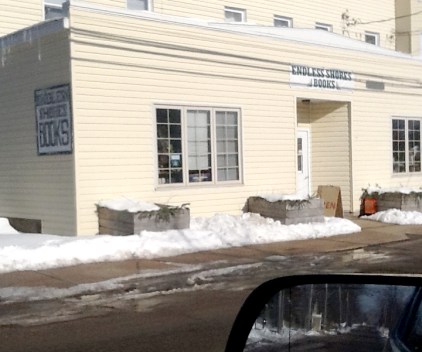 Yesterday, the ‘Learn to Run’ club met in Bridgetown at 10 am. They meet three times per week. The program goes from January to April each year. Afterwards, we went to Endless Shores Books. We were looking for second-hand children books to take to grandchildren in Iqaluit next week. We found a great selection. I also found a number of local, new books, including Geoff Butler ‘Our own Little World’. Geoff is from Granville Ferry. His books are a combination of paintings and poetry, with a sense of humour.
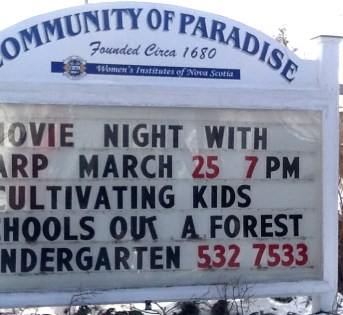 On Saturday evening, CARP hosted a movie night at the Paradise Community Hall on ‘Forest Schools’.It was a good turn out. We had the chance to watch documentary on experiential environmental education in Switzerland and to hear about a similar new initiative underway in the Greenwood area.
 If we want to change our attitude towards the earth, it’s resources and our place on its surface, we must become more informed about our ‘geography’; not simply latitude and longitude, but rather ourselves and the processes that affect our behaviour. Geography, in an holistic sense, is physical, biological, economic and social. It is spatial and temporal: neighbourhoods, regions, countries and global; hours, days, years, decades, centuries, lifetimes and beyond.
 Ernest Blair Experiment