 Before Christmas, I went into Ed’s second-hand book store in Sydney, Cape Breton. I found a copy of ‘George Orwell’s Friend. Selected Writing by Paul Potts’. It caught my attention because of my personal interest in things ‘Orwellian’.I also appreciated the use of Orwell’s name to introduce the work of Paul Potts, a little-known Canadian poet. There were several remaindered copies, all signed by the author.How did they end up in Sydney ?
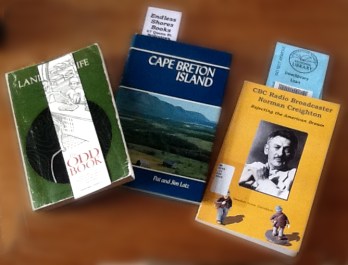
In January, I was advised to go to Endless Shores Books in Bridgetown. I was looking for a copy of Whirligig, a selection of Ernest Buckler’s short prose. Instead, I discovered ‘Cape Breton Island’ by Pat and Jim Lotz. Essentially, a geography of Cape Breton written in 1974. It begged the question of an updated version in 2017. Jim was a Geographer and independent writer (he died last year).
This weekend, we went to Wolfville and gravitated to The Odd Book, a second-hand bookstore on Front Street. As a university town, there seemed to be an excellent supply of books. I found ‘Land and Life. A Selection from the writings of Carl Ortwin Sauer’ 1967, edited by John Leighly. As the quotation on the back cover states ‘ Geographers will treasure this volume for many generations’ The Professional Geographer.
In Part V, The Pursuit of Learning, we find essays on ‘The Morphology of Landscape’ and ‘The Education of a Geographer’. Inside the back cover a previous owner had made the following notes:
‘The Valley’s physical boundaries are everywhere visible. North and South Mountains…’
‘Landscapes have subjective meaning for the inhabitants (cf page.344).’idiom’ and ‘vernacular’ are part of that, and so is distance perception and knowledge limitations’.
This brings up two questions. First, there is no teaching of Geography at Acadia University, who was the previous owner of the book ?
Second, there is the larger question. How, and what books find their way into second-hand bookstores ? What is the history of a particular book, as it passes hand to hand ?
References
Paul Potts. 2006. George Orwell’s Friend. Selected Writing by Paul Potts. Introduction by Ronald Caplan. Breton Books.
Pat and Jim Lotz. 1974. Cape Breton Island. Douglas, David and Charles, Vancouver.
Carl O. Sauer. 1967. Land and Life.A Selection from the writings of Carl Ortwin Sauer. Edited by John Leighly. University of California Press, Berkeley.
Postscript
Through inter-library loan, I received from Acadia University library.
Heather Davidson 2005.CBC Broadcaster Norman Creighton. Rejecting the American Dream. This book is about the life and times of Norm Creighton, long time resident of Hantsport.
Inside the front cover, three very timely quotations.
Edward Albee
‘The play (The American Dream) is an examination of the American scene, an attack on the substitution of the artificial for real values in our society, a condemnation of complacency, cruelty, emasculation and vacuity; it is a stand against the fiction that everything in this slipping land of ours is peachy-keen’.
John Maynard Keynes
‘Capitalism is the extraordinary belief that the nastiest of men for the nastiest of motives will somehow work for the benefit of all’.
ee cummings
to be nobody but myself, in a world which is doing its best night and day to make me everybody else, means to fight the hardest battle which any human being can fight and never stop fighting’.

 Ernest Blair Experiment