Posted in New thinking

A Treasure Chest

As part of the sale, we had to clean out the attic of the farm house. There were several totes, containing possessions from Andrew, Julia and Julia’s Dad. They proved to be a literary treasure chest.

They included three books by Roald Dahl : Ah, Sweet Mystery of Life; Boy: Tales of Childhood; and, George’s Marvelous Medicine.

From Farley Mowat, High Latitudes: an Arctic journey (with a foreword by Margaret Atwood); and Colin Fletcher, The Man Who Walked Through Time.

A separate box contained thirty volumes of Granta, a quarterly paperback magazine of new writing, published by Penguin, from #21 to #69. For example, #21 The Story-Teller includes contributions from Bruce Chatwin, Oliver Sacks and Primo Levi (1987).

The icing on the cake was the Signet classic, George Orwell, Animal Farm with a new Preface by Russell Baker(1996).


Thank you, to Brent Hall, who responded to the link on Lonnie Donegan and skiffle (see blog post HERE), with two additional links showing the trajectory from Donegan via James Page to Led Zeppelin.

Via Brent Hall, check out Lonnie Donegan’s “Rock Island Line“, “Mama Don’t Want to Skiffle Anymore” and “Led Zeppelin“.

Wonderful entertainment !


Postscript

We rescued the Hunter chest from the wood shed and returned it to the rightful owners, the Hunter family.

Acknowledgements.

Through gifting links, we find a sense of community. The above books represent only a subset from the ‘treasure chest’. En route, I appreciated the feedback from Jane, Peter, Andrew Ronay and others overseas. Heather and Edward enjoyed the results with me.

References

Roald Dahl, 1990, Ah, Sweet Mystery of Life, Penguin.

Roald Dahl, 1986, Boy: Tales of Childhood, Puffin.

Roald Dahl, 1983, George’s Marvellous Medicine, Bantam.

Farley Mowat, 2002, High Latitudes. An Arctic Journey, Steerforth Press.

Colin Fletcher, 1989, The Man who walked through time., Vintage Books.

George Orwell, 1956, Animal Farm, Signet Classic.

Granta 21 The Story-Teller. Spring 1987.

’The Story-Teller. What does it suggest? Folk-tales, myths, sea voyages, a cartoon campfire. In short, a way of writing that is distinctly “unmodern”.
Posted in New thinking, Opinion

Nanny State

Friends, Shirley and Klaus Langpohl, in an email comment, made reference to Nova Scotia as a ‘Nanny State’. This took me back to the UK and the days of Margaret Thatcher. In these days of COVID and the state of Health Services in Nova Scotia, it’s hard not to be concerned about the ‘nanny state’.

To offset this thought, Heather and I watched a Zoom presentation on Glyphosate spraying and it’s impact on wildlife and forest birds. Presented by Rod Cumberland and Marc-Andre Villard, and moderated by Catherine Harrop, CBC.

It was revealing to learn that Glyphosate spraying has been banned in Quebec. Also, there is a lot of scientific evidence on the impact of Glyphosate spraying in New Brunswick. In New Brunswick, the scientific community is at odds with JD Irving and the Forest industry.

What is happening in Nova Scotia?

Last Summer, we managed to stop spraying on a few parcels. What will happen this season? From the Zoom call, we learned that the spray season tends to be August-September. The land that has been clear-cut this Winter, will it be sprayed this August/September? What happens to the residue, will it flow into the river systems? Last Summer, the village of Lawrencetown had to notify the government about our water supply.

Who will be watching in 2021?

Given the situation in Quebec and New Brunswick, why are we spraying Crown lands? This must STOP! It will only stop, if there is community engagement and we pay attention to the science.


To change the topic, and offer a more optimistic tone. From Chelsea Green Publishing, online ‘Farming for the Future: a journey into regenerative practice’ webinar series. This involves collaboration with Dartington Trust. I went to their web site.

They offer a M.A in Arts and Place. Does that sound like a good fit for Annapolis County? We have a significant number of artists living in the region AND we have a Centre of Geographic Sciences.

Dartington Trust is in Totnes, Devon, England and is linked to Schumacher College (Small is Beautiful).

Acknowledgements

Klaus and Shirley for helping me focus. Jacob Fillmore and Extinction Rebellion fighting to save our forests from clearcutting and aerial spraying. Edward and Heather contribute in so many ways.

References

Rod Cumberland and Marc-Andre Villard Zoom meeting moderated by Catherine Harrop, CBC.

Chelsea Green Publishing , Farming for the Future Webinar Series

Dartington Trust M.A in Arts and Place.

Posted in Art, New thinking

Mapping Nova Scotia Artists’ Plein Air Sites

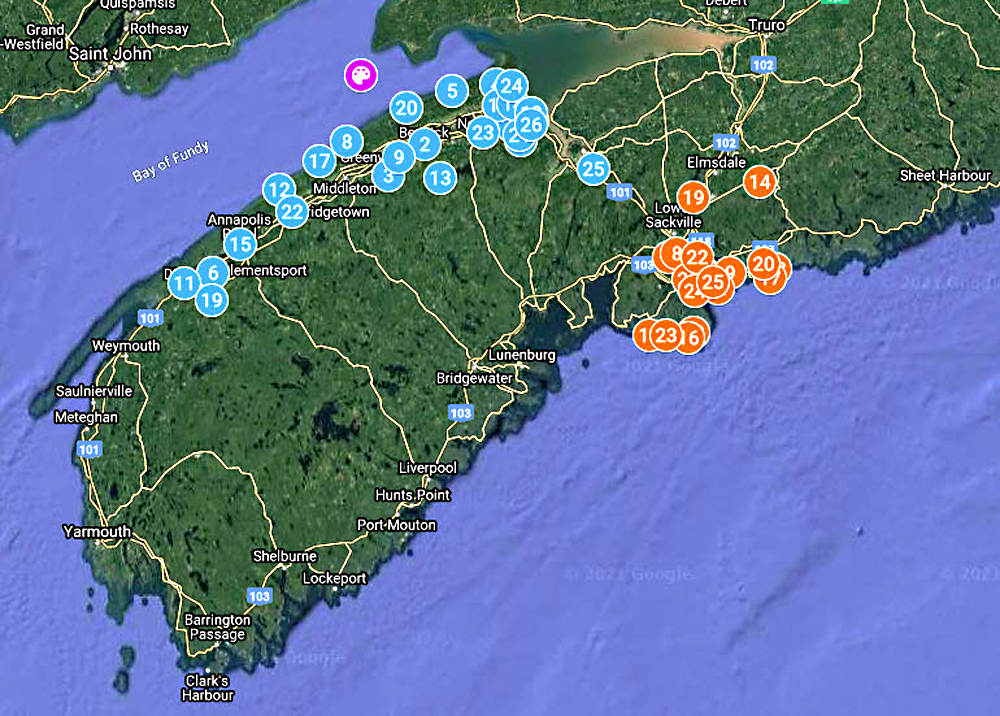
Fifty-two paint-out sites are planned for this season’s plein air artists in the Annapolis Valley and HRM.

For location details, click the map link: http://tinyurl.com/PleinAirMap then click a map pin or legend.

The one valued attribute of those artists who paint outdoors, on location (en plein air) is “extended geographic memory”. We watch, listen, smell, taste and touch our surroundings — for 2-3 hours. Geography becomes imprinted. As we gain artistic skills, we paint more than what we know. We paint more than what we see. We paint what we feel.

Eric Rhoads, publisher of Plein Air magazine and Fine Art Connoisseur magazine in the USA, states that the plein air movement is currently the fastest growing art movement in the world. There are tens of thousands of plein air artists in the world. So when they reacted positively to my interactive Google map that was a big deal for me. This is probably the first such map for plein air artists in the world, and so much more is possible.

Wow, that is very cool!

— Plein Air Magazine

I wrote back to Plein Air magazine, “Thanks. I did this on my own but with the right development team in place [thinking COGS’ student project] a plein air map could be scaled globally so artists could see when and where paint-outs are located, with contact and other information. This would go a long way to network the plein air community on their travels.“. They are now looking into this further.

Reactions from elsewhere have also been very positive.


POSTSCRIPT

Not many of our readers know we have a celebrated, world-class plein air artist living in Digby, Nova Scotia; just down the road.

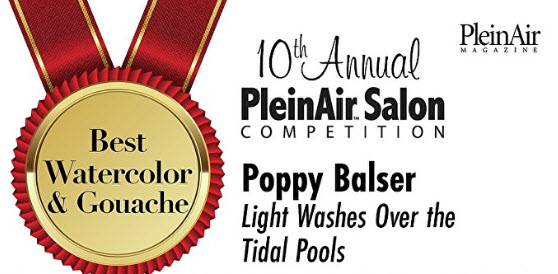
Poppy Balser recently received yet another prestigious international award. This time it was for her watercolour “Light Washes Over Tidal Pools”, inspired by her many visits to Point Prim and area.

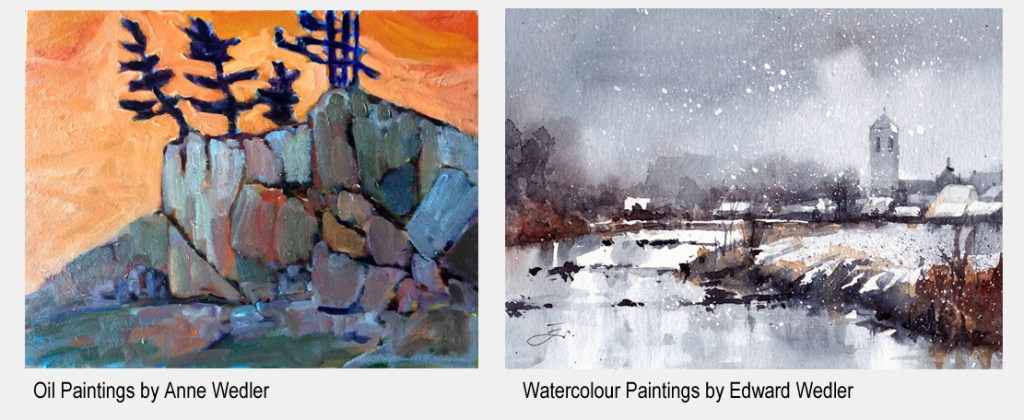
Oh, why not toot my own horn? A website I share with Anne is located at wedlerfineart.com
95% of our work is en plein air.

Posted in New thinking, Opinion

GIS and Vaccination

Brenda Thompson raised the question about travel time to vaccination clinics (CH Wednesday, March 17, page A8). From the description it appears that there are presently no vaccination clinics in Annapolis and Digby counties for the over 80 cohort, partly because of the specialized storage requirements.

In the same time window (this week) I have noticed:

  1. Statistics Canada is seeking to hire staff for the next census;
  2. COGS is looking for graduating student projects in Lawrencetown.

Let me join the dots.

Not too many years ago, the provincial government had a group called Community Counts. This group used GIS technology to massage Statistics Canada census data at the enumeration area (EA) level. Given the need to locate vaccination clinics throughout Nova Scotia to meet the diverse needs of the population, would it not make sense to use this type of information and technology to map the demand?

Here is my proposal.

Obtain the latest census information for the province. Map the existing vaccination sites. Analyse the travel time for citizens to attend these sites. Identify the additional vaccination sites which maximize the accessibility for vulnerable populations.

In my day (pre-2011) this would be a relevant, excellent public service project for students graduating from COGS.

If we wanted to add an additional dimension, how about a map of citizens without a family doctor? Or access to high speed Internet? These are all examples of geographic research which could be facilitated by NSCC and CORAH . It is also an example of giving citizens access to public information. It’s also the “community” in Community College.


Ray Cronin has an essay in A Plague Year Reader on Maud Lewis. Here are a couple of quotations:

One cannot discuss Maud Lewis without also discussing tourism and the economic factors that made tourism so important in her life.”

“Tourism has been the most successful strategy for bringing jobs, even if only seasonally, to rural Nova Scotia. That seasonal market, coupled with government assistance programs, enabled people to stay in their rural homes and help fuel a folk art boom in the latter half of the 20th century unique to Nova Scotia in its scope and impact.”
p.115.


From Oliver Sacks’s book ‘Why we need gardens?’ p.243-247

The wonder of gardens was introduced to me very early, before the war, when my mother or Auntie Len would take me to the great botanical gardens at Kew.

The effect of nature’s qualities on health are not only spiritual and emotional but physical and neurological. I have no doubt that they reflect deep changes in brain physiology and perhaps even its structure

I remember well trips to Kew Gardens (see also The Royal Landscape) from my childhood days in West London.

Acknowledgements

Edward provided his critical artistic eyes. Heather shared the same space.

References

Ian Fairclough, Woman questions travel time to vaccine clinics, Chronicle Herald, Wednesday March 17, 2021, A8.

Ray Cronin, Gaspereau Field Guides to Canadian Artists, No. 5. Maud Lewis: Creating an Icon.

Oliver Sacks, 2020, Everything in its Place, Vintage Canada.

Posted in New thinking, Opinion

COGS Weather Network

This week, I had the opportunity to follow up with David Colville at COGS about his team’s work on the Applied Research Weather Network.

Image courtesy of David Colville

In particular, I was interested in the availability of the current and historic data from the weather stations. From my perspective, access to these records over the last ten to twenty years would be helpful, as the region seeks to address climate change.

COGS Applied Research Weather Network Map close-up

In the Register (January 28, 2021) an adhoc coalition is advocating the creation of a world class climate change and ecological research centre. The Annapolis Climate and Ecological Research Centre (ACERC) spokesperson is Peter Nicholson.

He is also Chair for the Canadian Institute for Climate Choices (CICC).

To my mind, these two initiatives beg the question : at what point does weather turn into climate? Will the data from the weather stations be analyzed in terms of climate change? Would historical data allow us to investigate whether we are seeing warmer drier Summers ? Are we seeing fewer, less severe Winter storms? What will be the impact on the hydrology of the Annapolis River system? What will be the impact on agricultural practices? Does the climate change impact our forests and their ecology?

There would appear to be considerable room for collaboration between the community interests and the educational centres in the region. This would include both the work on the weather network, as well as the work by Tim Webster’s team on sea level rise at AGRG in Middleton.

The availability of on-line ‘story-maps’ demonstrates the technology which now exists in support of this type of collaboration.

Later in the week, I visited Endless Shores Books in Bridgetown. In the spirit of ‘Reading where we Live’. (see The Bridgetown Reader, January 29, 2021). I noticed copies of Will Bird ‘This is Nova Scotia’ and Harold Horwood ‘Dancing on the Shore. A Celebration of Life at Annapolis Basin’ on the shelves.

At home, I checked out the new edition of Horwood’s book and came across the following quotations.

So the whole region from Digby to Belleisle enjoys a microclimate like that of regions some hundreds of miles to the south…. It is consequently, not only a good place for raising animals but also for gardening. Such vegetables as tomatoes, peppers and squash flourish mightily on the shores of the Annapolis Basin.” p.23.

Whoever first planted peach trees on these shores must have been amazed at their success. A few of us even grow melons besides our patches of corn, potatoes and peas.” p.24.

Harold Horwood wrote the book in Upper Clements, where he lived with his family.

Postscript

Friday was a beautiful cross country ski day. Along the Rifle Range road towards Trout Lake. Just animal tracks, and two sets of ski tracks.

Acknowledgements

I want to acknowledge both Ashley Thompson for the excellent content of the Annapolis Valley Register, and Lewis for the contribution of The Reader to our community. While I was employed at AGRG in Middleton, I always enjoyed the company of excellent researchers, technicians, support staff and students. Edward and Heather continue to be supportive today.

References

COGS Applied Research Weather Network.

Annapolis Valley Register. January 28, 2021. Land in Atlantic Canada is sinking.

The Reader, January 29, 2021, Reading Where We Live: This is Nova Scotia.

Harold Horwood, 2010, Dancing on the Shore. a Celebration of Life at Annapolis Basin, Pottersfield Press.

Will Bird. 1950. This is Nova Scotia.

Posted in New thinking

Local Geography

Yesterday (Wednesday) Heather and I participated in the Winter Bird Count, coordinated by David Colville.

Mourning Dove

This gave us the opportunity to walk down to the Annapolis River in the morning. In the afternoon, we went up through the property to the Inglisville Road. Besides the exercise, on a cool day, -10 degrees, we observed mourning doves, chickadees, nuthatches, blue jays, crows, woodpeckers and juncos. The great majority preferring the easy pickings at our bird feeder.

The traverse from the river to the top of South Mountain brought memories of our local geography.

What would we learn if we made the traverse, once a month? Or four times per year?

This led, naturally to questions of citizen science. Previously, when employed at AGRG, we had climate stations on the property. What would we learn, if we had say, 4-6 stations in a transect from the river bank to the southern edge of our property on the mountain? What is the temperature and humidity profile along the transect? At different times of the year?

Let’s take it a step further. When I was at AGRG (NSCC) we had a network throughout the Annapolis Valley. Could we create a community based organization that would maintain this type of network? Could we find a group of landowners between Digby and Kentville who would be interested and willing to monitor a series of transects from the Bay of Fundy to North Mountain to the Annapolis River valley up onto South Mountain?

If we maintained the network, we would be able to monitor climate change in the region.

As a citizen scientist I would welcome the opportunity to participate in developing our understanding of the local climate, it’s relationship to the landscape, and to the other species which share this landscape.

As a citizen scientist I would welcome the opportunity to participate in developing our understanding of the local climate, it’s relationship to the landscape, and to the other species which share this landscape.

A note sent to me from Orion Magazine on the loss of contributing editor, Barry Lopez.

Orion Magazine: Photography by David Littschwager

 the world is losing a lot of light. Let us hope others will take it up and shine it brightly in 2021

— SANDRA BARRY

Acknowledgements

To David Colville for including us in the bird count. Heather for sharing the forest walk. Sandra Barry for forwarding the note on Barry Lopez. Edward for his magic touch.

References

Mary Ellen Hannibal, 2016, Citizen Scientist: Searching for heroes and Hope in an Age of Extinction. The Experiment.

Article on Barry Lopez (1945-2020) in Orion Magazine, December 31, 2020.

Some of my previous blog post links to Citizen Science:
A Proposal: Crowdsourcing and Citizen Scientists
We are all Geographers
Citizen Scientist…
Community Information Utility: it’s time has come.

Posted in New thinking

Electoral Reform

By the time this blog is posted, we shall know the results of the Municipal Election in Annapolis County. We shall know in the words of The Reader editorial whether ‘Small Things Matter’. We will see the impact of online voting. At this critical juncture, I wonder whether we need electoral reform.

Do we need eleven Councillors in Annapolis County?
Do we need separate elections for the towns, e.g. Annapolis Royal, Middleton?
Is the management of the natural resources in this province independent of the municipalities?

In the past, I have expressed concern about the management of our landscape, and its relation to climate change.

Looking for solace, in these difficult times, I picked up again, Daniel Botkin’s No Man’s Garden: Thoreau and a new vision for civilization and nature. In the book, Botkin identifies three types of expert (p.111):

  1. Contemporary professional experts
  2. The great thinkers of the past.
  3. Experiential experts – local people with local knowledge based on their experience of living in an area and observing carefully.

My thesis would be that we need a combination of all three. Likewise on municipal council we need all three.

It would be a mistake, in my mind, if we focussed only on the small things, and did not understand the larger context. Or what was happening in our larger geography.

There are many good resources available. This morning, I visited Dawn Oman’s gallery in Bridgetown to ask about tickets to the Dave Gunning concert on October 24th.

While there, I had the chance to pick up the latest issue of Up Here magazine, devoted to Northern Canada.

From Celes Davar, we received the recommendation to watch Kiss the Ground , starring Woody Harrelson on Netflix. It defines the importance of the soil to our global ecosystem.
From Anne Crossman, I was sent the link to Striking Balance, a series on Canada’s biosphere reserves.

They are filming the episode on the Southwest Nova Biosphere Reserve, to be aired at the end of November on the CBC. Finally, we received an update from Larry Powell on the Gordonstoun project. This offers employment opportunities for local business. It emphasizes ‘place-based’ education. Our geography, the Annapolis Valley, fits within the Atlantic Canada bubble, as well as the Canada nation.

Acknowledgements

To all those friends who continue to share ideas and experiences: Dawn Oman, Celes Davar, Anne Crossman. Heather, who has helped shoulder the burden of a bumper apple crop in the orchard. Edward for ongoing support.

References

Daniel Botkin, 2001. No Man’s Garden: Thoreau and a new vision for civilization and nature. Island Press.

Posted in New thinking

Maps in the Eyes of Children

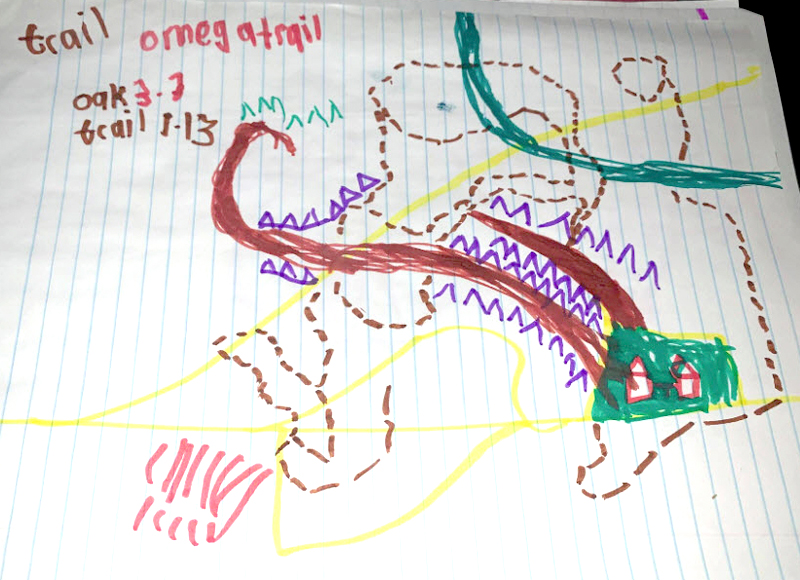
My daughter, Allison, spent much of the summer camping in Southern Ontario, close to her home. On those trips my two grandchildren created maps as one of their pastime activities. My grandson is six years old and his sister is four years old.

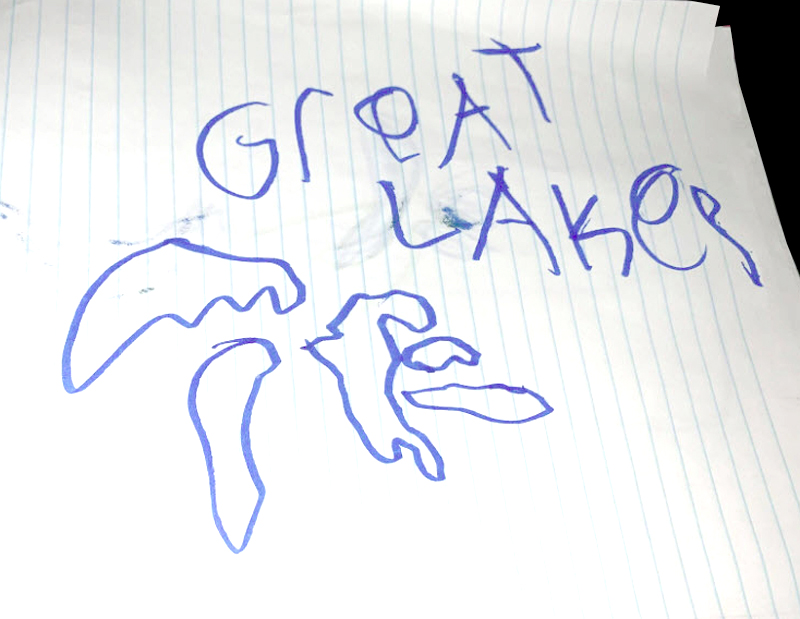
Great Lakes as imagined by my six-year old grandson.

To place his campsite location in context within a larger geography, my grandson mapped the Great Lakes from memory — something I would have difficulty doing.

Closer to home, he mapped features that were important to him at each campground.

Campground map by my grandson

The features intrigued me. He names the trails and records their lengths, marks roadways and walkways, streams and green spaces, and important features to a six-year old that I cannot recognize. Tents are numerous and line well-travelled paths. Important to him (and the family) is the location of the public washrooms. This is one of about eight maps he drew at different campsites.

Of importance to his younger four-year-old sibling was the location of two blue water bodies, connecting river, and the land in between. An understandably simpler map.

I recall my many mapping conversations with former COGS instructor Konrad Dramowicz, years ago. He studied how children perceive their space and geography from maps he had them create, based on their travels to and from school.


Looking further into this topic, I was referred to Dr David Sobel in New Hampshire, and his book Mapmaking With Children, in which he discusses the crisis in geography education. The story doesn’t end here. I emailed Dr Sobel and he writes,

Yes, some children have the mapmaking gene expressed more strongly — a great thing to encourage.  Unusual, from a developmental perspective, for a 6 year old to have internalized a map image of the scope of the Great Lakes system.

My two older grandchildren from Nova Scotia also create maps. These maps are dynamic and strategic based on their invented game call “The Wall”. It is a game designed to see who can outwit the other, to infiltrate their opponent over, under, around or through The Wall. This game has provided hours of entertainment for them, and their adult challengers as well.

While instructing at COGS, eons ago, I did visit some elementary schools in Annapolis County to talk about Canada’s space, remote sensing and mapping programs. When bringing in some local airphotos and topographic maps to middle school aged youth their exuberance was surprisingly upbeat. Youth want to understand their geography. I hope that COGS continues to fightback the geography crisis noted by Dr Sobel.


Reference

Dr David Sobel, 1998, Mapmaking with Children: sense of place education for elementary years, Heinemann.

Postscript

For those interested in making a “collage map” watch this video from the Art Gallery of Nova Scotia. LINK: https://youtu.be/H1FXyFH7HrE This project is inspired by the 1975 work, “A Map of Meagher’s Grant”, by artist Evelyn Dickie.

“This is a great activity to do to celebrate the neighbourhood we live in or a home from the past that holds dear to our heart.”

Posted in New thinking

Island of Hope: the Annapolis Valley

After the rally in Burlington, the next step was to try to persuade the Annapolis Municipal Council to ban spraying in the County. The Warden and some Councillors appear to be receptive to the motion.

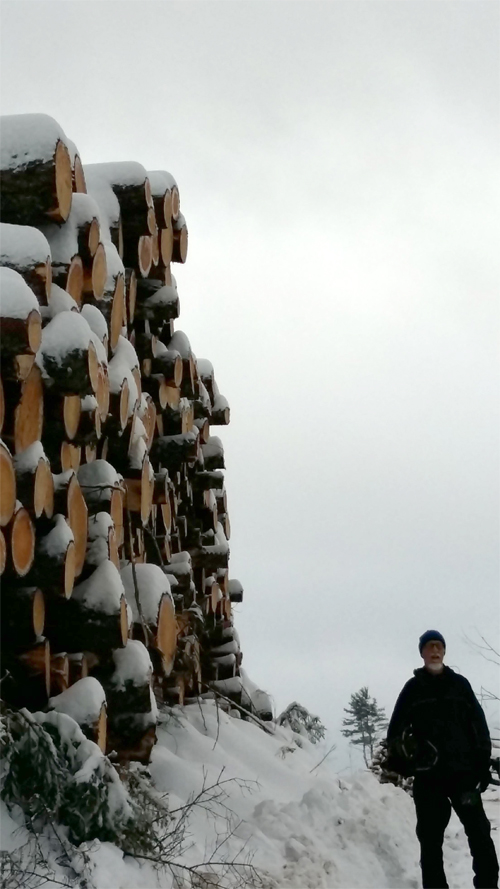
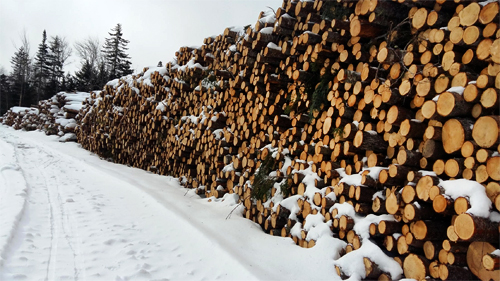
The need to spray is contingent on previous forest clear-cutting. Therefore, the larger issue is to stop clear-cutting.

What can citizens do (for example)?

In the case of spraying in Annapolis County, we can lobby our Councillors. We also need to be fully informed. We need to know:

  1. Which parcels are designated for spraying?
  2. Where are they located? A map.
  3. Who owns the land?
  4. Who will conduct the spraying? When?

If necessary, Annapolis County citizens will have to stand up in the same way as the citizens of Burlington.

If we wish to stop clear-cutting, we need to know:

  1. Which parcels have been clear-cut, by whom, when?
  2. Which parcels are designated for future clear-cut by whom, when?
  3. Which parcels that have been clear-cut, and have already been sprayed?

As in all these situations, a key is the understanding the geography of our landscape. Again, we can lobby, the Centre of Geographic Sciences (COGS), to help us map the landscape, the forest cover and areas at risk.

Centre of Geographic Sciences

With the forthcoming municipal election, we should promote the concept of an Island of Hope. This could be just Annapolis County or it could extend through the physiographic region, the Annapolis Valley.

An Island of Hope is a region where life has a higher value than money. This will require a different definition of economy and well-being.

In nature’s economy the currency is not money, it is life

— Vandana Shiva


If our municipal units agree with this approach, we can all learn through citizen engagement, collaboration with our educational institutions, and sharing our findings with other regions of the province and beyond.

Our experiment is only as effective as the initial design.

Acknowledgements

First, the inspirational efforts of the citizens in the Burlington area. Those citizens of Annapolis County who have responded to the call for action. Edward for mastering the new WordPress editor. Heather for passing along her Facebook feedback and the Dave Gunning song.

References

Rick Ketcheson link, “How Economic Growth has become Anti-Life
Celes Davar link.
Circular Economy. Explainer video.

Footnote

Listen to Dave Gunning “Wish I Was Wrong

Posted in New thinking

Disrupting College Education

Google has announced a new program Google Career Certification. These certificates are considered equivalent to a four-year degree for related roles. Given the move by universities and colleges to online education, this raises the prospect of re-thinking tertiary education (perhaps, secondary too).person_graduateStudent

Let us assume that software vendors will continue to offer a wider range of online, hands-on tutorials on their products. The role of colleges and universities will be to develop “critical thinking”.

Back in the 1980s, when I was teaching at COGS, in the third semester, each student would undertake a cooperative project with government and industry contacts. Fast forward to 2020, I can envisage projects driven by the needs of the community, that focus on the local geography.

For example, in Annapolis County, we are seeing a movement towards protecting community forests. Students from this region could focus on tools that would allow citizen groups to build ‘pods’ of like-minded citizens who wished to maintain and protect similar forest values.

If a student is attending COGS online from another part of the country, eg BC or Nunavut, then their cooperative project would engage citizens from their local geography. The topic would be defined by the community.person_communityAssembly

Besides technical support for the online tutorials, students would need access to a mentor for the critical thinking component of their education. In the case of the Annapolis Valley, it could be a retired academic or informed citizen.

Since the cooperative project is determined by geography, it would be important to define a set of new relationships:

a) citizens with an understanding of geographic issues;
b) vendors bring their understanding of the online learning materials;
c) critical thinking on the relationship between education/technology/community.

What is needed to make this work at COGS?

A willingness for open discussion:

a) with the primary software vendors,
b) citizen advisory groups
c) and critical thinking mentorship.

In this disruptive education scenario, there is an opportunity to redefine collaboration or ‘community’ college to be much more inclusive with a wide range of members from different geographic communities. The scenario could include multiple technologies. It offers a new vision for civilization and nature.

bookCover_trespassPostscript

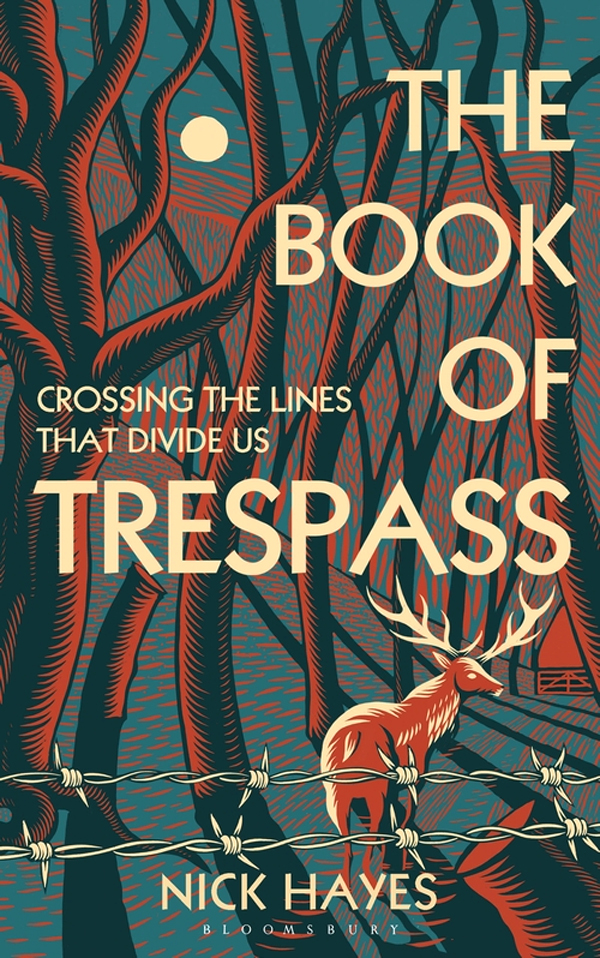
In the latest Guardian Weekly (August 21) there is a review of Nick Hayes’s book, The Book of Trespass: crossing the lines that divide us. p.60.

References

Google Link
Email from Nina Newington.
Nick Hayes, 2020. The Book of Trespass: Crossing the Lines that Divide Us. Bloomsbury Circus.
Acknowledgements

Edward for forwarding the Google link. Nina for her thoughts on citizen collaboration and forest values. Heather for seeing the individual species from the trees.