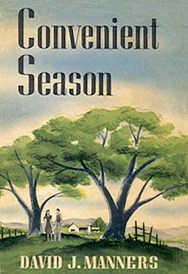
 From my previous blog, you will know that David Manners wrote Convenient Season, published by EP Dutton in 1941.
As described on the web site (davidmanners.com),
“Convenient Season recalls his youth in the community of Centrelea where David’s aunt and uncle, the Chadwicks, had a beautiful Summer home. Convenient Season echoes David’s love of nature and depicts the home and community through the eyes of a young man who has returned to Nova Scotia from the United States hoping for fulfilment.”
I was interested in the origin of the title. So I went online, and typed it in:
Acts 24:25
“And as he reasoned of righteousness, temperance and judgement to come, Felix trembled and answered ‘Go your way for this time, when I have a convenient season, I will call thee’ “
or
“This hour is your convenient season for that which is best worth your attention and doing”
Having read the book, I started online with Wikipedia ‘David Manners’

“He was born Rauff de Ryther Duan Acklom (April 30,1900 – December 23,1998).
Born in Halifax, moved to New York where his father was a literary advisor at EP Dutton.
Manners studied Forestry at the University of Toronto, where he got into acting and drama. In the late 1930’s he was best remembered for his role in Dracula with Boris Karloff (movie to be shown, by the way, on February 23rd 7 pm at Centrelea Movie night).
In 1940 he officially changed his name to David Joseph Manners (his mother’s maiden name). He later purchased a ranch in the desert at Victorville, California, where he lived with his partner, Bill Mercer.
 He wrote a second novel, Under Running Laughter in 1943. In his later life, he published several non-fiction works, The Soundless Voice, The Wonder within you, and Look through: an evidence of self-discovery.
This week, I contacted Jaki at the Lawrencetown library and have requested these books through inter-library loan.
The curiosity for myself is to imagine Manners (and Towne see below) describing the local landscape and lifestyle eighty, or a hundred years ago. How would we try to describe our landscape and lifestyle today? Fortunately, we are surrounded by talented, creative artists and writers. And we have access to the wonderful resources in our libraries, and online.
Postscript
As part of the Winter 2019 Speaker Series at the new Annapolis Royal Library on February 10th 2-3:30 pm. It began in a Library talk by Joan Francuz author of Press Enter to Continue. Scribes from Babylon to Silicon. A History of Technical Writing.
Acknowledgements.
To Anne Crossman who first send me down this path. Edward Wedler for his continued technical support.
References
Check out the davidmanners.com web site for more detail on his movies, books and a full life.
David J. Manners 1941 Convenient Season. EP Dutton
David J. Manners. 1943. Under Running Laughter. EP Dutton.
Charles Hanson Towne. 1923. Ambling through Acadia. Crowell Publishing Company


 Fifty years ago in the United Kingdom, they created The Open University.
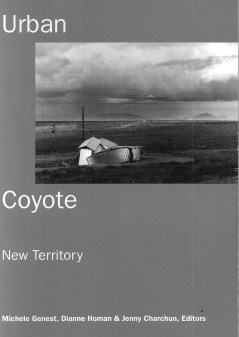 Over the Christmas break, I came across two connections to the Centre for Local Prosperity (CLP). Gregory Heming (Senior Advisor) forwarded to me a copy of his essay, entitled ‘Letter to Wendell Berry’, as well as ‘Conjectures of a Northern Journeyman’, published in Urban Coyote.
 The second connection was to discover a reference to the work of Robert Cervelli in the book by Niki Jabbour Year-round Vegetable Gardener. Cervelli (besides his role as Executive Director, CLP) grows vegetables in his cold frame and unheated greenhouse.
 The concept of CARP was as a ‘project’. Reaching the goal of heritage river, would allow us to take it off the project, ‘to do ‘ list. Of course, the quality of the water depends on the activities in the Annapolis watershed. This means the removal of forest cover would need to managed, with these criteria in mind.
 In our working world, we become used to responding to a variety of tasks and deadlines. What happens in our retirement? We are still geared to tasks and specific timelines. Imagine a situation where two individuals who have structured their lives according to tasks, and deadlines. Suddenly, in retirement, we need to change our behaviour and recognize that living in a rural society, the timelines are driven more by natural cycles. The green beans and the gooseberries need to be picked. The beans have to be blanched, before freezing. The gooseberries turned into jam.
 In the teaching environment, we understand semesters, final examinations, Summer vacation. In the research environment, there is fieldwork, analysis, writing reports and going to conferences. There is also the structure of the research grant: proposals, the research and the deliverables.
 Along with retirement comes the role of ‘elder’. What have we learned from our career? Can we mentor the next generation to address environmental issues? Or the relationship between ‘Man and Nature’? What processes exist so that this knowledge can be applied to current issues in society? How can we change our educational institutions? How can we change our governing institutions?
 It seems that these (human) memories of the landscape, and its utilization, get passed down from generation to generation.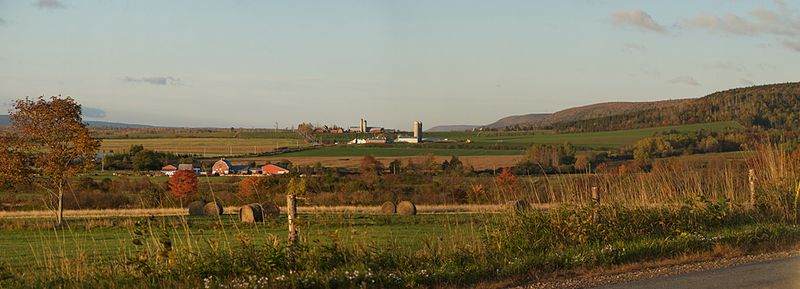
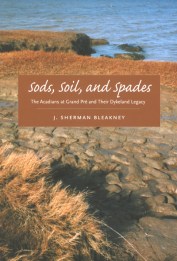 As a footnote, and an example of the type of individual research that can be undertaken to better understand our rich landscape, check out the book by Sherman Bleakney, Sods, soils and spades. The Acadians at Grand Pre and their dykeland legacy.

 If we look at the presentation schedule, there is much supportive evidence: 3D, LiDAR, Community Mapping, Indigenous Mapping, an artistic approach to place-making.
 The four closures were Windsor Wear, Fundy Gypsum Company, Britex and Minas Basin Paperboard Mill. The last closure is also described in a separate book, We wanted it to last forever. It includes both photographs and interviews with former employees at the mill.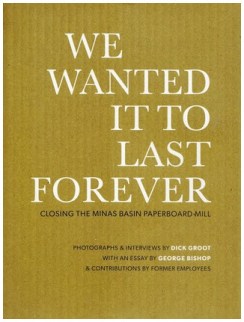
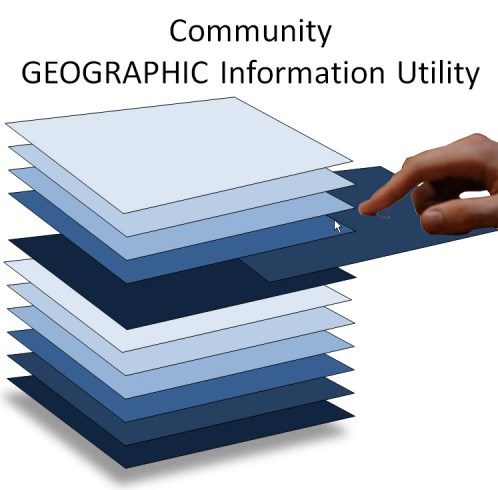 The concept of a ‘community information utility’ (CIU) is very generic and subject to various interpretations. I suggest we add the descriptor ‘GEOGRAPHIC’ to avoid confusion with other utilities — like electricity, water, etc. — thus, CGIU.
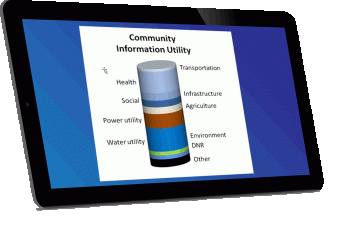 Around 2011, I was working at AGRG on Community Mapping. We had discovered the work of Paul Beach in Sault Ste Marie. He had developed the Community Information Utility (CIU) concept and implemented it in his region. The idea was to give citizens access to digital geographic information about their community. We brought Paul to Halifax and Lawrencetown. He met with Ian Thompson (Deputy Minister, and later with the Chronicle Herald). AGRG hired Ron L’Esperance’s company to see if the concept could work in Southwest Nova.
 Ernest Blair Experiment