It’s a sad day when a forestry company has to issue a court injunction against a group of citizens who are seeking to protect forest values. What has happened to the role of government to balance competing interests? Are crown lands supposed to be managed for multiple values?
We can do better. The technologies exist for detailed management of the landscape. This includes tree species, wildlife species, soil conditions, water and air quality. The same is true of our seascape. In other jurisdictions, it is no longer a race to the bottom. There are other values besides the $$$.
What needs to change?
the accountability of government.
the accountability of our educational institutions.
citizen engagement.
We need a society which values our differences. That recognizes the richness of our landscape/seascape and its capacity to support a wide range of viewpoints. We should be a haven for different perspectives and points of view.
Southwest Nova Scotia did not embrace the biosphere reserve concept to see it ‘flushed down the toilet’ because of the inability of our government representatives to understand that society can uphold multiple values.
Let’s wake up! If not now, at least after the COVID pandemic is over. Indeed, now we have the time to think about doing things differently. If the politicians don’t understand it, then let’s change them. In turn, if the civil servants don’t understand it, then let’s change them. If educational institutions don’t understand it, let’s change the teaching and research agendas.
Perhaps, we could start by renaming the Nova Scotia Department of Lands and Forestry to the Nova Scotia Department of Landscape Ecology. A radical idea. Meaningless, unless there is a change in behaviour.
Last Thursday, Heather and I went to the Extinction Rebellion (XR) encampment on crown land within the Southwest Nova Biosphere region.
It is about a two hour drive from our home base in Paradise. You take Highway #101 to Weymouth and then head inland towards the Tobeatic Wilderness Area. This requires driving over twenty kilometres on forestry roads.
On our return home, I wanted to check our route and thus went to the Nova Scotia Atlas. The area of interest is on page 71. What struck me was the difference in land use designation between 2001 (first edition) and 2019 (seventh edition). This is perhaps best illustrated by page 64. (See photographs).
Map LEFT: 2001 Map RIGHT 2019 Push the centre slider left/right to compare the two maps.
The map sheet has changed colour. From primarily white (private land ownership in 2001) to primarily green (crown lands) and yellow (provincial parks, wilderness areas and nature reserves) in 2019. My assumption is that this is the result of the Bowater Mersey land coming under the management of the provincial department of Lands and Forestry. In 2016, WestFor Management Inc. was established to implement the forest management.
The good news is that the yellow areas are ‘protected’ from clearcutting. The bad news is that the green areas ‘crown lands’ are available for cutting at the discretion of the provincial government, in association with WestFor.
These findings need to be placed within the context of the Biosphere Reserve. The Southwest Nova Biosphere Reserve was established in 2001. At that time, it defined as a core area: Kejimkujik National Park and the Tobeatic Wilderness Area and the surrounding working landscape. At the time of review, UNESCO MAB insisted on a definition of the buffer zone, which would require engagement of interested parties, in particular, the Nova Scotia Department of Lands and Forestry.
Last week, Doug Hickman sent a report to UNESCO, the provincial and municipal governments which identifies the need for a management plan which protects the habitat of endangered species in the region, in particular the mainland moose (see download links, below).
Meanwhile, cutting continues apace on both private land and crown land.
Acknowledgements.
Doug Hickman for producing a comprehensive review of the situation in a short time frame. Heather for her work on a safety plan. Edward for his graphics skills.
References
The Nova Scotia Atlas. 2001. Fifth edition co-published by Formac and the Province of Nova Scotia.
The Nova Scotia Atlas 2019. Seventh edition co-published by Formac and the Province of Nova Scotia
Doug Hickman, November 18, 2020. Backgrounder and Report (two documents) “GUTTED. Endangered Mainland Moose and how the government of Nova Scotia makes a mockery of UNESCO” (see below)
Watching the first two episodes, one was reminded of the definition of crown lands in Great Britain. There were images of deer hunting, shooting grouse in the Scottish Highlands around Balmoral. It is the playground of the privileged. Seeing ‘Prince Charles’ one remembers his time at Gordonstoun.
How much of this colonial past are we bringing to Nova Scotia ? Is this a culture of monied privilege that we are importing into the Annapolis Valley ?
The good news is The Crown series, an excellent product from the BBC, reminds us both of the class system in Great Britain and acts as a vivid reminder of the term ‘crown lands’. At a time when we need to revisit the concept in Nova Scotia.
Driving down Highway #1 from Bridgetown to Annapolis Royal, just past The Broken Wheel B&B, Heather remarked on the invasion of multiflora rose (see earlier blog post) on the south side of the road towards the Annapolis River. Clearly, it does not take much neglect before these species colonize abandoned fields and take them out of production.
We noted, too, the new pavement on Highway #1. Unlike Highway #201, there seems to be little truck traffic, either logs or aggregate.
Is this because the Premier has a home on Highway #1? Is it because different highways have different codes? Or perhaps the residents on Highway #201 are less vocal in their opposition to logging and aggregate trucks? Or the logs and aggregate are coming off South Mountain? Incognito? Who knows.
Regardless, I am content that I am able to watch Netflix at home on a dark Winter evening.
Acknowledgements
Heather is my observant travel companion. Edward is my blog graphic designer.
“David Foreman, founder of the Earth First ! Movement recently (1990) states his radical provenance. ‘It came from the Public Lands Conservation movement – the solid, stodgy movement that goes back to the thirties and before. Yet these land and wildlife issues were what politicized John Muir, John Wesley Powell and Aldo Leopold — the abuses of public land.” p.29.
“American Public lands are the twentieth-century incarnation of a much older institution known across Eurasia – in English, called the ‘commons’ – which was the ancient mode of both protecting and managing the wilds of the self-governing regions. It worked well enough until the age of market economics, colonization and imperialism.”:
“Because it is traditional and local, it is not identical with today’s ‘public domain’ which is land held and managed by a central government. Under a national state such management may be destructive or benign – but in no case is it locally managed. One of the ideas in the current debate on how to reform our public lands is that of returning them to regional control.”
“In the United States, an enormous area was de facto public domain and the Forest Service, the Park Service and the Bureau of Land Management were formed to manage it. (The same sorts of land in Canada and Australia are called ”Crown Lands”, a reflection of the history of English rulers trying to wrest the Commons from the people.”
“The commons is a curious and elegant social institution within which human beings once lived free political lives while weaving through natural systems. The commons is a level of organization of human society that includes the non-human. The level above the local commons is the Bio-region. Understanding the Commons and it’s role within the larger regional culture is one more step towards integrating ecology with economy.” p.37.
From my conversations with David Sollows and Cliff Drysdale (both with SNBRA) it appears that we need to have a similar discussion about Crown lands in Nova Scotia.
He quoted Health Canada, “it does not present risks of concern to human health or the environment when used according to the revised label directions”.
This response does not answer my concern. My concern is that the spraying of the forest with a herbicide is part of the clear-cutting, industrial approach to forest management. This approach does not recognize the value of all the other species which co-exist in this landscape. We have not heard from Minister Rankin.
Except, that he is running to replace Premier Stephen McNeil on an ‘environmental’ agenda!
Over ten years ago, I was directly involved in the recognition of the value of Southwest Nova as a Biosphere Reserve (SNBR) under the UNESCO Man and Biosphere program. Today, you see the signage on the Highway #101. This reserve includes a core protected area: Kejimkujik National Park and the Tobeatic Wilderness Area, a buffer zone and the working landscape.
How is this part of the province being impacted by the different forestry practices: clear-cutting, selective cutting and ecological forestry?
Again, it would make a wonderful GIS student project to undertake a polygon on polygon overlay between the SNBR zones, and the forested parcels in Southwest Nova Scotia. To conduct this analysis, we would need a map of the forest stands and their harvest history. This type of analysis should be of interest to our environmental NGOs e.g. MTRI, CARP and UNESCO MAB.
What does it mean for our ‘island of hope’ – Annapolis County, at a time of municipal election ?
Orchard Experience
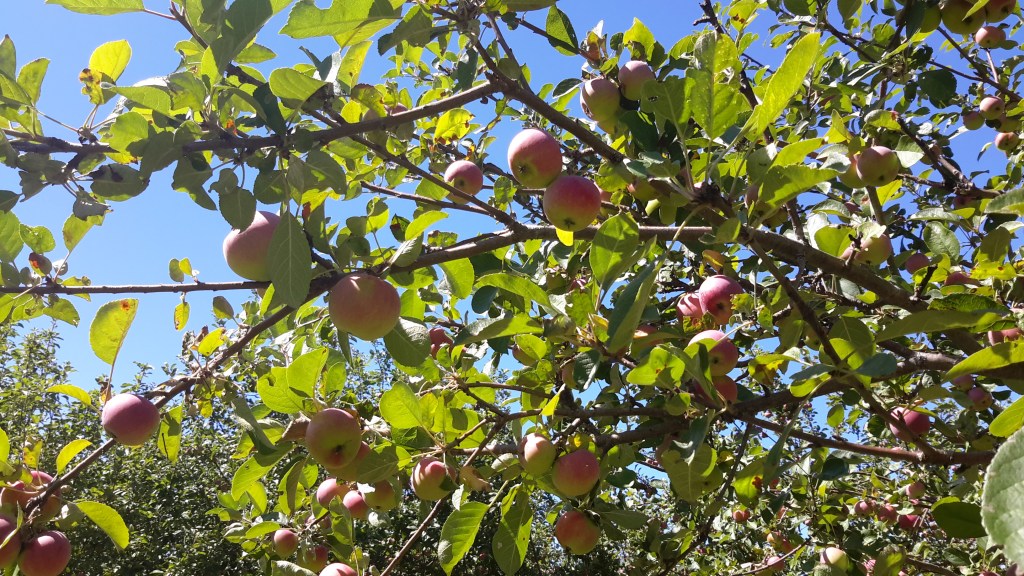
It has been a hot , dry Summer. This has led to a bumper apple crop. It now looks like we will exceed 21 bins of NovaMac/MacFree apples. There is no spraying. It is a certified organic product which will be used to make apple cider, cider vinegar and apple brandy.
Acknowledgements
Heather and I wish to thank the collaborators with the harvest: Rick and Kathy, Neil Bent and Brian Boates. It could not have been done without your encouragement.
Postscript
We watched David Attenborough’s “A Life on Our Planet” on Netflix. He is 93 years old. The film emphasized the need for rewilding our landscape, for attention to our ocean environment and for the move to alternative renewable energy : solar, wind and hydro.
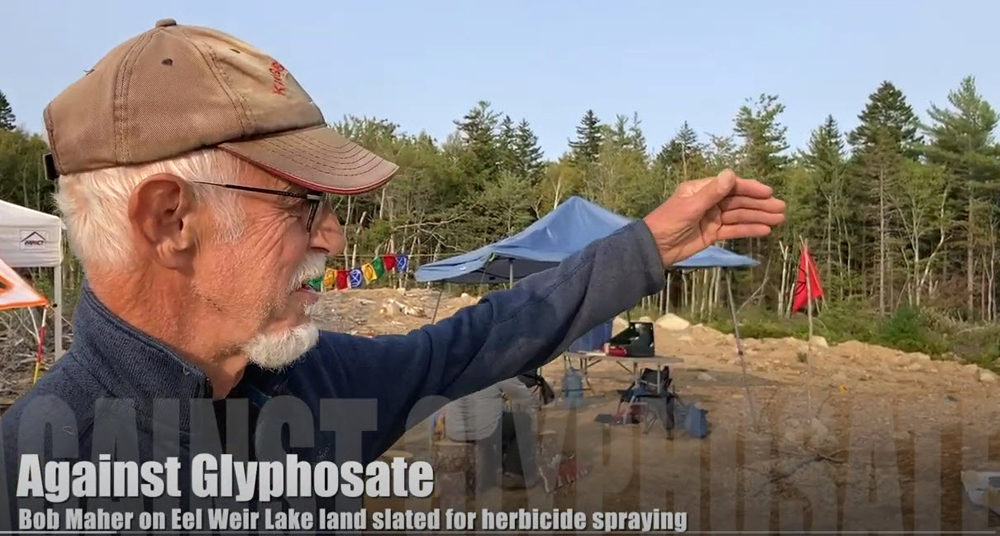
This week, Heather and I have been spending a fair amount of time at the Eel Weir Lake camp with the Extinction Rebellion, protesting the aerial spraying with Glyphosate over three parcels in Annapolis County : one at Eel Weir Lake and two at Paradise Lake.
At the protest site. VIDEO LINK (by media reporter Lawrence Powell)
As we tried to help with directions to the site, Heather noticed a a difference between the fifth edition of The Nova Scotia Atlas (2001) and the seventh edition (2019).
Maps from two dates, about twenty years apart (Left 2001; Right 2019)
Her sharp eye noted:
The location of West Inglisville has moved from the turn in the road on the West Inglisville Road to the end of the Trout Lake Road (cartographic freedom)
the road changed from Local Road (red) to Loose Surface(black)
the areas designated as crown land (Green) were much more extensive in 2019 than 2001.
You can still observe the Eel Weir Lake parcel however it is now surrounded by crown land, especially towards Paradise Lake.
The questions are:
Can the crown land now be clear-cut?
If so, by whom. Freeman Lumber?
After clear-cutting, will we see more aerial spraying?
I remember when I used to teach Geography at the university that Mark Monmonier wrote a wonderful book, How to Lie with Maps (1996).
In the case of the Nova Scotia Atlas, it seems that there have been political decisions to change the designation of crown land. This would then give the government the go ahead to contact the forestry sector for forest management. It could be clear-cutting, including spraying, or it could be ecological forestry. Either way, there should be a process where the citizens can see these maps. At the current rate, the whole province could be designated clear-cut and set to be sprayed. This is TOTALLY unacceptable.
What is the definition of ‘crown land’? Is it land for recreation and enjoyment by Nova Scotians? Or simply a land bank for the forestry industry?
Thanks to those individuals who joined us the camp: Steve, Rick, Carol, Kathy, Heather, Darlene, Debby, Nina, Peter, Neil, Justine, George. Visits from Larry Powell and Tim Habinski. Some dropped in, others stayed overnight. Special kudos to the Extinction Rebellion team. Heather for all her hard work and keen eye. Siqsiq for keeping the coyotes at bay. Edward and David for help with the graphics.
It is a busy time in Paradise. Time to pick apples, and to harvest tomatoes and vegetables from the garden. And, protest about the possibility of aerial spraying at Roxbury on Paradise Lake and at Eel Weir Lake. There are two parcels of land at Roxbury and one parcel at Eel Weir Lake (see map HERE).
“Don’t Spray Us” sign on Hwy 201
The Eel Weir Lake and Mud Lake are part of the water supply catchment for the Village of Lawrencetown.
Heather and I made a reconnaissance of the Eel Weir Lake parcel. We checked out the access roads, off the Inglisville Road. Finally, deciding that the best access to the protest camp would be from the Rifle Range Road.
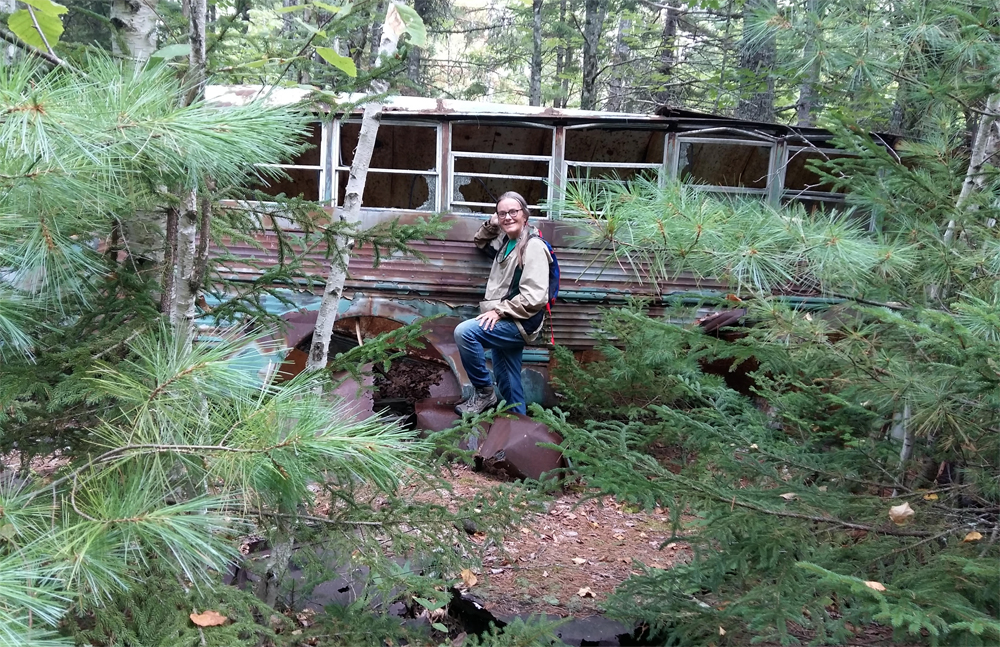
On our travels, we found the remains of the tree planters bus. Hidden away in the woods, after the last cycle of harvesting and planting.
Bus buried into the South Mountain woods
If you want to obtain a good visual picture of the forest cover, and landscape, key in West Inglisville into Google Earth.
When we were at the Burlington rally, one of the team mentioned the title of a folk song, ‘No cell phones in Paradise’. I would add a sign ‘No spraying in Paradise‘. Note the frog in the above poster.
If you spend time up in the woods on South Mountain, you will notice the beautiful night sky. On the ground, you will see the amphibians (frogs, toads, salamanders), the bees on the goldenrod, the birds and other critters. Plus the rich mix of Acadian forest species.
If you live down slope, along the Inglisville Road, Highway #201 or Highway #1 it is likely that the rain falling on the forests of South Mountain is making its way down to the Annapolis River.
Please check the news release for further information , and support ‘No spraying in Paradise’.
Postscript
Want to see what happens three years after whole forest clear-cutting near Middle Musquodoboit, Nova Scotia? Click HERE.
This week, I received a link to George Monbiot’s Guardian article on a new campaign ‘to decolonize the countryside’. Meanwhile, in Nova Scotia I read Larry Powell’s article on the Protected Community Forest initiative.
Reflecting on the differences and similarities between Europe and North America, I recall arriving in Schefferville, Quebec to work at the McGill Sub-Arctic Research Laboratory in Summer 1964. Conducting field research on the Canadian Shield, I developed a very different perspective on the relationship between man and nature.
Eventually, in 1969, I left my job with IBM in England and moved to Canada to study alpine vegetation patterns in the Rockies, just off the Columbia Icefields.
This week, I have been hearing about plans to spray the vegetation in the West Inglisville and Paradise area of South Mountain. I have obtained the Property Identifiers (PID) and with Viewpoint can accurately locate the designated areas.
Here are my questions.
1) the Municipality of Annapolis produced its Forestry report in 2018. Does the Municipality have a say in the Forestry practices impacting citizens in the county?
2) Driving to Bridgewater, I see signs ‘Nova Scotia needs Forestry’. Is that indeed the case? If so, what type of forestry? Read Bob Bancroft’s article in this weekend’s Chronicle Herald.
3) Does the Municipality have any control or input over land use planning in the county? Or are all decisions related to Forestry, Agriculture, Mining made at the provincial level?
4) Finally, with the demise of local newspapers, it is hard to imagine how we are going to understand the positions of candidates in the municipal election. Thankfully, we have The Bridgetown Reader and the link municipalelection-annapoliscounty.com for the basic facts.
To my brother for the Guardian link. To Rocky Hebb for notice about the spraying. To Gregory Heming for the PIDs. Larry Powell for his report on the Protected Community Forest. As always, support from Heather and Edward.
I want to use the word ‘accountability‘ in two very different ways. First, at the time of a municipal election, candidates are seeking to hold local government to account. This week’s The Reader (August 14) includes contributions from Susan Robinson-Burnie (District 7) and Alan Parish (District 3). Meanwhile, from the Municipality, we are now seeing coverage on the new waste management site in West Paradise.
If you will excuse a bit of ‘wordplay’, I would like to address ‘a County ability’.
I continue to be amazed that, at a time when so many of our issues are Geographic in nature (e.g. climate change, COVID, sustainable land management) that the county does not make better use of the resources at both COGS and AGRG. Many of these Geomatics technologies are in high demand (e.g. LiDAR, image analysis, GIS). Annapolis County could showcase a leadership role in municipal land management.
What is stopping us?
Is it the same reason we cannot collaborate with adjoining counties and towns?
In response to my queries, Edward sent me the link to the following TED talk …
It features Chris Fisher, archaeologist and founder of Earth Archive.
Edward’s question: “Could we develop a Nova Scotia Archive as part of the Earth Archive Mission [starting in the Valley]?
YES. And we could start by utilizing the skills, abilities and resources that reside in Annapolis County.
Postscript
Finished reading Randall Fuller’s The Book that Changed America. Fuller describes the impact of Darwin’s Origin of Species on the intellectual community in Concord in 1860. This included Emerson, Thoreau and Asa Gray (the botanist). It was the time of Abraham Lincoln as President and the anti-slavery movement.
If you are a book-lover, check out the documentary The Booksellers on GEM.
Acknowledgements
Edward for the TED talks link. Heather for the help in the garden. Anne Crossman for the updates on the municipal scene. Jon Murphy for news from GoGeomatics.
We have started to see Municipal election signs appear along the roadside. In the current issue of The Reader, candidate Alan Parish (District 3) articulated his position. Clearly, time to figure out the councillor candidates for our district.
What are the issues of concern to residents of Annapolis County? My list would include:
loss of forested land (aka land use planning)
waste management
health services
internet services
Some of these issues include both municipal and provincial politics. Given there are no political parties at the municipal level, it’s hard to understand whether there is a slate of candidates who share a common platform or whether each district beats to its own drum. I suspect the latter is the case.
Let me unpack each of my four concerns.
forest land use.
Within the county, there are citizen groups concerned about the remaining forest cover. The county has produced a forestry report. However, decisions and practices appear to be under the control of the provincial government. Check out the Healthy Forest Coalition newsletter for an update.
waste management
This is portrayed as a financial matter. What we know is that we have waste management sites outside of Lawrencetown, on the Arlington Road, and now in West Paradise. Is this all necessary? What is the financial context for these decisions?
health services
The provision of health services is a provincial matter. However, the lack of services in our county impacts the quality of living in Annapolis County. We see new infrastructure in Middleton and Lawrencetown, but will it improve access to a family doctor?
internet services
There is a multitude of different providers in the county. What are the costs and quality of these services? Again, what is the relationship between municipal and provincial strategies? How complete is the coverage?
The bottom line is that every resident lives in a specific district. If you want to choose between candidates, you need to know what they stand for, what is their position on the above issues? Do they share their position with other councillors? Do they understand the provincial view on these same issues?
Given the recent appointment of Larry Powell, as public relations/press office to the Municipality, it would be exceedingly timely if there was transparency on these and other issues. Given municipal politics does not follow party lines, it is important to see if there is an alternative to the status quo.
Perhaps there could be a public debate between current councillors standing for re-election and those seeking election. Meanwhile, Larry could provide an objective factual report on previous decisions and their costs.
From previous blogs, I have had useful conversations with Brian Arnott in Lunenburg about ‘communities of place’ and ‘communities of interest’. I was on the board of the Valley Regional Enterprise Network (VREN) but found that neither the County nor the town of Annapolis Royal supported the organization. It proved to be very Kings County centric.
Ultimately, we must understand that we live within a nested series of geographies. My civic address places me in a specific district within Annapolis County, within the physiographic region called the Annapolis Valley. This is part of Southwest Nova Scotia, etc. I believe that we live in District 7, our current representative is Warden, Timothy Habinski.
This sunflower adorns our front yard.
In terms of my personal interest, this lies within education. What is happening at the Centre of Geographic Sciences, a sub-campus of the NSCC? What is happening to the Gordonstoun project? How do these initiatives fit within the municipal and provincial agenda? Will it improve the quality of education for everyone in Annapolis County? Are there sustainable economic development opportunities?
References
Municipality County of Annapolis, 2018. Forestry Report.
Acknowledgements
Much appreciation to those friends and acquaintances who respond on occasion to my blog. Heather for our discussions on a ‘sense of place’. Edward for his artistic contributions.








 Meanwhile, in Nova Scotia I read Larry Powell’s article on the
  While in Lunenburg to collect a few bottles of Hunter brandy at
  First, at the time of a municipal election, candidates are seeking to hold local government to account. This week’s
  In response to my queries, Edward sent me the link to the
  Postscript
 In the current issue of
  forest land use.
 waste management
 health services
 internet services
 From previous blogs, I have had useful conversations with Brian Arnott in Lunenburg about ‘
 Ernest Blair Experiment