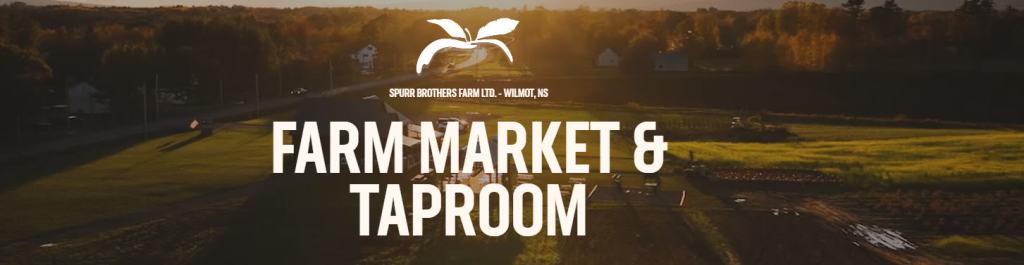
We were early for our appointment at the Hearing Institute Atlantic in Kingston. We decided to stop for a coffee at Spurr Brothers in Wilmot.
Sitting outside looking across the landscape, it raised many questions.
How long have they been in business ?
How large is the acreage ?
Do they have a map showing the variety of crops ?
I asked the waitress if they had a map. Could we produce a map using drone technology ? Could this be an example of Agri-tourism ?
I decided to follow up with three colleagues from my previous life at COGS.
To Jeff Wentzell, now with the provincial Department of Agriculture. Is this an example of a new direction in Agriculture ?
To David Colville, what would it take for a student at COGS to produce a three-dimensional fly-over of the property ? Could we identify each type of crop ? Or apple variety ?
To Celes Davar, does this represent the leading edge of Agri-tourism in Nova Scotia ? What type of collaboration is necessary to develop a new form of Agri-tourism in the Annapolis Valley ?
The answers to these questions, could be linked back to ‘a flight of cider’. (see June 30th blog).
We are in the middle of downsizing. Everything in one house has to be assessed, and a decision made about its future value. This process is both cathartic and overwhelming.
While we are making the transition, we have to combine it with day-to-day living. We have been discovering new geographies, discarding some old geographies. We will enjoy the benefits of living within a community. We will miss being close to the trees on South Mountain. We will not miss the fast-driving traffic on Highway #201.
We will miss the birds, butterflies, and the array of shrubs and flowers planted over two decades. Hopefully, we will not miss the accumulated possessions from earlier lives and outdoor pursuits.
We will not miss the regular commutes to Bridgetown or Middleton for groceries, banking, health services.
With the simplification comes time to re-evaluate our interests in an ever-changing world.The road ahead is littered with decisions about the management of our own habitat: the local landscape in the Annapolis Valley; coastal protection in a time of rapid climate change. It includes the relationship between the politics in Canada, North America, Europe and the planet Earth.
Fortunately, we have lived and worked in many Geographies. Some will be worthy of a re-visit Just to benchmark our perception and understanding. Others will remain ‘once in a lifetime’ visitations. We started with very little. We have accumulated much. Now we can divest ourselves, and return to the basic needs: physical and mental health in a supportive environment. That includes ‘community’.
Acknowledgements
I look forward to Heather, Andrew, Patrick and Laurel and their families help in making this major transition. No graphics or links.
This week, we have become sharply aware of the changes in demography in rural Nova Scotia. We are moving from a rural route into Middleton.
Our neighbours have moved from Toronto to Hwy #201, Paradise., with their young family. Furthermore, we met another young family who have moved from Slovenia via Penticton. Arriving this week to purchase a farm property on Hwy #201 in Carleton Corner.
I hope that the residents of Annapolis County will extend support and welcome to these new residents. They are seeking to live close to the land and become part of the farming community.
As part of our move into town, we have had to deal with the bureaucracy of different banking systems. In particular to move assets from ScotiaBank, Bridgetown (closing in November) to the Credit Union in Middleton. The challenge has been exacerbated by the intricacies of online banking.
Hopefully, this weekend, Andrew (our son) will arrive after the long drive from BC to NS.Then we can move the heavy furniture from Paradise to Middleton.
The move presents a time of stress. We have accumulated many artifacts, books and memories from twenty four years at #6326.
Taking a break, we walked the Middleton Marsh trail. It includes new signage prepared by CARP. Thank you Sandra Barry, for keeping us current with the wetland project.
Postscript
Edward is away in Newfoundland. No graphics or links for a few weeks.
Monday (June 24) we took possession of a new (to us) house in Middleton overlooking the Annapolis River.
We were tired of commuting from Paradise to either Middleton or Bridgetown, for groceries, banking and health services.
For the next month, we will declutter and move our essentials to our new community. We had for some time considered Bridgetown but the demise of banking services encouraged us to consider, and finally choose, Middleton.
Middleton allows us to walk to the grocery store, bank and hospital.
Already, we are making discoveries in the Middleton geography. We celebrated on Wednesday, stopping at Spurr Brothers, Wilmot, for fresh vegetables, and a flight of cider. The setting was idyllic, looking up to the orchards on the north side of the Valley. There seemed to be no traffic noise from Highway #1.
We have lived for over twenty years on Highway #201, just beyond the boundary of Lawrencetown. It will be difficult to leave behind our garden, the woodlot that runs up to the Inglisville Road. We will miss the convenience of Lunn’s Mill, and walks down to the Annapolis River through the old Lawrencetown tree nursery.
We look forward to exploring the trails around Middleton; the opportunity to canoe on the Annapolis River, to bicycle along the Middle Road. We will have easy access to the CORAH workshops on the NSCC campus and events at the MacDonald Museum.
Acknowledgements
This is a huge step for Heather and myself. I am eternally grateful that Heather can share the journey.
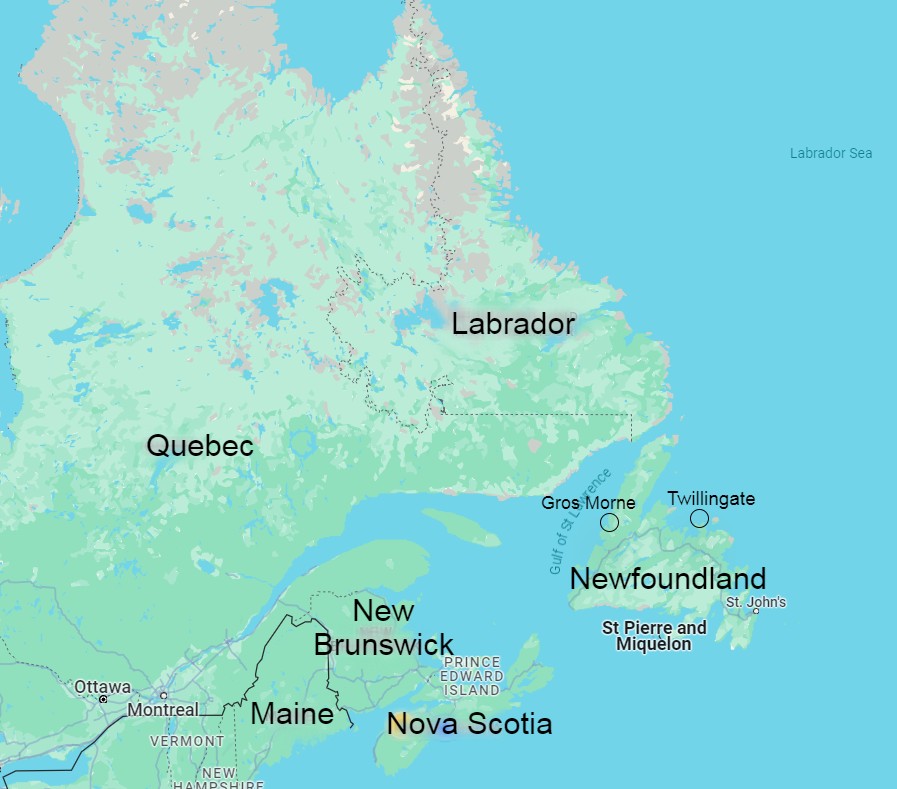
Edward and Anne will tent and paint en plein air in Twillingate, Fogo Island and Gros Morne National Park, Newfoundland, this July. You can follow their journey on their interactive map, Facebook, Instagram and YouTube at Footsteps (Farther) East from their website wedlerfineart.com
The day started early. Kyle from Bridgetown Computers arrived to assist Heather organize her photographs on the cell phone. She was running out of space. Generally, I do not use my cell phone, except in emergencies. However I do recognize the convenience of having both Internet and telephone connectivity on the same device. This seems to be a debate in the media today.
Afterwards, I headed to Bridgetown to meet with John W. I wanted to share my experiences of the CSRS conference in Halifax. John recalled being part of the organizing committee in the 1980’s for an earlier venue in Halifax.
As we discussed the ‘joys of Decluttering’ , John handed me a mint copy of the 1988-90 calendar for the College of Geographic Sciences. Of particular interest, to me, were pages 14-15. It gives a list of faculty: twenty one in total, plus emeritus James Doig and Walter Morrison.
Programs were grouped under three departments (p.9).
Scientific Computer Programming, Remote Sensing, Computer Graphics and Geographic Information Systems.
It would be interesting to compare the instructional staff and programs between 1988 and 2024.
The third meeting after lunch was in Annapolis Royal with Anne Crossman. Anne needed my signature as part of the process of closing down EBLES (Ernest Buckler Literary Event Society). The funds remaining will be divided between Centrelea Community Hall and West Dalhousie Community Hall. Both communities have been very supportive over the years. I wish to thank the other members of EBLES for their good work and camaraderie: Anne Crossman, Jane Borecki, John Montgomerie and Steve Raftery..
In the heat of the evening, we took a cooling drive up the Hampton Mountain Road to the Bay of Fundy, Port Lorne to Mount Hanley, before returning on the Clarence Road to Lawrencetown and home. In the setting Sun, the house on South Mountain had remained warm.
Acknowledgements
Edward and Anne Wedler are away in Parsboro for the International Plein Air Art festival. Perhaps, Edward will author a blog on his return. Meanwhile no graphics or links for a week or two.
Today, Heather and I visited Brian Arnott on the shore of Atuomkuk/ Wentzell Lake of the Pijnuiskaq/ LaHave River Watershed. Brian and Leslie Wright have been the Principals for Novita Interpares Management Consultants, since 1972 (read the post, Citizen Advisory).
We met when I was a Senior Research Scientist at the Applied Geomatics Research Group (AGRG) in Middleton.
From the ‘Future of Windhorse Farm, Ulnooweg Education Centre :
‘ through a combination of purchase and gift, Windhorse has been transferred to the Ulnooweg Education Centre, an indigenous-led registered charity serving all of Atlantic Canada.’
‘Asitu’lisk part of the Ulnooweg Education Centre, is a place for the indigenous people of Atlantic Canada to welcome all who wish to come and learn about culture, language, ecology, health, ceremony and science. Asitu’lisk is a place to connect the generations and a place to heal and grow for all people.’
Brian provided a guided tour of the buildings and grounds. We walked through Asitu’lisk ‘It contains a hemlock grove that is over four centuries old and at least one tree – Grandmother Maple that has been dated at 530 years old; older than the arrival of Europeans on these shores.’
For more information go to Asitu’lisk or reach out to Leslie Wright, Lead, Planning and Management (lwright@ulnooweg.ca).
PS At the end of 2021, Jim and Margaret Drescher brought their long-standing dream to life by returning Windhorse Farm to the rightful caregivers, the Mi’kmaq, the original people of this land Mikma’ki.
Acknowledgements
Thank you to Brian for his guided tour of Asitu’lisk ( a verb that means that which gives you balance). The word is pronounced (ah-see-dew-lisk)
AEC stands for Architecture, Engineering and Construction. In essence, it is the application of GIS to the ‘ built environment’.
From my opening slide ‘ Fifty years of GIS and RS at COGS’, it shows me on our ‘walk to Georgetown in 2013. The message is simple. You have to ‘walk the talk’.
In this case, walking from Yarmouth, NS on the Rails to Trails to Georgetown , PEI to attend a conference on rural economic development in Atlantic Canada. To join Zita Cobb and others in the celebration of living in rural communities.
The message is also true from Edward Wedler. In the same time frame, he invented the venue ‘Ride the Lobster’, an 800km unicycle relay race around Nova Scotia (i.e. ‘the lobster’)
One final link, from Maria Popova, I received my weekly newsletter. The Marginalian. June 9, 2024.
We have been away for a few days in New Glasgow. It is good to get back to the gardening. The sunshine with the occasional shower has been good for the flowers: rhododendrons, wisteria and lupins.
In essence, Red, White and Blue; the colours of the Union Jack.
Today, I went into COGS to meet with David MacLean. Since I only have the resources of my iPad, I don’t have-access to software to create slides for the CSRS keynote presentation next week. With significant help from both David and Edward, they were able to master the complexities of the Google world.
Introductory slide from my CSRS presentation
Even using my iPad at COGS, I needed to bring my cell phone to obtain an access code to the Internet. Oh, the joys of keeping up with technology.
In presenting Fifty years of GIS and RS at COGS, I have been able to witness the changes in technical education at a rural institution. It remains a remarkable story.
Besides the technological changes, we have witnessed significant changes in the philosophy of education, especially in relationship to an aging population. The other key factor is the change in our relationship to the landscape and the community. Fortunately, there have been a number of writers who have reflected upon these relationships
I received their 2024 Award of Distinction. Their motto is ‘location matters’.
Simeon Roberts invited me to give a ‘dry run’ of my CSRS presentation ‘Fifty years of GIS and RS at COGS’. To be delivered in Halifax in June.
Of particular interest to me was the concern of GANS on education. This has been heightened by the cancellation of GIS programs (among other programs) at SSFC (Sir Sanford Fleming College) in Ontario and at RRU (Royal Roads University) and Vancouver Island University (Masters Program) in British Columbia. Their closure appears to be the result of the federal reduction in funding for foreign students coming to Canada. GANS expressed the concern of the possibility of increased competition, elsewhere in Canada for COGS graduates.
To counteract the shortage of qualified GIS/RS professionals, we must better understand that ‘geography matters’ to address the issues of climate change across the vast, diverse landscape of Canada. We need a better understanding of our geography and access to appropriate training in the related technologies of GIS and RS. This will likely require input from the Canada Centre for Remote Sensing (CCRS), as well as the GIS community at the federal level. We need the equivalent of CACRS (Canada Advisory Committee on Remote Sensing) — a CACGIS ( Canada Advisory Committee on GIS).
In 1977, George Argus at the Canadian Museum of Nature invited the author to join his Rare and Endangered Plants Project in Ottawa (see posts Enlightenment and Biogeography). Both Patrick and Andrew were born at the Ottawa General Hospital.
‘The computer seems to be the ‘magic bullet’ that will solve our communication problems and will permit us to turn around the environmental crisis in the next decades. The use of Geographic Information Systems to put our problems into some kind of geographic perspective, holistic modelling to see the big picture and expert systems to train cadres of ‘village ecologists ‘ who will keep watch on the ecosystem in which they live. I don’t believe it will work.’
‘Remote Sensing is an effective way to gather data on a macro scale level. The need however for extensive ground truthing and continuous examination of assumptions cannot be overemphasized.‘
‘In the face of problems such as world overpopulation, our undeterred rush towards more and more consumerism now being clothed in ‘green rhetoric’, the continued exploitation of the natural world, and the measure of everything in economic terms, the technological barriers to environmental information seem trivial.’
‘Although these technological barriers are not completely clear, I have a feeling that their solution will involve grappling with three other problems: politics, education and money.’
Heather and I have fond memories of our time in Ottawa. From a work perspective, it produced two publications. The Rare Vascular Plants of Nova Scotia, and the Rare Vascular Plants of Saskatchewan.
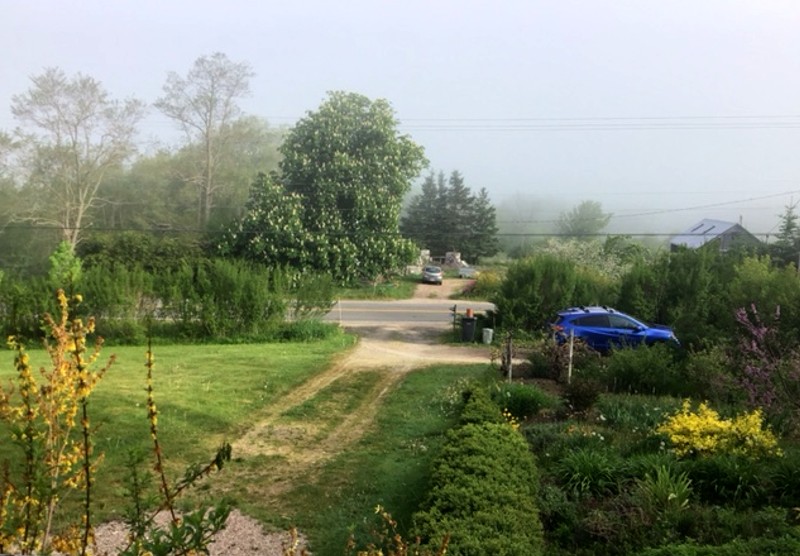
Today, I look across the road at the flowering horse chestnut tree. I remember George, the beekeeper and willow (Salix) expert, being impressed by the diversity of bees on the tree (see post The Bookshelf )
I believe that George’s comments on technology are even more true today.
References
G. W. Argus, 1992, Technological Barriers, Environmental Monitoring and Assessment Journal, v 20, p.175-177.
R. V. Maher, David White, George Argus and Paul Keddy,1977,The Rare Vascular Plants of Nova Scotia, 37 pp, Syllogeus 18, Published by the National Museum, Ottawa.
R. V. Maher, George Argus and Vernon Harmes, 1978, The Rare Vascular Plants of Saskatchewan, 42 pp, Syllogeus 19, Published by the National Museum, Ottawa.








 Ernest Blair Experiment