Posted in Uncategorized

Tick Talk

This week has been consumed by tick management. We made a call to the Greenwood Animal Hospital and arranged for an appointment for Siqsiq. The result was a monthly pill. Next step was the human species.

After a couple of days, dealing with the telephone network, we decided to ‘bite the bullet’ and went to Emergency at the Middleton Hospital. We left four hours later, with prescriptions for a single dose antibiotic.

Meanwhile on CBC Maritime Noon, there was the seasonal discussion of ticks and Lyme’s disease. Evidence suggests that the mild Winters in Nova Scotia are leading to an increase in the tick population.

It is interesting that it is easier to obtain treatment for our pets than ourselves. Although I recognize that pet health can be critically important to human health.


LINK to NOW Lunenburg County Big Ideas

From NOW Lunenburg County, I see they are looking for BIG IDEAS. My proposal, whether it be Lunenburg, Annapolis or Great Village, focus on the rural landscape and its value to artists, scientists and those who wish to have a close relationship to the landscape. Examples abound.

Great Village: look at the work of the Elizabeth Bishop Society. For Annapolis County, we have Ernest Buckler and a number of other artists. In an earlier blog, I cited the example of the Roald Dahl Museum and Story Centre in Great Missenden UK. This week, in the latest Guardian Weekly I was reading about David Hockney and his new exhibit in London ‘Spring in Normandy’ (PDF).

LINK to BOFEP

On the Science side, I received the latest newsletter from BOFEB (PDF). From a landscape perspective, our marine environment is often woefully under-represented. Conversely, imagine if we had an ‘environmental partnership’ for the landward side of the Bay of Fundy?

Postscript

From Frank Fox, BBC News reference to ‘The reason wild forests beat plantations’.

Acknowledgements

Dr. Opthof Emergency Doctor, Middleton. Heather and Siqsiq for their help in battle of the ticks. Edward added the graphics and links. Much appreciated.

References

Lunenburg County NOW. Big Ideas competition.

BOFEP May 2021 newsletter (PDF).

The Guardian Weekly, May 21, 2021, Interview with David Hockney: A Man for All Seasons. p51-54 (PDF) David Hockney: The Arrival of Spring, Normandy, 2020 is at the Royal Academy, London.

Posted in Uncategorized

Making Connections

I received this photograph a couple of days ago from my brother.

It shows paddle steamers docking at Clacton Pier in 1938. This is before the Second World War. Clacton is in Essex on the East coast of England, about one hundred miles northeast of London. From the photograph, it looked to be quite prosperous.

Fast forward to the late 1950s. My grandfather, Harry Ballard on my mother’s side, was a taxi driver in London, driving a black cab. On his retirement, he and his wife, Jane bought a bungalow on the cliff tops at Holland-on-Sea.

LINK to online image of Holland-on-Sea.

Our family of five used to go there to visit during the Summer holidays. We would walk, bicycle or bus to Clacton, go out on the pier and watch the fishermen (and ladies) cast their lines into the water. Other days, we would go North to Frinton-on-Sea, again along the coastal path.

Meanwhile, on my Father’s side, John Maher and his wife lived nearby in Hampton. He was a nurseryman, growing and breeding chrysanthemums. They would be sold at the Covent Garden market in London.

LINK to online image of Covent Garden history.

Today, I find myself combining a taxi-driver sense of place with a nurseryman’s interest in plants.

I noticed, today, that the rhododendrons, which we purchased several years ago from Captain Steele’s nursery on the South Shore, are in flower.

The yellow variety was named after his wife. They seem particularly happy in the woods at the foot of the slope of South Mountain.

These connections come together in the study of Biogeography: place and plants.

Acknowledgements

Peter found the photograph of Clacton Pier (1938). I snapped the photograph of the rhododendron. Heather works hard, sharing the gardening. Edward shares the blogging.

Postscript

Check out Brain Pickings, May 5, 2021, David Whyte, A Velocity of Being: Letters to a Young Reader. “Collection of 121 original illustrated letters to children about why we read and how books transform us.”

Posted in Uncategorized

Stories and Maps: the Franklin expedition

On the way to Iqaluit, we had a stopover in Ottawa. On the recommendation of Andrew, my son, we went to see the Franklin exhibition at the Canadian Museum of History.
franklinExpedition

There were many aspects of the exhibit design which caught my imagination. At the entrance, a projector system showed the history of exploration routes into the Arctic. Each route revealed more of the known geography of the North. These images served to provide a graphic context for the Franklin expedition. The layout of the ship on the floor of the gallery again provided a tremendous sense of the size and plan of the individual vessel. Third, and most revealing to myself, was the combination of Inuit storytelling with current artwork.

While listening to the recordings, it became clear that the role of storytelling in the oral Inuit culture was critical to our understanding of the fate of the Franklin expedition. These stories of the landscape provided a narrative which allowed the Inuit to travel from place to place. The stories were retold in the igloos by the elders. They replaced maps, although there were wooden maps carved to identify islands and inlets.

Once we arrived in Iqaluit, I had access to books. I found Woodman’s book Unravelling the Franklin Mystery: Inuit Testimony. This gives more background to the many insights at the exhibition. A second book, on Andrew’s bookshelf, was Annie Dillard’s Teaching a Stone to TalkExpeditions and Encounters. It includes An Expedition to the Pole p 29-64. This essay is brilliant, divided into several headings: The Land, The People, The Technology. These topics and their focus on the Franklin Expedition reverberates with the exhibition (written in 1982).

Meanwhile, as I was flying from Ottawa to Iqaluit, I was re-reading Robert MacFarlane, The Wild Places p 17.

“I also decided that, as I traveled, I would draw up a map to set against the road atlas. A prose map that would seek to make sense of the remaining wild places of the archipelago visible again, or that would record them before they vanished for good. This would be a map, I hoped, that would not connect up cities, towns, hotels and airports. Instead, it would link headlands, cliffs, beaches, mountain tops, tors, forests, river-mouths and waterfalls.”

One last story. Talking to Julia last night, I found that she had been hired to teach Map Making at Nunavut Arctic College. On the side table, I found, Map Use: Reading, Analysis, Interpretation by Kimmerling et al. Six hundred and fifty pages. With a Foreword by Jack Dangermond at Esri.

It seems that we have come ‘full circle’.

References

David C. Woodman. 2015. Unravelling the Franklin Mystery: Inuit Testimony. Second Edition

Annie Dillard. 1982. Teaching a Stone to Talk: Expeditions and Encounters.

Robert MacFarlane. 2007. The Wild Places. Penguin Books.

Jon Kimerling et al. 2016. Map Use: Reading, Analysis, Interpretation.

Elaine Anselin. Closing in on Franklin. Up Here. Jan/Feb 2018. p 55-62


Posted in Uncategorized

There’s Nothing There: a rural myth

There’s nothing there!” scolded Joan, my plein air artist friend. “You’re sending us to a place next week, to a crossroads, where there is absolutely nothing to paint”. Joan was referring to the intersection of Black Rock Road and Brooklyn Street, Kings County, Nova Scotia — our fifth paint-out site of the season (we have 21 more to paint). “I go by there almost every week. Why are we going THERE?”

057_100dayChallenge_rainyWayfarersBrewery_BW_90dpi
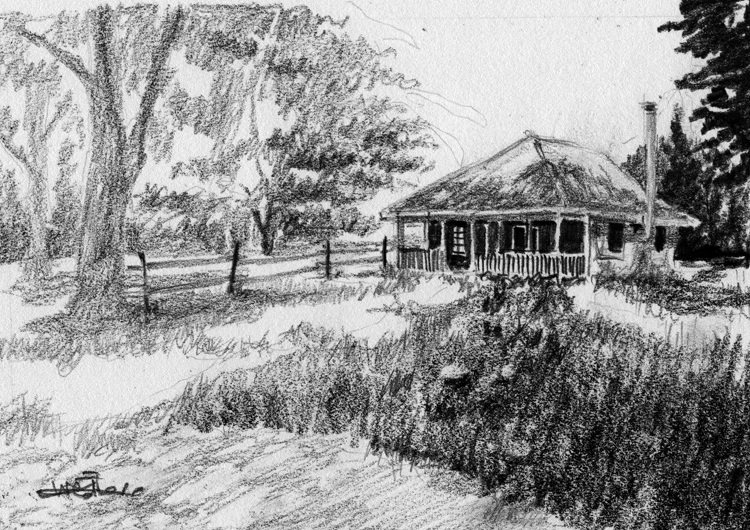
En Plein Air sketch of decaying home along Brooklyn Street, Kings County, Nova Scotia by Edward Wedler at http://www.dootdootdaddy.blogspot.ca

That’s part of the problem. Through familiarity, Joan has become numbed to the nuances of this rural setting — the details many would miss just driving past. Along with six other artist friends we rhymed off to her the many scenes that can be captured there. “You can do the graveyard or the decaying house across the road from the Grafton Community Hall. What about the cows or the rows of corn in the farmer’s fields? Have you ever looked up the road, towards North Mountain, to see the thick fog hanging in the air from the Bay of Fundy? If you drive up the mountain you can look back at the patchwork quilt of farmer’s fields and see the sunlit silos across the Valley on the South Mountain. “

My wife, Anne, was trained in acrylic art by Floridian artist Joseph Melançon. He paints in the form of the Canadian Group of Seven artists and can create masterpieces from what looks like banal landscape photos, devoid of details. He opens our artists’ eyes to the understated geography of rural settings. He creates something from what appears to be nothing.

In my travels across Canada, it was the Prairies that struck me most as an artist. The smallest glimmer from a pond, the most subtle grouping of wildflowers, the flutter of startled ducks, the line of telephone pole after telephone pole, was magnified ten-fold in contrast to the expanse of fields and open sky. One notices more clearly the slightest shift in colour, line and form.

I have learned that, through the artist’s eyes, when we focus we begin to see what may appear ordinary but in a new light. Bear River photographer and filmmaker, Tim Wilson, reminds me of that every time he posts another photo or video to his Facebook or website from rural Nova Scotia. Anyone see the film Maudie? Stricken with arthritis and almost stuck in a small house in rural Nova Scotia folk artist Maude Lewis managed to paint and paint and paint. There was always something to paint.

Look carefully and maybe stop awhile. There is always something to see (and do). To say that there’s “nothing there” is a rural myth.