Posted in Common Place, Nature

Red and Blue

Some days are defined by external events, others by small coincidences. Heather has been putting out sunflower seeds for the birds, along the deck railing. This morning, we were treated to a beautiful display from the Red Cardinals and the Blue Jays.

Otherwise, the day was by defined by the appointment at Honda in Kentville, to change to Summer tyres.


Anne Crossman forwarded a link about land ownership on Haida Gwaii, bringing back good memories (read posts Reaching Out, A Short Story, Lessons From Haida Gwaii Part 1, and Lessons from Haida Gwaii Part 2).

Landmark deal recognizes Haida Nation’s title over Haida Gwaii
The Canadian Press | Posted: Sunday, April 14th, 2024 8:15 PM | Last Updated: April 15th

John Wightman forwarded an aerial photograph (image taken by The Valley Eye) of the construction site for the new Mountain Lea residence in Bridgetown.

Edward shared a link to “Work in the Age of Artificial Intelligence”, an online seminar hosted by the Brookings Institute in the USA.

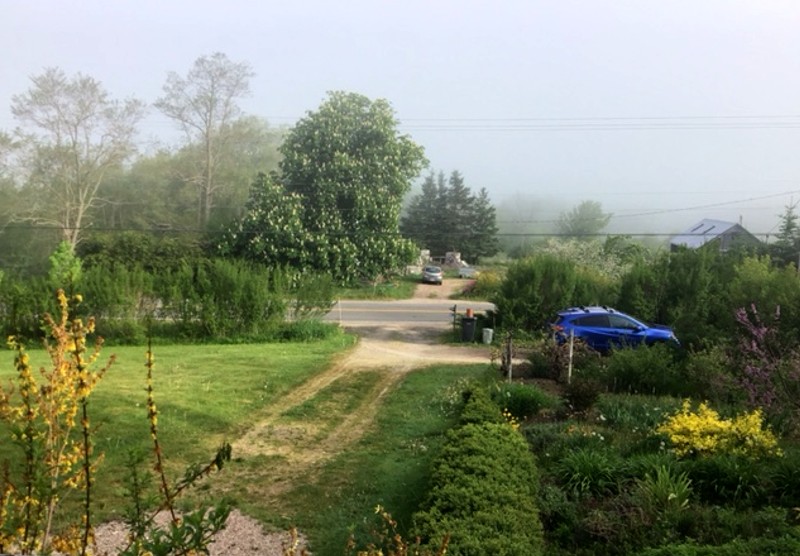
At the end of the Day, I could not resist a photograph of the Scilla, flowering amongst the lupin leaves.

Surely, Spring has arrived; followed by the tick season; and then the lady-slipper orchids.

Acknowledgements

Thanks to Anne Crossman, John Wightman and Edward for their emails. Heather encourages the bird life in the backyard.

References

Haida Gwaii
Mountain Lea
AI and work

Posted in biographical sketch

Family Matters

This weekend, we went to Windsor to see the Student Art Exhibition at Kings Edgehill School (KES), curated and organized by Sandy Stewart, Heather’s sister.

We stopped for lunch at the Schoolhouse Brewery.


While in New Glasgow, we checked out accommodation for our family reunion this August. Traditionally, this would be at Pictou Lodge however after the hurricane, about two years ago, it remains closed.

We found a replacement at Smith Rock Lodge & Chalets atop Fitzpatrick Mountain, near Scotsburn.

Again, we noted the devastation to the forests in the region. It will take a concerted effort to repair the damage.


Earlier in the week, Edward stopped in, on his way back from Annapolis Royal. We were able to grab coffee at Bees Knees and take it down to the Annapolis River. It has been many months, with Edward away in Florida. It helped me set my direction for the CSRS keynote talk in June.


This week finished reading The Dome Chronicles (see post “The Secret”). I discovered that Garry Leeson’s home base is Harmony, on South Mountain, up behind the Canadian Forces Base, 14 Wing Greenwood.

This week too, I heard from Simeon Roberts. Apparently, the Valley Regional Economic Network (VREN) is exploring the application of GIS technology for site selection in the region. Simeon reminded me that we had been promoting the concept of a community information utility for several years (see previous posts “The Geographic Sciences and Regional Development” and “Community Innovation“).


Finally, Heather and I enjoyed Wednesday night movies at King’s Theatre in Annapolis Royal — Five Hundred Days in the Wild, Dianne Whelan’s six-year journey travelling the Trans Canada Trail,

and then Anthony Hopkins, One Life about saving Czechoslovakia refugee children in the Second World War.

Acknowledgements

Heather and I enjoyed both the Art Exhibition at KES with Sandy and the drive to Scotsburn with Jay. Edward and Simeon offered useful feedback.

Edward once painted Convocation Hall at King’s Edgehill School en plein air, in watercolour.

References

Gary Leeson, 2019, The Dome Chronicles, Nevermore Press via Nimbus Publishing.
Smith Rock Lodge and Chalets, Scotsburn, www.smithrockchalets.com
Valley REN Site Selector Tool

Posted in New thinking, Travel

Niche Map of Nova Scotia Attracts 25,000 Map Views

Now, I’m not one to gloat but almost 25,000 map views are the latest counts on my interactive plein air art map at tinyurl.com/PleinAirMap.

Not bad for a niche map focused on Nova Scotia. I should see the numbers rise soon since I have recently posted this map link to several Facebook Groups in Canada, the USA, Europe and beyond. It’s also a great way, to attract visitors from away who are looking for activities to do in Nova Scotia. Artists as far away as New Zealand are sharing my map. Think experiential tourism! (see Preparing for Experiential Tourism, Rethinking Tourism, and A Question of Scale)

I’d love to attract a COGS student and challenge them to scale the map globally where there are hundreds of thousands of interested plein air artists, urban sketchers, art lovers and experiential tourists. Maybe I have yet to attract any because I want them to use the Google Suite of software and have COGS students working with Google Map developers.

I once emailed back and forth with Eric Rhoads, the publisher of Plein Air Magazine out of the USA. While he couldn’t spare his resources, he thought the map was a great idea.

Your thoughts?


Posted in Book Review

Lunenburg

Saturday, it was time to step out of the Valley. We had not driven down Highway #10 to Bridgewater this Winter. I wanted a change of bookstores. After a short stop in Mahone Bay, we found ourselves at Block Shop Books in Lunenburg.

Of course, we did not leave empty-handed.

I found Rebecca Solnit’s A Paradise built in Hell.

Heather found Annie Proulx’s Fen, Bog and Swamp.

The last Solnit book, for me, was Orwell’s Roses (see post Orwell’s Roses, and Orwell’s Roses Part 2). Here we are a few years later – still living in Paradise – seeking optimism from the “extraordinary communities that arise in disaster” – will they include rural Nova Scotia?

Heather stayed closer to her roots with “a short history of peatland destruction and its role in the climate crisis”.

From the previous two blog posts (The Question and The Secret), I am looking for The Answer. Does it lie in Paradise? Or in the words of Bill McKibbon “The freshest, deepest, most optimistic account of human nature I’ve come across in many years“.

Acknowledgements

Edward continues to step up to the challenge. Heather remains closely connected to our garden, the greenhouse and the surrounding woodlots.

References

Rebecca Solnit, 2010, A Paradise Built in Hell, PenguinRandomHouse.
Annie Proulx, 2022, Fen, Bog and Swamp, Scribner/Simon & Schuster.

Posted in Book Review

The Secret

Garry Leeson describes his book, The Secret of the Spring as historical fiction.

Before reading, we ventured to Spa Springs. We came from the Margaretsville side. I remembered the Vault Road, from the time when we lived in Clarence in the 1980’s. This time we found the Spring Bottling plant.

After reading Leeson’s book. I need a return trip to appreciate the location of the Spa Hotel, as well as the actual Spring. That will be another day.

What I gained from Leeson was how through historical research, it is possible to create a sense of livelihood, lifestyle over several decades in rural Nova Scotia.

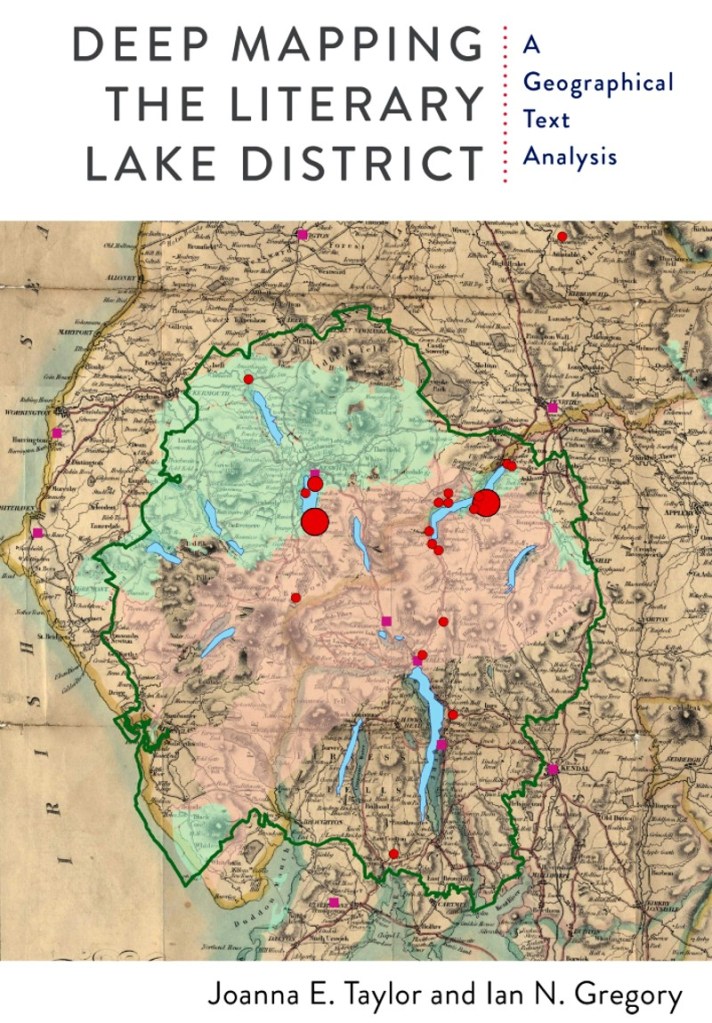
It also generated an interest in Historical Geography. How much geographical fiction exists in the mountain and the valley? This will lead to my reading Leeson’s The Dome Chronicles describing the ‘back-to-the-land movement in the 1960’s and 1980’s.

After checking with Paul Colville, I made a side trip to The Inside Story. Not only did I find the Dome Chronicles, but also I discovered Dan Johnson’s Ashes, the sequel to the Secret of the Spring. A great success!

Acknowledgements

Paul Colville helped me locate Leeson’s books. Heather shared the drive through Spa Springs. Edward added the graphics.

References.

Gary Leeson, 2019, The Dome Chronicles, Nevermore Press via Nimbus Publishing.
Gary Leeson, 2021, The Secret of the Spring, Moose House Publications.
Gary Leeson, 2023, Dan Johnson’s Ashes, Moose House Publications.

Posted in Uncategorized

The Question

The provincial government has scrapped the Coastal Protection Act; instead, it downloaded coastal problems to the municipalities and individual landowners (see post Two Emails).

The Coastal Zone is essentially a geographic problem. Here is my question. Has the government approached the Centre of Geographic Sciences (COGS) scientists and faculty?

They have the technology and tools to monitor changes in land use (e.g. GIS and Remote Sensing).

In addition, the Applied Geomatics Research Group (AGRG) under Tim Webster has access to field equipment to monitor changes in the coastal zone.

If the plan is to download the problem to municipalities, do these organizations have access to these tools and trained staff? Do Planning graduates from COGS have these skills? ( see previous blog)

From my perspective, the NSCC should ensure there is a sufficient number of graduates with both the technical skills and the geographic science.

I will forward this blog to Tim, to find out whether AGRG has been approached to provide both types of expertise. The Coastal Zone remains a critical component of both the economic and environmental future of Nova Scotia. We need to prepare for this future, through education and training.


Home reading includes Garry Leeson’s The Secret of the Spring.

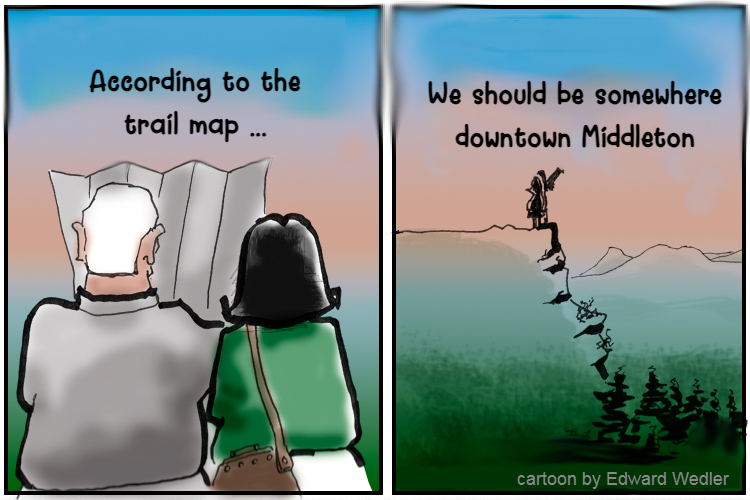
The location is Spa Springs, just outside of Middleton. The story is fiction. Leeson has also written The Dome Chronicles about the back-to-the-land movement in rural Nova Scotia.

Acknowledgements

Edward added the graphics and links.

Reference

Garry Leeson, 2021, The Secret of the Spring, Moose House Press.

Posted in Uncategorized

Country Roads

This week, we had to make two trips to New Glasgow. It is a three-hour drive, one way. One redeeming feature was that we took different routes.

Highway #101 to Windsor; the first time (our traditional route) through the Rawdon Hills to Truro, the second time, through Old Barns to Kennetcook. Either way, there are opportunities to savour the rural landscapes of East and West Hants municipalities with their roller coaster roads.


This week, too, I received a letter from Nick Lasch. He was Director of Planning in the 1980s for the Municipality of the County of Annapolis. He enclosed a copy of the Municipal Planning Strategy (MPS) (Fall, 1988). At that time he had a strong relationship with both Mike Donnelly and Phil Hore, instructors in the Planning program at COGS.

Together, they used GIS and Remote Sensing to develop a comprehensive property mapping project for the County. This was done with the support of LRIS, NS Remote Sensing Group and of the province’s orthophoto mapping. With the completion of the property mapping, a GIS project was initiated to develop a database to include specifics for each parcel, and tied each parcel with an ID to property maps.

Roll the clock forward thirty-six years. What is the current status of property mapping and the application of GIS and RS in Annapolis County?

The main purpose (1988) was to provide a comprehensive database for the county to facilitate decisions and provide valuable information for the proposed MPS, LUB and future planning endeavours.

As part of my background research for the CSRS (Canadian Symposium on Remote Sensing) keynote presentation this June, I shall try to find the answer (see post Fifty Years of GIS and Remote Sensing at COGS).

Also, what is the status of the Planning program at COGS today?

Acknowledgments

Thanks to Bruce Gillis and Nick Lasch for their interest and background information.
Hopefully, Edward is back from his art retreat in Florida and can add graphics.

Posted in Uncategorized

Up the Valley

This Saturday, we went to the Farmers’ Market in Wolfville. I wanted to see the results of FAN-fare. It was very busy. There was a tremendous sense of community. Lots of Food, Arts and Nature. Afterwards, we stopped briefly at The Odd Book store. Heather found Wild Foresting, Practising Nature’s Wisdom by Drengson and Taylor published by New Society. This brings back good memories of the West Coast.

Our next stop was an excellent lunch at the ArtCan cafe in Canning. Here, I happened upon Ways of Life. On Places, Painters and Poets by Andrew Motion. Afterwards, given the blue skies and sunshine, we opted for the backroads: from Canning to Kentville; then the old Highway #1 home to Paradise.

Earlier in the week, I had picked up tickets for the house concert at Dawn Oman’s gallery in Bridgetown. In the intimate atmosphere of the repurposed church, we enjoyed the songs performed by Permanent Resonance. This capped a full day.

Sunday, time for a walk through Valley View Park. We followed it with the long drive up the Morse Road to West Dalhousie. The community hall brought back memories of the world of Ernest Buckler, and the community efforts of the Ernest Buckler Literary Event Society (EBLES). Thanks, Jane, Anne and John.

Acknowledgements.

Heather shared the busy itinerary. Edward is away painting in Florida; we may miss his contribution.

References

Alan Drengson and Duncan Taylor (ed.) 2009. Wild Foresting. Practising Nature’s Wisdom. New Society Publishers.

Andrew Motion. 2008. Ways of Life. On Places, Painters and Poets. Selected Essays and Reviews 1994-2008. Faber and Faber.

Posted in biographical sketch

Back Story

Last weekend, I met with John Wightman to discuss the transition from the Nova Scotia Land Survey Institute (NSLSI) to the College of Geographic Sciences (COGS).

John reflected on the structure of the programs, and the need to fill the new building in Lawrencetown.

In 1980, there were three departments: Planning and Cartography, Computer Programming, and Survey Engineering.

John’s objective was to create a technical institute, similar to ITC in Enschede. By adding new technology and faculty, he hoped to develop a relationship with one of the universities in the region.

From a computer technology perspective, this led to programs in Scientific Computer Programming, Business Computer Programming, Computer Graphics, Geographic Information Systems, Remote Sensing, and Business Geographics. Planning and Cartography remained similar with new technology. Likewise, Survey Engineering added Marine Geomatics Engineering to Geomatics Engineering Technology.

On the weekend I met with Bruce Gillis, Lawyer. He was interested in sharing with me the Annapolis County Atlas, produced by the Annapolis County Planning Department in 1984. This proves to be a remarkable document in light of the state of county planning today, 2024 (forty years later).

Both of these meetings shed light on the trajectory of COGS over the last fifty years, and the opportunity to apply both GIS and Remote Sensing technology. Evidently, John had close ties with both the Canadian Centre for Remote Sensing (CCRS) as well as the GIS community through Roger Tomlinson.

Postscript

We went to Hampton Beach. There were a couple of local volunteers cleaning up the old rope and plastic. Apparently, there is a group from Halifax that has taken on this mission. Concern for our marine environment.

Acknowledgements

To John Wightman and Bruce Gillis for their memories of both NSLSI and COGS. Edward added the graphics.

References

Annapolis County Atlas, October 1984, Published by the Annapolis County Planning Department.

Posted in Uncategorized

Lost Posters

In my cluttered office, I found two posters that define my current thinking — from Esri, “Make Every Place a Creative Space” and a second from Kenneth Field’s book, “Cartography”.


Yesterday (Saturday), Heather and I went to ARTSPLACE in Annapolis Royal. We wanted to see the exhibition by artist Janice Leonard ‘Postcards of Paradise,’ (March 1-23).

These pieces are small 5” x 7” paintings on board. The time of day, place and date are noted on the back, as well as an excerpt from my journal of the day so as to mimic a postcard, an archaic form of communication.

The series of postcards of Paradise, Nova Scotia since 2016, reminded Heather and me of similar scenes we see on our walks around East Paradise, and along the Annapolis River.

Afterward, we stopped at the Brown Dog for lunch. In the Library, I found Thomas Cooper’s “The Roots of My Obsession: thirty great gardeners reveal why they garden”.

On the way home, we decided to take the Spurr Road from Round Hill to West Dalhousie. For old-times sake. Unfortunately, as we passed Wrights Lake and reached the junction with the old Military Road between Annapolis Royal and West Dalhousie, the road was closed (washed out ?). We back-tracked to Round Hill on Highway #201 and home.

Acknowledgements

Edward added the graphics and links. Heather shared the drive to Annapolis Royal and up onto South Mountain.

Reference

Thomas Cooper (ed.), The Roots of My Obsession: thirty great gardeners reveal why they garden, Timber Press, London.