Posted in Art, Event Review

Plein Air Paint-Out Map for 2023

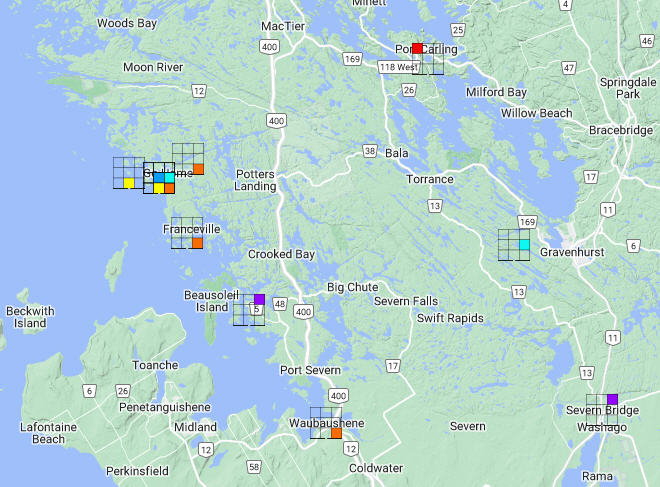
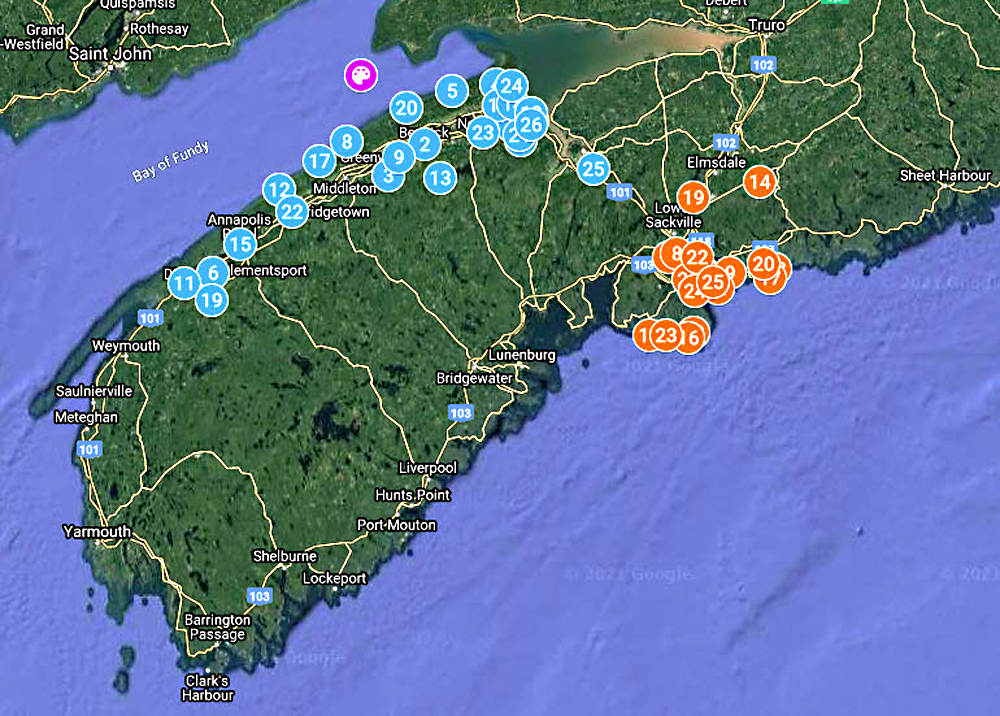
Our Nova Scotia plein air art map grows with community user input. It currently has 19,000+ map views.
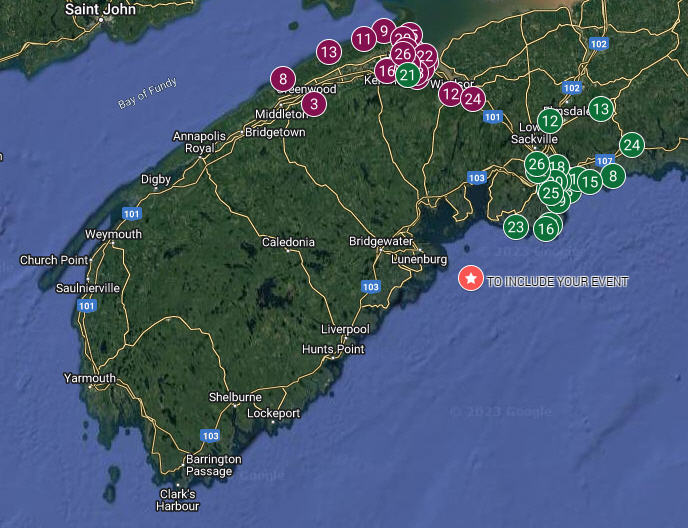
The map shows paint-out locations for the upcoming, outdoor (en plein air) painting season.

According to Plein Air Magazine, the plein-air painting movement is the fastest-growing movement in the art world today.

Editor, Eric Rhoads, calls it “the new golf”. Many tens of thousands of artists, worldwide, are involved in this movement.

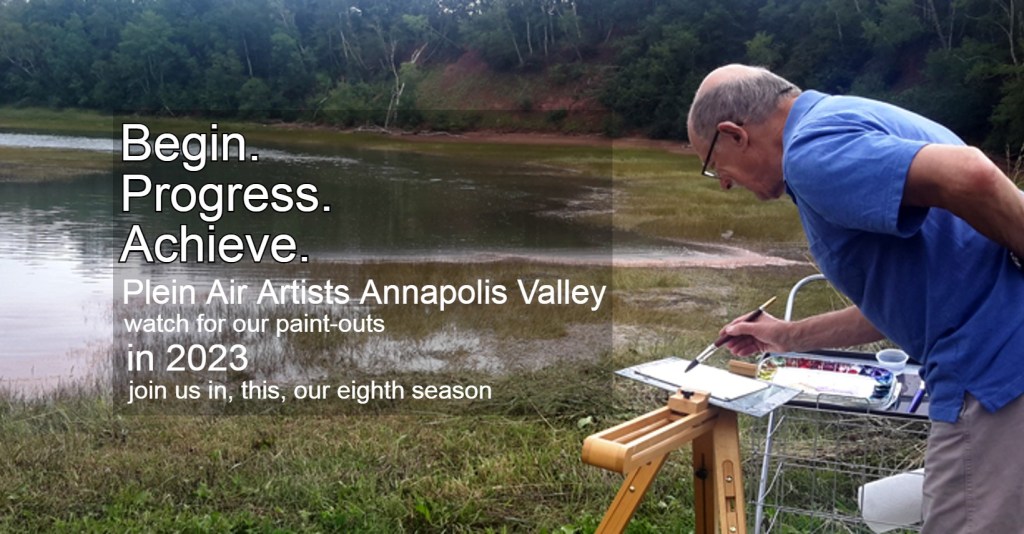
Anne and I have founded two groups in Nova Scotia (Plein Air Artists of the Annapolis Valley, PAAAV in 2016, and Plein Air Artists HRM, PAAHRM in 2019).

We participate in a third group, Halifax Urban Sketchers, HUSk, and have collaborated with the Nova Scotia Association of Architects to hold sketch-outs.
The map, and associated schedules, keep member artists, event organizers, art lovers, collectors, residents, and out-of-Province tourists aware of what, when, and where events are held. We have had visitors from Europe, across Canada and the USA join us based on this knowledge. Last year I created an icon on the map to allow others to place their event on the map. It’s crude (using Google Forms) but it works.


I use the Google Map platform because it is popular, and well-integrated with its suite of products (Google Sheets, Google Docs, Google Forms, Google Calendar, YouTube, etc.). Such a platform forms the basis of another map I am building for “Footsteps East”.

Our Footsteps East map tells the story of our 6,000+ km tenting and painting trek that Anne and I are undertaking from Nova Scotia to Lake Superior, and back. This organic, interactive map grows with text, and links to YouTube, Spotify, a Calendar, and sketches as we camp at each paint-out site. Anne looks after Instagram, Facebook, and Google Calendar.

On a final note, I’d like to say there are a number of improvements that would make such maps more valuable and scalable (and be monetized). If there is anyone out there who’d love to work with me on this let me know or refer me to some Google Map developers.

References

Link: Plein Air Map (tinyurl.com/PleinAirMap)
Link: 2023 Paint-Out Schedule PAAAV (https://bit.ly/3ZvR5Zz)
Link: 2023 Paint-Out Schedule PAAHRM (https://bit.ly/3ZvR5Zz)
Link: “Footsteps East Launch Pad(https://www.wedlerfineart.com/page/36519/footsteps-east-launch-pad)

Acknowledgments

Dr. Bob Maher as our Footsteps East Geographer Mentor and Advisor
Jesse Millican as our Footsteps East field video and audio recording Advisor
Techert Gallery as our host venue for the Footsteps East original art exhibition, September 2023
A global community of artists supporting and following us on our Footsteps East trek.

POSTSCRIPT
A recent plein air oil painting created by Anne in Florida.

Posted in Art

First Steps

About two weeks ago, Anne and I began our two-year FootSteps East journey in Herring Cove, Nova Scotia — the area in which artist A.Y. Jackson painted back in 1919. We logged this paint-out to our newly-created FootstepsEast Facebook Page, to our ESRI Footsteps East StoryMap and to our Google FootSteps East Map.

Here is an excerpt from the first map I have created in preparation for Footsteps East. The map pins look a bit strange, but let me explain.

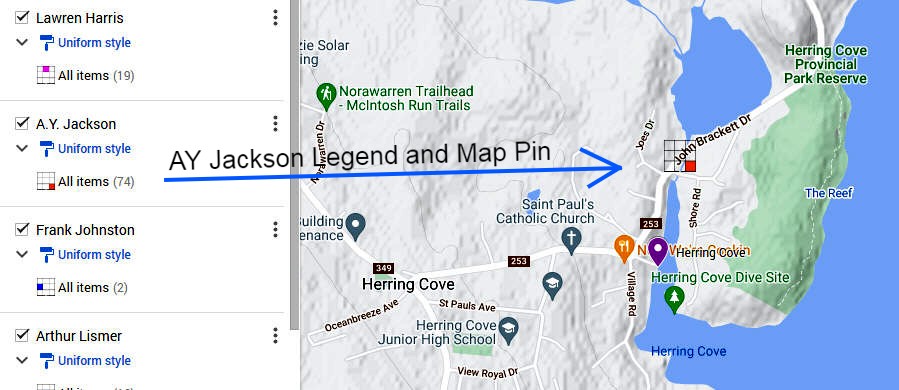
The pins sit over some of the paint-out locations of members of Canada’s Group of Seven Artists. Each coloured square represents a different member. I experimented with several different pins and ended up with this design in order that multiple artists could be shown at the same location, without overlapping/obscuring map pins.

This map will help plan a travel route through Eastern Canada.

Zeroing in on Herring Cove (our first step), you can see that I have included our journey’s log and sketch on the map.

Also shown at Herring Cove is the A.Y. Jackson map pin.

Once we have painted at three locations, I will make the map and social media links public.


This coming week (21-26th June 2022) we get to meet plein air artists from across Canada and the USA, in a competition to paint the landscapes around Parrsboro, Nova Scotia (Parrsboro International Plein Air Festival). We are up against some seriously talented pros.

For August, Anne and I have collaborated with King’s County Museum to design “Brush with Nature“. This is where regional artists come to paint features of natural/historical interest in a LONG BRUSH event (01-18th August 2022) within Kings County and a SHORT BRUSH event (Saturday, 20th August 2022) at Miner’s Marsh in Kentville. The first Call to Artists has already attracted some great local talent.

ACKNOWLEDGEMENTS

Anne is my painting buddy and we share this Footsteps East journey. Bob is my Geographic Mentor sharing his wit and wisdom.

REFERENCE

McMichael Gallery, Group of Seven website
https://mcmichael.com/collection/group-of-seven/

Posted in Art, Event Review

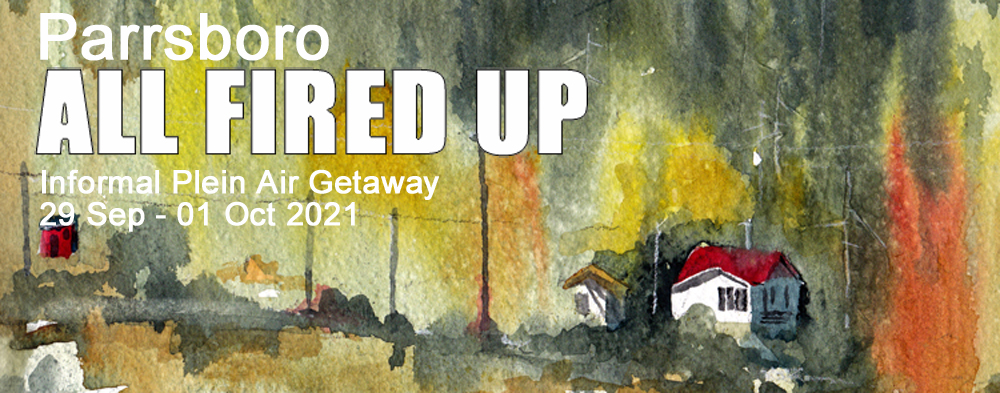
PIPAF Atlantic Edition 2021

Last week, for three days, twenty artists competed in the Parrsboro International Plein Air Festival Atlantic Edition (PIPAF).

The spectacular Parrsboro coastline offers artists great inspiration.

For the first time, Anne and I were juried in to compete alongside great talent from across the region — from Weymouth, Nova Scotia, to St Andrews, New Brunswick.

Each morning and afternoon we scattered out between Advocate Harbour to Five Islands to pick our spot and paint the landscape. One day, Anne painted inland at Newville Lake, north of Parrsboro.

I seemed to gravitate to the built (and decaying) environment. Two of my watercolours captured abandoned buildings and trucks at “Parrsboro’s Bone Yard“. Others avoided this site. Once completed, we posted our artwork online at the PIPAF website and also to our online gallery.

On Saturday evening at “The Gala”, artists’ entries were judged by the owner of Zwicker’s Gallery in Halifax, Ian Muncaster. Aside from “Best in the Show”, categories included “Best Use of Light”, “Best Seascape”, “Best Nocturne” and more.

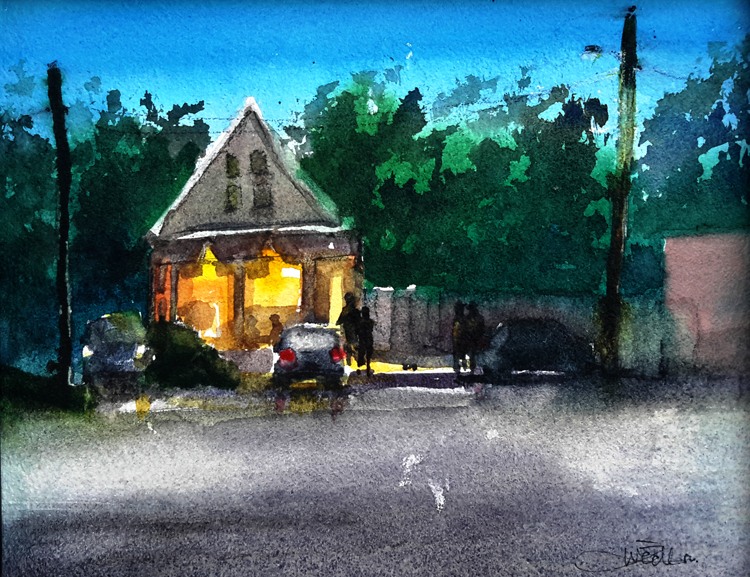
My nocturne entry, “Late Night Donuts“, was painted at night opposite Tim’s. People claim I left Anne stranded on a dark rural road to paint Partridge Island bathed in moonlight. Not true. She insisted I leave her there to paint. Her painting resulted in, “I Might Have Heard a Bear“.

Sunday, the last day of the competition, saw these twenty artists joined by others to paint in the Quick Draw event.

PIPAF 2021 Quick Draw Event attracted other artists and art lovers.

In addition to seeing our art-loving friends from the Annapolis Valley, we got to see our Halifax Urban Sketcher friends from Halifax who join in on the Quick Draw event.

While Anne and I did not win any prize, we reached an important milestone in our art journey. We were “juried in” to compete against the best in Atlantic Canada. We grew our network of like-minded artists, met new friends, discovered friendly townsfolk, and grew to love the land. So much so, that Anne booked us a cabin to return at the end of the month to capture the colours of fall in Parrsboro.

REFERENCE

PIPAF 2021 Special Edition: Anne & Edward Fine Art Newsletter XVIII
(Here, is included the full story behind “I Might Have Heard a Bear”, several of our paintings, and more.)

Posted in Art, New thinking

Mapping Nova Scotia Artists’ Plein Air Sites

Fifty-two paint-out sites are planned for this season’s plein air artists in the Annapolis Valley and HRM.

For location details, click the map link: http://tinyurl.com/PleinAirMap then click a map pin or legend.

The one valued attribute of those artists who paint outdoors, on location (en plein air) is “extended geographic memory”. We watch, listen, smell, taste and touch our surroundings — for 2-3 hours. Geography becomes imprinted. As we gain artistic skills, we paint more than what we know. We paint more than what we see. We paint what we feel.

Eric Rhoads, publisher of Plein Air magazine and Fine Art Connoisseur magazine in the USA, states that the plein air movement is currently the fastest growing art movement in the world. There are tens of thousands of plein air artists in the world. So when they reacted positively to my interactive Google map that was a big deal for me. This is probably the first such map for plein air artists in the world, and so much more is possible.

Wow, that is very cool!

— Plein Air Magazine

I wrote back to Plein Air magazine, “Thanks. I did this on my own but with the right development team in place [thinking COGS’ student project] a plein air map could be scaled globally so artists could see when and where paint-outs are located, with contact and other information. This would go a long way to network the plein air community on their travels.“. They are now looking into this further.

Reactions from elsewhere have also been very positive.


POSTSCRIPT

Not many of our readers know we have a celebrated, world-class plein air artist living in Digby, Nova Scotia; just down the road.

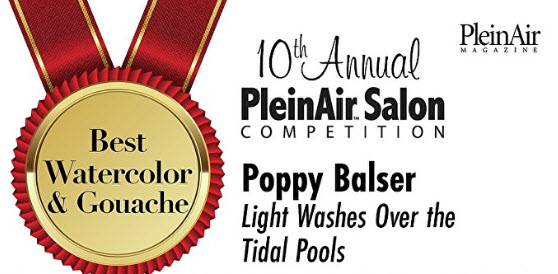
Poppy Balser recently received yet another prestigious international award. This time it was for her watercolour “Light Washes Over Tidal Pools”, inspired by her many visits to Point Prim and area.

Oh, why not toot my own horn? A website I share with Anne is located at wedlerfineart.com
95% of our work is en plein air.

Posted in Art

Artists’ view of the landscape.

Unlike photographers, geographers or geologists, landscape artists see their world as collections of lines, contours, shapes, colours, light and shadows. Identifying features is secondary.

pleinair_tupperville_10may16_90dpi_edwardwedler
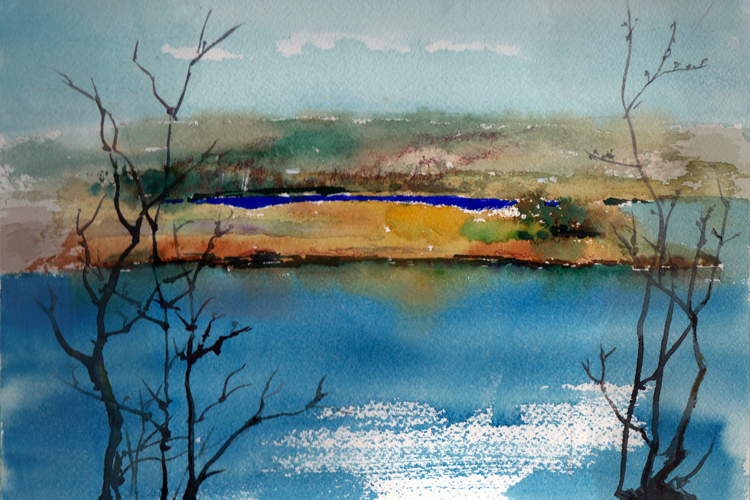
“Annapolis River at Tupperville, Nova Scotia” (watercolour by Edward Wedler)

A geographer tries to make sense of the landscape,  looking at relationships between features to explain where things are, how they came to be, how they evolve and change over time, and how they interact with us. A geologist examines the makeup of landscape to understand how it formed over millennia and how it may change in future. They want to understand how the landscape works. A photographer captures the visual character of a landscape under different lighting and weather conditions at a particular point in time on photosensitive material.

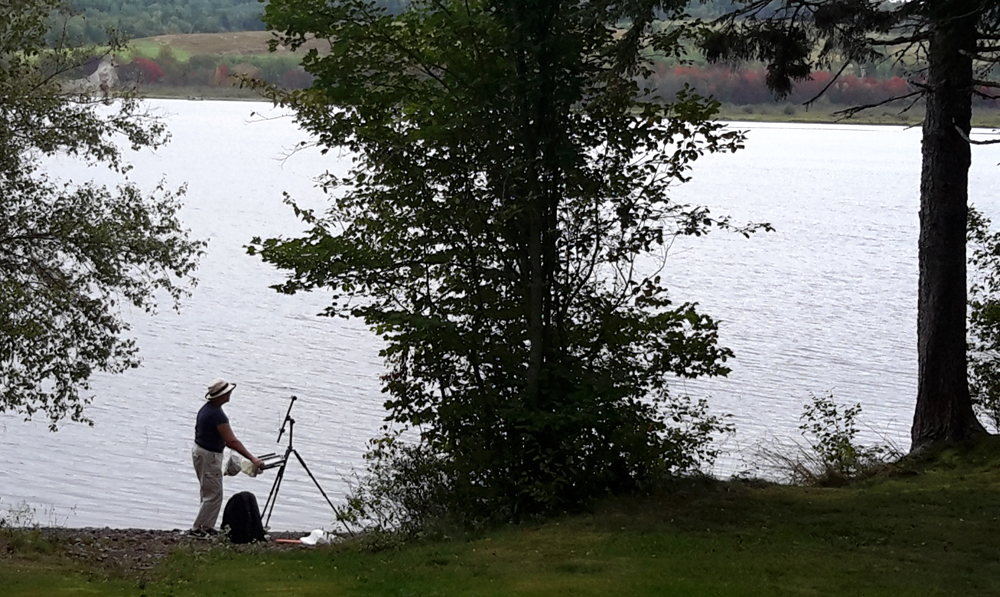
The “en plein air artist” paints on location, mostly outdoors. Each artist pulls out their materials and tools and begins to work quickly. It’s like speed dating with light and shadow. The artist will look for one or two focal points. They will look at distant, mid-ground and foreground features to figure out what to highlight and what to suppress. Often they will add to or remove elements from the scene for aesthetic/design reasons. Their view of the landscape is an interpretation perhaps in oils, watercolours, acrylics, pastels, pen and ink, or graphite. The plein air artist also seeks to elicit an emotional response to the art of their immediate environment. I consider the geography of the plein air artist as the geography of perception.

The Annapolis Valley Plein Air Art group, to which I belong, paints landscapes throughout our area — towns, farmlands, and coastal waterways. Each week we assemble at a different “paint-out” site. At the one site, some will paint details of rocks in a stream bed. Some will paint tourists enjoying the sunshine on benches along a path. Some will paint distant hills framed by woodlots. The landscape becomes a collection of deeply personal, visual expressions and no two paintings or sketches are the same.

What can we learn from interpreting the landscape through artists’ eyes? One of my mentors, Vlad Yeliseyev, is often heard to “rant” to plein air artists, “Don’t paint a photograph. Paint a story.” Local Digby artist, Poppy Balser states in her profile “Watercolour is the perfect medium for me to capture the atmosphere and light of my local environment.” In his book “Interpreting the Landscape in Watercolor”, Don Andrews illustrates the magic of linking light, shadow and colour”. For me one artist may see a tree as blue, nestled in the cold shadows. Another may see the same tree as olive green, absorbing scant rays of sunshine peaking through breaks in the clouds.

Unlike the photographer, geographer, or geologist, the artist is the landscape’s chorister; composing a visual libretto.