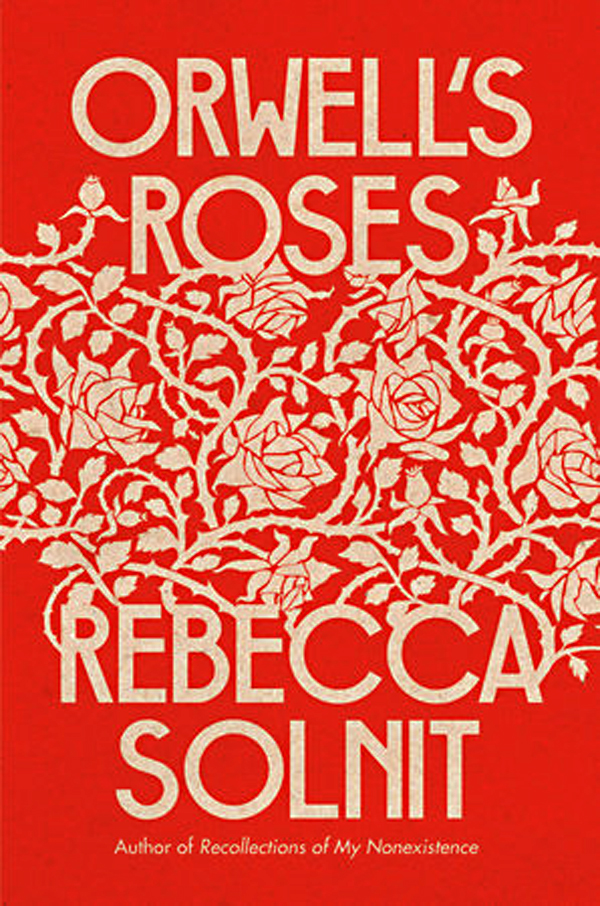
At the end of October 2021, Heather and I were driving to New Glasgow. We listened to an interview with Rebecca Solnit on her new book, Orwell’s Roses ( see blog post November 2, 2021). On our return I went to the Lawrencetown library and put in a request. It arrived here last week. I had time to read it in New Glasgow this weekend.
For the first time, I gained an appreciation for the life of Eric Blair (George Orwell). Born in 1903, in North India, he died from TB in 1950. At 13 years of age, he went to Eton for four years, then joined the Burmese police for five years; left in 1927. Subsequently, he wrote a number of books, including Down and Out in Paris and London (1929), The Road to Wigan Pier (1937), Homage to Catalonia (1938), Animal Farm (1945), Nineteen Eighty Four (1949). For more details, you can Google ‘George Orwell’ his pen name that he assumed in 1935.
The theme of Solnit’s book starts with Orwell’s relationship to the English garden, and her discovery of roses at a cottage in Wallington, Hertfordshire, he planted in 1936.

It ends with his life at Barnhill on the Eastern shore of the Jura peninsula, in the Hebrides in 1949. In between, Solnit explores his writing within the context of England between 1930-1950, including the Spanish Civil war and the Second World War.
Of course, her text is particularly relevant, as we see the happenings in Ukraine. Here is her concluding paragraph.
”Orwell’s signal achievement was to name and describe as no one else had the way that totalitarianism was a threat not just to liberty and human rights but to language and consciousness, and he did it in so compelling a way that his last book casts a shadow or a beacon’s light – into the present. But that achievement is enriched and deepened by the commitment and idealism that fueled it, the things he valued and desired, and his valuation of desire itself, and pleasure and joy, and his recognition that these can be forces of opposition to the authoritarian state and its soul-destroying intrusions.The work he did is everyone’s job now. It always was.” p.268.
This week, I received two items of feedback to my blogs. From Sandra Barry, a link to Bored Panda that shows a variety of interesting maps. From Klaus and Shirley Langpohl, a link to a video of Stephen Talbott’s presentation to the Nature Institute ’Gestures of a Life’. A thought provoking commentary on present day scientific method.
Postscript
My blog title Ernest Blair Experiment is a tip of the cap to Ernest Buckler and Eric Blair.
Acknowledgements
Thanks to Jaki Fraser for bring in the Rebecca Solnit book. To Sandra Barry, and Klaus and Shirley Langpohl, for sharing their readings. Edward contributed the graphics. Heather shared the New Glasgow travels.
References
Rebecca Solnit, 2021, Orwell’s Roses, Penguin Books.
Gestures of a Life, Stephen L. Talbott, The Nature Institute.

 Ernest Blair Experiment
Bob
Agreed on the Solnit book. Do you know “A Paradise Made in Hell”? (I think that’s the title.) In it she talks about how people come together in disastrous times. Also applicable to the Ukraine situation.
Brian
Brian Arnott Principal Novita Interpares | Leaf + Branch
novitainterpares.ca
>
LikeLike
A Paradise build in Hell. I will see if I can get it from the library.
Bob
LikeLike