Posted in Uncategorized

Venn Diagram

In ‘The Story of COGS’ I use a Venn Diagram of three intersecting circles to show the intersection of Concepts, Technology and Applications. At the intersection we have collaboration, projects and partnerships (see posts Background Story to the COGS and CCA Relationship and Tour de COGS).

This came to mind yesterday, as I was reading my emails.

From GoGeomatics Canada, Chris North had written an article ‘ The GIS industry at an Existential Crossroads’. I remember Chris from his twenty years with Esri Canada.

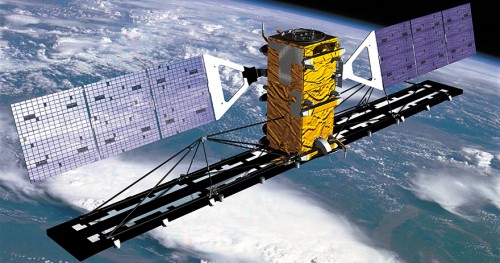
The second email was a notice from Esri Canada about a webinar on June 19 ‘ Sky bound solutions. Drones revolutionizing AEC practices.’.

AEC stands for Architecture, Engineering and Construction. In essence, it is the application of GIS to the ‘ built environment’.

From my opening slide ‘ Fifty years of GIS and RS at COGS’, it shows me on our ‘walk to Georgetown in 2013. The message is simple. You have to ‘walk the talk’.

In this case, walking from Yarmouth, NS on the Rails to Trails to Georgetown , PEI to attend a conference on rural economic development in Atlantic Canada. To join Zita Cobb and others in the celebration of living in rural communities.

The message is also true from Edward Wedler. In the same time frame, he invented the venue ‘Ride the Lobster’, an 800km unicycle relay race around Nova Scotia (i.e. ‘the lobster’)

One final link, from Maria Popova, I received my weekly newsletter. The Marginalian. June 9, 2024.
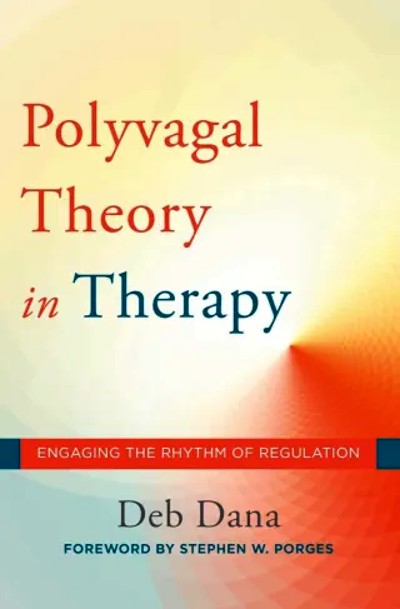
Today, it was ‘Polyvagal theory and the neurobiology of connection’. Check it out.

References

Bob Maher and Heather Stewart, 2014, The Story of the College of Geographic Sciences: A Nova Scotian experiment in Technical Education.

Posted in Uncategorized

Red, White and Blue

We have been away for a few days in New Glasgow. It is good to get back to the gardening. The sunshine with the occasional shower has been good for the flowers: rhododendrons, wisteria and lupins.

In essence, Red, White and Blue; the colours of the Union Jack.


Today, I went into COGS to meet with David MacLean. Since I only have the resources of my iPad, I don’t have-access to software to create slides for the CSRS keynote presentation next week. With significant help from both David and Edward, they were able to master the complexities of the Google world.

Introductory slide from my CSRS presentation

Even using my iPad at COGS, I needed to bring my cell phone to obtain an access code to the Internet. Oh, the joys of keeping up with technology.

In presenting Fifty years of GIS and RS at COGS, I have been able to witness the changes in technical education at a rural institution. It remains a remarkable story.

Besides the technological changes, we have witnessed significant changes in the philosophy of education, especially in relationship to an aging population. The other key factor is the change in our relationship to the landscape and the community. Fortunately, there have been a number of writers who have reflected upon these relationships

Posted in Uncategorized

GANS AGM

This week (Thursday, May 30), I attended the Annual General Meeting of the Geomatics Association of Nova Scotia at the ESRI Canada office in Bedford.

I received their 2024 Award of Distinction. Their motto is ‘location matters’.

Simeon Roberts invited me to give a ‘dry run’ of my CSRS presentation ‘Fifty years of GIS and RS at COGS’. To be delivered in Halifax in June.

Of particular interest to me was the concern of GANS on education. This has been heightened by the cancellation of GIS programs (among other programs) at SSFC (Sir Sanford Fleming College) in Ontario and at RRU (Royal Roads University) and Vancouver Island University (Masters Program) in British Columbia. Their closure appears to be the result of the federal reduction in funding for foreign students coming to Canada. GANS expressed the concern of the possibility of increased competition, elsewhere in Canada for COGS graduates.

To counteract the shortage of qualified GIS/RS professionals, we must better understand that ‘geography matters’ to address the issues of climate change across the vast, diverse landscape of Canada. We need a better understanding of our geography and access to appropriate training in the related technologies of GIS and RS. This will likely require input from the Canada Centre for Remote Sensing (CCRS), as well as the GIS community at the federal level. We need the equivalent of CACRS (Canada Advisory Committee on Remote Sensing) — a CACGIS ( Canada Advisory Committee on GIS).

Useful Online and Related References

Ellsworth LeDrew and Robert Ryerson, The Evolution of Remote Sensing Education in Canada’s Universities and Colleges: Decades of Innovation and Expansion, Canadian Journal of Remote Sensing, Vol 49, 2023, Issue 1

Robert Maher and Heather Stewart, 2014, The Story of COGS (https://thestoryofcogs.ca/)

Check out Robert Maher’s blog site. ernestblairexperiment.wordpress.com

Visit the GoGeomatics online magazine

Posted in Uncategorized

Technological Barriers

In 1977, George Argus at the Canadian Museum of Nature invited the author to join his Rare and Endangered Plants Project in Ottawa (see posts Enlightenment and Biogeography). Both Patrick and Andrew were born at the Ottawa General Hospital.

Move forward to today.

I discovered a copy of a short commentary by George in the Environmental Monitoring and Assessment Journal tucked away in my bookcase. The title is Technological Barriers.

The computer seems to be the ‘magic bullet’ that will solve our communication problems and will permit us to turn around the environmental crisis in the next decades. The use of Geographic Information Systems to put our problems into some kind of geographic perspective, holistic modelling to see the big picture and expert systems to train cadres of ‘village ecologists ‘ who will keep watch on the ecosystem in which they live. I don’t believe it will work.’

Remote Sensing is an effective way to gather data on a macro scale level. The need however for extensive ground truthing and continuous examination of assumptions cannot be overemphasized.

In the face of problems such as world overpopulation, our undeterred rush towards more and more consumerism now being clothed in ‘green rhetoric’, the continued exploitation of the natural world, and the measure of everything in economic terms, the technological barriers to environmental information seem trivial.

Although these technological barriers are not completely clear, I have a feeling that their solution will involve grappling with three other problems: politics, education and money.’

Heather and I have fond memories of our time in Ottawa. From a work perspective, it produced two publications. The Rare Vascular Plants of Nova Scotia, and the Rare Vascular Plants of Saskatchewan.

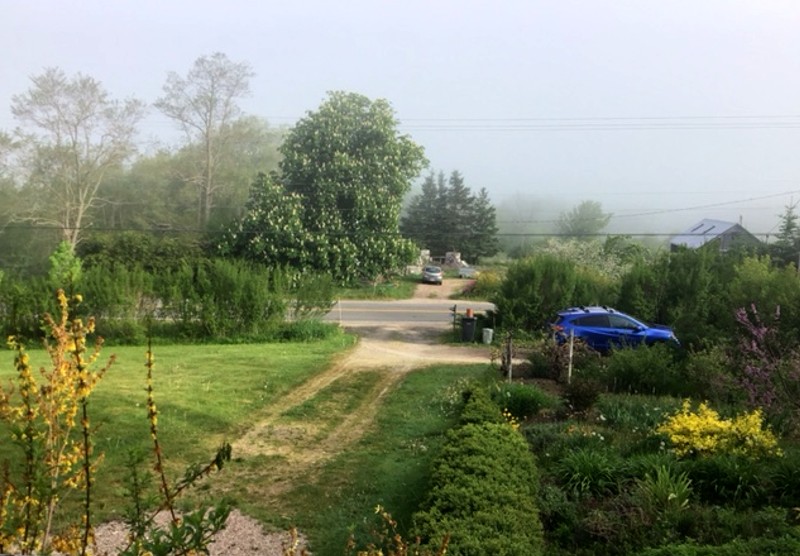
Today, I look across the road at the flowering horse chestnut tree. I remember George, the beekeeper and willow (Salix) expert, being impressed by the diversity of bees on the tree (see post The Bookshelf )

I believe that George’s comments on technology are even more true today.

References

G. W. Argus, 1992, Technological Barriers, Environmental Monitoring and Assessment Journal, v 20, p.175-177.

R. V. Maher, David White, George Argus and Paul Keddy,1977,The Rare Vascular Plants of Nova Scotia, 37 pp, Syllogeus 18, Published by the National Museum, Ottawa.

R. V. Maher, George Argus and Vernon Harmes, 1978, The Rare Vascular Plants of Saskatchewan, 42 pp, Syllogeus 19, Published by the National Museum, Ottawa.

Posted in Uncategorized

Living in Place

This week, (May 22,2024) we held a meeting of the Ernest Buckler Literary Event Society (EBLES).

Jane Borecky, Anne Crossman, myself and Heather Stewart met at John Montgomery’s house in Bridgetown. Our motto remains Reading where we live: A Celebration of Local Writing (read posts Eccentrics, in Paradise, Authors Among Us, and EBLES Meeting).

Once again, I went to my bookshelves. I found the EBLES program for Saturday, June 3, 2017, at the Bridgetown Legion and one for Saturday, June 29, 2019 at the Temple on Queen. Somewhere, there is a program for the West Dalhousie Community Hall event for Saturday, May 19, 2023.

While browsing, I found a newsletter from the Elizabeth Bishop Society of Nova Scotia (Summer 2012) plus a self-guided tour of Elizabeth Bishop ‘s Great Village. It amuses me that both Ernest Buckler and Elizabeth Bishop share the same initials EB (read posts The Pastoral Economy and Geography III: Place Writing and Maps)

Two other finds.

The Nova Scotia Policy Review (2008, 2009) and Coastlands (2009, 2011), edited and published by Rachel Brighton, a resident of Bridgetown (read post Bring Back Coastlands).

MapAnnapolis Community Mapping project (read post Mapping Annapolis County)

About us:

Community-created asset maps are based on the premise that local residents possess expert knowledge of their local environments which can be expressed in a geographical framework which is easily understandable and universally recognized. Participatory maps often represent a socially or culturally distinct understanding of landscape and include information that is excluded from mainstream or official maps.’ Map Annapolis.

EBLES continues to support both the West Dalhousie and Centrelea communities. This seems appropriate: The Mountain and the Valley is important to David Manners (see post The Curious Mind), Ernest Buckler and those of us interested in the literary legacy of this part of the Annapolis Valley.


This week spent time financing property in Middleton. Changed our bank from Scotia Bank to Credit Union. Despite its name, Scotia Bank is not serving the needs of Nova Scotians in rural areas, closing branches in Annapolis Royal and Bridgetown.

Acknowledgements

Thank you John Montgomery for the hospitality. Jane Borecky and Anne Crossman for their hard work. Heather Stewart, for sharing the load.

References

Rachel Brighton, 2009, Coastlands: The Maritimes Policy Review, Vol 3.1, An ethical look at agriculture.

Rachel Brighton, 2011, Coastlands: The Maritimes Policy Review, Vol 4.1. Feast to Famine.

Claude Bissell, 1989, Ernest Buckler Remembered. University of Toronto Press.

David Manners, 1941, Convenient Season, Dutton Press.

Posted in Uncategorized

Newspaper Clippings

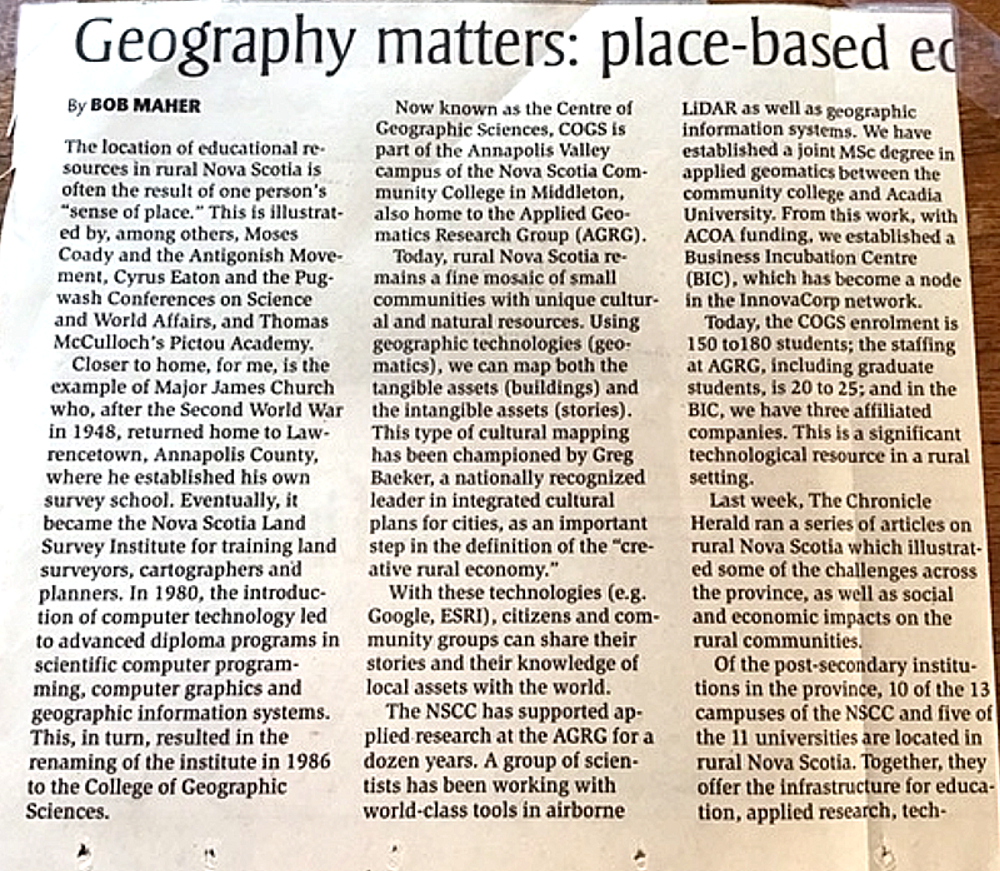
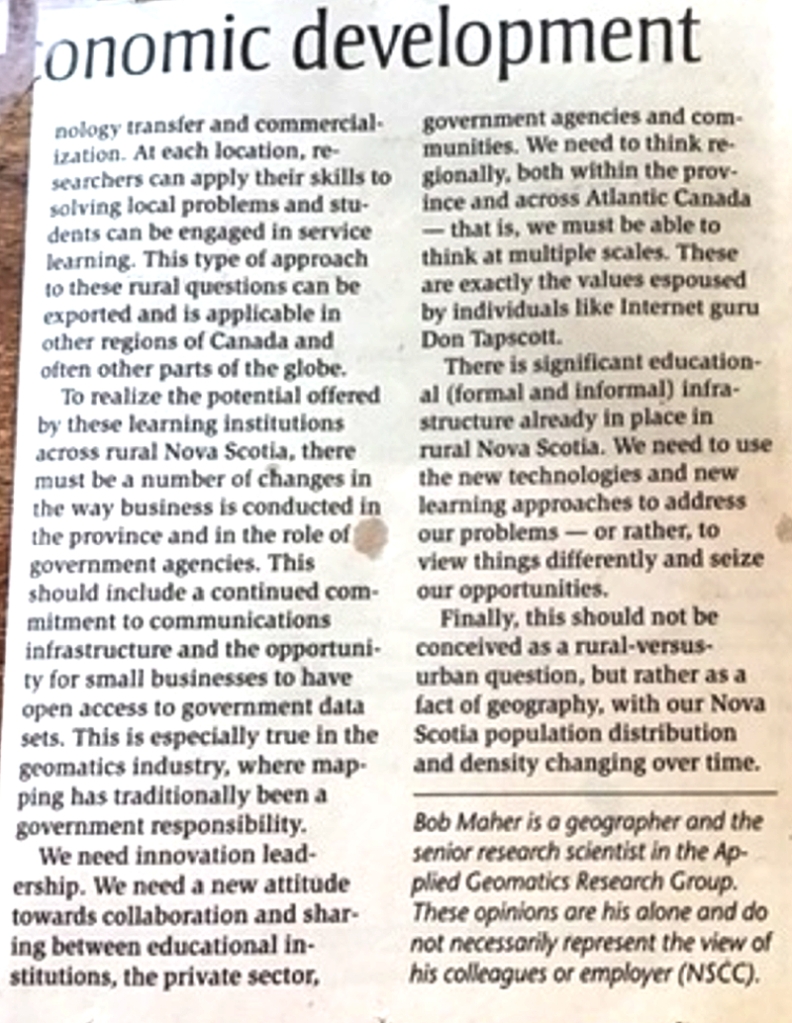
One of the surprises that comes from Decluttering is the discovery of old newspaper clippings. I found the following four articles from the Annapolis County Spectator of interest. All written by the author.

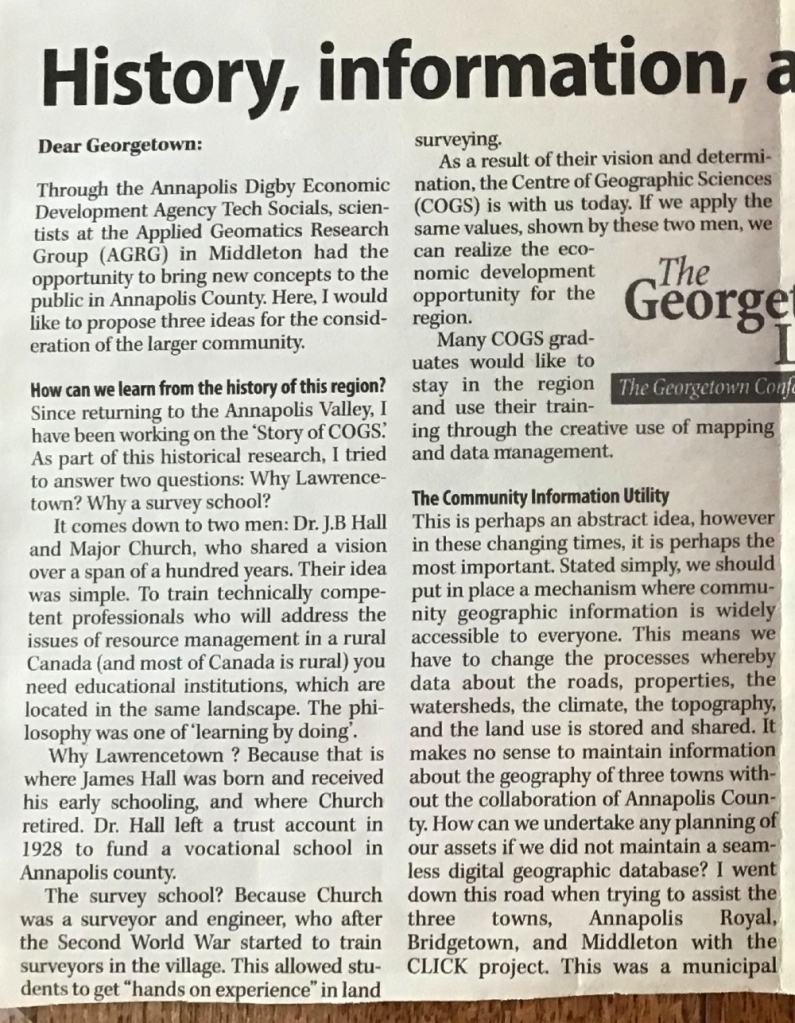
1) Geography matters: place-based economic develop. October 29, 2011
2) Geography, technology and scale. October 11, 2012
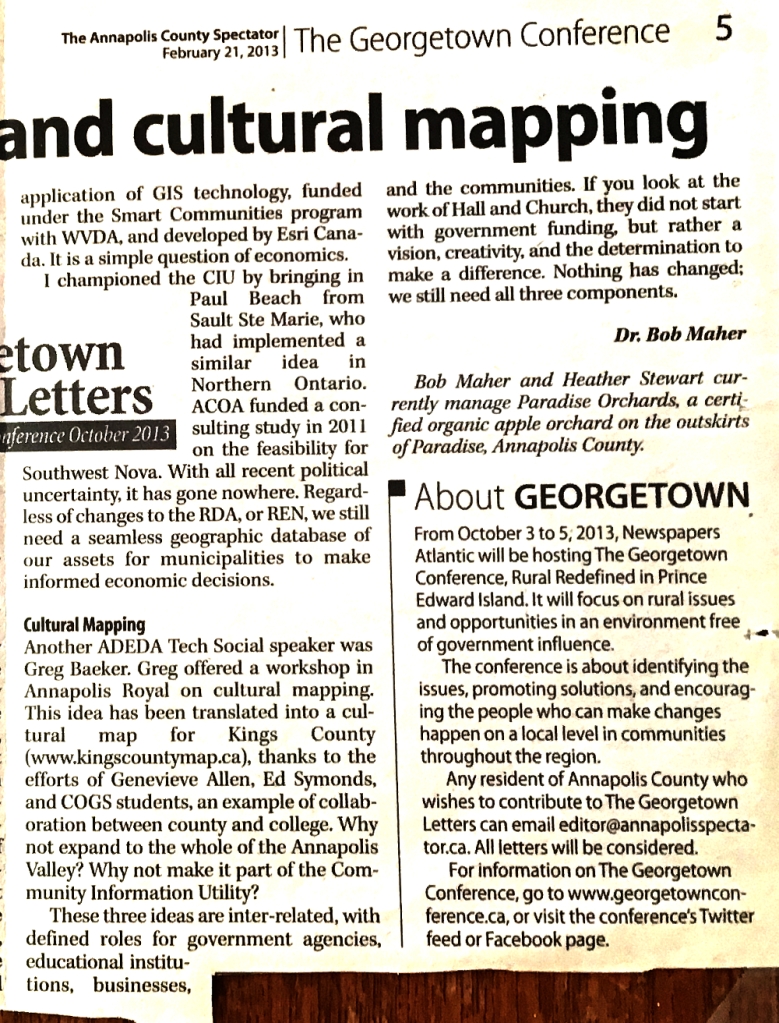
3) History, information and cultural mapping. February 21, 2013.
4) Connecting the stories. October 21, 2013.


GEOGRAPHY MATTERS ARTICLE

It is significant that the NSCC fired the author, Chris Hopkinson and Jeff Wentzell on November 22, 2011 (after the first article was published).


HISTORY, INFORMATION & CULTURAL MAPPING: GEORGETOWN LETTER ARTICLE


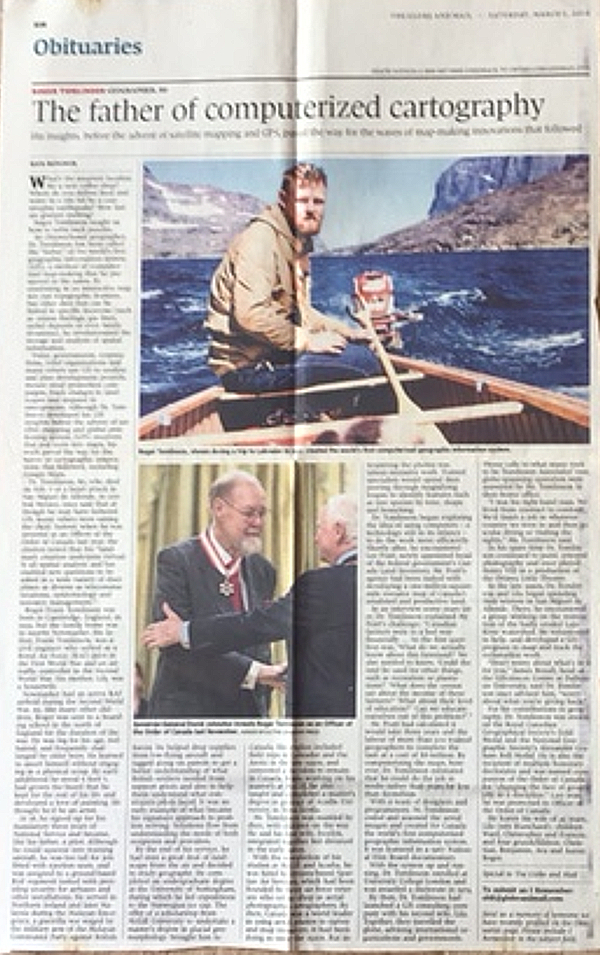
On a different note, I found the obituary for Roger Tomlinson, the Father of Computerized Cartography; a full page in the Globe and Mail, Saturday March 1, 2014.

It includes a photograph of Roger conducting field work in Labrador in 1957.

The author was in Labrador at the McGill Sub-Arctic Research Lab in Schefferville conducting field work in 1964-65. He completed his B.Sc. Honours thesis ‘ A Biogeographical Study of the Shoal Lake Area, Labrador’ at the University of Birmingham, UK.

ROGER TOMLINSON OBITUARY ARTICLE

Posted in Uncategorized

Decluttering

These last couple of weeks I have been Decluttering our house and my mind. We have decided to move to Middleton where we can walk to the grocery store, health services and the bank. Philosophically, we want to increase our level of walking and decrease jumping in the car to buy the necessities of life.

At the same time, in preparation for a talk on ‘Fifty Years of GIS and RS at COGS’ I have been Decluttering my mind.

A third dimension is going through the book cases, determining which books that I likely won’t re-read. They can go to Endless Shores in Bridgetown. Thank you, Jennifer Crouse.

Two books did demand my attention.

The first is David Orr’s “Earth in Mind: On Education, environment and the Human Prospect“. This fits well with my thoughts on future education at COGS.

The second, Theodore Roszak’s “The Making of an Elder Culture: Reflections on the Future of America’s Most Audacious Generation“. In this case, I would focus on being an elder in Canada.


Next week, I am scheduled to speak at the Geomatics Association of Nova Scotia (GANS) AGM. It will be a chance to test out a few ideas before the Canadian Society for Remote Sensing (CSRS) keynote talk in June.


As the post-war boomer generation reaches eighty it seems appropriate to declutter life. This means simplifying, identifying core values, and looking at the larger issues of our generation (e.g. climate change).

Posted in Travel

Another Blue Sky Day

On Tuesday, Heather and I took a drive up the Valley. The first stop was Tides Art Gallery in Kentville. Unfortunately, they are closed on Tuesday. Instead, We stopped in at Gaspereau Press.

I picked up another Plague Year Reader, recently published excerpts in 2023. It included Sea Run: Notes on John Thompson’s Stilt Jack by Peter Sanger.

Our final destination was the ArtCan Kitchen & Studios café for an early brunch. I remembered their excellent home made soup and bread. The cafe in Canning overlooks the Gaspereau River. Besides art books and supplies, they had for sale books by Dick Groot (Geographer) and Soren Bondrup- Nielsen (Ecologist).

On our return trip, we took the backroad (Hwy #221) through orchards and vineyards. On a blue sky day the fields which had been recently ploughed, were shining bright.

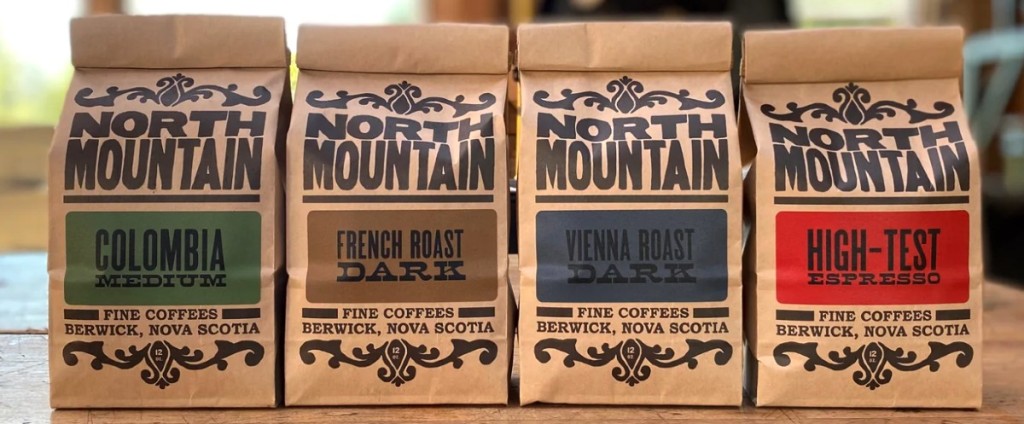
Last stop: Berwick, at North Mountain Fine Coffees, I refurbished our supply of ground, French Roast Dark beans.

Postscript

This weekend, I rediscovered Theodore Roszak in the bookcase and am re-reading The Making of an Elder Culture; very relevant today.

I found the latest issue of The Canning Gazette. Spring and Mud are Here.

Acknowledgements

Edward added the graphics and links. Heather shared the drive.

References

Gaspereau Press, Gary Dunfield and Andrew Steeves, 2023, Yet Another Plague Year Reader.

Soren Bondrup- Nielsen, 2014, Merging: Contemplations on Farming and Ecology from Horseback, Gaspereau Press.

Dick Groot, 2012, Come From Away: Artists of Minas Basin. A documentary of a little known migration.

Theodore Roszak, 2009, The Making of an Elder Culture, New Society Publishers.

The Canning Gazette, April 2024, Issue 439, Jodi DeLong, Editor.

Posted in Nature, Travel

Blue Sky Day

Friday, we decided it was time to return to Kejimkujik National Park and walk the Peter Point trail. It was a remarkable adventure.

The park remains closed and so the roads to Eel Weir and the trail were unoccupied. We only saw one couple from Maitland Bridge walking their dog.

What a splendid day ! No traffic on Highway #8 between Annapolis Royal and the Park. In the sky, we could see the con-trails of aircraft, flying between the Maritimes and New England.

After the exhilaration, we stopped at the Brown Dog Kitchen. It is operating under new management. We enjoyed a coffee and curry puffs. Two per serving.

In the Library, I found “Dropped Threads: What We Aren’t Told” edited by Carol Shields and Marjorie Anderson on the used bookshelf. For Heather, Spinach and Swiss Chard seeds.

Saturday, we returned to the Library to hear Claire Jimmison. It is part of the 2024 Speaker Series, sponsored by the Friends of the Annapolis Royal Library.

Acknowledgements

Heather shared the bliss of the Peter Point trail. Edward added the graphics and links.

Reference

Carol Shields and Marjorie Anderson (ed), 2001, Dropped Threads: What We Aren’t Told, Vintage Canada.

PS
We are blessed with access to a National Park, especially in the off-season, before visitors arrive in May.

Posted in Common Place, Nature

Red and Blue

Some days are defined by external events, others by small coincidences. Heather has been putting out sunflower seeds for the birds, along the deck railing. This morning, we were treated to a beautiful display from the Red Cardinals and the Blue Jays.

Otherwise, the day was by defined by the appointment at Honda in Kentville, to change to Summer tyres.


Anne Crossman forwarded a link about land ownership on Haida Gwaii, bringing back good memories (read posts Reaching Out, A Short Story, Lessons From Haida Gwaii Part 1, and Lessons from Haida Gwaii Part 2).

Landmark deal recognizes Haida Nation’s title over Haida Gwaii
The Canadian Press | Posted: Sunday, April 14th, 2024 8:15 PM | Last Updated: April 15th

John Wightman forwarded an aerial photograph (image taken by The Valley Eye) of the construction site for the new Mountain Lea residence in Bridgetown.

Edward shared a link to “Work in the Age of Artificial Intelligence”, an online seminar hosted by the Brookings Institute in the USA.

At the end of the Day, I could not resist a photograph of the Scilla, flowering amongst the lupin leaves.

Surely, Spring has arrived; followed by the tick season; and then the lady-slipper orchids.

Acknowledgements

Thanks to Anne Crossman, John Wightman and Edward for their emails. Heather encourages the bird life in the backyard.

References

Haida Gwaii
Mountain Lea
AI and work