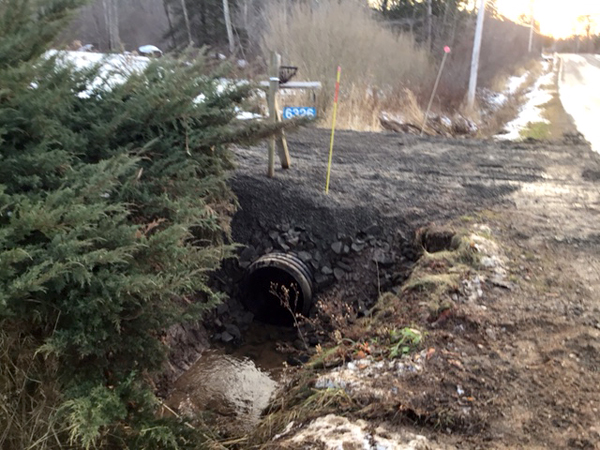
A week ago we noticed that one of the culverts to our driveway needed repair.
We decided it was time to ‘winterize’ the property in Paradise.
We wanted to ensure that the various systems were functional: security, telephone, Internet etc. If we wanted oil delivery in Winter, the culvert needed to be replaced.
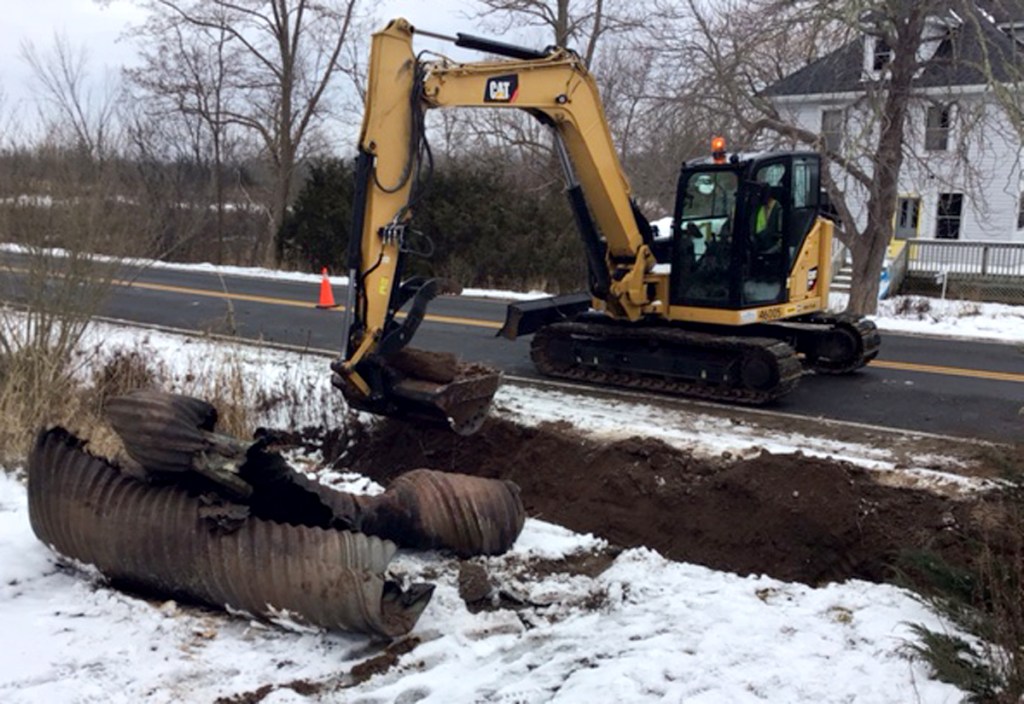
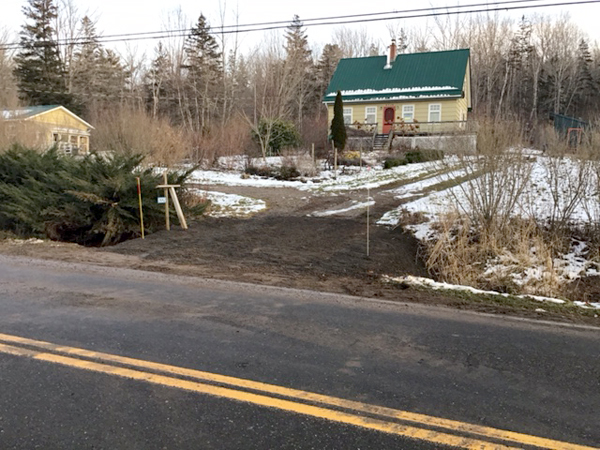
Last Thursday, we stopped at the Transportation office in Middleton. Heather explained our circumstance. That same afternoon, the staff made a site visit. Next day, early they arrived with back hoe, a replacement culvert and gravel fill.
By early afternoon, it had been repaired. We were both impressed and thankful.
Imagine, if we could achieve the same level of response on health services.
We have been in Halifax for over three months, and negotiated with specialists for aftercare, after heart surgery. This includes hearing tests, swallow tests etc. If we could connect with referral services in the Annapolis Valley this would allow us to live in our house in Paradise.
During our stay in Paradise last week. We were able to meet with Paul and Ruth Colville at the Capital in Middleton for lunch and conversation. We also visit Anne and Bill Crossman in Annapolis Royal for a similar exchange of views on health services in Annapolis County. It is critically important to maintain these contacts and to share experiences.
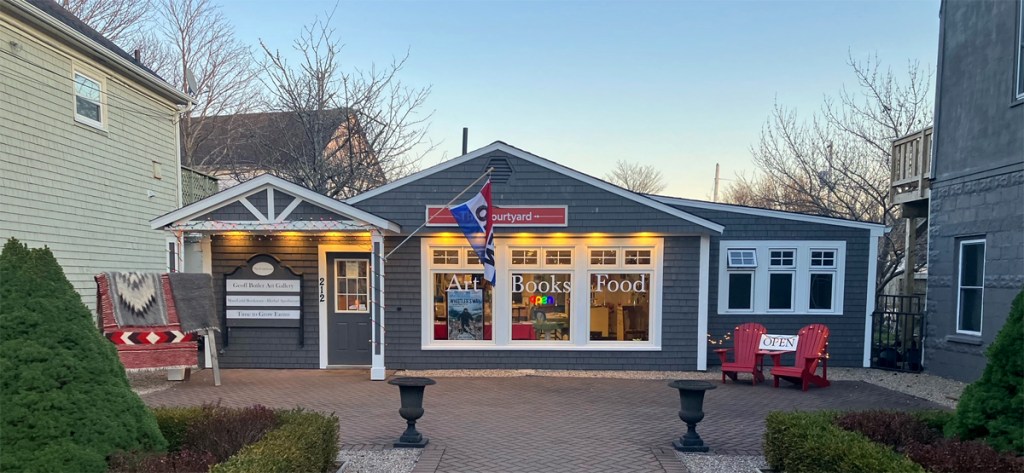
From Jane Nicholson, I have heard about Russell Florens bookstore at 212 St. George. A partnership with Geoff Butler and a baker named Denise. All non-fiction books. Next time, we are in the Valley, we will visit The Courtyard – Art, Books and Food.
Acknowledgements
Paul and Ruth Colville, Anne and Bill Crossman shared theirAnnapolis County experiences. Jane Nicholson for information on the bookstore. Edward added the graphics. Staff at the Middleton Transportation office for their rapid response and kindness.
I received only one book this Christmas, from Patrick, “Life Lessons from the Ocean: Soothing Wisdom from the Sea”,written by Richard Harrington, a British Marine Biologist, and illustrated by Annie Davidson,
”From learning to go with the tide, to taking inspiration from starfish about how to handle setbacks, the book contains a lesson for everyone.”
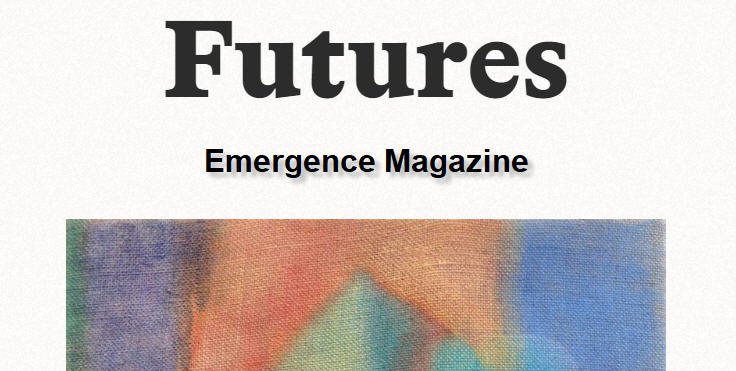
Barry Lopez died Christmas Day 2020. In the current online Emergence Magazine, Jeremy Seifert gives us the film ‘Horizons’, a tribute to Barry’s life and work.
“Barry shares what drove him towards new horizons so that he might help our culture find balance with the living earth.”.
Postscript
This morning on our walk, we rediscovered Lil MacPherson’s restaurant “The Wooden Monkey”
Brings back memories.
References
Alex Bruce, 2022, Building a better Bridgetown, Saltscapes Vol 23 No. 6. p.26-30.
Richard Harrington, 2020, Life Lessons from the Ocean: Soothing Wisdom from the Sea, LOM Art. Illustrated by Annie Davidson.
Jeremy Seifert, 2022, Film Horizons, in Emergence Magazine, Our Year in Review.
It brought back memories of my travels to Alaska, after completing field work in the Canadian Rockies in the early ‘70’s. Merton died in Bangkok in 1968.
The book includes essays on ‘Community, Politics and Contemplation’, ‘Prayer, Tradition and Experience’ and ‘The Life that Unifies’.
The book provides background to the recent Emergence Magazine article ‘On the Road with Thomas Merton’ by Fred Bahnson. Within the article, there is a link to a film by Jeremy Seifert, under the same name.
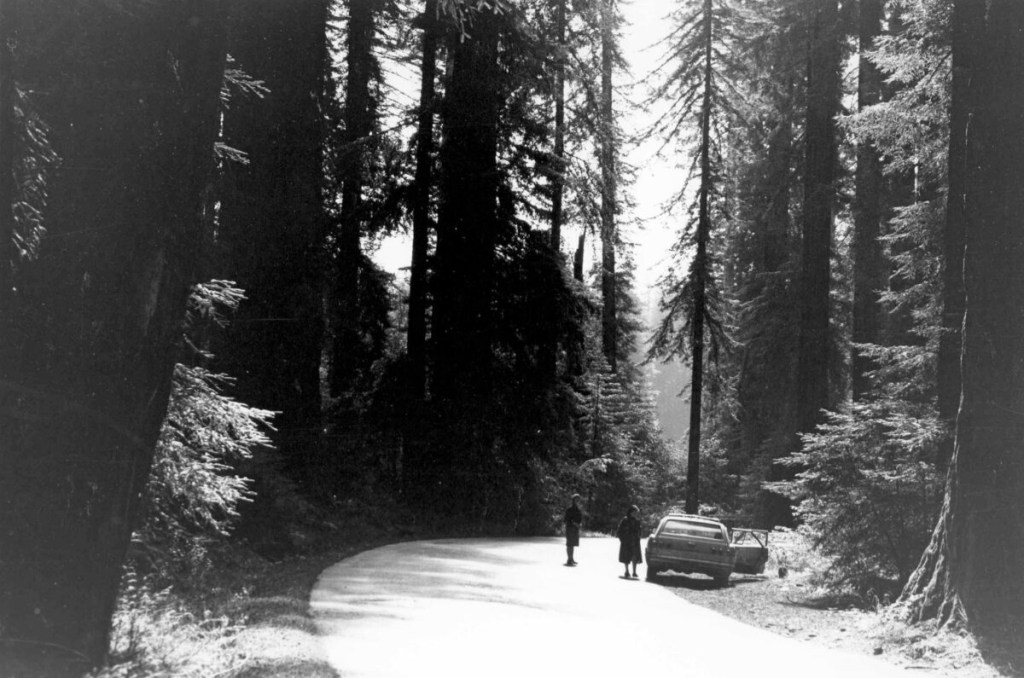
”In May 1968, Christian mystic Thomas Merton undertook a pilgrimage to the American West. Fifty years later, filmmaker Jeremy Seifert set out to follow Merton’s path retracing the monk’s journey across the landscape. Amid stunning backdrops of ocean, redwood and canyon, the film features the faces and voices of people Merton encountered.”
Source: Emergence Magazine (photo by Thomas Merton: California 1968)
”The film shares a remarkable geography, as well as the perceptions of Merton who took his first extended trip away from Gethsemani Abbey, his monastic home in Kentucky.”
This week, I received the 2023 calendar from Esri Canada.
Image Source (front and back covers): Esri Canada, Marketing Communications
The new calendar includes a map of “Sable Island” by Lost Art Cartography (November 2023), “Marine Stewardship” initiative by MakeWay (December 2023), and “Old Growth Forest” for the Indian River watershed (March 2023).
This week, I also received the Year in Review from Shorefast, Fogo Island. Programming highlights include ocean stewardship, community hub, diversifying our economy, Art and Climate Change, and Network building to strengthen community economics.
At Bookmark, I found three chap books by local authors, FOR FREE, under their Readerity program.
Alexander MacLeod. Re-reading J.M. Barry’s Peter and Wendy. Deidre Kessler. Indigo Bunting in a Date Palm. Sheree Fitch. A child with a book in a tree.
Finally, at the Halifax Public Library today, discovered Oliver Sacks, The River of Consciousness. Ten essays were outlined in the two weeks before his death. They include Darwin and the meaning of Flowers, Sentience: the mental life of plants and worms, the Creative Self, and the River of Consciousness.
While recovering from my heart surgery, I am enjoying excellent medical support in the city. Over the Christmas period, we shall have to evaluate the two communities: rural and urban. For now, we appreciate the connections in the urban environment.
Today, after my visit with Dr. Morris, by draining the fluid in my inner ears, I have recovered my hearing. We celebrated with lunch at the Daily Grind, a coffee shop, near our condominium at Bishop’s Landing in Halifax.
Earlier in the week, we took a drive down to the Valley. We managed to arrange for a car service and to pick up our snow tyres.
En route, we stopped at Berwick, a progressive small town in Kings County, which may offer possibilities of condominium living at a lower cost than Halifax, although likely without the medical expertise found in Halifax.
Stopped to say ‘hi’ to Debby and Rocky Hebb. We did manage to go to the Endless Shores in Bridgetown. They had “Iceland: A Simple Saga” as told to Peter Wyman. After reading his previous books, I found this one, rather disappointing.
It was 1980 when I joined the Nova Scotia Land Survey Institute (NSLSI) to teach Scientific Computer Programming (SCP) with Bruce Peveril. Bruce was primarily responsible for computer languages. I was responsible for the applications. The administration at the Institute had recognized the need for computer technology in their current programs.
Over the next few years, we added Business Computer Programming, Computer Graphics, GIS programming, and Business Geographics. By 1986, we had three departments: Computer Programming, Cartography and Planning, and Surveying. It was time to change the name from Land Surveying to Geographic Sciences, thus the College of Geographic Sciences (COGS).
In terms of content, there was recognition that there was new software for GIS and Image Analysis. Edward Wedler was teaching Remote Sensing, along with Manou Akhavi. It was important to be able to customize the software. The relationship with the private sector included ESRI, DIPIX, and later PCI. The second realization, reflected in the curriculum, was major cooperative projects with industry and government partners. These projects demonstrated the application of technology to real-world problems, including Forestry, Geology, Statistics Canada, Health Sciences, and more.
The emphasis was on geographic science, and less on technology. Over time, there were changes in the academic community; Surveying, with its link to the University of New Brunswick, became more aligned with Geomatics Engineering.
My background is a Ph.D. in Biogeography under Dr. Michael Goodchild at the University of Western Ontario and later teaching at the Memorial University of Newfoundland in the Geography department. Geographic Science encompassed Physical Geography, Human Geography, Cultural Geography, Historical Geography, Economic Geography, Fisheries Geography, and Cartography. Through John Wightman, Vice-Principal at COGS, we were connected to Roger Tomlinson,’ Father of GIS ‘ in Canada.
After the Centre of Geographic Sciences (COGS) became part of the Nova Scotia Community College (NSCC), the emphasis was more on technology and less on the landscape. Surveying remained focussed on property boundaries. I left COGS and joined the Dalhousie EMDI project in Indonesia, subsequently, joined ESRI in California and later the Ontario Ministry of Natural Resources, working with Sir Sanford Fleming College on GIS education with Tim Easley.
When I returned to COGS in 2000, the emphasis was on Applied Geomatics research. This was a period when the focus shifted more toward technical employment skills.
What is the situation at COGS today?
a) are there still three departments? Computer programming? Cartography and Planning? Surveying?
b) do we still teach the application of geographic technologies to a wide range of landscape issues?
c) what has happened to the use of GIS technology in municipal planning, health planning, agriculture, forestry, and biodiversity studies?
d) do students still undertake projects with business and government agencies on the best application of these computer-based technologies to the landscape (seascape)?
e) what has happened to our knowledge of the landscape? To the different cultures and species who share this landscape? What are the impacts of climate change?
Postscript
We were at the Bookmark on Spring Garden Road, Halifax. Heather bought me an early Christmas present. Barry Lopez, posthumous book of essays,’ Embrace fearlessly THE Burning World’. Last night, I read the essay, ‘An Intimate Geography’. At the same wonderful store, I found the Harry Thurston poem ‘Icarus, Falling of Birds’, photography by Thaddeus Holownia.
’On the night of September 13th, a flock of songbirds on their migratory journey south was attracted ‘like moths to a flame’ to a hundred-foot-high flare at the Liquified Natural Gas Plant in Saint John, New Brunswick. The result was tragic, with 7500 to. 10,000 birds of twenty six species – being killed by the heat and the flames’.
References
Barry Lopez. 2022. Embrace Fearlessly THE Burning World. Essays. Random House.
Harry Thurston. 2022. Icarus, Falling of Birds. Photography by Thaddeus Holownia. Anchorage Press.
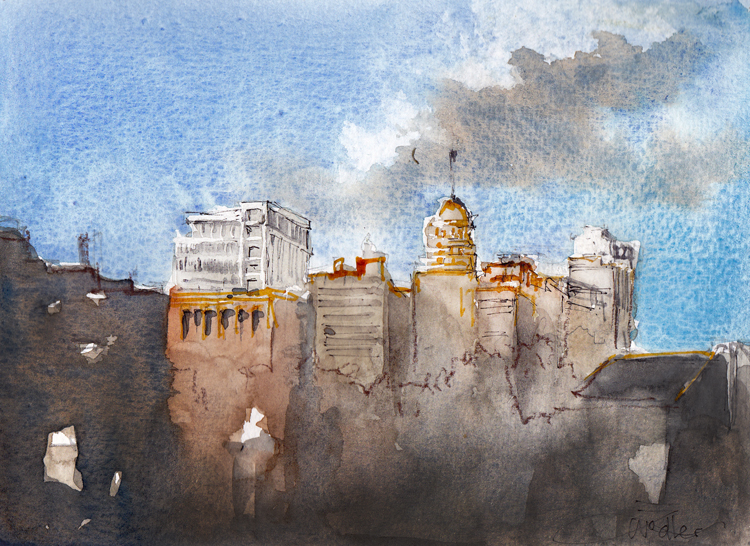
Effective November 14th, Heather and I have lived together at Bishop’s Landing on the Halifax waterfront. This means learning a new geography.
Watercolour by Edward Wedler of the Halifax skyline as seen from the boardwalk.
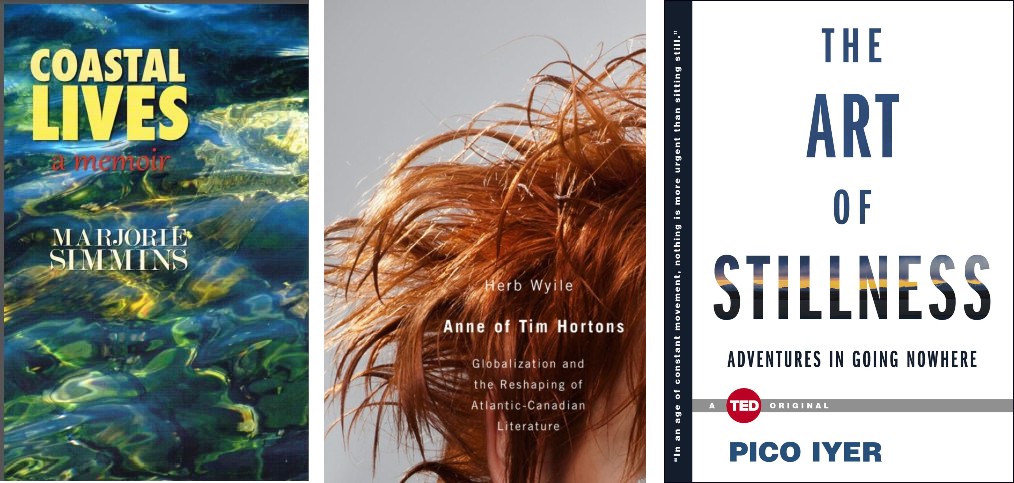
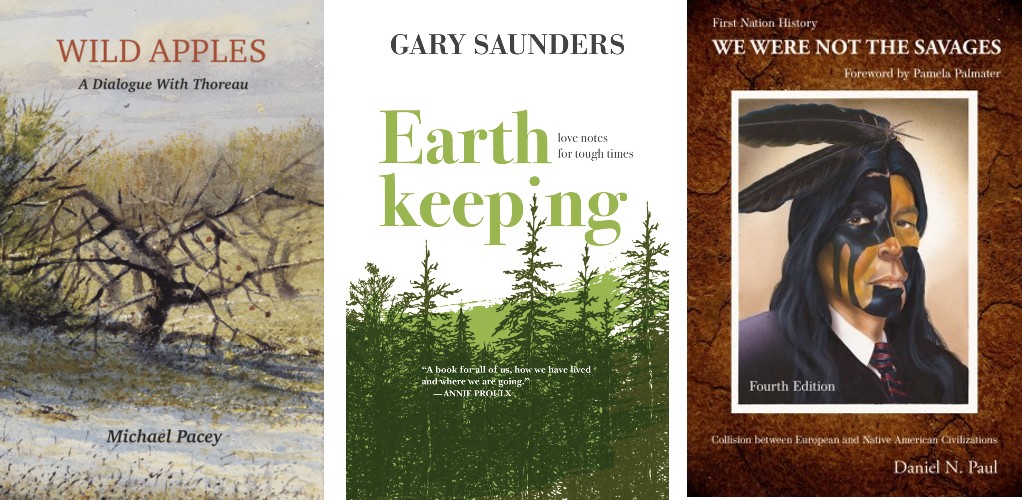
The starting point is walking from Pier 21 to Historic Properties along the boardwalk. In Historic Properties, Carrefour Atlantic offers an excellent selection of Atlantic Canada literature. I picked up three books to tide me over my convalescence.
Both were reviewed by Erica Butler in the current issue of Atlantic Books Today, No. 96. Under the title, Literary Human and Nature. How our stories help us understand our Place on Earth, p.8-15.
The third book is Daniel Paul’s, We are Not the Savages. This is taking much longer to read and digest.
I was reading Michael Pacey‘s poems based on quotations from Thoreau’s Journal, when Frank, an old friend from the Valley dropped off a gift, The Pocket Richard Jefferies. Passages chosen from the nature writing of Jefferies by AH Hyatt published in 1906. Jefferies’s writing is set in the British landscape. Thoreau’s writing is set in the New England landscape. Afterward, I was keen to see what Gary Saunders had to offer about the Nova Scotia landscape. Saunders lives around Old Barns, outside of Truro.
Given our forced migration into the city of Halifax, I was intrigued to read the following passage:
“The Old House: Honeymoon and after, p.193-197.
”Yet this old house is full of memories. And it has taught me plenty. To sell it now would feel like betrayal”
‘Assuming other rural householders might feel the same way I proposed a householder series to Rural Delivery editor, Dirk van Loon, himself a farmhouse dweller.”
”Make it seasonal and you’re on,” said he.
Clearly, we cannot afford to rent a furnished waterfront condo in Halifax every year. but perhaps we can find a small town, with shops within walking distance, and with good access to health services. That is the challenge ahead of us.
Certainly, other friends and colleagues have found this solution. BTW, I have upgraded my old Samsung for an iPhone. This makes me compatible with my iPad, and Patrick and Laurel for technical advice.
I noted too that my last blog for GoGeomatics, in November 2020, addressed the same issue “A Sense of Place“. Perhaps Jon Murphy would add this blog to the next edition of the online magazine.
To my regular readers, the reason for the hiatus is that two months ago, I had a heart attack, followed by open heart surgery at the Halifax Infirmary.
It was quite a weekend because Heather, my wife, also went to the hospital for a pacemaker.
The good news is that these events were preemptive, as we went together to Emergency at the Aberdeen Hospital in New Glasgow in early September.
After two months in the Infirmary. I have a detailed understanding of hospital routines, staffing levels, as well as the DOs and DO NOTs of hospital life. In this blog, I will focus on a few lessons we have learned as well as some of the sustaining factors.
Lesson1.
In traditional Western marriages, day-to-day tasks are usually split between husband and wife. For example, financial matters may be the purview of the husband. Not a good idea, both partners need to be equally informed about all aspects of living.
Lesson 2.
In a marriage, each partner may select their own technology of choice. My life is iPad and emails. Heather’s life is mobile phones. It is critical in a crisis that both partners understand the common technology.
Lesson 3.
The community network is vital. Foremost is the contribution from family. In our absence, they organized a rental condo in Halifax where Heather can live, while I was in the hospital for two months. The other community can extend from neighbours to work colleagues from the last forty years. Or even old-school friends from England. In our communications, we can share news, and the local Geography, including photographs. My photos are simple; from the view of Halifax Citadel to the interior of my room.
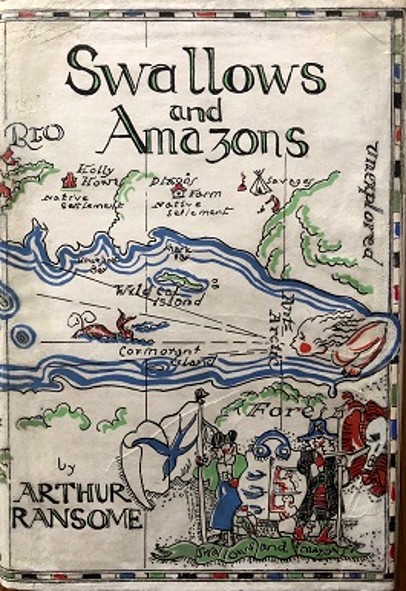
Back to the title of my blog, ‘Swallows and Thrushes’. This goes back to a book by Arthur Ransome “Swallows and Amazons“. I read this as a child.
In my case, Swallows refers to the ‘Swallow Test’ taken to evaluate your throat muscles for food consumption. Thrush refers to a throat infection that can impact your digestion ability.
For most of my hospital stay, food was delivered through feeding tubes. This severely restricted my mobility.
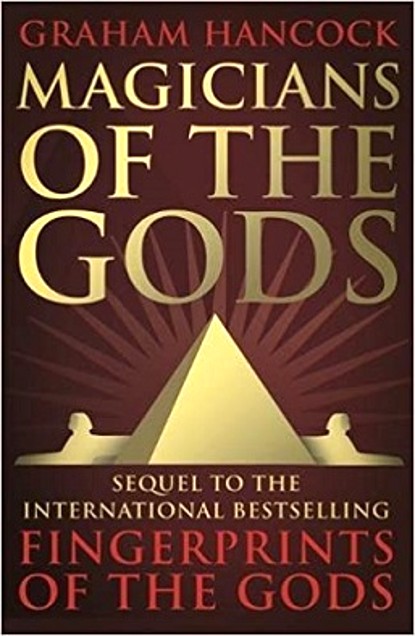
To end on a positive note, my physiotherapist, Pascal loaned me a book that he had enjoyed — Graham Hancock’s “Magicians of the Gods“.
It is a long read, full of facts and hypotheses about a previous civilization, about 9600 years ago, before a comet destroyed the earth’s climate and civilization.
POSTSCRIPT
I was released to join Heather at the Halifax condo on November 14th. This blog was delayed because of technical difficulties encountered by Edward with WordPress on his Chromebook in Florida. As we explore the geography of the Halifax waterfront, I hope to return to regular weekly blogs
The other book, I would recommend, is “Paddling Pathways“, a collection of essays on the significance of paddling by canoe, in the northern rivers of Canada. This is very timely since, in September, we purchased a new canoe. It is now sitting in Patrick’s garage in Peterborough.
To everyone who has emailed me these last two months … Heartfelt thanks!
It feels like it is time for a return visit to the West coast. Both blogs appear relevant today. I wonder what has happened at the Gowgaia Institute.
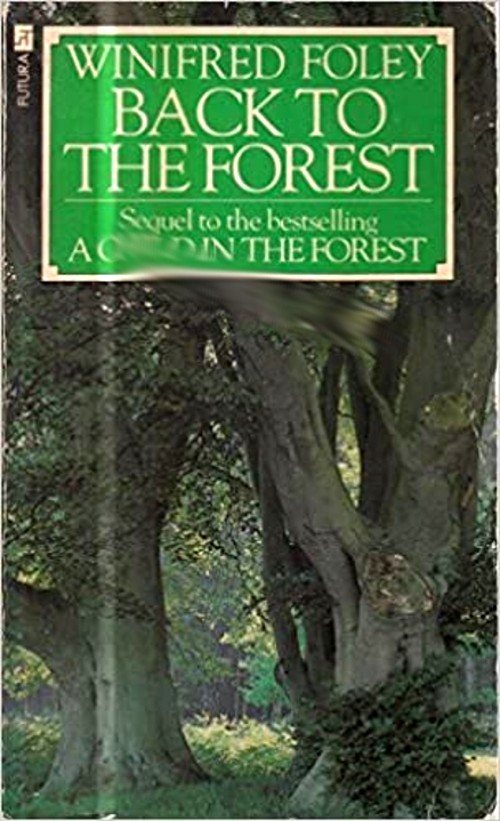
On the reading front, I have two new books. In New Glasgow, I picked up Back to the Forest.
In this case, the forest referenced is the Forest of Dean. It describes the move of a young family from the suburbs of London to the West Country at the end of the Second World War. About the time that I was born. It is a sequel to A Child in the Forest; both written by Winifred Foley.
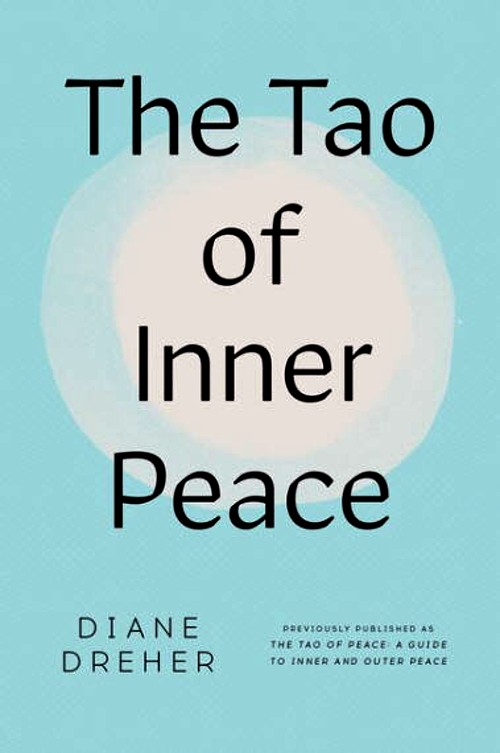
It adapts the ancient principle of Tao to today’s world by showing how to integrate the many facets of everyday life to create a balanced, dynamic harmonious whole. In particular, I am interested in the subject of mindfulness.
’Without the active yang of career commitment, life becomes too yin for many retired people. They need to find new interests, new challenges.’ p.32.
’When we take time to live more consciously, we don’t react mindlessly to our environment. Our days are filled with active choices, balancing the current of yin and Yang into greater harmony.’ p.33.
While reading about Scott Fitzgerald, I noted that one of his four books is entitled This Side of Paradise. That’s exactly where we are today. Perhaps better known by Fitzgerald is The Great Gatsby. Fitzgerald lived from 1896-1940.
Acknowledgements
Support from Heather and the families of Patrick, Andrew and Laurel. Edward added the graphics.
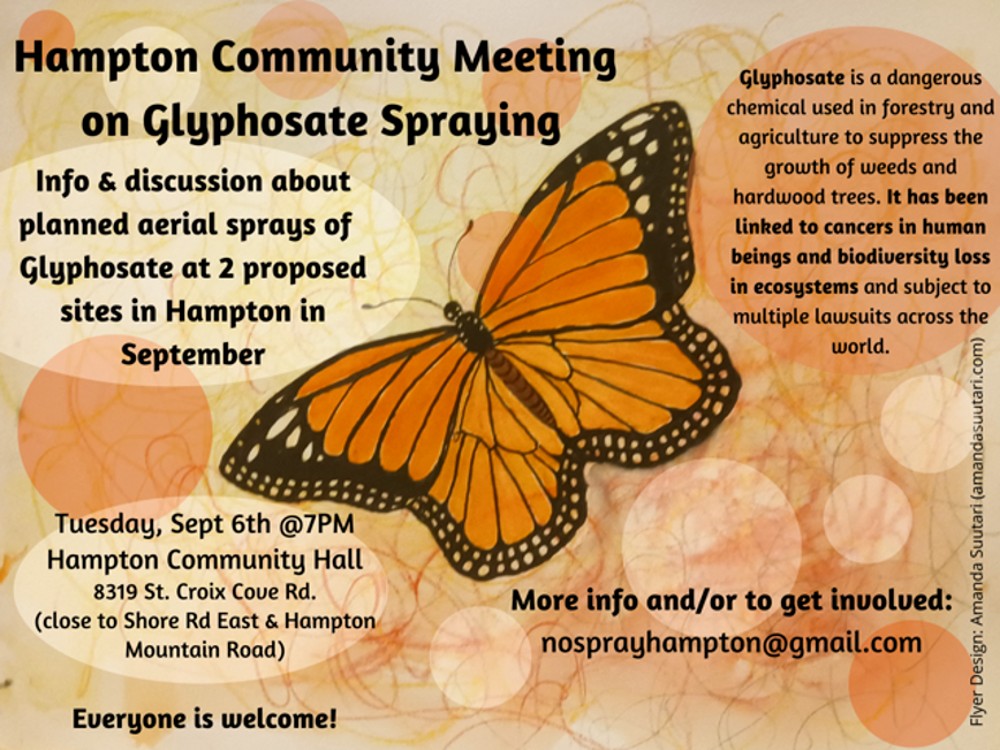
On Thursday, we went to 2600 McNally Road, Burlington for a rally to stop glyphosate spraying of the forests on North Mountain.
Next week, there is a meeting at the Hampton Community Hall on the same topic.
Friday, while in Berwick at the pharmacist, I noticed a book “From the Brow to the Bay”. This describes the historical geography of the Burlington area. It was published by the Burlington Community Club.
This type of publication is a model of the relationship between the human community and the landscape. It makes me realize that each of us lives in the landscape. We interact with other members of our community, at work, as well as at play. We invest time and energy into that landscape. At the same time, we maintain a network of community relationships.
Over a period of time, we see changes in the staff of our institutions, the institutional goals, as well as the infrastructure.
The single-minded pursuit of forest products occurs at the expense of other species, and their communication networks. This type of habitat destruction can also occur in the human species.
I have followed the writing and career of Sheree Fitch. Therefore, it was a pleasant surprise to read her article ‘Still kissing the Joy as it Flies’ in the weekend Chronicle Herald. I look forward to revisiting their habitat, on the back road outside of River John.
Acknowledgements
The organizers of the Burlington rally, including Anna Osborn, Nina Newington and Leo Glavine. Heather shared the journey to Burlington and Berwick. Edward contributed the graphics.
References
Burlington Community Club,2012. From the Brow to the Bay: Historic Burlington and Area, Published by the Burlington Community Club.