Posted in Opinion

Spot the difference?

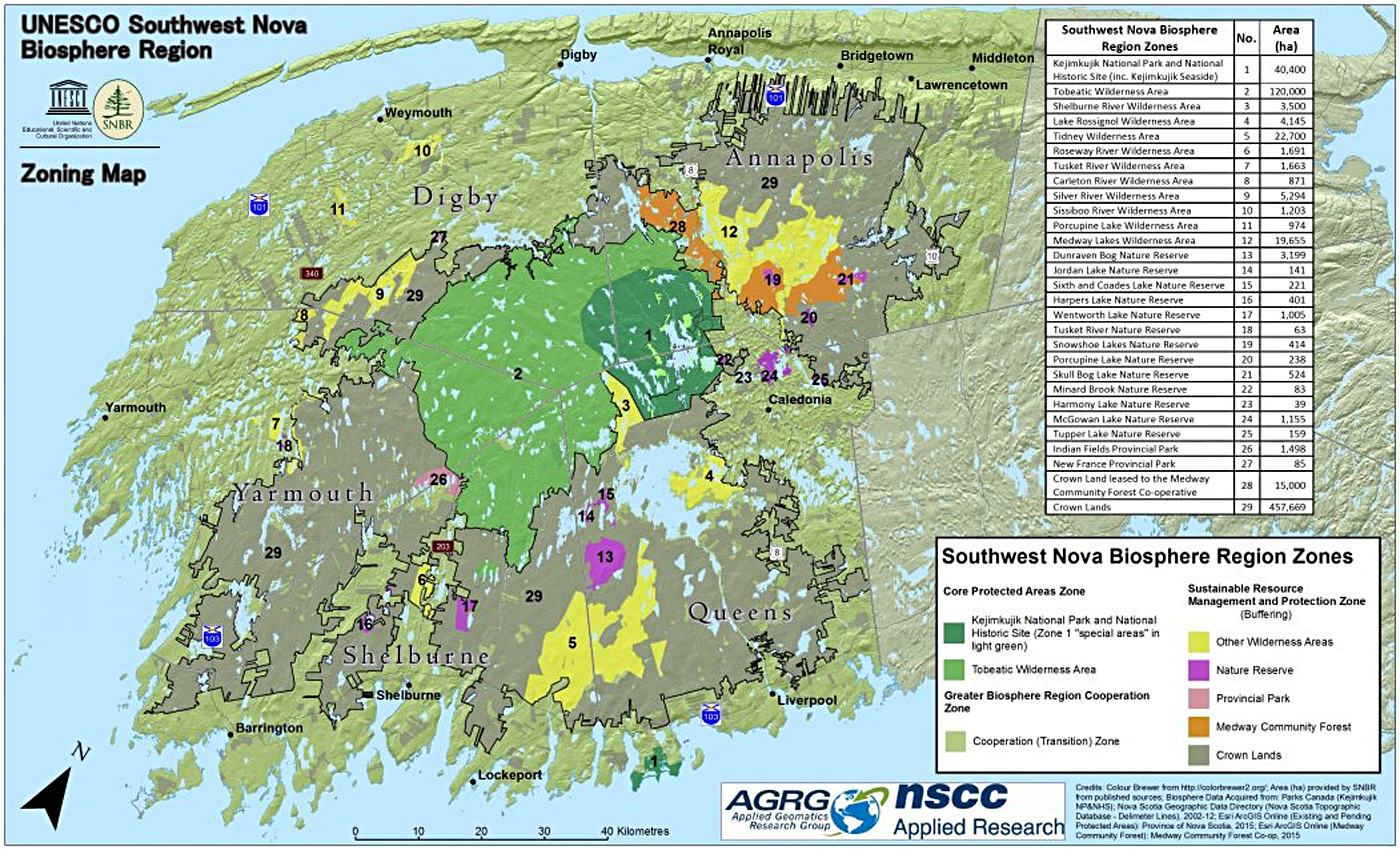
Last Thursday, Heather and I went to the Extinction Rebellion (XR) encampment on crown land within the Southwest Nova Biosphere region.

It is about a two hour drive from our home base in Paradise. You take Highway #101 to Weymouth and then head inland towards the Tobeatic Wilderness Area. This requires driving over twenty kilometres on forestry roads.

On our return home, I wanted to check our route and thus went to the Nova Scotia Atlas. The area of interest is on page 71. What struck me was the difference in land use designation between 2001 (first edition) and 2019 (seventh edition). This is perhaps best illustrated by page 64. (See photographs).

Map LEFT: 2001 Map RIGHT 2019
Push the centre slider left/right to compare the two maps.

The map sheet has changed colour. From primarily white (private land ownership in 2001) to primarily green (crown lands) and yellow (provincial parks, wilderness areas and nature reserves) in 2019. My assumption is that this is the result of the Bowater Mersey land coming under the management of the provincial department of Lands and Forestry. In 2016, WestFor Management Inc. was established to implement the forest management.

The good news is that the yellow areas are ‘protected’ from clearcutting. The bad news is that the green areas ‘crown lands’ are available for cutting at the discretion of the provincial government, in association with WestFor.

These findings need to be placed within the context of the Biosphere Reserve. The Southwest Nova Biosphere Reserve was established in 2001. At that time, it defined as a core area: Kejimkujik National Park and the Tobeatic Wilderness Area and the surrounding working landscape. At the time of review, UNESCO MAB insisted on a definition of the buffer zone, which would require engagement of interested parties, in particular, the Nova Scotia Department of Lands and Forestry.

Last week, Doug Hickman sent a report to UNESCO, the provincial and municipal governments which identifies the need for a management plan which protects the habitat of endangered species in the region, in particular the mainland moose (see download links, below).

Meanwhile, cutting continues apace on both private land and crown land.

Acknowledgements.

Doug Hickman for producing a comprehensive review of the situation in a short time frame. Heather for her work on a safety plan. Edward for his graphics skills.

References

The Nova Scotia Atlas. 2001. Fifth edition co-published by Formac and the Province of Nova Scotia.

The Nova Scotia Atlas 2019. Seventh edition co-published by Formac and the Province of Nova Scotia

Doug Hickman, November 18, 2020. Backgrounder and Report (two documents) “GUTTED. Endangered Mainland Moose and how the government of Nova Scotia makes a mockery of UNESCO” (see below)
Posted in Event Review

Gordonstoun Nova Scotia

Thursday evening, I attended the Gordonstoun Nova Scotia Information Forum put on by Friends of Gordonstoun Nova Scotia (FOGNS) at Cornwallis Park. The moderator was Linda Hume Leahy. FOGNS is a citizen support group, numbering over 600 members.

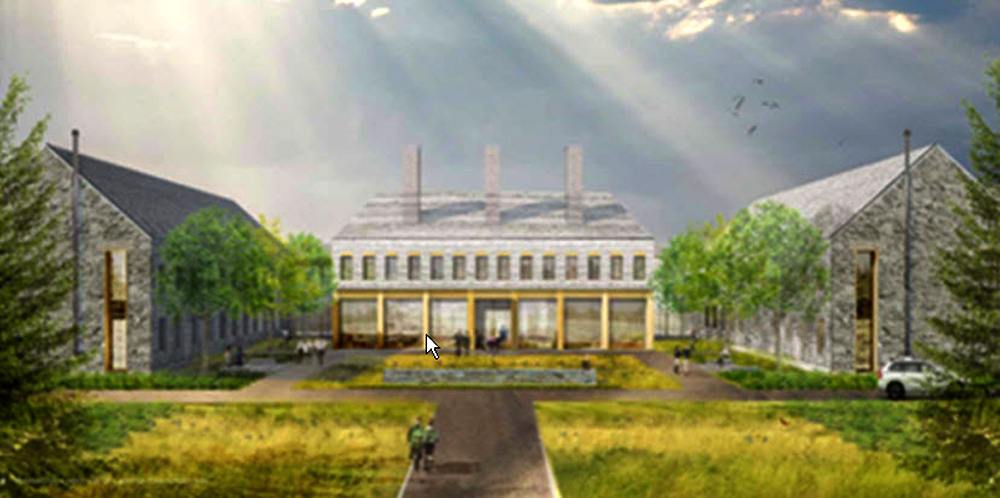
Architect’s image distributed by Municipality of Annapolis County

The one and a half hour presentation was made by Richard Thorne and Kate Cornell on behalf of Gordonstoun NS. The event was under strict COVID social distancing and face mask rules. There were between 60-80 citizens in the audience. Thorne is Acting Principal. Cornell is Development Officer. Consultant, Edward Ferren was in the audience. Because of COVID there was no opportunity to ask questions from the floor.

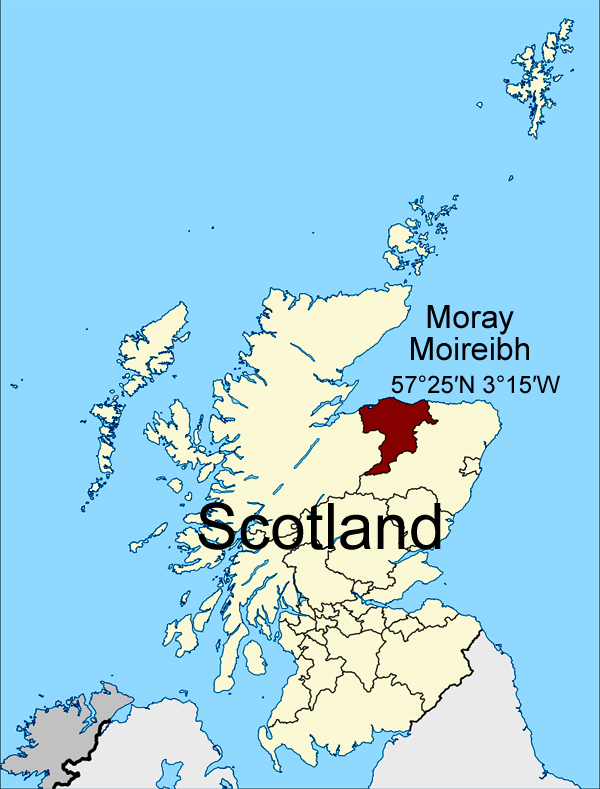
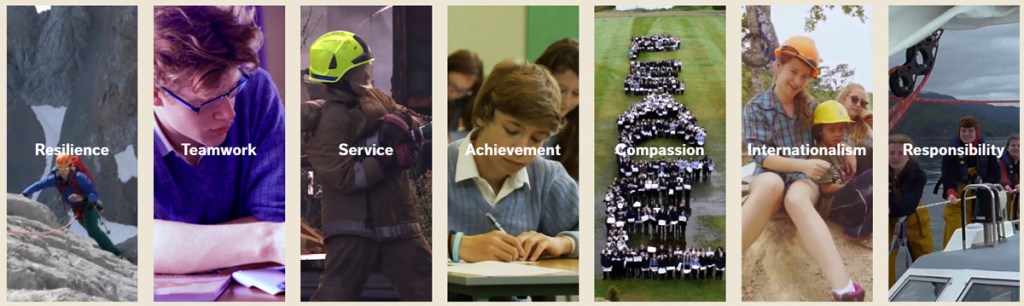
Richard and Kate provided an in-depth background to the Gordonstoun philosophy, the role of Kurt Hahn and the establishment of Gordonstoun School in Moray, Scotland. Gordonstoun education for life includes teamwork, responsibility, resilience, achievement and compassion. The experience includes Outward Bound, the Duke of Edinburgh awards, and the Round Square movement. In the words of Hahn, it responds to the six declines of modern youth: fitness, initiative and enterprise, memory and imagination, skill and care, self-discipline and compassion.

From https://gordonstoun.org.uk/

The timeline for Gordonstoun Nova Scotia: they will be breaking the ground in late Spring 2021, hiring VP Academic and VP Finance by September 2021. First intake will be September 2022. There will be six hundred students, fifty-plus staff. The students will be Grade 9-12. The curriculum will be part of the International Baccalaureate (IB) program. The school will be not for profit and will offer full scholarships (two for Nova Scotia students and two for non- Nova Scotia students) valued at $78k for each of four years.

There will opportunity for the community to be involved through maintenance of the site, local provisioning and collaboration. The question posed : How are you going to be involved with us? And vice versa?

Overall, there was a lot of good background information. Via the Gordonstoun UK web site there are a range of videos on teamwork, responsibility, resilience, achievement, compassion. From a geographic perspective, there are many similarities between the Annapolis Basin and Moray, Scotland

Overall, there was a lot of good background information. Via the Gordonstoun UK web site there are a range of videos on teamwork, responsibility, resilience, achievement, compassion. From a geographic perspective, there are many similarities between the Annapolis Basin and Moray, Scotland

between mountain and the water

— Kurt Hahn

Acknowledgements

Thanks to Friends of Gordonstoun Nova Scotia for organizing the forum.

References

go to gordonstoun.org.uk to find the link to the videos

check Google for more on Kurt Hahn and his educational philosophy.

Ashley Thompson, SaltWire, 23 October 2020, “Citizen Group Formed in Support of Gordonstoun School”

Posted in Opinion

‘The Crown’ lands

In these COVID times, it was a relief to receive a new season of The Crown on Netflix (ten episodes ).

Creative Commons Attribution-NonCommercial-NoDerivs 3.0

Watching the first two episodes, one was reminded of the definition of crown lands in Great Britain. There were images of deer hunting, shooting grouse in the Scottish Highlands around Balmoral. It is the playground of the privileged. Seeing ‘Prince Charles’ one remembers his time at Gordonstoun.

How much of this colonial past are we bringing to Nova Scotia ? Is this a culture of monied privilege that we are importing into the Annapolis Valley ?

The good news is The Crown series, an excellent product from the BBC, reminds us both of the class system in Great Britain and acts as a vivid reminder of the term ‘crown lands’. At a time when we need to revisit the concept in Nova Scotia.

Driving down Highway #1 from Bridgetown to Annapolis Royal, just past The Broken Wheel B&B, Heather remarked on the invasion of multiflora rose (see earlier blog post) on the south side of the road towards the Annapolis River. Clearly, it does not take much neglect before these species colonize abandoned fields and take them out of production.

We noted, too, the new pavement on Highway #1. Unlike Highway #201, there seems to be little truck traffic, either logs or aggregate.

Is this because the Premier has a home on Highway #1? Is it because different highways have different codes? Or perhaps the residents on Highway #201 are less vocal in their opposition to logging and aggregate trucks? Or the logs and aggregate are coming off South Mountain? Incognito? Who knows.

Regardless, I am content that I am able to watch Netflix at home on a dark Winter evening.

Acknowledgements

Heather is my observant travel companion. Edward is my blog graphic designer.

Posted in biographical sketch

The Railway Era

After going to Kings County Honda in Kentville to service my CRV, we stopped at the Maritime Express Cider Company.

They are located in the old Cornwallis Inn. We sampled a flight of different ciders, and had the chance to chat with the cider maker, Jimi Doidge. This peaked our interest in the best mix of varieties for hard cider from our organic orchard.

Friday, Alex Cole from Little Foot Yurts stopped by the house to harvest some of the coppiced poles for his yurt operation. He anticipates a couple of workshops later in the year, on both charcoal making and yurt construction.

QSaturday was the opening of The Station in Bridgetown (previously, The End of the Line pub). This will be the primary retail outlet for Lunn’s Mill brewery. We wish them every success.

In this week’s Reader, there was notice of Gordonstoun Nova Scotia Information Forum next Thursday at Cornwallis Park. You can submit questions. Here is mine.
“How will Gordonstoun School work with educational institutions and educators in Annapolis County to implement ‘place-based ‘ learning ?”

There has been some discussion locally about the Southwest Nova Biosphere Reserve. David Colville at COGS provide me with a link to the current map that shows the core, the buffer and the working landscape. The core is Kejimkujik National Park and the Tobeatic Wilderness Area. The area of concern is the buffer zone that includes crown land.

Don’t forget the showing of Striking Balance on CBC Sunday, November 29th. The focus is the Southwest Nova Biosphere Reserve.

Congratulations to Anne Crossman. She will be writing a weekly column in Saltwire’s Annapolis Valley Register every Thursday. Anne has been a watchful observer of local politics, especially at the municipal level. With a new council, it is even more important to keep citizens informed about any changes in direction or policy.

Postscript

I had intended to write about a ‘sense of place’ but recognized that this region has a deep history from the Mi’kmaq time onwards. That time goes back, way beyond the railway era. Hence I revised the title. (See reference in Curated Magazine)

Acknowledgements

Bill and Anne Crossman for hosting Chinese Food Friday. Heather for her engagement with safety planning and the encampment. Edward always adds graphic value and feedback to my draft blog.

Reference

Curated: Food and Drink Magazine. September 2020. Vol 9. Issue 40. Article on Maritime Express. A Sense of Place. p.36-40.

Posted in Creative writing

Word Pressing

Working in the orchard, you learn that trees produce many products, if you look after them. Fresh apples, cider, vinegar, brandy. The products also feed others : deer, bear, squirrel, chipmunk plus numerous bird species.

Can we apply the same analogy to my use of WordPress? Another realization. In writing my blog over the last few years, I have become dependent on WordPress.

What would happen if you applied those same cyclic and sustainable lessons to the way we manage the trees in the forest ?

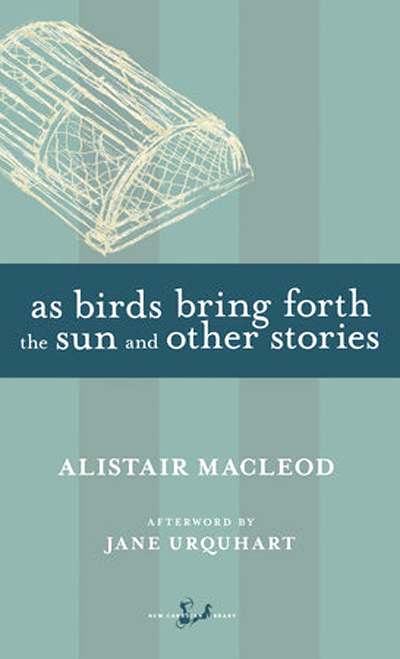
When I read Alistair MacLeod, I appreciate his descriptions of life, and the lives along the Cape Breton coastline. I appreciate his use of language, including Gaelic. Is the story telling process really word processing or, as in the case of cider pressing, extracting the essence from the fruit which comes from the trees which we manage for a variety of products?

We have a deep relationship with our landscape and we interact in many ways with the landscape and all the other species which co-exist with us. Why allow a single-minded fixation on wood supply to destroy this complex relationship with the forested landscape and its co-habitants? Why do we see changes in the climate ? Why do we see the changes in the population of these other species ?

I am willing to put my faith in the cider press, but also in the word press.

INPUT: Crown lands, Sustainability, Clear-cutting

OUTPUT: Haiku

Crown lands management

Like a war zone

Wildlife homeless.

— HAIKU by Heather Stewart

Postscript.

Please read Alistair MacLeod’s As Birds Bring Forth the Sun.

Acknowledgements

Each week, Edward helps me master the idiosyncrasies of the WordPress software. Heather continues to see the trees and not the wood.

References

Edward found this link to over forty classic British movies for free, hidden as a scavenger hunt on Google Maps. In his view, mixing maps, GIS and geography with entertainment is a powerful, educational and business notion. Looks like fun.

Posted in biographical sketch

Cider Pressing

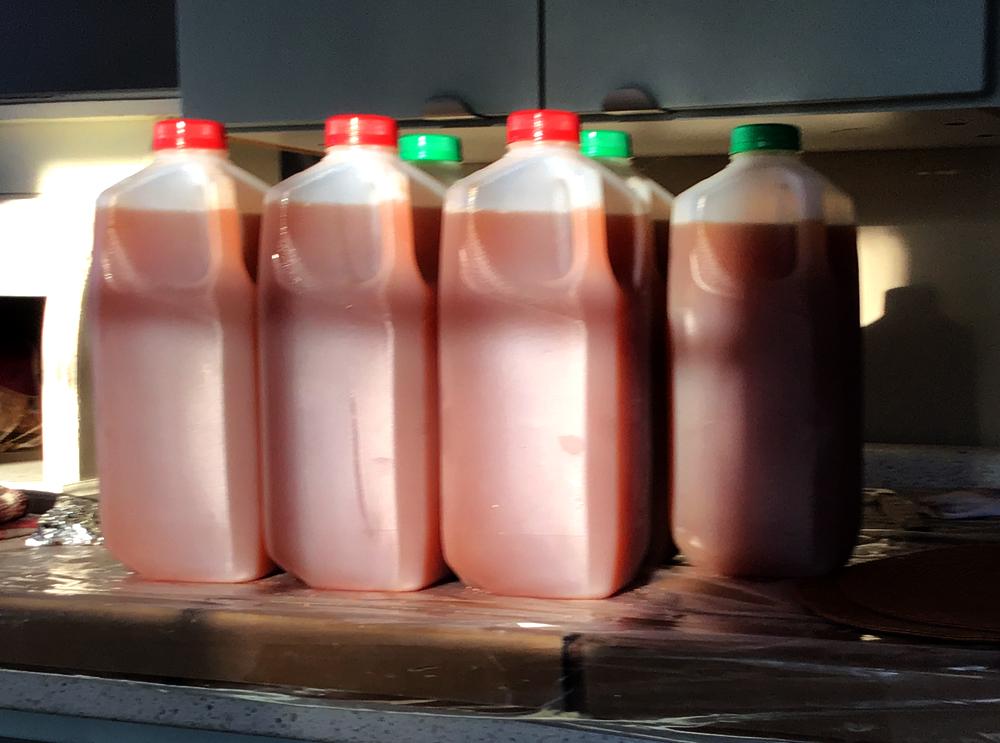
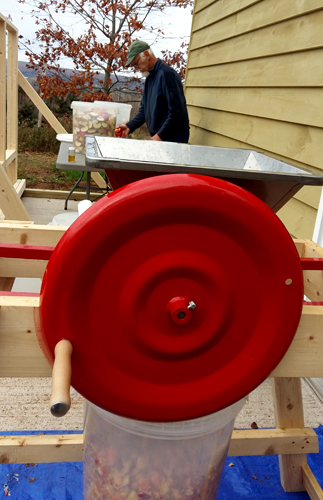
After shipping our apples in bulk to Brian Boates for vinegar and brandy, we had eight boxes left of the three varieties: NovaMac, NovaSpy and MacFree. From each box, we will likely get two, two-litre containers of juice.

On the left is the press. On the right, it is the grinder.We grind up the apples. Fill cloth bag. Add blocks. And screw down tight.Juice flows out the bottom. Liquid gold. Organic apple juice. Yes it was a fantastic day. We have been apple processing all day. I turned the Spies into pie filling. Heather turned Nova Mac into juice

The fun part is mixing the varieties for sweetness and flavour. Less fun, is the preparation: washing, cleaning, cutting etc.

There is a real pleasure in being so task-oriented. It contrasts strongly with those parts of rural living that we cannot change – COVID, politics in the US, and the related politics regarding forestry and resource management in Nova Scotia (we are trying). Then there are the vagaries of rural Internet.

Last night, we attended a meeting of the Annapolis chapter of Extinction Rebellion (ER) at the Centrelea Community Hall. We wanted to hear the update on the forestry practices in the Tobeatic region of Digby County. ER have been occupying a camp for the last couple of weeks. Because of our orchard commitments, we have not had the time or energy to join them on the ground. From their descriptions we will try to make a visit, to understand the level and type of cutting and the network of logging roads that have been put in place.

The single minded focus on wood supply at the expense of other values inherent in the landscape appears to contravene the philosophy and values of the designated UNESCO Man and Biosphere (MAB) program.

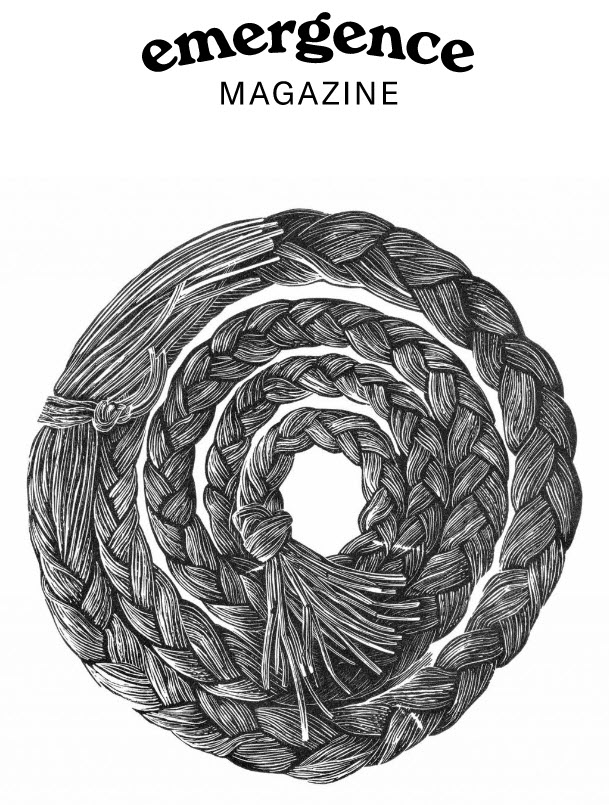
Artwork by Tony Drehfal

As Robin Wall Kimmerer expresses in Emergence Magazine today:

”What does it take to abandon what does not work and take the risks of uncertainty”

Acknowledgements

Nina Newington and the Annapolis ER for their work on the ground in Digby County. Heather shares the pleasures of cider making. Edward for his graphics.

Reference

Robin Wall Kimmerer, Sky woman Falling, Emergence Magazine. November 10, 2020.

Posted in Event Review

Rising to the Challenge

We went to Annapolis Royal to see the exhibition, Annapolis Basin : Rising to the Challenge by Sally O’Grady and David Colville at the ARTsPLACE.

It is there until December 19th. Heather and I loved the townscape paintings by Sally. David provided the maps in the brochure (adding the geography).

It did make us ‘rise to the challenge’. The challenge is educating our Annapolis County community about climate change, and in this part of Nova Scotia, sea level rise.

I can imagine the following. Sally’s paintings show us the current skyline around the Annapolis Basin. Just think, using the latest estimates of sea level rise, and storm surges, with a projector unit, we could show where these estimates would impact the communities. This would offer a wonderful education opportunity. I am hoping there will be a second edition which gives citizens some idea of the changes in 2030 and 2050, based on the latest science. That’s my challenge!

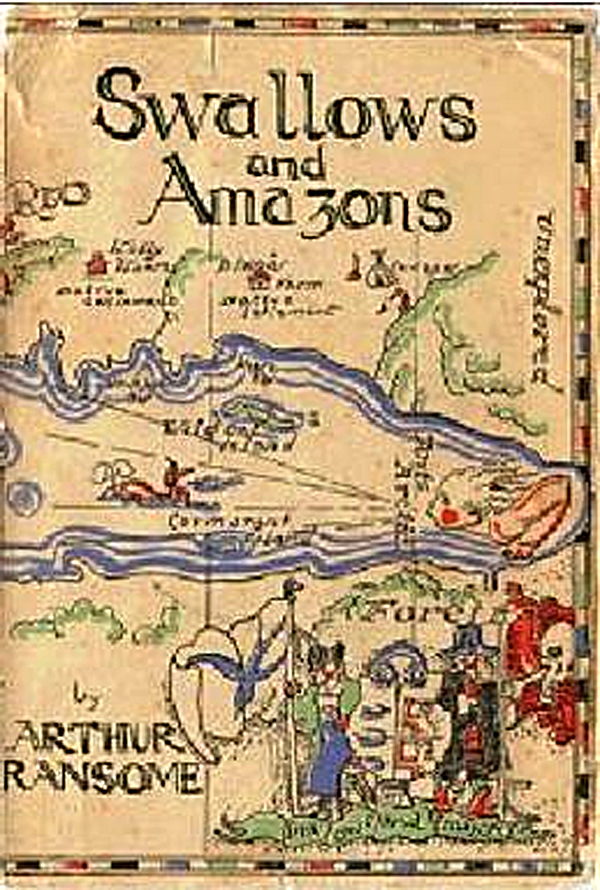
Afterwards, we stopped at the Great Expectations Books & Cafe. JoAnn had found a copy of Swallows and Amazons by Arthur Ransome.

We had promised to find it, and send it on to Quinn in Iqaluit. Imagine our surprise in Lawrencetown, when an hour later we received in the mail from Indigo a modern reprint of the same book. Heather had ordered it, not expecting JoAnn to find the missing volume. A bonus for our grandchildren.

The afternoon was capped with a walk with Siqsiq around the French Basin trail.

Next week (Monday 7-9 pm) there is Annapolis County Extinction Rebellion meeting at the Centrelea Community Hall. This will give us an update on the forestry practices in the Tobeatic region. From the feedback to my last blog (Crown Lands), we need to continue to challenge NS Lands and Forestry on their Crown Lands policies.

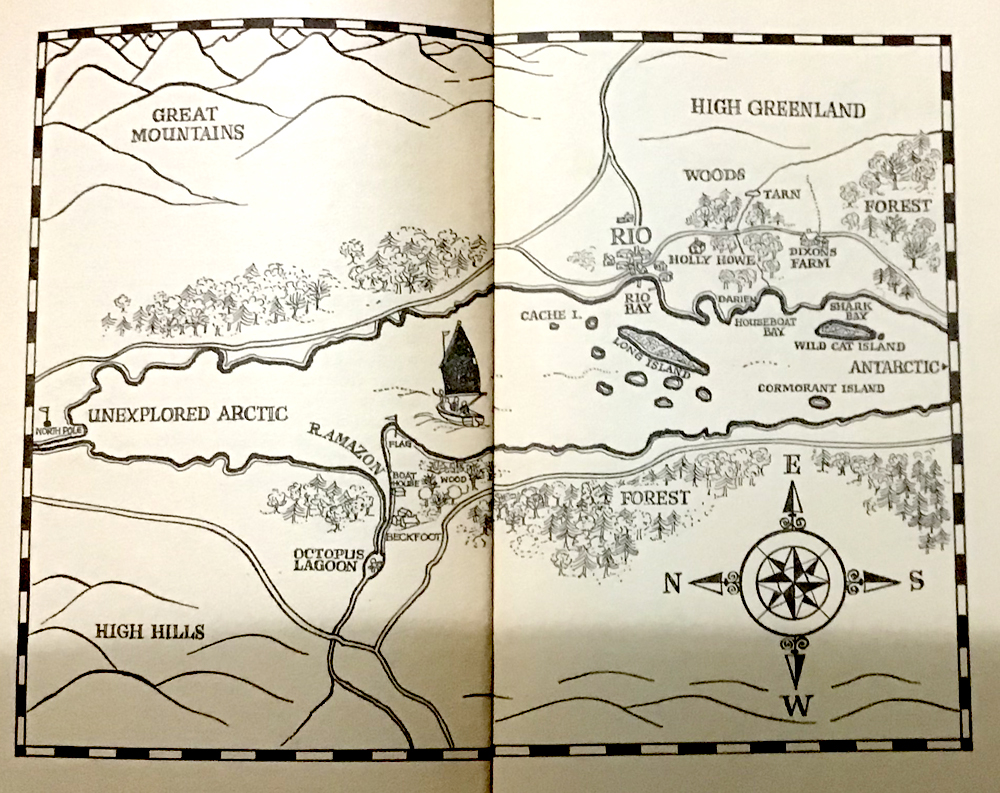
This map could be the Annapolis Basin. The sailors could be from the new Gordonstoun School.

Acknowledgements

JoAnn for finding the Arthur Ransome book. Sally and David for their challenge. I hope they can take it to the next level.

References

Arthur Ransome, 1930. Swallows and Amazons Puffin Books (1962)

Alistair MacLeod, 1986. As Birds bring forth the Sun and Other Stories. McClelland and Stewart (PenguinRandomHouse).

Postscript

I found a copy of the Alistair MacLeod short stories at the Great Expectations Cafe. Meanwhile, Tony Berger’s book on Ella Manuel continues to inspire me with the local stories from Bonne Bay.

Posted in Opinion

Crown Lands

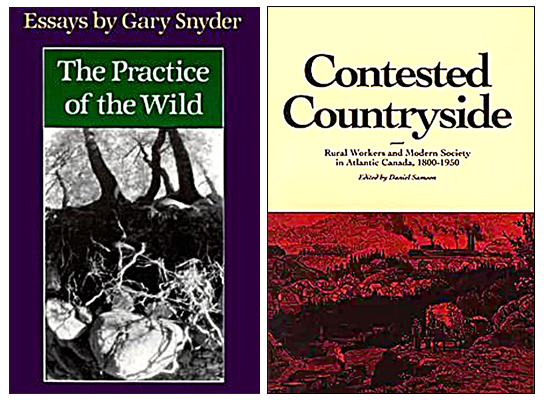
This weekend, I had the time to read carefully Gary Snyder’s essay, The Place, the Region and the Commons in The Practice of the Wild.

David Foreman, founder of the Earth First ! Movement recently (1990) states his radical provenance. ‘It came from the Public Lands Conservation movement – the solid, stodgy movement that goes back to the thirties and before. Yet these land and wildlife issues were what politicized John Muir, John Wesley Powell and Aldo Leopold — the abuses of public land.” p.29.

“American Public lands are the twentieth-century incarnation of a much older institution known across Eurasia – in English, called the ‘commons’ – which was the ancient mode of both protecting and managing the wilds of the self-governing regions. It worked well enough until the age of market economics, colonization and imperialism.”:

“Because it is traditional and local, it is not identical with today’s ‘public domain’ which is land held and managed by a central government. Under a national state such management may be destructive or benign – but in no case is it locally managed. One of the ideas in the current debate on how to reform our public lands is that of returning them to regional control.”

“In the United States, an enormous area was de facto public domain and the Forest Service, the Park Service and the Bureau of Land Management were formed to manage it. (The same sorts of land in Canada and Australia are called ”Crown Lands”, a reflection of the history of English rulers trying to wrest the Commons from the people.”

“The commons is a curious and elegant social institution within which human beings once lived free political lives while weaving through natural systems. The commons is a level of organization of human society that includes the non-human. The level above the local commons is the Bio-region. Understanding the Commons and it’s role within the larger regional culture is one more step towards integrating ecology with economy.” p.37.

From my conversations with David Sollows and Cliff Drysdale (both with SNBRA) it appears that we need to have a similar discussion about Crown lands in Nova Scotia.

Perhaps a starting point would be for the key players: SNBRA, NS Department of Lands and Forestry, Municipal governments and WestFor to check out Gary Snyder’s essay: The Place, The Region and the Commons.

Acknowledgements
David Sollows and Cliff Drysdale for their interaction. Edward and Heather for their support.

Reference

Gary Snyder, 1990. The Practice of the Wild. North Point Press.

Postscript

Memories of Haida Gwaii


Posted in Book Review

Rereading History

Monday, we headed up to Wolfville. I could not resist a quick stop at the Odd Book. Within minutes, I had found two keepers.

The Practice of the Wild, essays by Gary Snyder. It seemed very appropriate to the battle we face trying to preserve the forested landscape in Nova Scotia. The first essay, The Etiquette of Freedom talks about the words, Nature, Wild and Wilderness. The second essay, The Place, the Region and the Commons covers the world is places, understanding the Commons and Bio-regional perspectives.

The second book published by Gorsebrook Studies in the Political Economy of the Atlantic region, Contested Countryside : rural workers and modern society in Atlantic Canada 1800-1950, edited by Daniel Samson. Within the chapter by Erik Kristiansen, Time, Memory and Rural Transformation: Rereading History in the Fiction of Charles Bruce and Ernest Buckler, it places Buckler into the economic context after the Second World War. Not an easy read, but thought provoking. There is also an Afterword by Daniel Samson Capitalism and Modernization in the Atlantic Canada countryside. With that in mind, move forward to 2020.

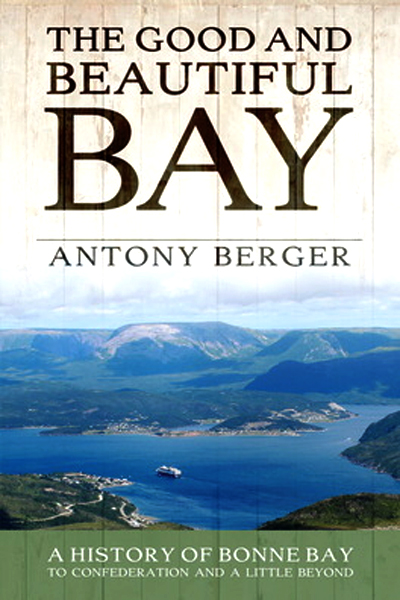
The third book is by Antony Berger and is the biography of his mother, Ella Manuel. This one came from the Lawrencetown library. Heather has snagged it, so this is an indirect review. It describes her life in Western Newfoundland, after the Second World War, a single Mother with young children, and the economic life in Lomond and Bonne Bay. Interestingly, Berger has also written about Bonne Bay: This Good and Beautiful Bay, a History of Bonne Bay to Confederation and a little beyond. Berger now spends his time between Wolfville and Woody Point.


All three books raise the question: what is the impact of the surrounding landscape and rural economy on the writers view of the world?

In the case of Gary Snyder, it is the Yuba River country in the Sierra Nevada of Northern California. For Ernest Buckler, it is the Annapolis Valley. For Ella Manuel and Antony Berger it is Bonne Bay, Western Newfoundland.

I would encourage reading the chapter in Contested Countryside, Rereading of History, by Eric Kristiansen; challenging, but definitely relevant to our times.

Last weekend, we attended the Dave Gunning concert in Bridgetown. We came away with two CDs. This week, I have been listening to ‘These Hands’ and ‘Circle of Boots’.


Finally, I had the chance to drop off some excess books at Endless Shores in Bridgetown and thus obtain a credit. The ones that were not of interest to Jennifer, I took to the Bridgetown post office.

Acknowledgements

The Odd Book in Wolfville, close to the university, is a readers’ goldmine. Jaki at the library obtained the Ella Manuel biography. Heather for her comments on the book. Edward for his graphics.

References

Gary Snyder, 1990. The Practice of the Wild. North Point Press.

David Samson (Ed.), 1994. Contested Countryside. Rural workers and modern society in Atlantic Canada 1880-1950. Acadiensis Press.

Antony Berger, 2014. The Good and Beautiful Bay: A History of Bonne Bay to Confederation and a little beyond. Flanker Press.

Antony Berger, 2020. No Place for a Woman. The life and Newfoundland stories of Ella Manuel. Breakwater Books.

Dave Gunning CDs No more Pennies 2012. Up against the Sky. 2019.

Posted in Creative writing

The Nova Spy

Bob Bent, local author, recently published a novel Spy on Ice. It is the story of a Canadian hockey player who is recruited by the Ottawa Senators to spy on a Russian player whose father is Head of Russian Intelligence.

This week, we picked the last Nova Spy tree in the orchard. Afterwards, we sent a selection of apples to Andrew and family in Iqaluit.

Thinking about the Nova Spy, it seemed like a good idea to seek out heritage varieties in the Annapolis Valley. I found one example on the West Inglisville Road. Interestingly, these four large trunk trees stand on a property, once owned by Bob Bent.

I recall writing a blog in November 2017 Apple Pressing and the Ghost Orchard. It contains references to the writing of Tom Burford, Julian Gwyn and Helen Humphreys. It concludes with a Robert Frost poem, ‘AfterApple-picking’.

Perhaps there is a novel in The Nova Spy, based on the search for heritage apple varieties in rural Nova Scotia.


Postscripts

Through inter-library loan, I received Antony Berger (Ed.) No Place for a Woman: The Life and Newfoundland Stories of Ella Manuel. Heather and I both recall visiting her home above Woody Point in 1975. Heather was working at Gros Morne National Park. I was teaching at Memorial University and supervising Biogeography graduate students on the West coast.

Blessings, A visual journey through the Irish landscape, Emergence Magazine.

Acknowledgements

Edward for encouraging the link between Ice Spy and Nova Spy. Jaki at the Lawrencetown library for the inter-library loan service. Heather continues to pick MacFree in the orchard. Perhaps, we can conduct an organic cider taste test, using all three varieties.

References

Bob Bent, 2020. Spy on Ice, Nevermore Press.

Antony Berger, 2020. No Place for a Woman, Breakwater Press.
(LINK to Book Launch)