Last fall, I drove through New Brunswick on my way to/from Québec and Ontario with my wife, Anne. The roads have improved immeasurably from a couple of decades ago, so we actually had time to savour the landscape and talk about what we saw. As we travelled, I noticed something strange about our conversation.
We increasingly saw the landscape as artists.
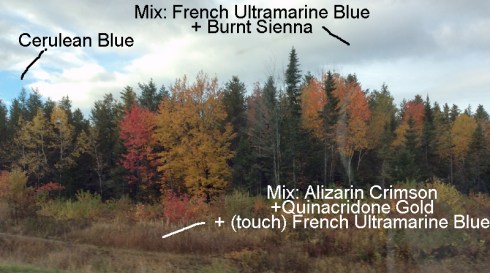 The sky wasn’t just overcast or sunny. The sky was a mix of Burnt Sienna with a touch of French Ultramarine Blue or was a variegated wash from Cerulean Blue to Cadmium Yellow. We were not just engulfed in fall foliage of colours. Hills became brushstrokes of Alizarin Crimson, Quinacridone Gold (I love that colour) and Prussian Blue.
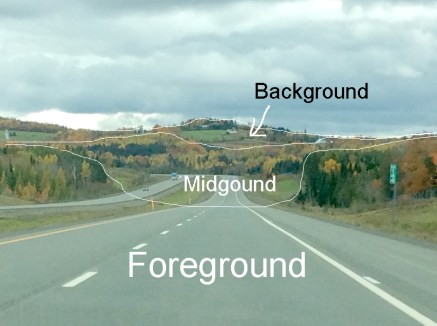 We divided the landscape into zones (foregrounds, mid-grounds, and backgrounds) and described how we would paint aerial perspective, “treat edges” and change tonal contrasts, to give a sense of distance.
 Many times we would identify a focal point in the landscape (almost with “eye-spy-with-my-little-eye enthusiasm) and would suggest ways to direct viewers’ eyes to that point. Would it be the slope of the hills, the line of our winding road, edges of forest stands or the illumination of light breaking through the clouds? How would our favourite artists, or The Group Of Seven treat that focal point?
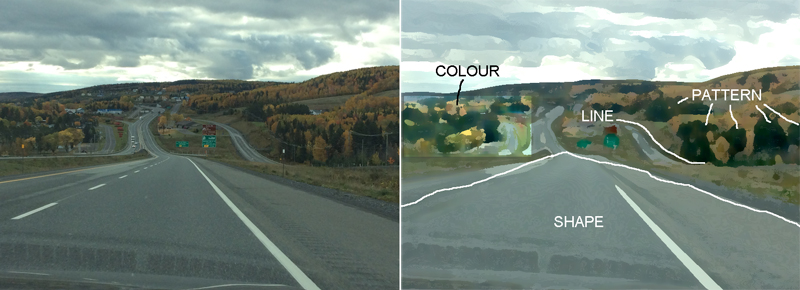 As we drove, we unpacked our landscape NOT in terms of “things” (such as houses, fence rows, barns, silos or cows) but in terms of shape, line, colour, patterns, gradation and composition. We became exhilarated, as artists, to not only view the landscape but to offer ways to interpret the landscape — whether it be as a realist, impressionist or abstract artist — in oils, acrylics, watercolours or inks.
Anne and I enjoyed kilometres (miles) of child-like revelations and “aha” moments on what could have been just an ordinary road trip through New Brunswick, Quebec and Ontario (although the scenery was spectacular). We did not just see the landscape. We interpreted the landscape.
Great to be an artist!
LINKS:
Edward Wedler website: www.edwardwedlerart.blogspot.com
Anne Wedler website: www.annewedlerart.wordpress.com
 POSTSCRIPT:
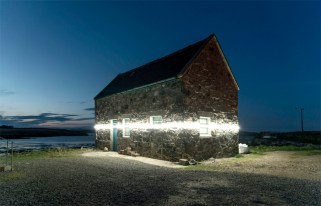
Bob Maher brought to my attention an article where art and science meet to bring the issue of rising sea levels to the public’s attention in dramatic fashion (that helps connect my left brain and right brain).
LINK: https://www.thisiscolossal.com/2019/03/lines-hebrides/
 Click on any numbered site to see details of when paint-out is/was scheduled.
 Ernest Blair Experiment