Posted in Creative writing

Some thoughts on the yellow-spotted salamander

pic_yellowSpottedSalamander
By Camazine, Wikipedia, CC BY-SA 3.0

In the Spring, Heather and I noticed a yellow-spotted salamander on the edge of our garden pond. Today, the pond is almost dry, full of weeds and bulrushes. The pond depends on the runoff from South Mountain.

The salamander is at risk, as the provincial government supports the use of sprays to manage the clear-cuts. Who will speak for the salamander?

Meanwhile, as we approach a municipal election, candidates focus on fiscal accountability. If we destroy our landscape and the species that call it home, then arguing about the costs of different projects is relatively insignificant.

This Thursday, there is a protest against spraying on North Mountain,
https://www.facebook.com/ExtinctionRebellionNovaScotia/posts/1114729368923750 Image may contain: plant, tree, grass, outdoor and nature

My brother, Peter sent me a BBC4 interview with Robert MacFarlane. MacFarlane is well known for his books on the ‘language of place’.banner_BBC4interviewRobertMacFarlane In the podcast, he makes a couple of interesting points.

MacFarlane quotes the poet, W.H.Auden:

“Culture is no better than its woods”

He also speaks to the need to collaborate with artists and musicians, especially when campaigning to save the trees and the landscape.

Acknowledgements

Peter Maher for his support from France. Edward and Heather for their support in Nova Scotia. Nina Newington for her campaigning.

pic_3_orchard26Aug2020References

BBC4 Front Row. Interview with Robert MacFarlane by Kristy Lang.
George Orwell. Some Thoughts on the Common Toad. Penguin Great Ideas. #99.

The title of this blog is a homage to George Orwell (1903-1950). His thoughts on the Common Toad was first published in 1946. He concludes the essay.

“The atom bombs are piling up in the factories, the police are prowling through the cities, the lies are streaming from the loudspeakers, but the earth is still going round the sun, and neither dictators nor the bureaucrats, deeply as they disapprove of the process, are able to prevent it”. p.6.

Post-postscript

From one of my boxes of books, I noticed, peaking out, David Knight and Alun Joseph (Ed) 1999. Restructuring Societies: Insights from the Social Sciences. It contains an essay by Bob Rae. ‘Two men against Revolution. Edmund Burke and George Orwell’. That is now over twenty years ago!

Posted in Art, Creative writing, Poetry

One, Two, Three

Sandra Barry from Middleton sent me a notice on the Elizabeth Bishop Society of Nova Scotia (EBSNS) Virtual Exhibit 2020 fundraiser.banner_EBS This year’s exhibit, Two Arts, is comprised of twelve Elizabeth Bishop inspired drawings by Natallia Pavaliayeva (NP) from Minsk, Belarus. Sandra curates the exhibition and also interviews the artist.

EBSNS
“Elizabeth Bishop is known as a poet of geography and place. How does your own sense of place influence your response to Bishop’s work ?”

NP
“This is one aspect of Bishop’s poetry that resonates powerfully with me. I love travelling very much – and I fully understand Bishop’s keenness for changing places, along with the opposite keenness to have a ‘home’, a place where she belongs to.”

From Sandra Barry’s curatorial statement :

“It was a difficult task to select only twelve images, but the idea of ‘home’ and ‘journey’ anchor the selection. Bishop once said that the poet carries home inside, and her sense of home comprised in a large part from elements and memories of Great Village and her childhood.”

From One Art, Elizabeth Bishop Letters, I was interested in her final collection of poems (1976). “It is to be called Geography III and looks like an old fashioned school book.” p.602.

“The poems in this small volume are some of the most important of her life: In the Waiting Room, Crusoe in England, The Moose, 12 O’Clock News, Poem, One Art, The End of March. They are also some of her most directly autobiographical poems, contemplation of her life as an artist.” p.96 Sandra Barry.

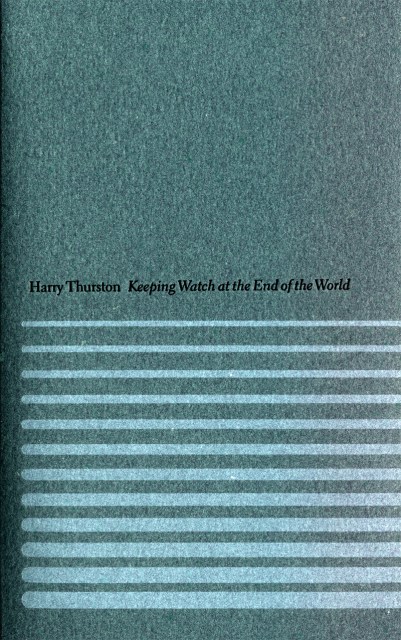
From here you can join the dots to Harry Thurston, Keeping Watch at the End of the World.bookCover_ThurstonEndOfTheWorld He has a poem ‘Geography: on first discovering Elizabeth Bishop in a Used Bookstore in Manhattan’. Dedicated to Sandra Barry. It starts:
“Geography III
(So plain but for the oddity
of Roman numerals),
I lift it down and begin,
by chance, From narrow provinces … “.
p.100

Thurston lives in Tidnish, Nova Scotia.

Andrew Spacey (online) provides an analysis of the poem ‘One Art’

“Elizabeth Bishop’s poem One Art is in the form of a villanelle, a traditional repetitive poem of nineteen lines. In it she meditates on the art of losing, building up a small catalogue of losses which includes house keys and a mother’s watch, before climaxing in the loss of houses, land and a loved one.”

pic_ladySlipper
Cypripedium acaule (Lady Slipper Orchid)

Postscript
This week with the rain showers we are seeing more flowers. On my walks with Siqsiq along the Annapolis River, I found the Pink Lady’s Slipper Orchid (Cypripedium acaule).

1-2-3

One Art, Two Arts, Geography III

Acknowledgements

Sandra Barry for her curatorial work on the EBSNS web site and blog. Edward Wedler for his artwork. Heather Stewart for her love and support.

References
Robert Giroux (Ed.), 1994. One Art, Elizabeth Bishop Letters. Farrar, Strauss and Giroux.
Sandra Barry, 2011. Elizabeth Bishop: Nova Scotia’s Home-made poet. Nimbus Publishing.
Harry Thurston, 2015. Keeping Watch at the End of the World. Gaspereau Press.

Posted in Creative writing, Nature

Road Trip/Spring Flowers

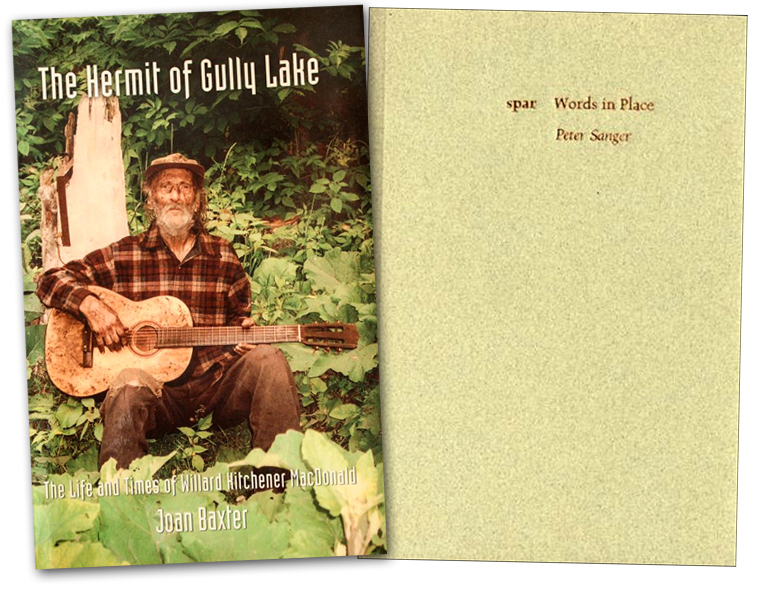
On Sunday, it was time for a road trip to New Glasgow. Heather had baked two pies: a spinach and bacon quiche, and an apple pie with crumble topping. This time, after Truro, we headed to Earltown, Brule and River John.bookCover_2books_hermitSpar Passing by Nuttby Mountain, we remembered the Hermit of Gully Lake, written by Joan Baxter. Further along the Berichan Road, I was reminded of Peter Sanger’s book Spar: Words in Place. We also recalled attending ‘Read by the Sea’ at the Firehall in River John.
Left at 7 am home by 7 pm. We spent the day with Great Grandad John and managed to FaceTime with all six great grandchildren. Siqsiq, the lone Inuit sled dog came along for the ride. It was an excellent day.

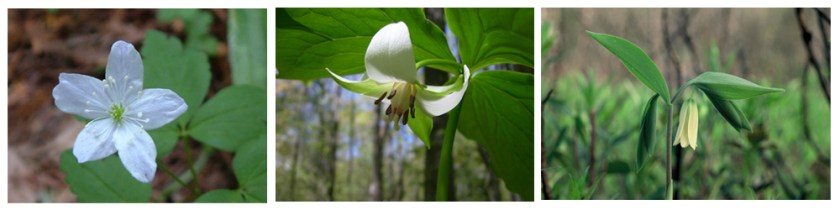
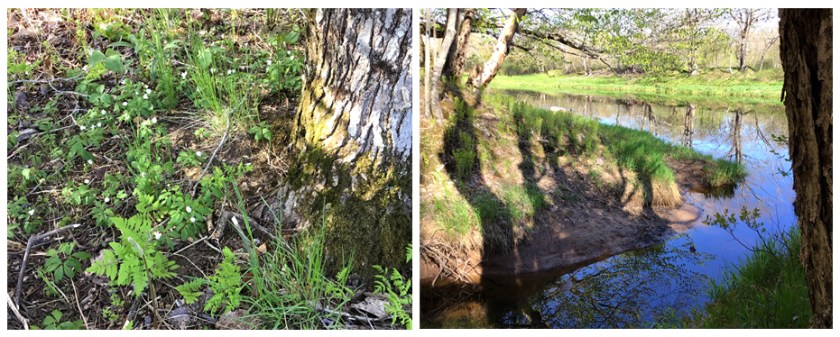
On Monday, I wanted to check the ephemeral Spring flowers that grow along the banks of the Annapolis River. It is a special habitat under Red Oak and White Pine, on riverine sands and gravel.wildflowersAnnapolisRiver

3wildflowersWe found Anemone (Anemone quinquefolia), Nodding Trillium (Trillium cernuum) and Bellwort (Uvularia sessifolia), undisturbed on Andrew’s property. This reminded me that now is a good time to rediscover these special botanical places, along the River, as well as in the beech woods on the slopes of North Mountain.

With the late frosts and dry, sunny days, it remains a challenge to plant out seedlings from the greenhouse. We really do need a couple of cool, rainy days.

Acknowledgements

Heather for the baking, travel companionship and botanical expertise. Edward for the technical graphics.

References

AE Roland and AR Olson, 1993. Spring Wild Flowers, Nimbus NSM.
Joan Baxter, 2005. The Hermit of Gully Lake: the life and times of Willard Kitchener MacDonald, Pottersfield Press.
Peter Sanger, 2002. Spar: Words in Place, Gaspereau Press.

Posted in Creative writing

See you in the movies

This week, we binge-watched Season 2 of Trapped.logo_NETFLIX It is a dark, detective story, set and filmed in Iceland. Part of the attraction was landscape photography. This somewhat coincided with another Netflix offering Leave No Trace, a film set in the Pacific Coast rainforests of Oregon. Again, a unique landscape backdrop.
So here is the question: if you wanted to promote Nova Scotia, what type of movie might you make to depict the landscape, lifestyle and values of this province?

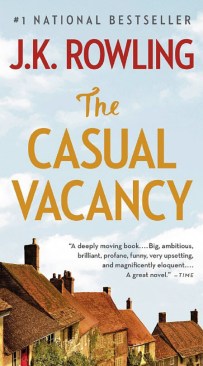
bookCover_casualVacancyOne idea came from a quick read of the first few chapters of the novel, “The Casual Vacancy” by JK Rowling. It is set in the small town of Pagford in England and describes the unfolding of events after the sudden death of one of the Town Councillors. Along the way, it unmasks the various values within society.

Other titles that come to mind, that could fit our geography: “The Constant Gardener” or “The Inconvenient Truth”.

Or we could talk about real events. For example, the Gordonstoun project and its Royal connection. Certainly, Annapolis Royal has a rich history that could provide a Pagford backdrop. We certainly have a large number of ‘constant gardeners’ and we are all fearful of the ‘inconvenient truth’.

Meanwhile, this Saturday, Centrelea Community Hall is the venue for ‘Butch Cassidy and the Sundance Kid’. The film was first released fifty years ago in 1969.

See you at the movies …

David Manners set a precedent, starting from Centrelea.

P.S. Whatever did happen to the Nova Scotia Film fund?
Should we undertake this project, before the forests have been completely ravaged?

(see Annapolis Spectator, June 12.2019. Turned down – Forestry minister Rankin rejects Annapolis County bid to preserve the older-growth forest.)

Acknowledgements

To Frank Fox for the suggestion to watch Trapped. To Heather Stewart who purchased The Casual Vacancy at the Thrift Store in Lawrencetown for seventy-five cents. To Nancy Godfrey for Saturday Night at the movies in Centrelea. Edward Wedler for his graphics talent, his artistic eye, and a link to his blog post, “What do the films “Outlander”, “Titanic” and “Dev-Con 4″ have in common?”

References

JK Rowling. 2012. The Casual Vacancy. Little Brown and Co.
Check online for the economic value of Rowling’s books.

Posted in Creative writing

Tidal Bore and Tidal Lore

Sanger in his essay, Groundmass, describes the tidal bore on the Shubenacadie River from the diaries of Charles Lyell and William Dawson (p.83). He also links the phenomena to the Elizabeth Bishop’s poem The Moose p.84.

Last week, we attended a meeting of the Paradise Historical Society. Aaron Taylor gave a presentation on ‘Where did the First People live before the Europeans came? What patterns can be found that might predict these locations in our area?” Aaron described the results of his archaeological research on Paradise riverside land. In particular on the properties of Jack Pearle and David Whitman.

Much of the discussion concerned the location of the tide head on the river. This brings fish species on the tide up into the river valley. Today, of course, we have the tidal power dam on the river at Annapolis Royal. Imagine if we had the same natural conditions today between the Annapolis Basin (Bay of Fundy) and the Annapolis River.

This week, I was able to pick up three books by William Inglis Morse from the Frank Morse library in Lawrencetown. In Acadian Lays and other verse, the poem The Call of the Marsh Hen (p.8)

In creaking flight the marsh-hen flies
Along the old French road, where the vale of Paradise
lies,
And gently down from the ancient hills a rippling stream
Doth wend its way to song and Acadian dream”.

There is a footnote. ‘The location of the old French road is near the confluence of the Annapolis River and the Paradise Brook, Nova Scotia,. The tides, freshets and the lapse of time have practically obliterated this way, leaving only a few traces across the interval of marshy land’.

in Genealogie (p.24) we find a photograph of Burn Brae. It is still recognizable as the house on the Morse Estate.

From his poem, ‘Acadia’ p9.

Land of the dark forest and mountain
And tides that surging flow,
Land of the murmuring pine tree
And the romance of long ago.

Evidence suggests that both the Mi’kmaq and the French Acadians were intimately familiar with the relationship between the Fundy tides and the river systems of Nova Scotia. They located their settlements, permanent or seasonal, to take advantage of the concentration of the fish stocks in the rivers.

Acknowledgements

To John Wightman for sharing his copy of William Inglis Morse Limited Edition book.

Thanks to Edward Wedler for finding the video of the tidal bore on the Shubenacadie River.

References

Peter Sanger.2002. Spar: Words in Place. Gaspereau Press.

Elizabeth Bishop. 1983. The Complete Poems. p 169

William Inglis Morse 1908.Acadian Lays and other verse. William Briggs, Toronto

William Inglis Morse (ed). 1925. Genealogiae or data concerning the families of Morse, Chipman, Phinney, Ensign and Whiting. Nathan Sawyer, Boston. Limited Edition 200 copies.

Posted in Creative writing, Nature

Place in words

Through the services of Inter-library loan, I received a copy of Peter Sanger’s book, Spar: words in place, published by Gaspereau Press in 2002.

It includes four essays: Biorachan Road, The Crooked Knife, Keeping: the Cameron Yard and Groundmass.

From his Foreword, “this collection speaks a word for Nature and that it does so in the spirit of sauntering“.

I was surprised to find the first essay ‘Biorachan Road’ covered part of the geography near Earltown. Heather and I had walked this section a few years ago, as part of our ‘Road to Georgetown ‘ project.

In the fourth essay, ‘Groundmass’, Sanger links a silvery-white translucent, vitreous, laminated rock that he found in a shed on his farm in South Maitland to the earlier science of Charles Lyell, Charles Darwin, William Dawson and to the poetry of Elizabeth Bishop ‘Crusoe in England‘. Sanger named the rock ‘spar’ from the Anglo-Saxon “spare” or “spaeren” meaning gypsum. There is much more to this essay, but for now, it gives an explanation of the title for this elegant, small collection of essays.

Cover_gettingOutOfTownIn Annapolis Royal at Bainton’s bookstore, I picked up Kent Thompson’s book Getting out of town by book and bike. It is an entertaining read, including the idea: “every now and again, I get on my bike and ride to a small town public library to look for Anna Karenina“. Thompson visits both the towns and writing of Ernest Buckler (Centrelea, West Dalhousie) and Elizabeth Bishop (Great Village). Writing of both EBs is of interest to me, and likely, to Nova Scotia.

cover_waterfallsOfNovaScotiaIn this same spirit, Heather was reading Waterfalls of Nova Scotia. It describes one hundred waterfalls. Number #19 is Eel Weir Brook Falls up behind Lawrencetown on South Mountain. While a short hike, it gave us an excuse to ‘get out of town’.
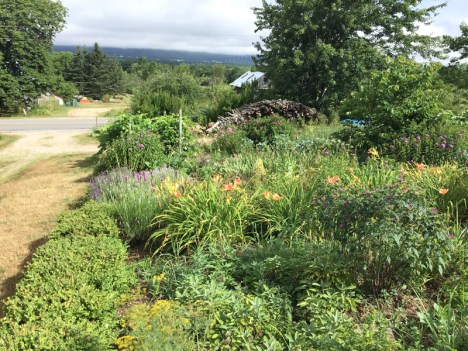
We can take this concept of ‘place in words’ a couple of steps further. If we fully appreciated the landscape, in terms of its geology, botany, zoology would we be quite so willing to remove the forest cover, to mine the bedrock? Perhaps, its time to resurrect, the works of Albert E. Roland. He made a significant contribution to our understanding of the geology, physiography and botany of this province. Would these words speak for Nature?

Acknowledgements

To Heather Stewart for the suggested waterfall hike. Also for access to her library, that includes the books by Albert Roland. Edward Wedler is on his way south to Florida yet we caught his graphics contribution.

References

Peter Sanger. 2002. Spar: words in place. Gaspereau Press.

Kent Thompson. 2001. Getting out of town by book and bike. Gaspeareau Press.

Benoit Lalonde. 2018. Waterfalls of Nova Scotia. A Guide. Goose Lane Editions.

Albert E. Roland.1982. Geological Background and Physiography of Nova Scotia. Nova Scotia Institute of Science.

Albert E. Roland and E.C. Smith. 1969. The Flora of Nova Scotia. Nova Scotia Museum.


Posted in Creative writing

Local Geography

Last week, we held a board meeting of the Ernest Buckler Literary Event Society (EBLES) at Lunn’s Mill beer company in Lawrencetown. The society supports biennial events in celebration of local writers. Afterwards, the topic of the Morse Estate in Paradise came up, and whether it was the model for the ‘secluded country guesthouse’ described in Buckler’s book The Cruelest Month.

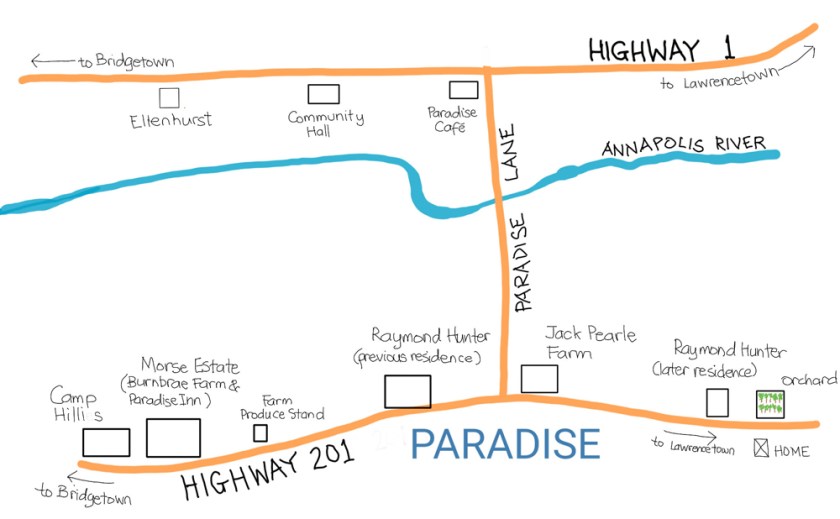
This set me on a quest. map_Hunter_1000w

The Morse Estate has been renamed Burnbrae Farm and Paradise Inn. Consequently, I dropped in, to meet the owners: Erik and Simone Wasiliew. They run it as a Bed and Breakfast. Recently, they have also purchased the adjacent Camp Hillis, a residential facility from the provincial government, and plan to integrate it back into the estate.

From my visit, I learned some of the histories of the Morse Estate, as well as an appreciation of the vision of the new owners.

In the book, one of the characters is Morse Halliday (perhaps a clue). The guesthouse is called ‘Endlaw’, an anagram of Thoreau’s Walden.

Clearly, Paradise is changing. Across the Annapolis River, we find the new Paradise Cafe. Jack Pearle, who farms on Paradise Lane, has a new produce stand on the Highway #201.

To learn more about the history of the houses in Paradise, stop at the Community Hall. For each house, there is a short history, photograph and ownership information. This year also sees the establishment of the Paradise Historical Society. Every August, the Hankinsons at Ellenhurst, stage the Moonlight concert.

My link to the village of Paradise is through Raymond Hunter. Raymond and Rona lived on the corner of Paradise Lane, opposite Jack Pearle. Later, they moved east along Highway #201 towards Lawrencetown, where Raymond planted an organic orchard. That is where we enter the story. We are picking the orchard and maintaining its organic status

bookCover_cruelestMonthIt is awesome to imagine an event at Burnbrae Farm and Paradise Inn that looks at Buckler’s book The Cruelest Month in its modern context. Ideally, in April, which Buckler defined as the cruelest month. Now, its time to re-read the book.
Acknowledgements

Anne Crossman and Jane Borecky, both Board members of EBLES, for their conversation and support. To Erik and Simone Wasiliew, Burnbrae Farm for their hospitality. Sandra Barry for sending me the link to the Elizabeth Bishop poem, The Map. https://www.poemhunter.com/best-poems/elizabeth-bishop/the-map/. And Edward Wedler for his illustration.

References

Ernest Buckler. 1963. The Cruelest Month. McClelland and Stewart Ltd.

Burnbrae Farm/Paradise Inn. go to http://www.burnbraeparadise.ca

Footnote

Through the Annapolis Valley Regional Library Interlibrary loan service, I have received a copy of Elizabeth Bishop’s book Geography III. It includes ten of her poems, published in 1976. The frontispiece makes reference to  ‘First Lessons in Geography’. Monteith’s Geographical Series. Published by A.S. Barnes & Co. 1884. Lesson VI: What is Geography ? Lesson X: What is a Map ? Bishop was familiar with this book in her childhood.

Answers. A description of the Earth’s surface. A picture of the whole or part of the Earth’s surface. Check the link above, to read Elizabeth Bishop’s poem The Map.


Posted in Creative writing, Poetry

Geography III: place, writing and maps

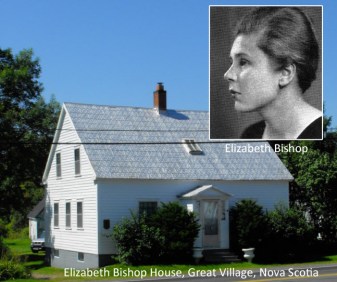
elizabethBishopAndHouseAt the end of last week, we decided to take a trip along the Parrsboro shore, primarily to check out the Fundy Geological Museum. On our way home, we stopped at Great Village, Nova Scotia. This community was of interest; it was the childhood home of the late poet, Elizabeth Bishop. On Friday afternoon, there was a poetry reading at St James Church; there was a self-guided tour of the village available; and one could see the Elizabeth Bishop House, now an artist’s retreat.

elizabethBishopinParisAt the church, I picked up a copy of the brochure Elizabeth Bishop’s Paris. This small brochure describes two visits to Paris in the mid-1930’s. Interestingly, it includes a map of central Paris, identifying locations visited by Bishop and Louise Crane. The map also shows the location of the first conference on Elizabeth Bishop in France. Elizabeth Bishop in Paris: Spaces of Translation and Translations of Space. 6-8 June 2018. The text was written by Jonathan Ellis, Sheffield University.
A second publication, that I purchased, was Echoes of Elizabeth Bishop. To celebrate the Elizabeth Bishop Centenary (2011), the Elizabeth Bishop Society of Nova Scotia (EBSNS) hosted a one-time short prose competition, asking participants to write about their own sense of place. There were five categories: Elementary (Grade 4-6), Junior High (Grade 7-9), Senior High (Grade 10-12), Post-secondary, Open (19 years or older). EBSNS published the winning entries, edited by Sandra Barry and Laurie Gunn. The book was typeset and printed by Gaspereau Press.

EBSNS maintains a website and published an annual newsletter. On the website, under the Media tab, there is a podcast of Claire Miller reading In the Village.

Geography III was Bishop’s final book of poems, published in 1976. On his website, Michael Ollinger, Digging into the earth’s surface: pondering Geography III by Elizabeth Bishop states:

“To describe the planet aptly is one thing, but to understand one’s place is another one altogether. The poems of Elizabeth Bishop’s Geography III go beyond mere description of the earth’s surface and delve into how geography defines not only where we are on the planet, but also who we are”.

” The phenomena of contextualizing  oneself in the world points to why Elizabeth Bishop may have chosen to title the collection Geography III as opposed to Geography I or Geography II; the geographies presented in the poems are more than just a description of the earth’s surface”

In my blog title, I have reinterpreted Geography III as “place, writing and maps“.

I hope you enjoy these links to the work of Elizabeth Bishop and appreciate the remarkable efforts of the EBSNS to connect her work to Great Village, Nova Scotia.

Thanks to Edward Wedler for the graphics, and Heather Stewart, my travel companion.

Postscript. The EBSNS is an excellent model for EBLES (Ernest Buckler Literary Event Society), of which, I am a Board member.

References

Elizabeth Bishop Society of Nova Scotia (EBSNS) http://elizabethbishopns.org

Elizabeth Bishop. 1976. Geography III. Farrah, Straus and Giroux, New York.

Elizabeth Bishop’s Paris. 2018. Brochure. Text by Jonathan Ellis, Sheffield University. j.s.ellis@sheffield.ac.uk

Sandra Barry and Laurie Gunn (eds.) 2013. Echoes of Elizabeth Bishop. Elizabeth Bishop Centenary (2011) Writing Competition. Published by EBSNS, Great Village, NS.

Michael Ollinger  Digging into the earth’s surface: pondering Geography III by Elizabeth Bishop. Posted March25, 2009. Check the Poetry tab at michaelollinger.org


Posted in Creative writing

A Sense of Well-Being

Summertime is a time for family. IMG_0713

Every couple of years, we bring everyone together from Vancouver, Iqaluit and Ontario; this year for a few days at Pictou Lodge. It is a time to shake up the ‘old routine’.

Here are a few examples.

There is the opportunity to share newly discovered places in the region: to enjoy the excellent seafood chowder and lobster rolls at the cafe in Hillsburn; or an excuse to go to the End of the Line pub to watch World Cup soccer, or to check out the new British fare at the Paradise Cafe on the weekend. Or to walk up the road to Lunn’s Mill for the beer, but stay for the food.

With children and grandchildren, we have to revisit the concept of the ‘electronic cottage’. Internet service is poor in rural Nova Scotia. Not that simple. “How come Grandad’s iPad cannot access Netflix but more recent devices can. Well, he bought it in 2011.” The solution: buy a new iPad with the latest operating system. Oh yes, and if you want to use the flat screen TV, why not purchase Google Chromecast. Of course, the biggest challenges are all the passwords for the Apple store, Google, Netflix etc.

For the ‘wanna-be’ farmer, it is wonderful to access the youthful confidence on the tractor. We can go down and bush-hog the lower field, move the rocks from the field boundary up to the side of the pond or lift the pallet of earthworm casts to the orchard. It still leaves me with a mowed cord-wood road to bring out next year’s Winter wood supply.

We watched, as there was a need to ‘mouse-proof’ the barn. Now we need new gutters for the barn. Let’s put gutters on the garage too. We can capture the rainwater for watering the garden.

It brings into your life, the task-driven urgency experienced in our cities every day. Yesterday, we were able to get a car window repaired in Middleton, pick up water-testing bottles at the hospital in Windsor, go to the Apple Store at Halifax Shopping Centre, and still have time to drop into the Source in Bridgetown for the Chromecast purchase.

Altogether, this has set me up for today’s blog. That is without mention of the dry soil, unpredictable rainfall, weeding, or need to pick green beans, peas and gooseberries.

Final message. Don’t be fooled into thinking that the arrival of the Internet is the panacea to all of our rural economic issues. The Internet is simply part of the Infrastructure. In addition, you need access to other devices; you need access to applications that are relevant to your lifestyle, and you need connections with others who have knowledge and solutions from other places. And you must be able to embrace ‘change’. That all together, can lead to ‘a sense of well-being’

In advance, I want to thank Edward Wedler, Heather Stewart and family for their encouragement, creativity and continued support.

Posted in Creative writing, Event Review

The Five Little Pigs

Do you remember the children’s’ nursery rhyme ‘ The Five Little Pigs’? Counted out on the toes or fingers of the child.

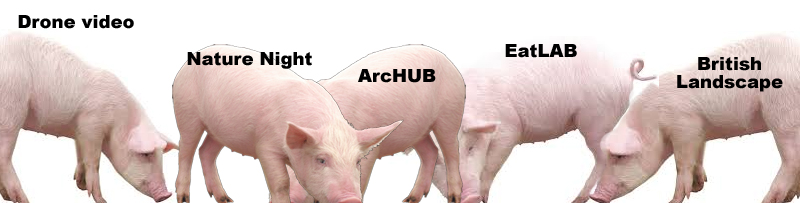
“This little pig went to market. This little pig stayed home. This little pig had roast beef. This little pig had none. This little pig went wee-wee all the way home.’ Here are my five little pigs.5pigs

  1. new drone video from Neil Green of forest cutting above the Inglisville road. You can compare it with the video shot in January.
  2. This Saturday evening there is Nature Night at Sugar Moon Farm. It includes talks by Dale Prest, Community Forests International, Greg Watson from North Nova Forestry Co-operative (NNFC) and Tom Miller, Friends of Red Tail. The event is designed to engage Nova Scotia’s small private woodlot owners in the fight against climate change. We are members of the NNFC and will attend.
  3. David MacLean at COGS sent me a link to the work of Scott Morehouse at Esri on ArcHUB. This is of interest for two reasons. ArcHUB is an industry-driven approach to the Community Information Utility concept. At the end of the article, there is a link to a video where Scott describes his early beginnings in GIS. This time frame coincides with the history of COGS.
  4. Yesterday I bumped into Wayne Regier. Wayne worked with me at AGRG.  He explained that there is now the EAT lab at NSCC, Middleton. EAT is Environmental and Agricultural Technologies.  There is the likelihood that the climate network established by David Colville will be extended across the province. This makes tremendous sense in the light of climate change. Secondly, the Lab is using drone and soil sensor networks to monitor the condition of vineyards in the province. Both excellent, supportable initiatives.
  5. Finally, I have now finished Nicholas Crane ‘s book The Making of the British Landscape. I have been lugging this tome around for the last month or so. It covers the last ten thousand years. In the last chapter, Crane talks about the changes in the British urban landscape over the last hundred years, post the industrial revolution and post the second world war. It reminded me how much land use is impacted by our industrial economy. This linked, in my mind, to Closure, Dick Groot’s photographic exhibit in Windsor on the demise of manufacturing in Nova Scotia. I plan to see his exhibit this Friday at the Cedar Centre in Windsor.

These are my ‘five little pigs’. I shall be able to report back on #2 and #5 next week. I have started to read Simon Winchester’s book. Unfortunately, the style is rather pedantic; however, I shall persevere, because I am interested in the field work necessary to produce that first Geology map of the United Kingdom. I think that I now understand why I could go to two second-hand bookstores and find the same book!

Not exactly sure, what the symbolism might be about those five pigs.

REFERENCES

Neil Green video link https://youtu.be/_X78Ei38_Wo

Nature Night at Sugar Moon Farm https://www.sugarmoon.ca

Link to ArcHUB http://www.esri.com/esri-news/arcwatch/0418/back-to-basics

Nicholas Crane. 2016. The Making of the British Landscape. From the Ice Age to the Present. Weidenfeld and Nicholson. Chapter 22 Interland 1920-2016.

Simon Winchester. 2001. The Map that changed the World. William Smith and the birth of Modern Geology. Harper Collins.