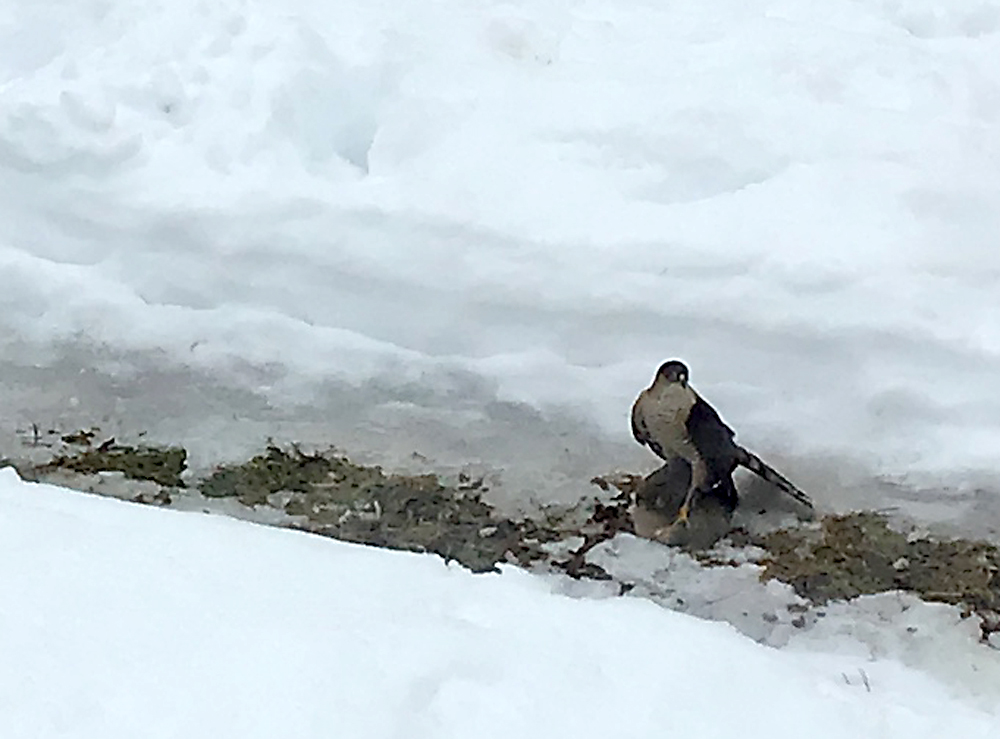
Heather has been feeding the birds all Winter. The main customers are chickadees, mourning doves, blue jays and red polls, and an assortment of woodpeckers — plus the squirrel family. Tuesday, looking out the living room window, I saw a bird flash by. It was a sharp-shinned hawk, in the process of preying on a mourning dove. Clearly, we are feeding others in the food chain.
On Edward’s recommendation, we started to watch the series: Canada: the story of us on CBC Gem. There are ten episodes, each of forty five minutes, covering the main events in the history of the country. Initially, we were stunned by the combination of beautiful landscapes, with commentaries by well-known Canadian personalities. It was a great way to fill snowy evenings. We are on episode six; it covers the First World War. The format is beginning to seem repetitious, however, I am sure we will finish the series.
In return, I would suggest Mango Dreams on Netflix. This is the story of an Indian doctor, reliving his childhood memories. Again, it offers insight into the political reality of the Indian sub-continent.
Acknowledgements.
Edward for his movie recommendation. Checking Google, it seems there are similar series for both the United States and Australia. Of course, I imagine that not everyone in Atlantic Canada will have the same list of historical events. Heather shared the movie watching.
This week, I received the quarterly newsletter from Jon Percy. Fundy Tidings is a useful compendium of initiatives that impact the ecology of the Bay of Fundy. It serves to reinforce the concept that even within the global pandemic environment, there are still individuals concerned about our local geography: landscape and seascape.
To top off the day, we watched The White Tiger on Netflix. Set in India, the story describes the journey from rural poverty to entrepreneurial success.
Of course, white tigers are extremely rare, as indeed, are green elephants.
Postscript
On Friday afternoon, we picked up ‘take and bake’ tacos with the fixings at Lunn’s Mill on the Carleton Road, Lawrencetown ( Highway #201). Very good.
Acknowledgements
Jon Percy for Fundy Tidings. Heather for sharing our meetings with both the Green Elephant and the White Tiger. Edward added his graphic talent.
References
Fundy Tidings, Newsletter of the Bay of Fundy Ecosystem Partnership, Creating-sharing-using knowledge about the Bay of Fundy, February 2021 issue
This week, we had to drive from New Glasgow to Antigonish. It was surprising to see the twinning of Highway #104. As part of the construction, this leads to significant removal of forest cover.
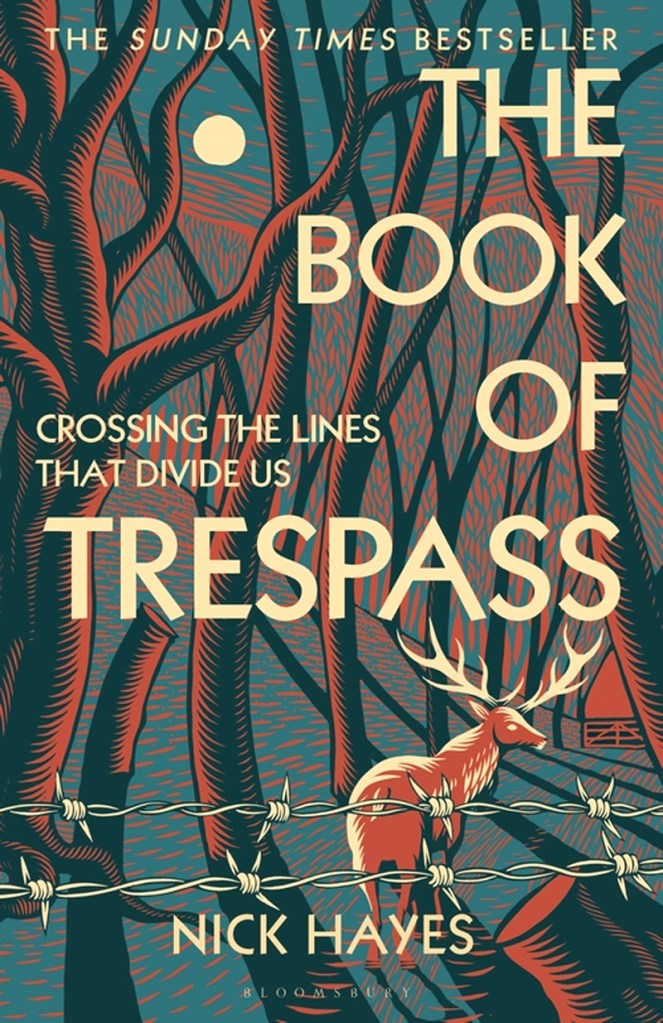
From England, I received the PLANTED newsletter, including an interview by Sam Peters with Nick Hayes on his book, The Book of Trespass. Hayes describes the lack of access to the English landscape, and makes comparisons to Scotland and Scandinavian countries. This also contrasts with the situation in Canada, and Nova Scotia in particular. Here, we have protesters in the courts for challenging the clearcutting of crown land in Digby County.
It seems such a long time ago. In 1964, after a summer working in Labrador, I returned to Montreal where I bought a Greyhound bus pass, $99 for 99 days of unlimited travel. This allowed me to travel down to Mexico, across to the west coast, California, before heading North to Victoria, BC. I caught the airplane home to England from Montreal. Later, I recall discussing the trip with a school friend, Roy Peters. He made a similar trip the following year. His son, Sam Peters is the Principal at PLANTED.
I also recall the days of hitch-hiking in the United Kingdom. We would take off on long weekends to go caving (spelunking). From the University of Birmingham, this included the Peak district, Derbyshire, the Mendips in the Southwest, and also Lisdoonvarna, on the west coast of Ireland. It’s hard to imagine this freedom, especially now in these COVID-19 days.
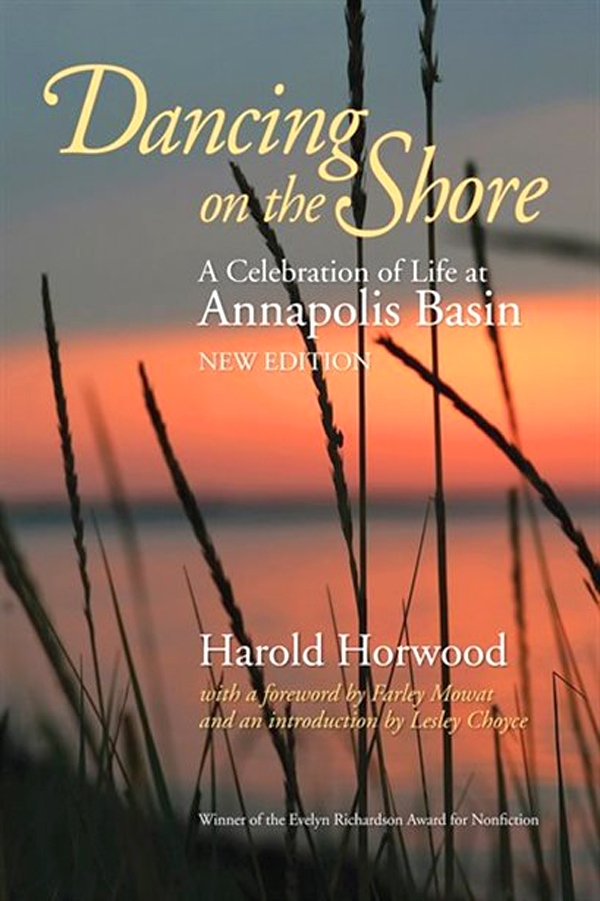
While in New Glasgow this week, I finished reading Harold Horwood’s Dancing on the Shore. It represents excellence in Canadian nature writing.
”The tides sweep over the clam flats in a great flood twice daily. The migrants sweep through the sky in great flocks twice a year. These vast rhythms, so visible in such a small space, seem very like the heartbeat and the breathing of a living planet.”
Postscript
Bloom where you are planted
— Raymond Hunter, an early organic farmer in the Annapolis Valley, cited on the Ironworks Hunter Brandy bottle.
Acknowledgements
Thanks to Roy Peters and Andrew Ronay for the connection to the Planted newsletter. Heather shared the drive to Antigonish. Edward for his graphics.
What impressed me about the conversation between two writers that I have enjoyed – was their emphasis on language, and it’s relationship to Geography.
It does not take much effort to transform ‘conversation’ to ‘conservation’.
Acknowledgements
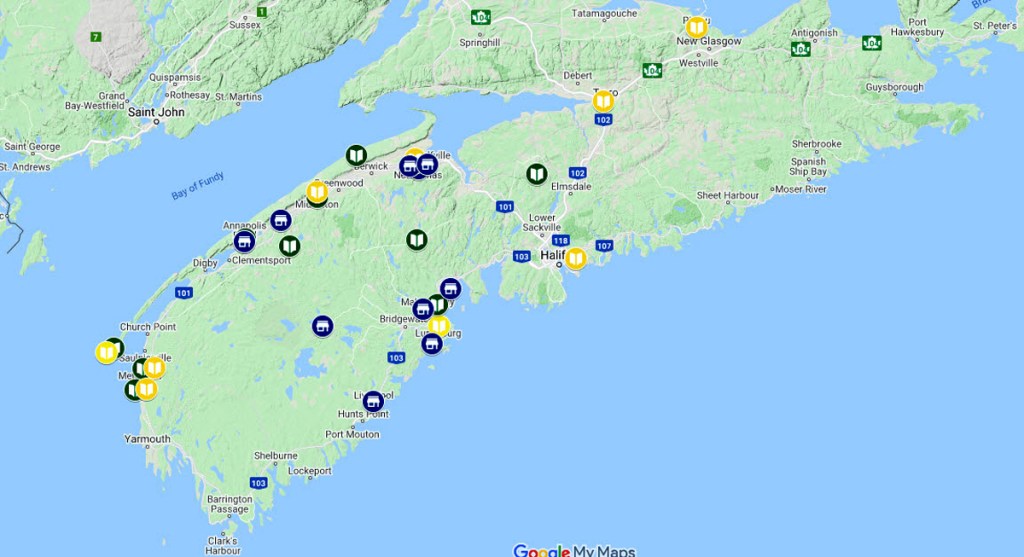
Sandra Barry for the kindness of forwarding the link to Orion magazine. Moose House Publications for their story map. Edward and Heather continue their support.
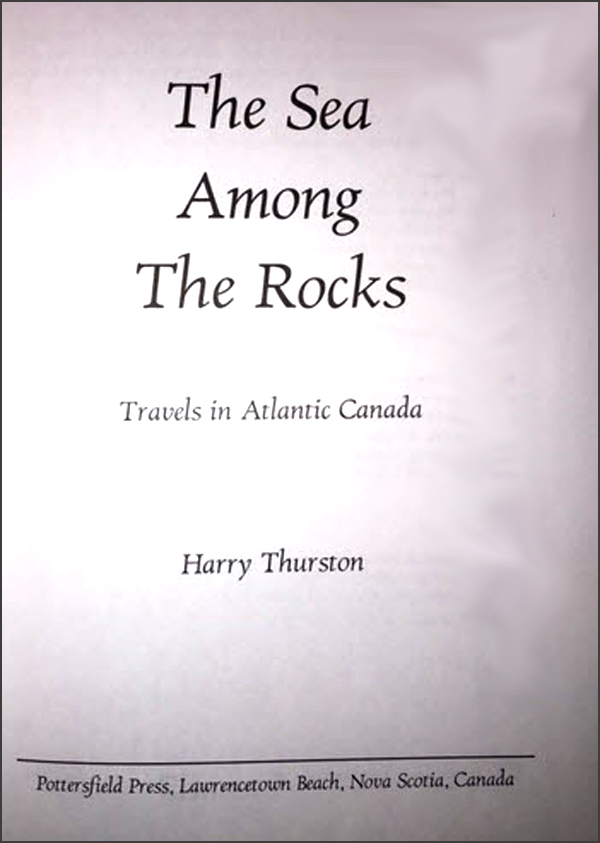
The Sea among the Rocks is a quotation from Evelyn Richardson, used as the title for Harry Thurston’s book of travels in Atlantic Canada.
“Though Morrill holds title to the Island of Bon Portage, who could sell or buy the sea among the rocks, the wind rippling the fields of grass, the moon’s lustrous path across the surging water, or the star-studded bowl of the night sky? They are without price, and priceless, and will be here for those who follow us. Then the work of our hands, those insignificant scratches on the face of the earth, may serve to remind others of our passing…”. p.255
I have just finished reading Thurston’s book. The writer has collected together a series of articles written between 1980-2000 in Atlantic Insight, Equinox, Harrowsmith and elsewhere. In all cases, they concern the use of the land and sea : farming, forestry, mining and fishing.
Examples include:
Prest’s Last Stand Mooseland, Nova Scotia The Enemy Above Millstream, New Brunswick The Fat of the Land Tatamagouche, Nova Scotia North of Nain Cut Throat Island, Labrador
Perhaps, is it time for Harry Thurston or the next generation of writers to document our relationship with the landscape; whether fishing, farming, forestry, mining in 2020?
This week, I received a notice from the province about an online survey to collect input directly from private woodland owners. www.novascotia.ca/woodland-owner-survey.
Postscript
My blog title, Life Ahead, is taken from the new Netflix movie starring Sophia Loren. Highly recommend.
Acknowledgements
John forwarded the link to woodland owner survey. Heather shared the movie night. Edward added his artistic touch.
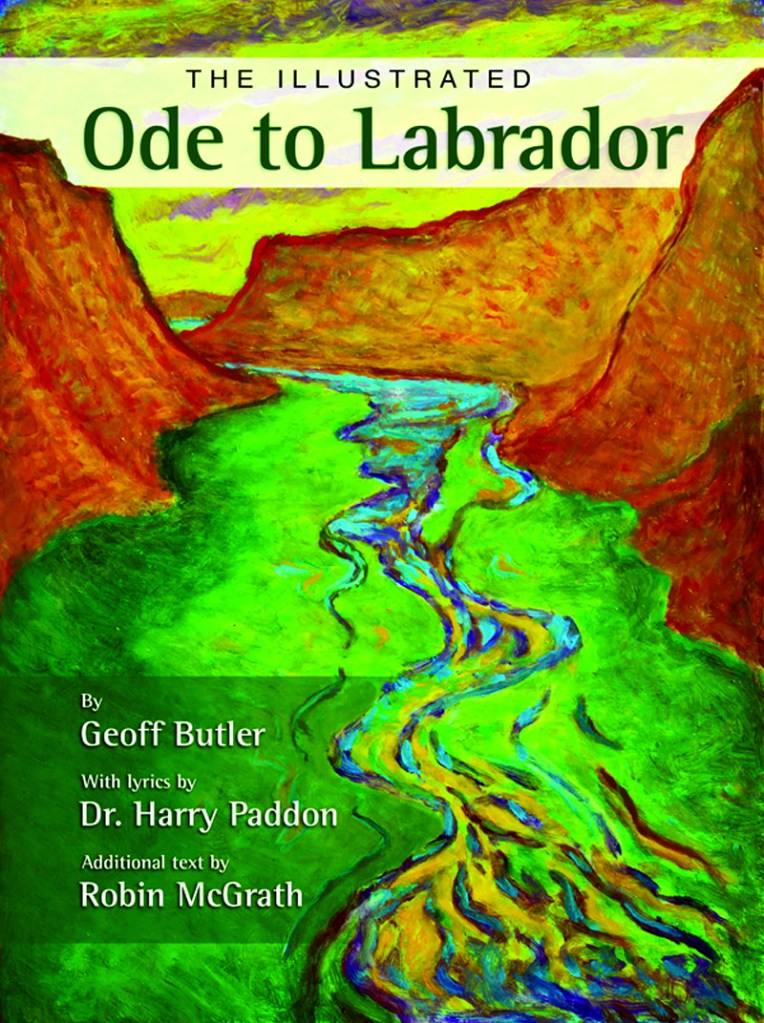
This weekend, we plan to send a care package to Iqaluit. It will include pairs of knitted socks, as well as a book illustrated by local artist, Geoff Butler “The Illustrated Ode to Labrador“.
The book was picked up months ago in Annapolis Royal. It tells the story of the Ode to Labrador. Besides the Art work, it contains lyrics by Harry Paddon and additional text by Robin McGrath.
I am sending it North for Andrew and the grandchildren to read. It brings back memories of my first field season in Labrador in 1964. I was based at the McGill Sub-Arctic Research Station in Schefferville, and developed a love for the Northern landscape.
Last Friday, we finished watching the BBC production of Victor Hugo, Les Miserables on Gem. While a gripping eight part series, it was hard to watch the turmoil of the French Revolution, as we endure the present COVID political uncertainties.
Same day, we had to pick up a book in Annapolis Royal. After enjoying the French Basin trail, dog walk with Siqsiq, we stopped for a morning coffee at Lola’s Café. This led to a brief stop at the Library. Here, I found an early Harry Thurston book (2002), “The Sea among the Rocks“. It is a collection of short pieces describing familiar places in Nova Scotia, Newfoundland and other parts of Atlantic Canada. In most cases, he writes from an environmental perspective.
‘Thurston writes passionately about the region’s bounty, the environmental destruction and the attempts to protect what’s left of our natural heritage. He shows how these concerns for the environment are inseparable from the spheres of community and culture’.
On returning home, I found an email from the Retired Teachers Organization (RTO) on a five part workshop, facilitated by the Acadia Entrepreneurship Centre. These online sessions address the topic of ‘redefining retirement’.
My questions are simple.
‘What can I do in 2021, to guarantee that there will be a Centre of Geographic Sciences in Lawrencetown for my grandchildren, should they decide to follow my career path — that means, the opportunity to study Cartography, Geographic Information Science, Remote Sensing and Surveying, ten years from now?
Retirement from an educational institution does not mean retirement from one’s life time academic and research interests. Most post-secondary institutions understand this point. How about the Nova Scotia Community College?
Postscript
We publish rural Nova Scotia. Check out Moose House Publications founded by Brenda Thompson in 2019. www.moosehousepress.com
Acknowledgements
Both Edward and Heather share many of the same interests. Friday evening, we had an excellent supper at The Station with Anne, Bill and Roger. Earlier, John shared his thoughts on the ‘state of the environment’.
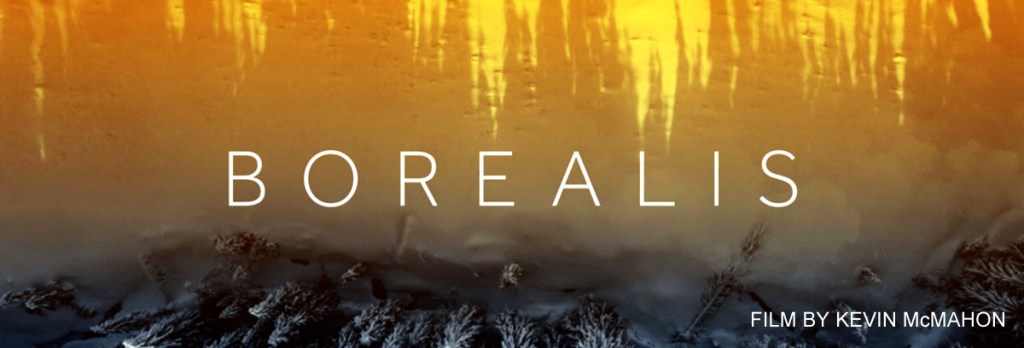
After weeks of Netflix and CBC Gem, it was refreshing to rediscover National Film Board (NFB) documentaries. For those seeking to change society’s perception of our forests, I would recommend the film, Borealis.
It describes the intrinsic values of the Boreal forest, especially in these times of climate change. Made me wonder whether there should be a similar film made on the Acadian forest.
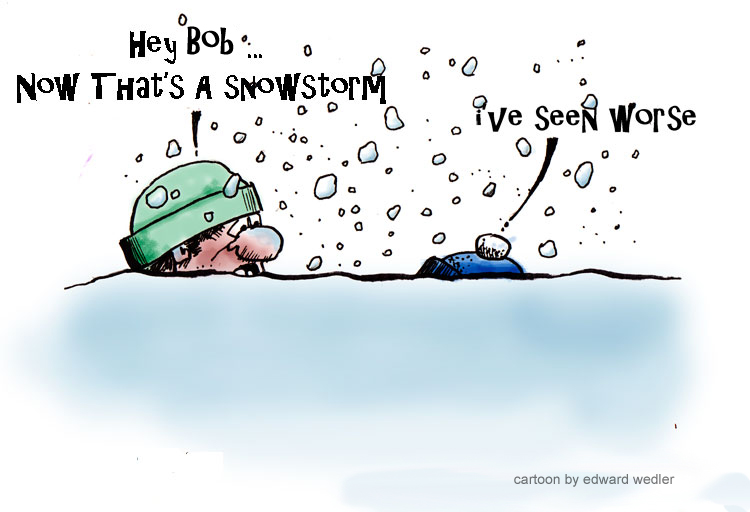
This has been a particularly long weekend. I just hope the snow stays around for a cross-country ski tomorrow (Sunday).
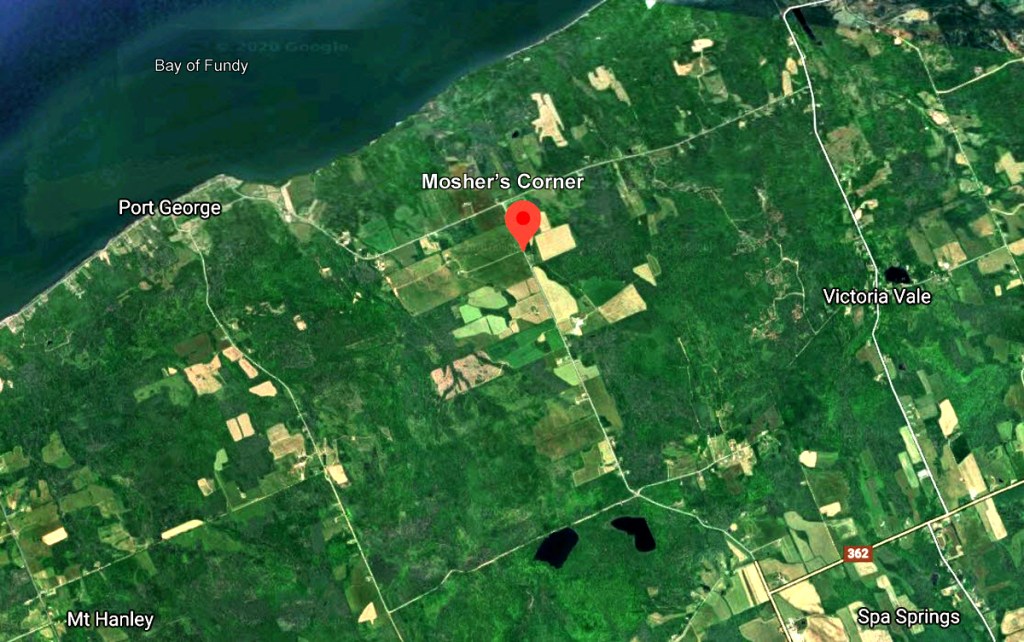
Over the Christmas holiday, I had the chance to read Paul Colville’s memoir, “Back to the Land”. It was an early draft that describes the journey of Paul and Ruth from the United States to Mosher’s Corner on North Mountain, and life thereafter.
Google satellite View around Mosher’s Corner, Nova Scotia
Each chapter looks at a decade of living, as part of the rural economy in Nova Scotia. It is planned for publication in 2021 (publisher to be determined). I look forward to the final version. No pressure, Paul.
Time to shovel the snow, and put on the skis.
Postscript
Just back from skiing. For the local reader, we parked at Lunn’s Mill. Skied through the Lawrencetown tree nursery to the Annapolis River. Along the river to Andrew’s property and up to our house. Turn round, and reverse the trip to Lunn’s Mill. Wish they were open on a Sunday, could do with a beer. Oh well, we have a growler of Brickyard Red at home.
Acknowledgements
Paul Colville, for the good times that go back to the Chimney Sweeping days. Heather for sharing the journey. Edward for his editorial insights.
References
National Film Board (NFB), 2020, Kevin McMahon, Borealis. ‘Explore how the plants and animals of Canada’s Boreal forest communicate and survive in this unique cinematic documentary’.
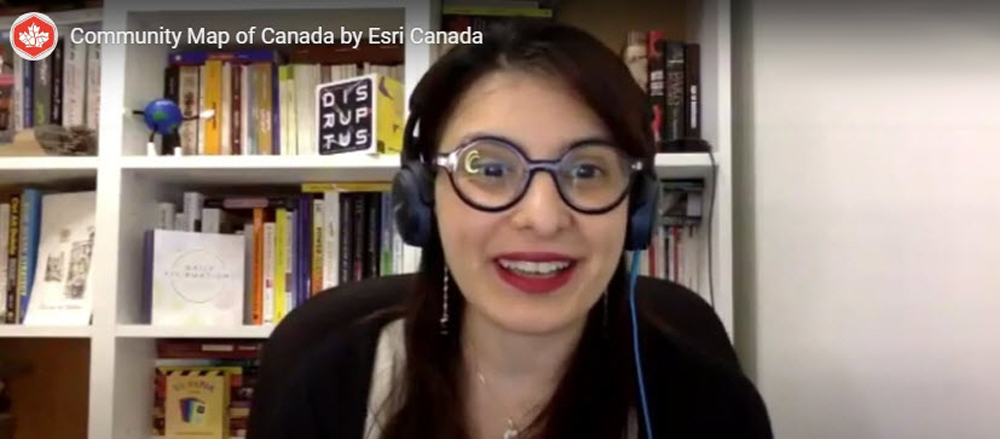
This peaked my interest, and reminded me of earlier initiatives in Nova Scotia. For example, Community Counts, the CLICK project and MapAnnapolis. What is the current status of these initiatives?
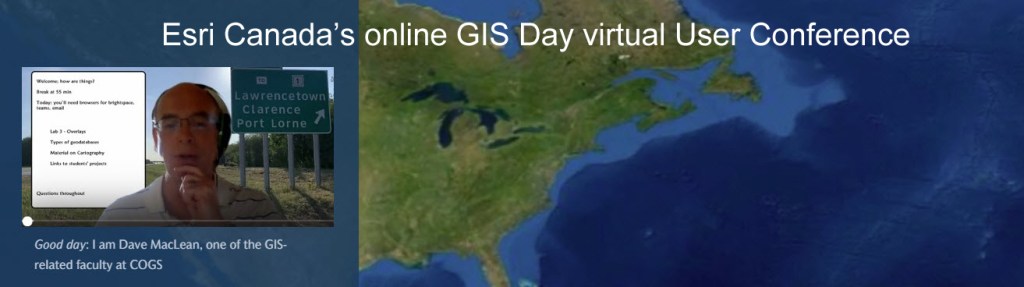
I raised the question with faculty at the Centre of Geographic Sciences (COGS). While I did not receive any definitive answers, I did have a response from Dave Maclean about the current virtual learning environment in Lawrencetown. Not being familiar with this world, I thought it worth sharing. Other members of the community may have an interest in the happenings inside the walls of COGS.
The virtual environment is global. So there is real potential to engage the GIS community in a network of mapping experiences. Here are a couple of possible examples.
One of my grandchildren lives in Iqaluit. What would it take to create a community map of the town from his perspective? Could the map be shared with his age cohort across other Northern communities? Or elsewhere in the world?
One of the issues in rural Nova Scotia is clearcutting the forests. Could we produce maps of clearcuts and potential clearcuts for Southwest Nova? Could we compare these maps of activity on crown land with equivalent maps in other countries, e.g. UK, New Zealand? If they apply ecological forestry, can we detect the difference? No spraying.
The reduction in face to face learning creates an opportunity. It can be more individualized, and less influenced by local context. Can we create customized networks around the individual needs of the community? Can we merge communities of place with communities of interest?
Acknowledgements
To Jon Murphy and Dave Maclean, both COGS graduates. Edward Wedler, COGS faculty in a earlier life.
References
GoGeomatics magazine interview, November 24, 2020.
Last Sunday, we saw two very different views of the Southwest Nova Biosphere Reserve.
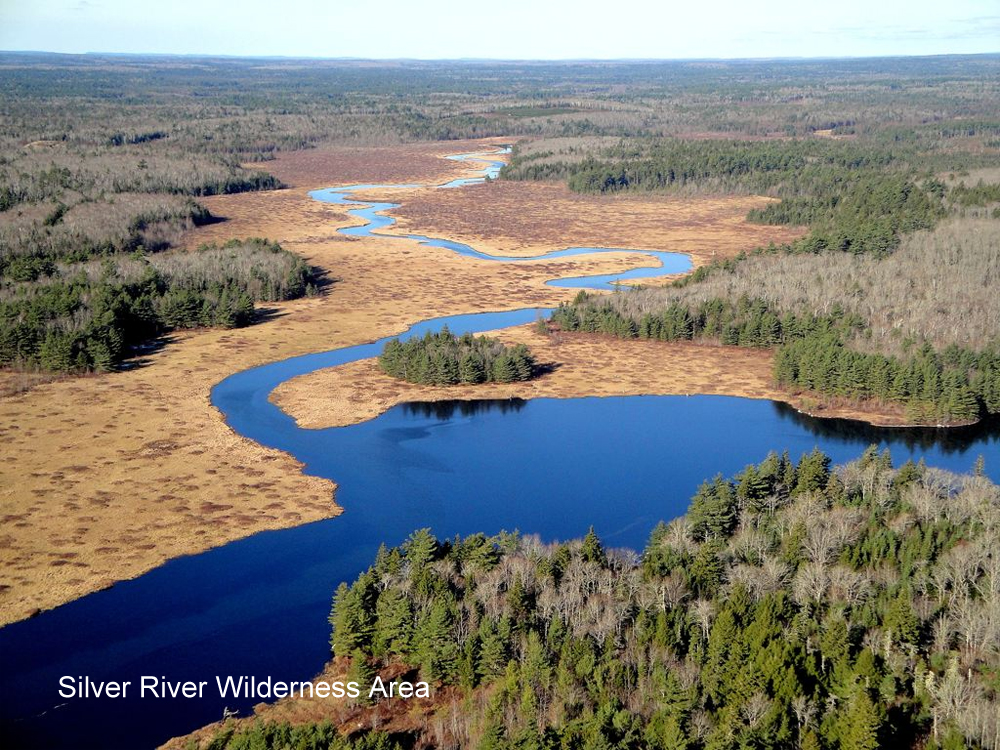
Around noon, we joined the protest by Extinction Rebellion (XR) at their encampment near the Silver River Wilderness Area.
Along with fifty or so other citizens, we formed a human chain along the forest boundary. We were protesting the impact of forest harvesting on the mainland moose habitat. The area is designated crown land and forms part of the buffer zone between the core protected area, Kejimkujik National Park and the Tobeatic Wilderness Area, and the working landscape. The Biosphere Reserve covers five counties in Southwest Nova Scotia. The mainland moose is designated as a species at risk.
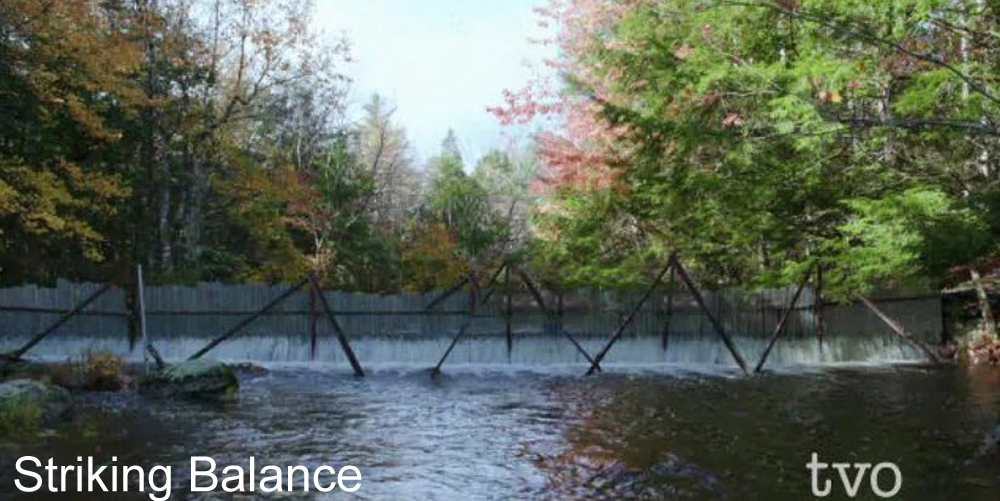
In the evening on TVO, they aired the documentary Striking Balance.
Season 2, Episode 9 presented the Southwest Nova Biosphere Reserve. This one hour program showed numerous examples of invasive species (e.g. green crab, pickerel, woolly hemlock adelgid) in the region and the efforts, particularly by Parks Canada to control their spread. Other segments looked at sea level rise and coastal communities, lichens and acid rain, plus the development of an interactive digital atlas.
What was missing, was any reference to the forestry practices and their impact on wildlife habitat. In particular, the impact of clearcutting and spraying in the buffer zone. The buffer is made up of both crown land and private land ownership.
As we drove home from Digby County to Paradise (Annapolis County) we listened to the radio. There were interviews with the three candidates for leadership of the provincial Liberal party. They all made reference to the Lahey report and its implementation in 2021. As well, there was talk about revisiting the definition of ‘crown lands’. We must wait to see whether our government can find a better balance between ecological, cultural and economic sustainability.
Meanwhile, XR will continue to occupy their encampment. We are hoping for reform within the Nova Scotia Department of Lands and Forestry — a renewed respect for the forested landscape and the habitat of species at risk — by implementing the Lahey report recommendations, redefining of crown lands, and thus reducing the need for clearcutting and spraying.
Acknowledgements
Heather Stewart, Doug Hickman, Nina Newington and many others who support this worthy cause. Edward Wedler for his graphics contribution.
Reference
Striking Balance, tvo.org Season 2 Episode 8 Southwest Nova Biosphere Reserve.
Footnote
Forest protectors from 30Nov2020 Encampment Update Note. Credit: Laura Bright.
Show support for the blockade by calling the company in charge of the logging and the government. WestFor main line: 9020-530-2362Marcus Zwicker (General Manager) 902-210-7073 communications@westfor.org See below for Derek Mombourquette’s contact information.
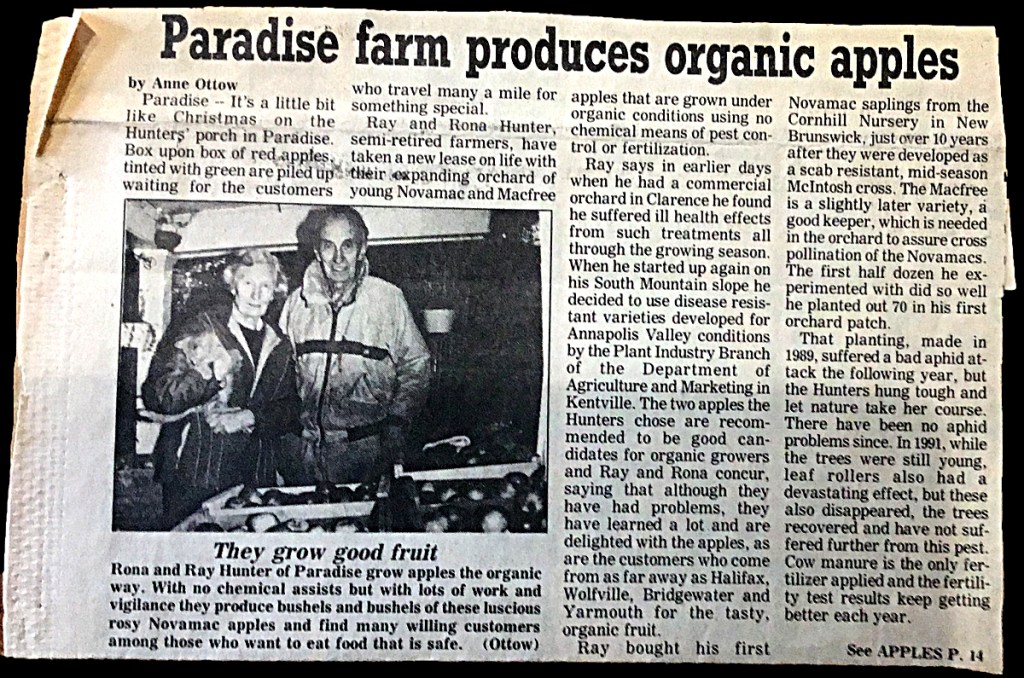
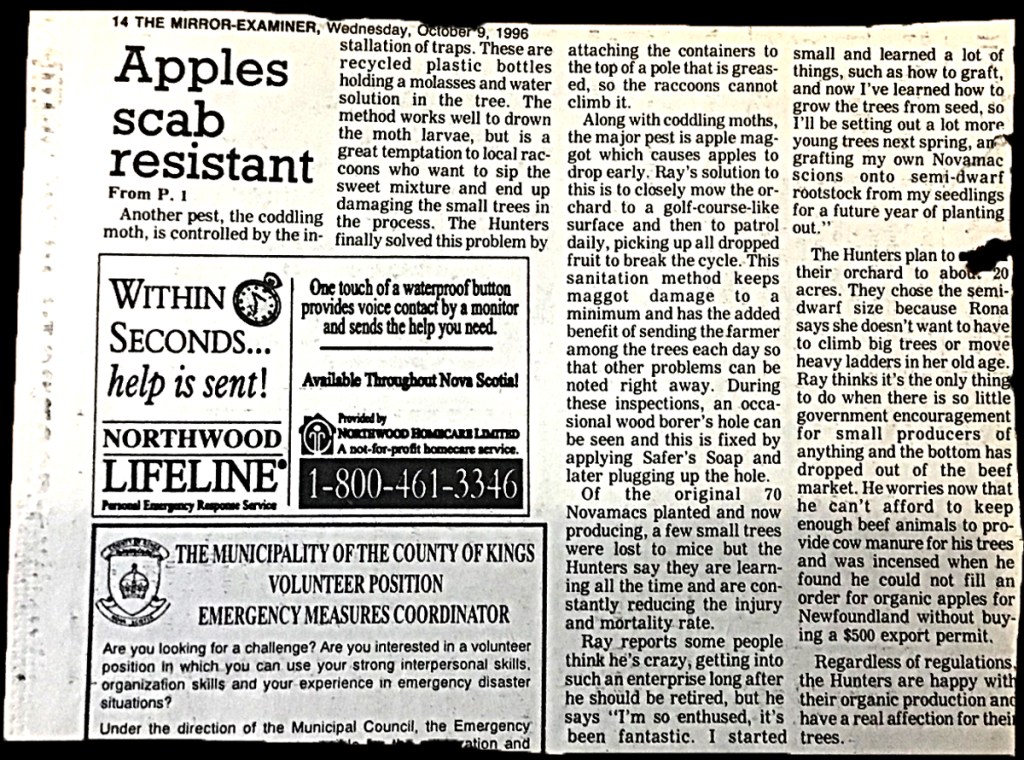
Do you remember when we had a weekly local newspaper in Bridgetown (The Monitor) and in Middleton (The Mirror-Examiner)? Do you recall reading the column written by Anne Ottow?
As we were completing the organic certification and inspection process with Allison Grant, I discovered in my filing cabinet a copy of Ottow’s interview with Raymond and Rona Hunter. It was published on October 9th, 1996. I hope that you can read it.
After the Hunters, the farm was briefly in the care of Rob and Clara Flanagan. Andrew, my son, purchased the property in 2005. And here we are in 2020, maintaining and harvesting organic apples from trees planted by Raymond.
The news media has changed significantly in the Valley, partly in response to the Internet. Larry Powell, who was a reporter with the Saltwire network is now employed by the municipality of Annapolis. His latest contribution is a YouTube video with Gregory Heming. Gregory has decided to withdraw, and not defend his seat in the forthcoming municipal election. Meanwhile, in Lawrencetown, I received a flier in my mailbox about the voting patterns of Councillor Martha Roberts. The author was Ron Habinski, father of the warden, Timothy. Not sure exactly what this means.
The best source of information for the forthcoming election, meetings and gatherings,and items for sale and service is The Reader. Steve Raftery and Andy Kerr are maintaining an election web site. In conclusion, I did receive an email from Nina Newington about a moratorium on spraying on private forest land this year. However, it still leaves unanswered a number of questions about forest management in Annapolis County:
How much forested land exists in Annapolis County? How much forested land in the County has been clear-cut and sprayed? When and where? If there is a moratorium on clear-cutting/spraying, what is the impact on the forestry sector? How much of Annapolis County is crown land? How much is private woodlots? How much is forested but conserved for outdoor recreation, e.g. parks? How much is forested but protects the water supply, e.g. Lawrencetown? How much is forested wetland or deciduous woodland at the slope of North Mountain
This is the type of analyses that the county needs to undertake on behalf its citizens — if, indeed, it believes in ecological forestry. I have suggested to Timothy Habinski that the Municipality should collaborate with COGS to conduct this type of geographic analysis, with maps, imagery and statistics.
Postscript
Raymond and Rona Hunter were strong advocates for organic agriculture. This means NO SPRAYING on our agricultural land.
Acknowledgements
Edward and Heather for their abiding interest in the landscape of Annapolis County and the species that live there. The potential for evidence-based management. Anne Crossman for moderating the all-candidate meetings for Districts 3 and 7.
References
Larry Powell, YouTube video. Steve Raftery and Andy Kerr for the municipal election web site via The Reader.




 Ernest Blair Experiment