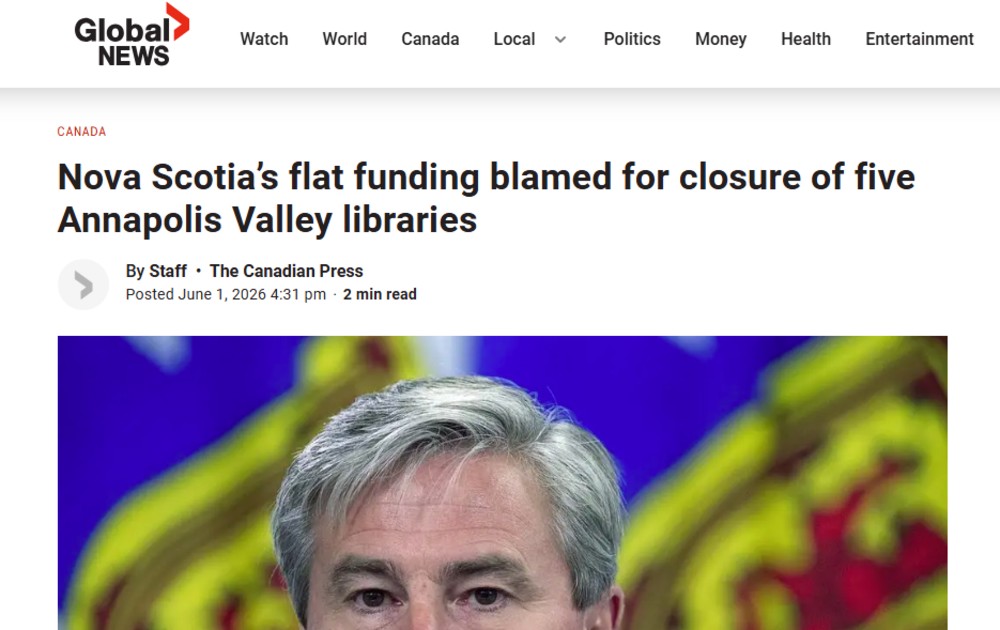
This week, we received a notice that the Annapolis Valley libraries are closing five branches, citing “static [flat] provincial funding”. This comes on the heels of a notice from the NSCC that they are laying off library staff.
Perhaps the assumption is that the population can access information via the Internet. Or that there is in-depth coverage in the local newspaper. Have you recently read the Chronicle Herald? Or better, the weekly Bridgetown Reader? Or are we outsourcing information sources to big tech AI that may know no geography?
Do we need to examine the role of community centres in rural Nova Scotia?
There are a number of larger questions that need to be discussed, many of them geographic in nature.
What is the impact of technology on access to information?
What are the changes in rural Nova Scotia? Population, activities on the land use: balance between resource management and conservation.
Are the changes in the demographics in line with access to the necessary resources.g. education, health, employment?
What is the relationship between urban NS and rural NS?
What is the relationship between NS and other provinces % urban v % rural?
If we reduce access to information resources how are we going to maintain a ‘creative rural economy’ Furthermore, what are we hollowing out when our Tourist Information Centres are closed?
Afterwards, we stopped at the Historic Gardens café. Today (Saturday) was the cafe opening for the season.
Yesterday, we needed to purchase Valley Kitchen pancake mix.
I had noted in The Reader, Howard Selig’s one page advertisement, that retail sales will be discontinued at 188 Marshall St. Effective June 5th; still available at the Independent grocery store.
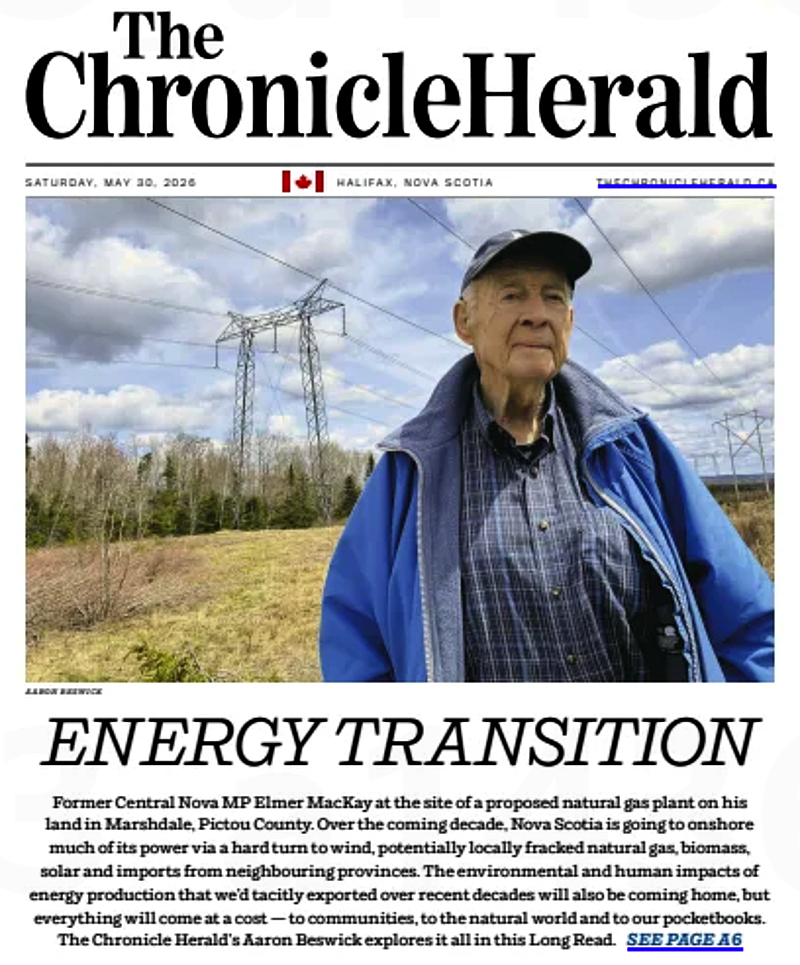
By way of contrast, today’s Chronicle Herald ( Saturday, May 30th. A1) contains several articles on the theme of Energy Transition.
‘Over the coming decades Nova Scotia is going to onshore much of its power via a hard turn to wind, potentially locally fracked natural gas, biomass, solar and imports from neighbouring provinces.
The environmental and human impacts of energy products that we’d tacitly exported over recent decades will also be coming home, but everything will come at a cost – to communities, to the natural world and to our pocket books’.
Sounds like there will be a need for Geographers at the local level — the Centre of Geographic Sciences, for example!
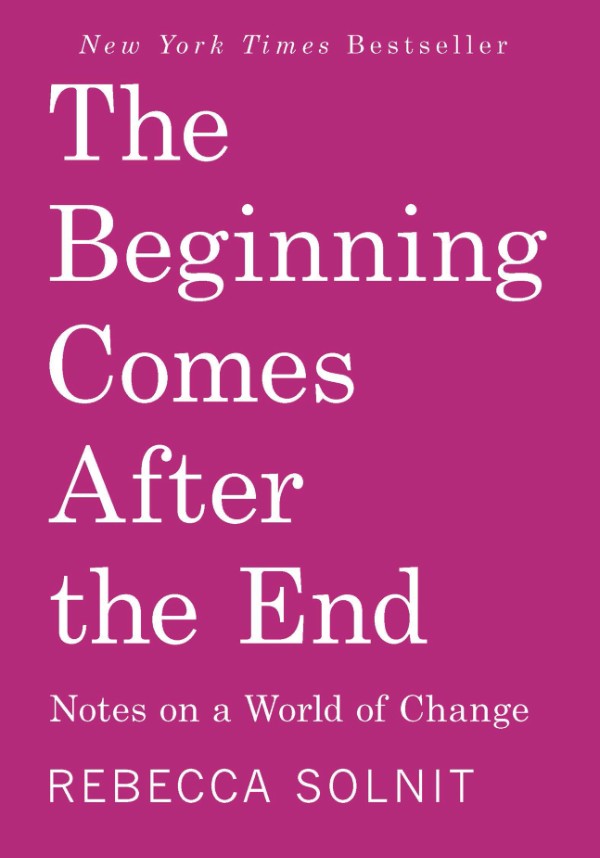
This weekend, I had the opportunity to read Rebecca Solnit’s ‘The Beginning comes after the End’ . Its subtitle is ‘Notes on a World of Change’.
From the back cover: ‘While the white nationalist and authoritarian backlash drives individualism and isolation, this new world embraces anti-racism, feminism, a more expansive understanding of gender, environmental thinking, scientific breakthroughs and Indigenous and non-Western ideas, pointing towards a more interconnected, relational world’.
This morning, I returned two books to the Middleton Library; Walter Isaacson’s book on Elon Musk and the poetry of Gerard Manley Hopkins (see It’s a Small World and A Celebration at Meier Point).
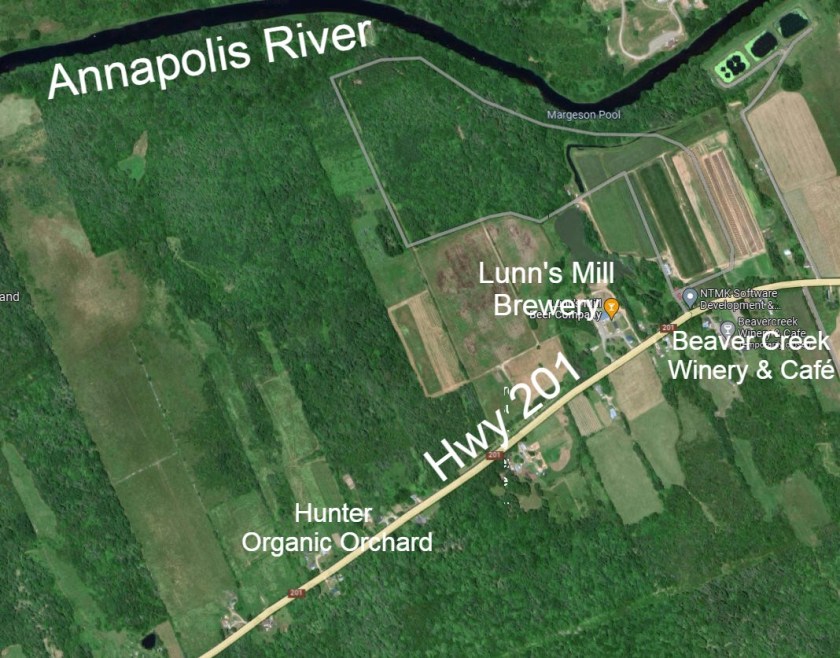
We have lived around West Paradise for over twenty years. When our son, Andrew, owned the Hunter Farm, we would walk down through the orchard to the Annapolis River (see Buddha Spring, Walk the Talk Part 1 and Guided Walk). Heading upstream towards Middleton, we entered the Lawrencetown Tree Nursery, managed by Nova Scotia Lands and Forests.
Today, you can access the Nursery from Highway #201 at Lunn’s Mill. On the banks of the river, the local fire department has a staging area for drying out their hoses, after fire prevention.
It appears that the tree nursery is not being actively managed. The forest roads are not being mowed.
Yesterday, we made the loop through the nursery, and back to Hwy #201. Once, we reached the car, we realized that it is a bad year for ticks !
The demise of the tree nursery is a lost opportunity. With the proximity to Lunn’s Mill there is an educational opportunity to teach current forestry practices and management. Instead, it is a ‘tick haven’. The ticks own the landscape. Be forewarned !
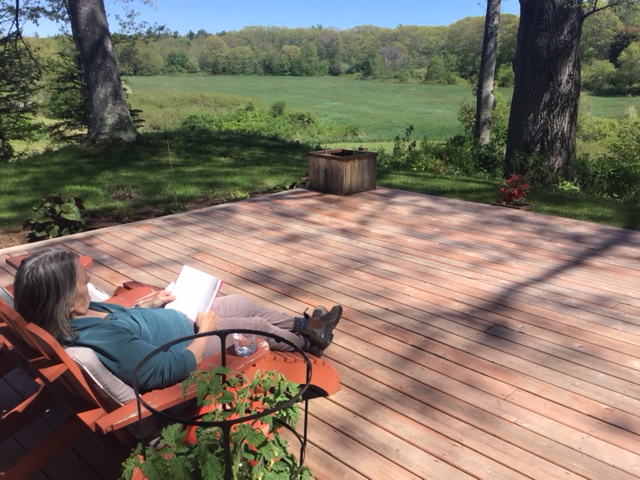
PS we moved to Middleton two years ago, to overlook the floodplain.
Saturday morning.
Market Day in Annapolis Royal. We stopped at Mare Gold bookstore and could not resist the new book by Rebecca Solnit.
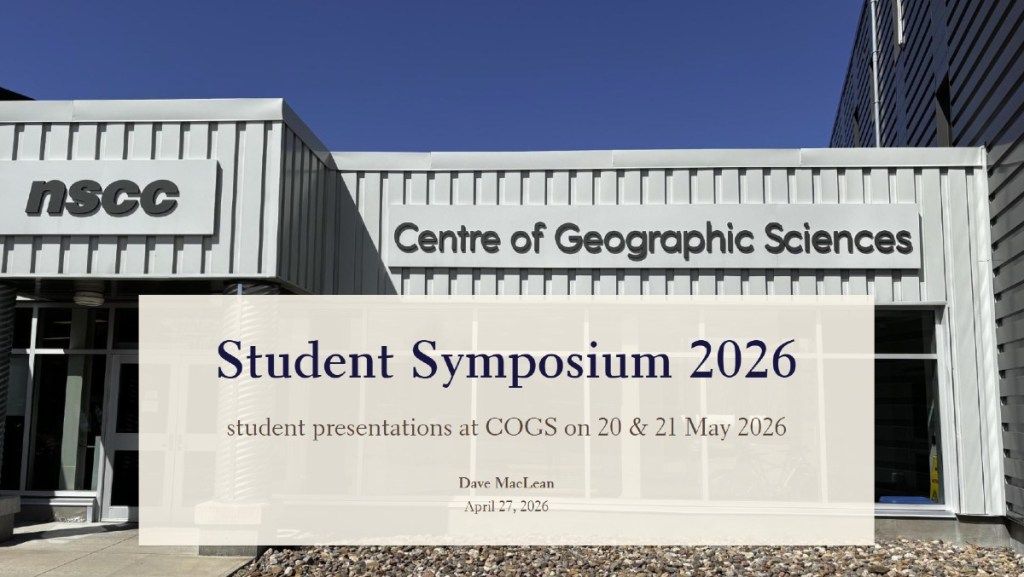
This week (May 20/21) COGS hosted a symposium of student presentations (Cartography and Geovisualization, Geospatial Data Analytics, GIS and GIS:Remote Sensing.
The presentations were made with Teams in the AV Room and the Board Room.
One of the presentations was by Christian Gastmeier: “Mapping the Geography of Places: A GeoAI and Cyber-cartographic study of the Annapolis Valley. Data input included Volumes 1-10 of my blog, ernestblairexperiment.wordpress.com from 2017-2026.
ernestblairexperiment takes its name from Ernest Buckler, author of ‘The Mountain and the Valley’. The British author, Eric Blair who wrote under the name, George Orwell. Experiment because it has been an experiment in the use of online communication (blogging).
Christian has taken on the challenge of applying the tools of GIS and AI to this collection of blog posts.
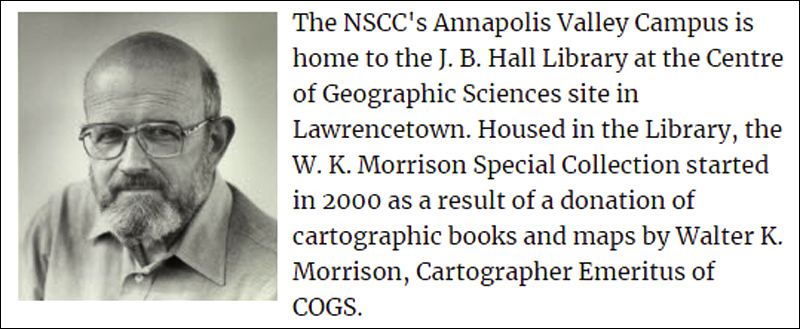
While at COGS, I was talking to Andrew Hannam, Library Technician in Lawrencetown. He confirmed that all Librarians at NSCC campuses have been ‘let go’ to meet provincial budget cuts. Given the importance of the written history of these collections to the institutions and future students, this is a matter of considerable concern (see Community Engagement, Antiques Map Tour and Map Stories).
Today, while I listened to the student online presentations, I had to worry about the ‘sense of place’, and the viability of three separate campuses in the Annapolis Valley: Lawrencetown, Middleton and Kentville — especially one with a focus on the Geographic Sciences.
It seems to be a contradiction to talk about ‘a sense of place’ and yet have the students online with no, or an empty, consideration of ‘place’. What does this mean for our ‘community’?
Postscript
Yesterday, Heather and I, in order to maintain our ‘sense of place’, walked the Peter Point trail in Kejimkujik National Park.
It has been a busy week that started on Mother’s Day. Heather and I took the drive from Annapolis Royal on Highway #8 to Kejimkujik National Park. Still closed, presumably until the weekend of May 25. The trees are beautiful at this time of year: red maple, white birch and white pine.
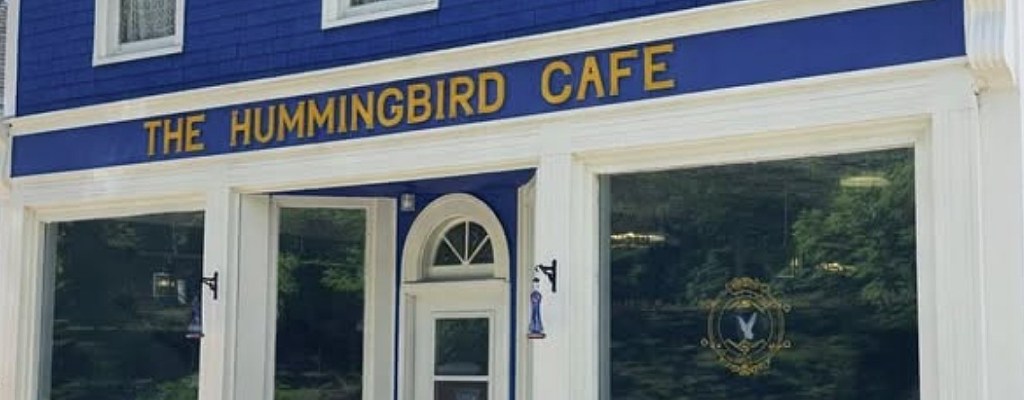
We then crossed from Highway #8 to New Germany on Highway # 10 via #208 South Brookfield, Pleasant River and Hemford. It was lunch time. We noticed the Hummingbird Cafe. We stopped for lunch.
It was excellent food and the cafe was packed with families from the surrounding communities. Afterwards, we took Highway #10 home to Middleton.
The next day, we wanted more exercise. We started the day at the parking lot on the Hampton Mountain Road. We walked the road to the side entrance of Valley View Park. The beech hangers were coming into their Spring flora. We noted our first red trillium in flower. We completed the trail through the park then up to the fire tower.
After a good stretch, we decided to return home via West Dalhousie. At the junction of Hwy #201 and the Morse Road, at 3 pm, we were behind the school bus. It made numerous stops before reaching the T-junction in the community. Before the village centre, there was significant evidence of the burn from the Long Lake fire (see Trial by Fire), including around the cemetery.
From the community centre, it is a dirt road, past several church camps to reach Hwy #10 at New Albany. From there, down South Mountain via Nictaux Falls to Middleton.
From Sandra Barry is the link to her Dalhousie Review publication “Shipwrecks of the Soul: Elizabeth Bishop’s reading of Gerard Manley Hopkins”, 26 pp.
This week, I was running errands in Middleton. First stop was the Library. I wanted to learn more about the English poet, Gerard Manley Hopkins (see post A Celebration at Meier Point). The staff put out an inter-library loan request.
I checked the new books and found the biography of Elon Musk by Walter Isaacson; a huge tome, 670 pages.
After the Library, next stop MacDonald Museum’s local art exhibition. Then the Summerland Nurseries for a planter and a shrub for Mothers Day (Stewartstonian, Evergreen Azalea).
Friday, we drove through the Rawdon Hills to New Glasgow. I started to read about Elon Musk. Page 47-48 has a reference to Peter Nicholson. He was in charge of strategic planning at ScotiaBank. Musk was at Queens University in Kingston 1990-1991.
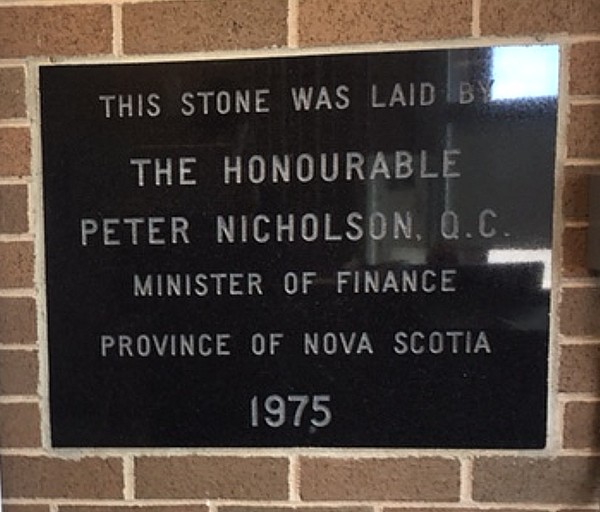
This rings a bell. At COGS in Lawrencetown, there is a stone with Nicholson’s name on it, commemorating the new building.
Somehow, this discovery seems to bode well for the collaboration between Christian and myself (see Mapping the Geography of Places) Christian Gastmeier and Bob Maher.
Postscript
While no picture of the commemoration stone from the family could be located, a description of Gerard Manley Hopkins’ poetry was found, described in Frances Cafferata’s MA Thesis Dissertation from the University of British Columbia, “Gerard Manley Hopkins’ use of nature in his poetry“.
This weekend, I made contact with Christian Gastmeier. He is a student at COGS working under the supervision of David MacLean. He is working remotely from Sudbury, Ontario. It is a capstone project: developing an AI-driven NLP pipeline for Spatiotemporal extraction.
I have included two paragraphs from his proposal:
“ Background
Since 2013, Bob Maher has maintained an extensive digital record of geographic observations through his blog ‘The Ernest Blair Experiment’. This body of work contains over a decade of high-fidelity local knowledge regarding the Annapolis Valley. However this data is currently ‘unstructured’, existing as a narrative text rather than a spatial database. Transforming this narrative into a Geographic information System (GIS) requires Natural Language Processing (NLP) to bridge the gap between human story telling and provincial resource management.
Purpose
The purpose of this project is to develop a reproducible cloud-based AI pipeline using ArcGIS to extract geographic themes from unstructured text. Leveraging the full ArcGIS online (AGOL) suite this project will:
automate extraction
Geocode and Validate
Cloud- Native Visualization
Multi-media Integration
System Scalability
Where things stand today (Monday, May 4,2026) ?
Christian emailed his Capstone project proposal
We had telephone conversation
Bob agreed to provide hard copy ( 13 volumes of his ernestblairexperiment blog
Christian is working remotely from Sudbury, Ontario.
Deliverables:
Spatiotemporal Cloud Database
Automated Extraction Pipeline
The Ernest Blair Digital Atlas
This blog will be sent to a wide range of industry/academic partners.
If you are interested in the full project proposal, contact Christian at W0529818@nscc.ca Future blog posts will track our progress.
Edward is unavailable for a few days. He suggested that I post this blog, as is.
We arrived in Annapolis County in 1980. I had accepted a teaching position at the Nova Scotia Land Survey Institute (NSLSI). It was to teach applications of mapping software in an intensive one year program (48 weeks) in Scientific Computer Programming. Heather and I, with two young boys (Patrick and Andrew), moved from Ottawa (National Museum) to West Dalhousie. We rented what was known as the Ernest Buckler house from Bill O’Neill. He and I commuted down the Morse Road to Bridgetown, and on to NSLSI in Lawrencetown.
After a couple of years, we moved to Clarence East, neighbours to the Barteaux, Elliot and vanRoestel families. In 1988, we moved to Indonesia, California, Ontario (Peterborough) and BC (Victoria) before returning to accept the position of Senior Research Scientist with the Applied Geomatics Research Group (AGRG) at the NSCC in 2000. At that time we purchased a house in East Paradise on Highway #201. Now, in 2026, we have relocated to Middleton.
Throughout our time in Annapolis County, we explored the Bay of Fundy coast, the Annapolis Valley and, to a limited degree, North and South Mountain. Despite our familiarity with the local Geography, we had never been to East Dalhousie.
Given the forest fires last year (see Trial by Fire), I wanted to visit Lake George and Lake Paul. We started out, gassing up the car in Berwick. Moving up onto South Mountain, it is very evident why Berwick is considered the “Apple Capital” of the Valley. From Morristown, we passed through Lake George and Lake Paul reaching the Dalhousie Road, where we turned west to East Dalhousie at the Kings County/Annapolis County line. At East Dalhousie, we turned South on the Cherryfield Road. The Cherryfield community is on Highway #10. Afterwards, we headed North, back to Middleton.
Three significant observations were made on travelling the backroads of Annapolis County
Access to good maps is essential. We always have a copy of the Nova Scotia Atlas in the car. In this case, the seventh edition.
The forests of South Mountain are remote and relatively inaccessible. Given the nature of climate change, there is a high probability of forest fires by lightening strikes. This happened in 2025. The management of these forests is critical, not only for remote communities, but also the proximity to the communities along the mountain slopes — not a time to reduce the resources and capacity of NS Lands and Forests.
It is very evident from the signage on individual driveways that the public, individual land owners, are concerned about the mining of uranium. Without travelling these back roads, the average politician/ civil servant would not understand the public concern.
A final comment.
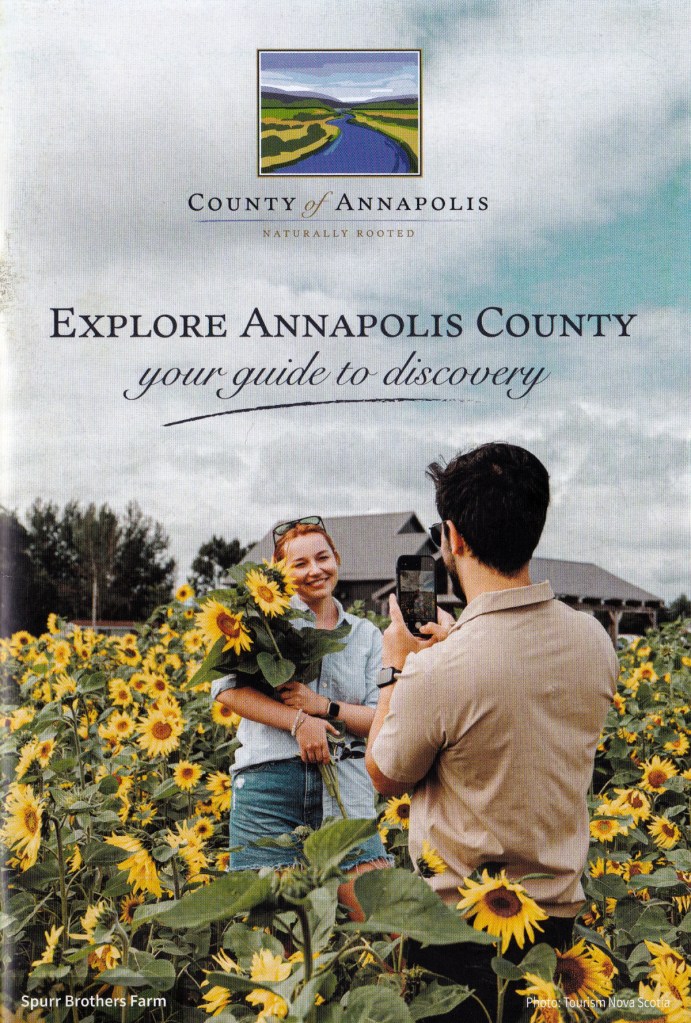
The county provides in the mail, “Explore Annapolis County: Your guide to discovery” an excellent publication – BUT NO MAPS ENCLOSED.
The drive through the back roads of Annapolis County was a revelation. And yet, we have known the geography since 1980 (approaching fifty years) on and off, and have been part of the history of the College of Geographic Sciences (COGS).
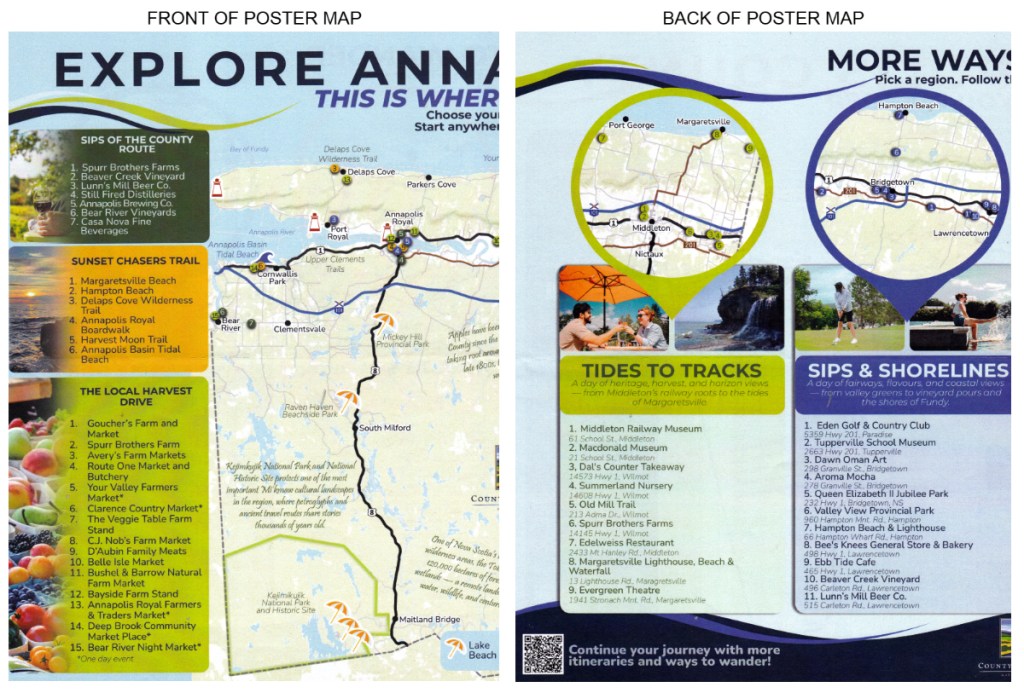
Edward visited the Annapolis County booth during the recent Saltscapes Exposition in Halifax. At the booth he did get a poster map, “Explore Annapolis County: This is where you wander”. The County marketer told him that the map promoted exploration “Choose your own adventure. Start anywhere. Go everywhere”. In essence it was thematic in nature.
A portion of the poster map is shown, above. A couple of QR codes on the back invite explorers to “Continue your journey with more itineraries and ways to wander”.