Posted in Event Review

Meditations en Plein Air

In recovery mode, after car troubles in Halifax on Saturday, we took a drive to Annapolis Royal.
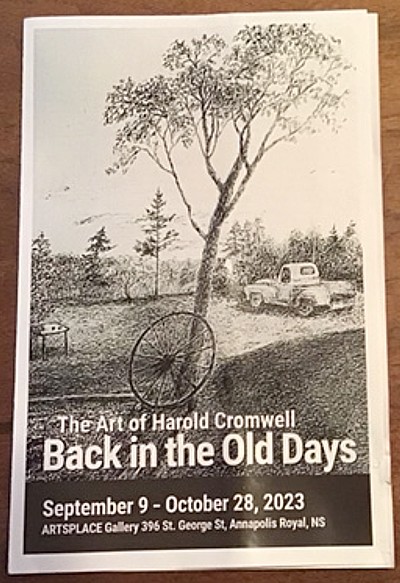
We wanted to see the Art of Harold Cromwell, Back in the Old Days exhibition ar ARTSPLACE gallery (September 9 – October 28). Ray Cronin provides an excellent overview of the artist and his work (see handout).

’Cromwell’s work depicts life in a rural community in the early twentieth century and is laced with humour and wry observation’.

I particularly enjoyed the search for deer hidden in his pen and ink drawings.

We managed to catch the Ciderfest parade in Bridgetown, the market at the legion and then the orchard walk by Jamie Inglis in Tupperville.

In the spirit of meditations on walking, we took the trail through Valley View Park to the communications tower. This led to thoughts on the role of ‘plein air’ art in the appreciation of landscape, and how the results would differ, depending on the artist and the medium. For Edward, water colour. For Anne, oils. The selection of subject matter would also depend on the interests, previous experience etc. It would be interesting to compare the results.

Unfortunately, because of car trouble, I did not have the time to look closely at the different paintings by Anne and Edward at the Teichert gallery on Thursday evening. Perhaps another day, or another event.
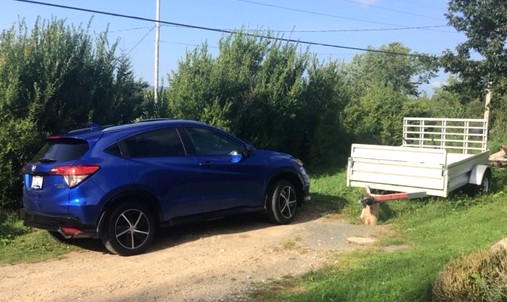
Our “new to us” vehicle.

Postscript

Visiting Inglis Heritage Farm brought back fond memories of managing the organic orchard planted by Raymond Hunter, across the road. It is now owned by Rob Jarvis and Sinead Wills (see posts “Naturally Rooted; Hunter’s Brandy” and “Times Have Changed“).

Acknowledgements

Foremost, the Canadian Automobile Association (CAA) technical support for getting us out of our car troubles. Thanks to Kings Honda who transitioned us into a new (to us) vehicle in short order. Edward and Anne provided cause for meditation. Heather and I are grateful for everything.

References

The Art of Harold Cromwell, Back in the old days, September 9 – October 28, 2023. ARTSPLACE Gallery Annapolis Royal, Brochure by Ray Cronin, former Director, Art Gallery of Nova Scotia.
Posted in biographical sketch

Tumultuous Twenty Four Hours

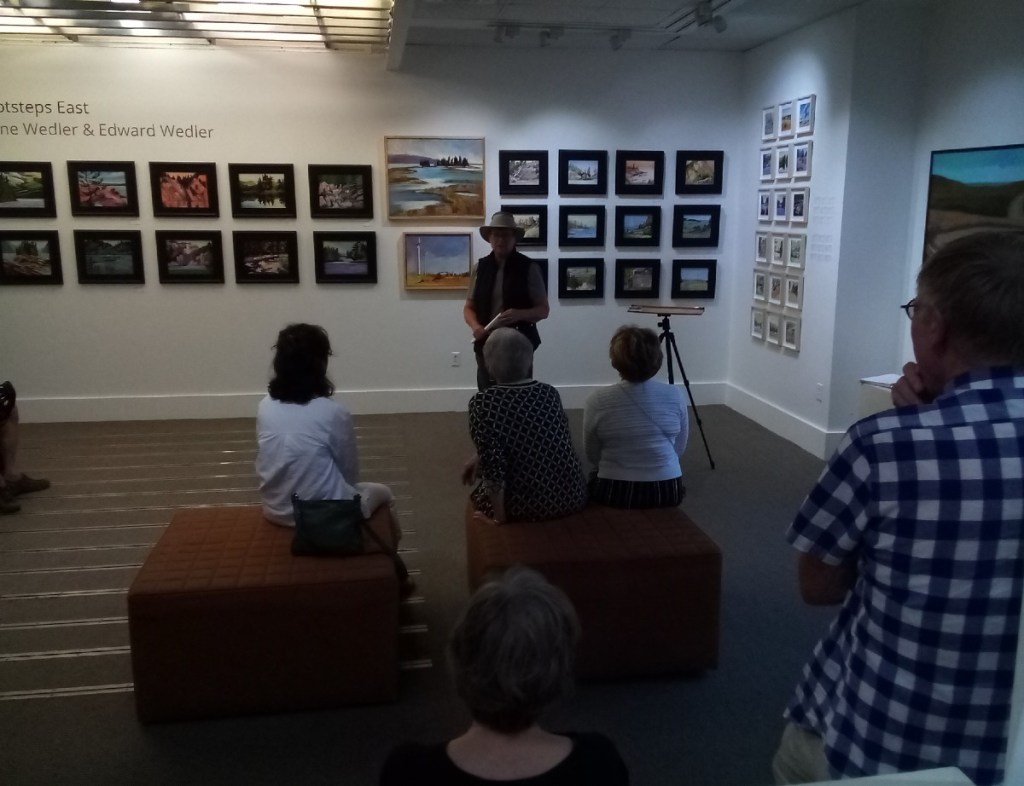
We went into Halifax (5 pm Thursday) to attend the opening reception of Footsteps East at the Teichert Gallery.

Anne and Edward gave a talk on their experience: the logistics, the impact of Summer storms, their understanding of the geology (landscape) and the changes in travel since the Group of Seven days ( from railroad to highways).

Before the opening, we stopped at the Bookmark on Spring Garden road. Here, I found Frederic Gros, A Philosophy of Walking.

With hindsight, the book was appropriate. We parked underground at the Muir hotel. Only to discover that the electric system had failed on our Honda CRV. This led to an overnight stay at the Muir.

Welcome to the Muir, and to refined, distinctly Nova Scotian hospitality on the Halifax Waterfront. Born of this Place, “Muir (Scottish Gaelic for sea) takes inspiration from the forces that have shaped Nova Scotia and its people.”

After contacting CAA, we eventually managed to book a tow truck for the next morning. This took us to Kings Honda in Kentville. After some deliberation, we decide to trade in our Honda CRV (2014) with 350,000 km for a Honda HRV (2021) with 35,000 km..

What was to be a quick visit to the city to hear Edward/ Anne’s talk, turned into a confrontation with the changes in technology in urban Halifax, in terms of our overnight stay but also the need for reliable transportation between city and the country.

Acknowledgements

The presentation by Anne and Edward served to illustrate the level of preparedness necessary to undertake a six week road trip, including the artistic equipment. Heather and Sandy Stewart shared the harrowing experience of vehicle breakdown in the city.

References

Frederic Gros, 2023, A Philosophy of Walking, 2nd edition, VersoPress.

The Beacon, Issue 1, A Muir Halifax publication.

Footsteps East en plein air: Nova Scotia to Lake Superior. Exhibition from 1st-30th September 2023. Teichert Gallery. 1723 Hollis Street, Halifax.

Posted in Common Place

Trenton Park

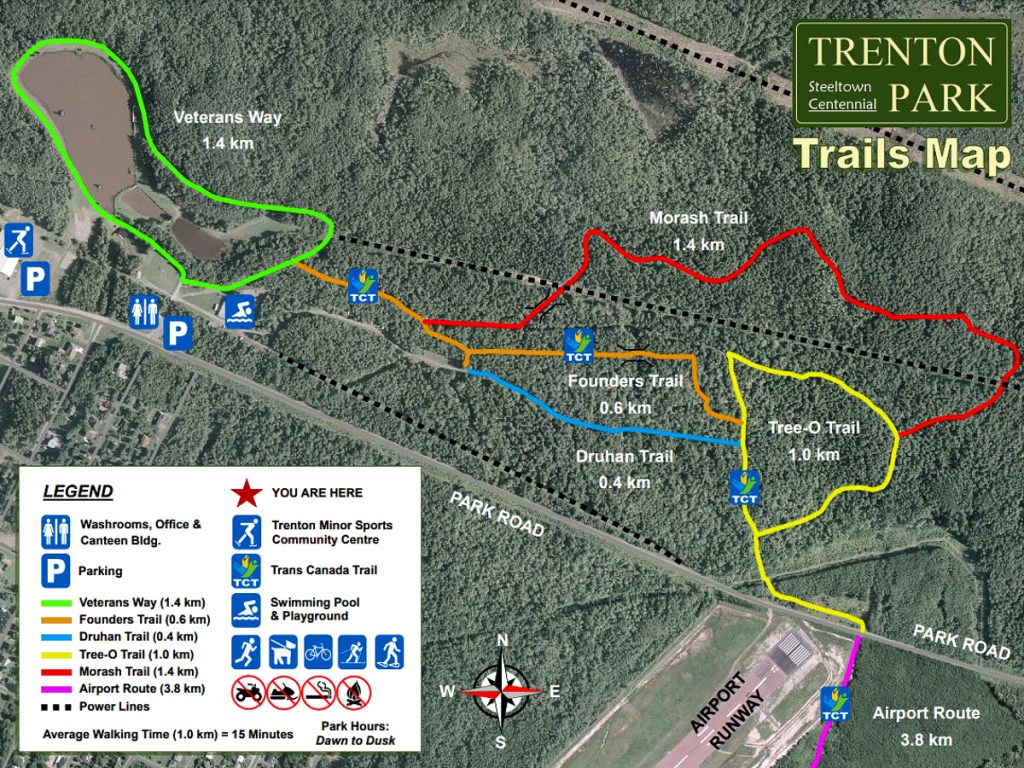
When we go to New Glasgow, we often take the opportunity to walk the Veterans Way around the lake at Trenton Park. This time, we took a different path, the Morash trail and Tree-O trail. We were surprised by a number of items.

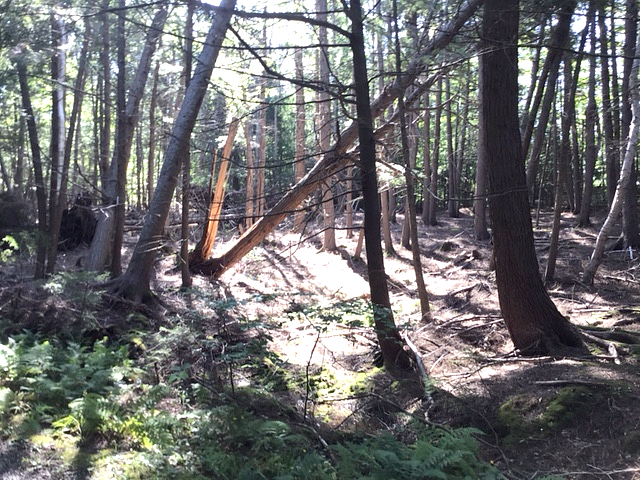
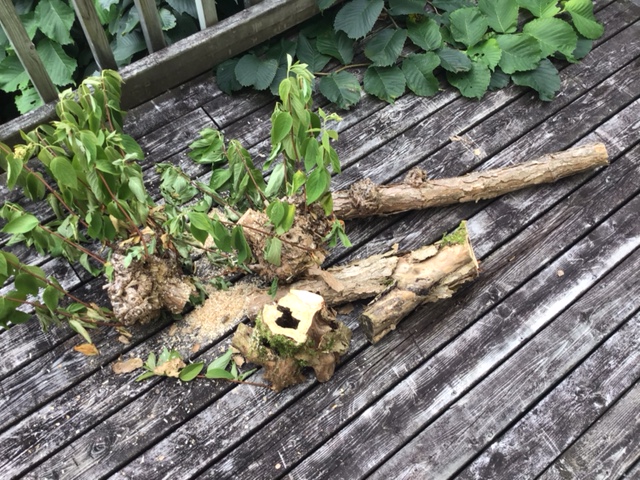
The trail was still heavily impacted by the results of Tropical Storm Fiona. It seemed that the trails permitted severe blowdown in the Hemlock forest. Almost a year later, the uprooted trees remained, and the trail was almost impassable.

There was no signage to warn about the condition of the trail. Indeed the trail maps showed on the legend a symbol, “You Are Here” but the symbol was not on the map.

On the positive side, there was considerable growth of fungi, along the trail edge.

Trenton Park is a remarkable community resource for all ages. Besides the trail system, there is a pool, playground and cafe. It is well used by a wide range of age groups from pre-school to seniors.

I find it surprising that there appears to be no consistent province-wide attempt to clean up the deadfall, particularly on crown land. Perhaps, we need Social Forestry in Nova Scotia.

Postscript

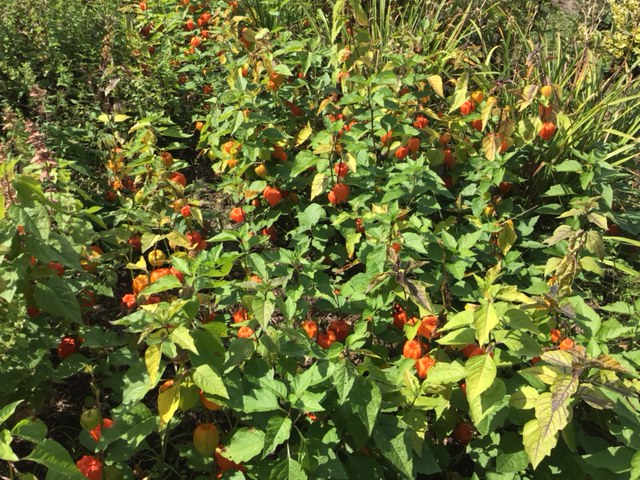
Chinese Lanterns in the garden

Acknowledgements

Heather and I walked the Morash trail.

Reference

Tomi Hazel Vaarde, 2023, Social Forestry: Tending the Land as People of Place, Synergetic Press.

Posted in biographical sketch

Common Place

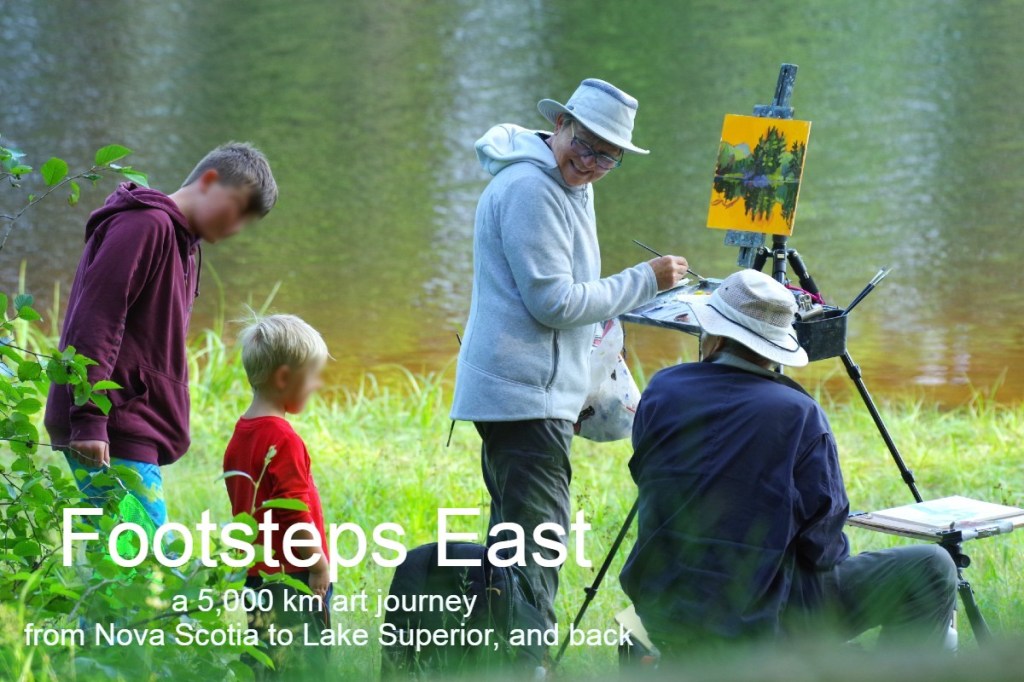
Yesterday, we drove up to New Glasgow. En route, we stopped at the Teichert Gallery in Halifax. It was the opening day of the exhibition “Footsteps East, en Plein Air, Nova Scotia to Lake Superior by Anne and Edward Wedler”. This collection of oil and watercolour landscapes is the culmination of a two- year journey, inspired by locations visited by Canada’s Group of Seven artists.’.

Algonquin Park, Ontario, where Anne and Edward meet young art lovers

Unfortunately, the gallery was still in the process of hanging the paintings. We did bump into Edward and Anne. We promised to return when the exhibition is underway.


The previous afternoon, I attended the AGM of CANMAP Research Institute. Historically, CANMAP has funded awards for best student in various programs at COGS.

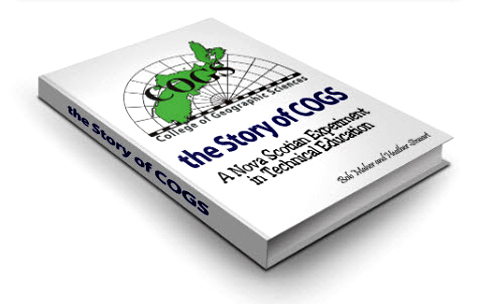
This reminded me of the Story of COGS.

t was initially the Nova Scotia Land Survey Institute (NSLSI), then the College of Geographic Sciences (COGS) (1986), then the Centre of Geographic Sciences, a sub-campus of the Annapolis Valley campus (Middleton), NSCC.

On September 15, GoGeomatics and others are attending a Back to school social at COGS. This raises a number of questions in my mind.

  1. Given the increasing online learning, what happens to a ‘sense of place’?
  2. Where did the Geography go?
  3. What happened to Lawrencetown when they closed the co-op?
  4. What will happen to COGS when all the programs are online?
  5. What happens to ‘place’? Viz-a-viz Lawrencetown?
  6. The same as when they closed the co-op?
  7. When did Geographic Sciences turn into Geomatics technology?

Returning to my relationship with Edward. We have shared (supported) a number of common experiences.

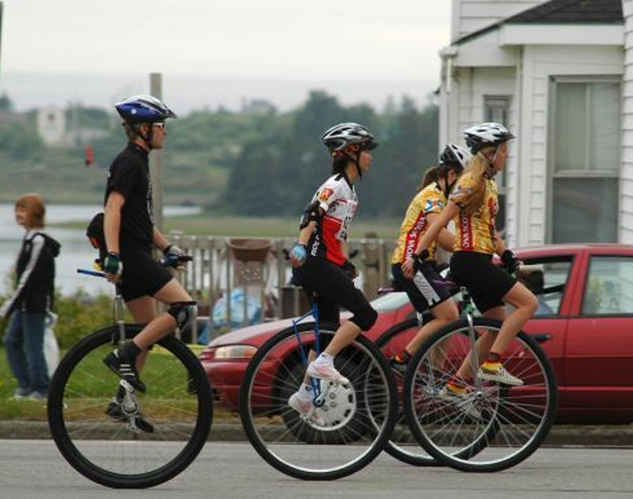
Ride the lobster
An international unicycle relay around Nova Scotia from Yarmouth to Baddeck, Cape Breton.

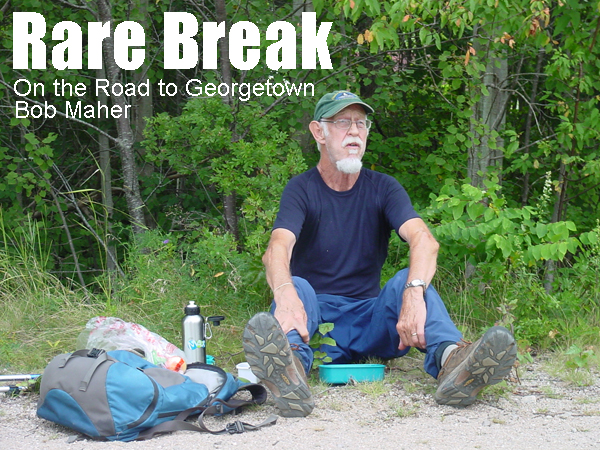
Road to Georgetown
Walking from the Annapolis Valley to Georgetown , PEI for a community development conference.

Footsteps East
Road trip from Nova Scotia to Lake Superior.


Postscripts

I received a newsletter from the Shorefast Foundation. It includes an interview with Zita Cobb at the Fogo Island Inn. This is an excellent example of place-based, Community tourism.

Once in a blue moon.
I photographed the blue moon from our deck before dawn on September 1st.

At the New Glasgow library, I found three books.

Joan Baxter, 2017, Seven Grains of Paradise, Pottersfield Press.
Gary Saunders, 1989, Alder Music: A Celebration of our Environment, Breakwater Press.
David Hamilton, 2023, Energized Poetry, Pictou Library.

Acknowledgements

John Wightman organized the CANMAP AGM. Edward Wedler added the links and graphics. Heather Stewart shares the journey.

Posted in biographical sketch, Book Review

People of Place

This week, after a prolonged break, I joined Heather on the bicycle ride from Paradise to Middleton. We left shortly after 9 am on a beautiful August morning ( Monday), cycled down into Lawrencetown, and turned right at the elementary school onto the Middle Road.

The Middle Road is straight, with a few gentle rises through fields of corn and hay. No traffic. It ends at the Nictaux Road where we turn left down into town. We stopped at the Bistro300 cafe for coffee and a cinnamon bun. Then came home. As we turned into the driveway on Highway 201, we heard the Lawrencetown Firehall siren for twelve noon. Set us up for the rest of the day.


Yesterday, I undertook another seasonal first. With the Z-track, I went down through Rob and Sinead’s property to the Triangle Field. It was infilling with Indian Hemp and Poplar seedlings. The total job took less than two hours. But there was immense personal satisfaction.


I dropped into the COGS Library to return the ESRI Press books on the Application of GIS. At the same time, I checked out the new acquisitions; one caught my eye. Tomi Hazel Vaarde’s, Social Forestry: Tending the Land as People of Place. Over 465 pages. I look forward to reading her definition of ‘People of Place’.

Meanwhile, I have been working through the two Paul Evans books, lent to me by Jeannie Shoveller (see blog post Two Hydrangeas). The first, Herbaceous, is a short collection of writing on different flowers in the British countryside, divided according to season and colour: yellow, white, pink, blue, and brown. A quick read.

’Herbaceous is gardening with words. It is a book of audacious botany and poetic vision.’

The second, How to see Nature, explores diverse landscapes: wastelands, meadowland, wild moors, and forests How to see Nature shares a title with a 1940 Batsford book, which was written with wartime evacuees in mind.

Acknowledgments

Andrew Hannam signed out Social Forestry to me. Heather joined me on the cycle ride. Jeannie lent me the Paul Evans books.

References

Toni Hazel Vaarde, 2023, Social Forestry: Tending the Land as People of Place, Synergetic Press.
Paul Evans, 2014, Herbaceous, Little Toller Books.
Paul Evans, 2018, How to see Nature, Batsford.

Posted in biographical sketch

Two Hydrangeas

At the front of the house are two hydrangeas.

They were there when we bought the property over twenty years ago. Today, one has died; the other continues to flower profusely. On either side of the steps, they seem to be growing under similar conditions.

After a busy week, we are taking a rest. Saturday we started in Bridgetown — bank, bookstore, coffee shop, grocery store, the library.

At the bookstore, I found Atlantic Forestry Review, July 2023. I read Nova Scotia ramping up forestry education. It describes the new program at the NSCC including an interview with Leif Helmer.

One of the programs is a one-year Forest Geomatics and Biometrics Technology program at COGS in Lawrencetown.

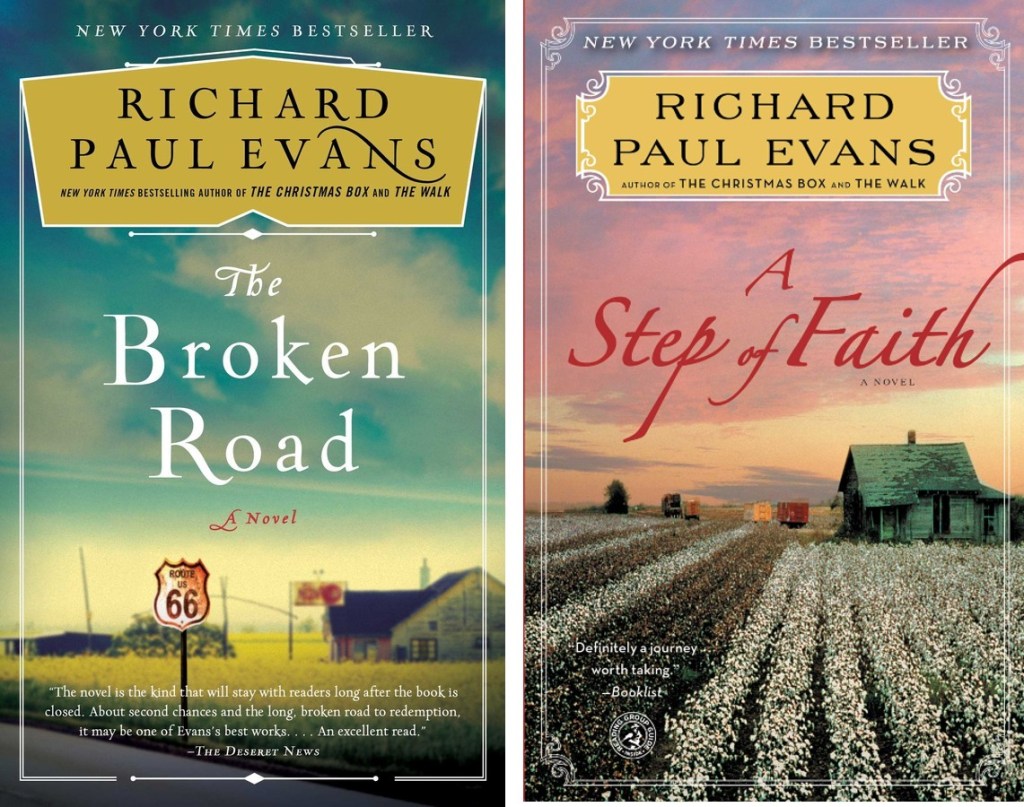
At the bookstore and the Library, I was seeking books by Paul Evans. Jeannie Shoveller (Barteaux) had recommended his writing to me. At the Library, I found the works of Richard Paul Evans, The Broken Road and A Step of Faith.

I checked back with Jeannie. Later in the afternoon, she dropped off Paul Evans Herbaceous and How to See Nature. They look excellent.


Four o’clock and off for a beer with John Wightman. We reviewed local politics and the connection between Greg Kerr and Carman Kerr. Kerr Lane is on Highway #1 on the way to Annapolis Royal.


Seven o’clock down to Annapolis Royal to see the new ‘Spectacle, Performance and Play’ exhibit at the O’Dell House Museum, Archive and Research Centre. At the same time, we reviewed the historic Acadian maps of Annapolis Royal.


Home, in time for fresh pesto made from basil, from our greenhouse, and watch As Time Goes By, and Doc Martin on the Maine PBS station. Heather made the astute observation that Doc Martin is about Health services in rural Southwest England. I could certainly recognize the parallels with rural Nova Scotia.

Postscript 1

Reading about the new Forest Geomatics program at COGS. I could not help but imagine a new Agriculture Geomatics program.

Postscript 2

Edward is back from his travels in the Footsteps of the Group of Seven. Thus, I have sent a draft of the blog for him to add graphics and links. Enjoy!

Acknowledgments

Jeannie Shoveller (Barteaux), Anjeanette LeMay, Sandra Barry, Edward Wedler, and Heather Stewart continue to offer support on this journey.

References

Atlantic Forestry Review, July 2023, Nova Scotia ramping up forestry education, Pages 14-15.
Paul Evans, 2014, Herbaceous, Little Toller Books.
Paul Evans, 2018, How to see Nature, Batsford.
Richard Paul Evans, 2013, A Step of Faith, Simon and Schuster.
Richard Paul Evans, 2017, The Broken Road, Simon and Schuster.

Posted in biographical sketch

Between Meetings

This week has been full. After the Liberal picnic on Sunday, I had a video chat with ESRI Press. The outcome was a proposal to ESRI on the feasibility of linking my blog, ernestblairexperiment.wordpress.com with their online StoryMap software. Edward had returned from his trek, Following in the footsteps of the Group of Seven, and has some excellent suggestions. Next month, the paintings of Edward and Anne can be viewed in Halifax at the Teichert Gallery.

His comments related to the possibility of corporate sponsorship, and to avoid the ‘herding of elders’.

The same day, I discussed the Annapolis Valley Exhibition with Brian Arnott. Specifically the juxtaposition of the exhibition grounds and COGS. There should be an opportunity to develop an educational partnership, centred around Agricultural GIS. From a visitor perspective, there could be workshops at the college, in the same time frame as the exhibition.

Thursday, I met with Carman Kerr. Following my meetings earlier in the week, we discussed experiential tourism and the opportunity presented by the Exhibition.

At the end of the week, Frank Fox, Paul and Ruth Colville, Heather and myself met at the Capitol in Middleton. We reviewed the above schedule and the untapped potential in the Annapolis Valley.

Between meetings, Heather and I escaped the heat of the Valley. We went across to the Bay of Fundy at Hampton Beach. On another occasion, we cleared a path down through the Hunter farm (across the road) to the Annapolis River. We returned to Highway #201 via the Tree Nursery. Stopped at Lunn’s Mill to purchase a growler of Brickyard Red.

Finally, Heather returned to her bicycle, after an absence,. enjoyed the ride along the Middle Road (Lawrencetown Elementary School) to Middleton.

Postscript.

Once again, I want to emphasize the value of The Bridgetown Reader to the community. In this week (August 25) issue, for example, the front page includes information on Mental Health Programs, ‘Living Life to the Full’ and an advertisement for Spectacle,Performance and Play, a collection of films and photographs from the Annapolis Heritage Society Archives at the O’Dell House Museum Saturday, August 26th 7:00 pm.

Acknowledgements

Appreciation to Edward Wedler, Brian Arnott, Heather Stewart, Ruth and Paul Colville, Frank Fox, Carman Kerr for their feedback on a very busy week.

Posted in Uncategorized

Blackberry Picnic

John Wightman invited us to pick blackberries from his garden. This week, we made blackberry jam, following Jane’s recipe.

Afterwards, we decided to attend the Liberal Annual Picnic at the Legion in Bridgetown. Guest speaker was Stephen McNeil, former Nova Scotia Premier. He described his work in marketing Nova Scotia’s Resources to the world. For the current government he agreed that the issues were health services, housing and inflation. Our current Liberal MLA is Carman Kerr. I hope to meet with him later this week. My concerns would be quality versus quantity. And in particular leveraging our intellectual resources.

Within this context, I had a useful video chat with members of ESRI Press, Catherine and Stacy. The general topic was the application of StoryMap software to my blog. A more specific issue was the representation of rural Geography to a global audience.

I found it revealing that I had been anticipating a conversation between rural Nova Scotia and urban California. In reality, Catherine was located in Maine, Stacy in New Jersey.

This week, aside from a conversation with Carman (face to face). I will meet with Edward Wedler to discuss the technicalities of connecting my blog to online GIS software. More later.

After attending the Annapolis Valley Exhibition, I remain concerned about the linkage between the education Resources at COGS and the need to provide agricultural education in the Annapolis Valley.

We need creative application of the technology to maintain the agricultural lifestyle in rural Nova Scotia. This means leadership.

Acknowledgements

John Wightman shared his blackberry patch, and encouraged our attendance at the Liberal Party picnic. Carman Kerr shows his continual support for the community. Catherine Ortiz and Stacy Krieg from ESRI Press for the video chat. Feedback came from Edward Wedler, Brian Arnott and Heather Stewart.

Posted in biographical sketch, Event Review

Valley Daze

Yesterday, Saturday, was the final day of the Annapolis Exhibition. We started early with a drive to New Minas. Heather had some maps on her cell phone. She wanted them printed and laminated. We went to Staples.

Afterwards, I wanted to check out a book on the Acadia campus in Wolfville.The Bookstore, Student Union and Library were all closed. The town was busy with students being dropped off, by their parents or friends.

We stopped in Kentville for brunch at the Half Acre Cafe, before going to Greenwood. We needed salt for the water purification system.

At four o’clock, I was scheduled for a beer with John Wightman. We reminisced about the 1980’s at COGS. The involvement of Roger Tomlinson, ESRI. We talked about the changes in the family farms in the Valley. Also the socio-economic changes within the small towns e.g. Bridgetown, Middleton.

Afterwards, with a stop for a slice of pizza, Heather and I went to the Garnet Rogers concert at the Evergreen Theatre, East Margaretsville. We noticed that there were crowds of cars parked in Lawrencetown. The Exhibition was a buzz.

To get to the theatre, we took Highway #1 to Gouchers Farm Market, then North to East Margaretsville. It was a full house, started at 8 pm. Garnet was a musical delight.

The concert finished around 10:15 pm. We decided to return via the coastal road. Through Margaretsville, across Delusion Road, down Gates Mountain Road to Middleton. In Middleton, we hit Highway #1.

As we approached Lawrencetown, there was a stream of cars leaving the village. We decided to avoid the traffic. Left at the Mount Hanley Road, across the Annapolis River, right on the Middle Road. Pitch black. No street lights. Heather’s sharp eyes spotted the deer and the skunk crossing the road. Eventually, we joined Highway #201, street lights and home. It was past 11 pm.

We turned on the network news. Fires still raging in BC and NWT. We reflected on Andrew and family driving from Midland, Michigan to Rossland, BC. Remembering our earlier cross-Country drives from California to Ontario, BC to Nova Scotia.

At the end of the day, we recalled one of Garnet’s anecdotes.

“Life is like a toilet-roll. As you reach the end, it unrolls much faster than at the beginning”.
We have strong memories today, of the dark skies in rural Nova Scotia, whether Delusion Road or the Middle Road, at 11 pm.

Posted in Uncategorized

The Exhibition

This week, it is the Annapolis Valley Exhibition, established in 1926, in Lawrencetown. Heather and I have fond memories of our boys showing calves and chickens at 4H in the 1980’s.

We visited the Ex. on a quiet Wednesday afternoon. We heard the voice of Phil Milo giving the commentary for participants in the main arena.

Our overall impression, aside from the beautiful hooked rugs and quilts, was less engagement from 4H, less engagement in terms of fruit and vegetable displays.

The Exhibition should be a showcase for agriculture in the Valley; an opportunity for wider public education on new trends in the farming community.

On a different note, this week, I have had conversations about land administration in the Annapolis Valley. I recall the days of collaboration between COGS and the Planning community on the application of GIS. There was the CLICK project, a collaboration between Roger Sturtevant, Eric Melanson and others. The initiative seems to have vanished. Including the data.

I wonder how effectively we are monitoring and managing land use change in the County. The tools exist, and are increasingly accessible to the wider public.

In the words of ESRI, if we want to be ‘valuing place and purpose’ in Annapolis County (or beyond, the Annapolis Valley) it is essential that the educational community engage with the land management community. COGS, the agricultural sector (including the Exhibition), the forestry sector, the mining sector, the fisheries sector need to work together to ‘organize Nature’ ( reference Cohen and Biro).

Acknowledgements

John Wightman suggested that I talk to Roger Sturtevant. Catherine Ortiz at ESRI Press. Heather Stewart shared the Exhibition visit.

References.

Brent Jones, Keith Mann (ed.) 2022. Applying GIS. Land Administration. Valuing Place and Purpose. ESRI Press.

Alice Cohen and Andrew Biro. 2023. Organizing Nature. U of T Press.