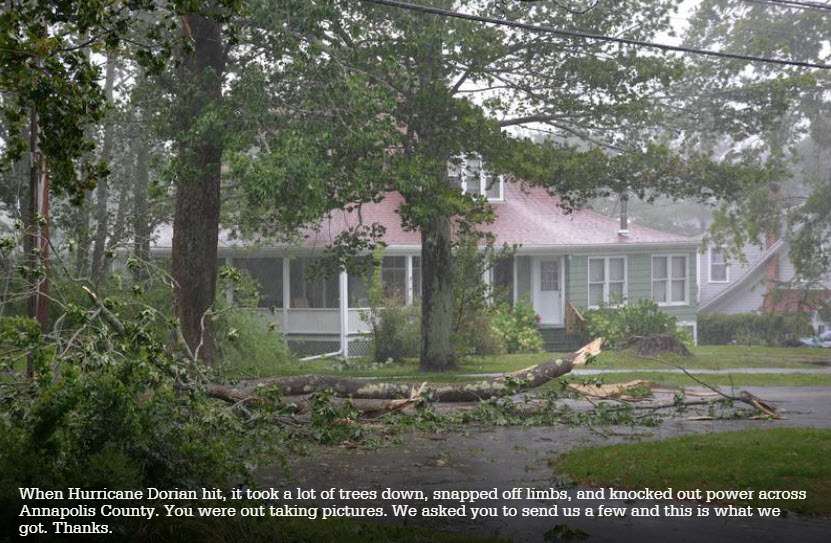
September is hurricane month in Nova Scotia.
This week, after Hurricane Dorian, the Municipality of Annapolis County passed a Declaration of Climate Emergency (see Annapolis Spectator, September 23rd).
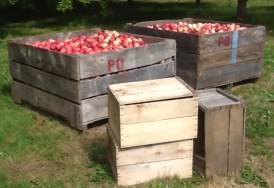 September is also the month when I need to be prepared for harvesting our organic apples. This means ensuring that the tractor is in good working order. Over the Winter, it developed a flat rear tire. This has led to the purchase of a new rim ($500) and its installation by High Country Tire. Fortunately, I had access to Neil Bent, who was able to mentor me in the challenges of bush hogging the upper field, as well as the forklift to move the Apple bins from the barn to the orchard. Each year, it seems harder to remember all the subtleties, adjusting the various levers and their proper settings.
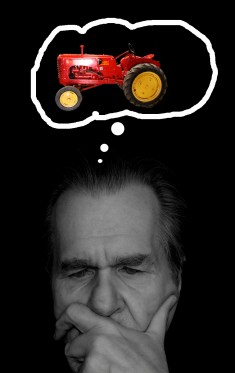 The capacity to move seamlessly from abstract thinking to practical task thinking is something that is needed by all elements of society. To address the climate emergency, we need to learn the details of new technologies, as well as to think differently with existing technologies. The new technologies include solar and wind energy. Existing technologies include different forms of communication. We also need a different approach to the concept of community.
We need a different relationship with our landscape.
The landscape is not a resource for exploitation. Rather, it is an integral, inseparable component of our identity. It should be appreciated, fostered and shared with others, who may stop by, if only for a few weeks or months.
We need, too, a much more inclusive approach to community.
We share our lives with two retired sled dogs. They were born in Nunavut. They spent part of their working life in Northern BC. Today, they enjoy the sights and sounds of the rural Nova Scotia landscape.
Footnote
This week, I have been in touch with the Hunter family about the apple brandy. One Raymond Hunter quotation which surfaced. “Bloom where you are planted.”
Acknowledgements
Neil Bent for his patience and knowledge of farm equipment. Timothy Habinski and Gregory Heming for their good work on Annapolis County Municipal Council, leading to the Declaration. Rocky and Debby Hebb for their memories of Raymond Hunter, and the Born Again Barn in Paradise. Heather Stewart for her enthusiasm for alternative technologies, and interest in the Extinction Rebellion movement. Edward Wedler for his graphics.
Reference
Annapolis Spectator. Article by Larry Powell.September 23, 2019.

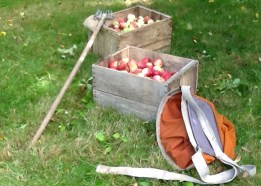 Meanwhile, at home, we are busy picking up the apple drops in the orchard. We wait for the apples to grow larger on the trees. We also wait for the first batch of Hunter’s brandy at
  Yesterday, I had to go to Kentville for a doctor’s appointment. On my way, I noticed the Kings’ County sign is ‘Orchards, vineyards and tides’ then, as one approaches Kentville on the Highway #101, the sign is ‘A breath of fresh air’.
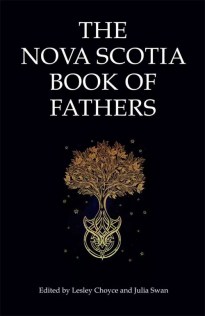
 We started to reflect on the difference. ‘Connected’ suggests a network of relationships between the elements of our natural environment and the people and culture that lived on the land. ‘Rooted’ suggests more a sense of permanence, with both feet on the ground.
 We have been working with them to produce a product, ‘Hunter’s Brandy’. Raymond and Rona Hunter were early organic farmers in the Annapolis Valley. In the late ‘80s, Raymond planted a small orchard in Paradise, less than a hundred trees, primarily NovaMac and MacFree varieties with the occasional Liberty and NovaSpy. We took responsibility for the orchard around 2008. Initially, we would hand-press the apples into sweet cider for sale at the farmers’ markets.
 More recently, we have reached an agreement with Brian Boates in Woodville to juice the apples and then deliver the liquid to Pierre Guevremont at Ironworks Distillery, Lunenburg. This week, we conducted the final tasting of Hunter’s Brandy. It has been two years in the making. Look out for it at your local farmers’ market or take a drive over the top to Lunenburg on the South Shore.
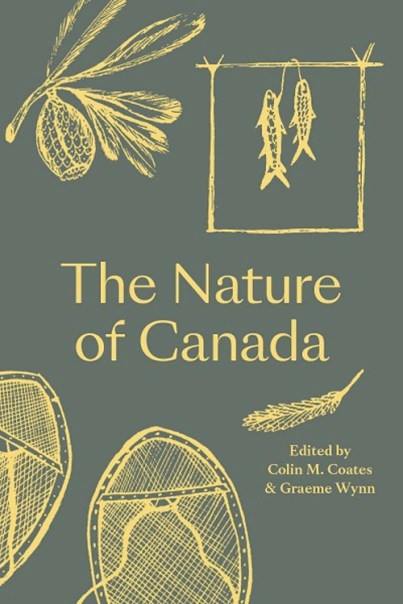 Subsequently, I picked up a copy at

 Joseph Weiss, in his book
 The third section addresses Care and Governance and the role of the
  on is the rightful heir to Haida Gwaii. Our culture is born of respect; and intimacy with the land and sea and air around us. Like the forests, the roots of our people are intertwined such that the greatest troubles cannot overcome us. We owe our existence to Haida Gwaii’ p.175
 To obtain an overview of the changes, we joined
  At the Sitka Studio, I found ‘

 Ernest Blair Experiment