The Newfoundland ferry docks at North Sydney. This gave me the opportunity to stop at a couple of my favourite shops in Sydney. First stop, was Ed’s second-hand book store where for two dollars I purchased Larry Mc Cann (ed.) People and Place. Studies in Small Town Life in the Maritimes. Later, I had a coffee at Doktor Luke’s, which also has second-hand books. There, I picked up a copy of David Ehrenfeld’s book Beginning Again. People and Nature in the New Millennium.

The McCann book was published in 1987. It contains a wide range of essays by faculty at Mount Allison. The essays are divided into three categories: Casting the Pattern, the Passing of Traditional Society, and Contemporary Small Town Life. Besides the book title, the essays that caught my attention were:
Carrie MacMillan. Seaward Vision and a Sense of Place. the Maritime Novel 1880-1920.
Eric Ross. The Rise and Fall of Pictou Island.
While I had a copy of Ehrenfeld’s book at home, I had not previously noticed his chapter on ‘The Roots of Prophecy: Orwell and Nature’. This seemed serendipitous.
I had specifically called my blog site: the Ernest Blair experiment. Ernest celebrates Ernest Buckler. Blair recognizes Eric Blair aka George Orwell.
Ehrenfeld talks about the three qualities that Orwell used in his analysis of the changing life of his, and our times. The first is honesty. The second is reliability/continuity/durability/resilience . And finally, the third property of nature important to Orwell is beauty and serenity.
“Orwell had two visions of utopia: one, a vision of a world in which nature is cherished and improved by a gentle and caring human civilization, and the other a vision of a world in which people treat each other decently and fairly, without exploitation.
Ultimately, as we see in The Road to Wigan Pier, the two visions came together in the picture of a ‘simpler’, ‘harder’ predominantly agricultural way of life in which the machine is present, but under human control and ‘progress’ is not definable as making the world safe for little fat men. A world in which progress, itself, is not a form of exploitation.” Ehrenfeld see page 27.
Thought: “Living in the Moment”
Does this concept change as you get older ? That is, you have a finite number of moments. Can you replace living in the moment (time) with living in the place (space) ?Why do older people go on cruises ? Change the place; change the moment. Its time/space. Not time or space.
What is the meaning of going back to visit old haunts ? Realize changing time, but same space ? Not really, spaces (landscapes) change too!
The value of a long term relationship with a place e.g. a garden. Growing things, different seasons.
Why in youth, keep moving ? Different spaces. Living in different moments Are we trying to extend the good moments. No, trying to find the right space. Is it the moment or is it the sense of being able to change or control ? Is there a progression as you age ? The changing perception of time/space, over a lifetime or over a lifespace.
References
Larry McCann (editor). 1987. People and Place. Studies of Small Town Life in the Maritimes. Acadiensis Press. Mount Allison University.
David Ehrenfeld.1993. Beginning Again. People and Nature in the New Millennium. Oxford University Press.
George Orwell. 1937. The Road to Wigan Pier. Gollancz Press.

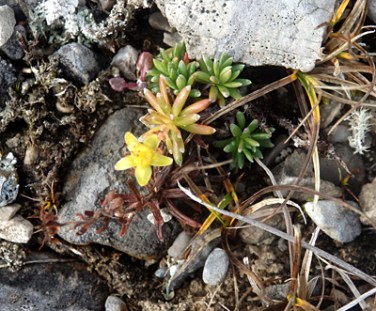 We had many personal realizations. While we had studied the plants in the National Park, visiting the serpentine Tablelands and the barrens on the top of Gros Morne, we had not gone North of the park. Over the last forty years, scientists have rediscovered the geology and biology of the Great Northern peninsula, in particular the uniqueness of the limestone barrens.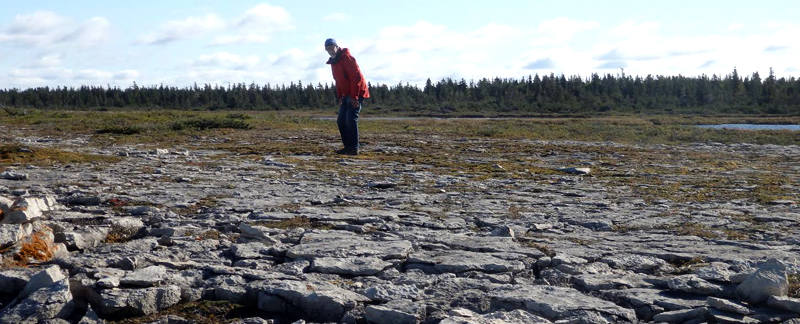
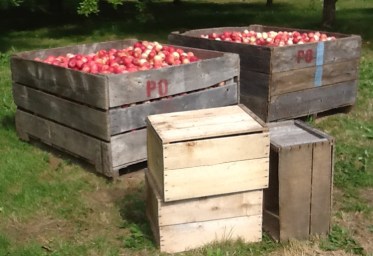 Last year, we picked fourteen bins. It takes eighteen boxes to fill a single bin. The apples come from ninety one trees; four varieties: NovaMac, MacFree, Liberty and NovaSpy — all scab free. We arranged for Brian Boates in Woodville to pick up the fourteen bins on a flat bed, and then to juice the crop. The juice was transported to Ironworks distillery in Lunenburg, where Pierre Guevremont is turning it into apple brandy. It will be another year before we can sample the result.This year, so far, we have picked five bins. It looks like the yield will be less this year. The size of the harvest depends on pruning, pollination and microclimate. This year we pruned the higher branches to make for easier picking. We have had a dry, warm Summer. Less water likely affects the number and size of the apples.
 Future considerations include the addition of organic fertilizer (earthworm castings), drip irrigation in dry years, the addition of beehives for increased pollination. These thoughts are my brain pickings from the orchard.
 First, there was the news that the tenant was moving from Andrew’s farm house across the road. This meant screening a number of possible new tenants. Meanwhile, there was a significant number of ‘to do’ tasks while Heather was away. They included chain sawing several cords of firewood, painting outbuildings, and getting organized for this year’s apple harvest in the orchard. Apple picking demands moving full apple bins with the fork lift on the tractor. Ah yes, this requires fixing the ‘soft’ tire on the tractor.

 ” the business community, not just governments, has a responsibility for turning the region into something more than a region of the mind. Community institutions need to step up and contribute to the region’s economic development.” (July 29/17 Chronicle Herald F3).
 In my neighbourhood on Hwy 201, I see new craft beer company (Lunn’s Mill) and Beavercreek Winery. In Paradise, the Morse Estate (Buckler. The Cruelest Month 1963) has been transformed into Burnbrae Farm and Paradise Inn. The town of Bridgetown has merged with the Municipality of Annapolis County.


 Afterwards, I was driving my son’s tractor to bush hog the lower field on his property. Last week, I had discovered that the PTO (power take off ) was not driving the mowing unit. Over $1400 later, I had an operational unit. This was the test.
 Ernest Blair Experiment