Posted in Art, Nature, Photo Essay, Travel

Footsteps East  our 5,000 km plein air journey

Plein air art saved us from disaster — and may have even saved our lives!

A massive, cracking thunderstorm with torrential rain struck our campsite. 

At the time, we were painting about 20 km south; in Petit-Saguenay, Quebec, a fjordic region of Canada. Mountainous landslides washed out the only access road back to our campsite. About 200 campers, their tents and RVs were left stranded. They had to be airlifted/ boated out. Tragically, two were swept out to sea and lost their lives. It took over a week to be safely escorted back to camp so we could retrieve our tent and gear. What a start to our 5,000 km plein air trek through eastern Canada!

We planned to travel through landscapes painted 100 years ago by Canadian artists Tom Thomson and members of The Group of Seven — from Nova Scotia to northern Lake Superior and back — and to explore our painting styles.

In Ontario, we visited quaint towns that offered mouth-watering bakery products and parks made famous for their breathtaking topography. In Killarney we hiked “The Crack”; the most rugged trail in the La Cloche Mountain Range.

And canoed the lakes. We travelled by rail up The Agawa Canyon. In Neys and Pakawaska we painted near a WWII prisoner-of-war camp. On our return, we enjoyed camp-time with our daughter and grandchildren and painted the farmlands of Huron County.

Every day, our Footsteps East journey remains crystal clear — the squeal of soaring hawks, the fragrance of pine-filled valleys, the fresh breath of morning air along the rocky shoreline of Georgian Bay and the many spectacular skies.
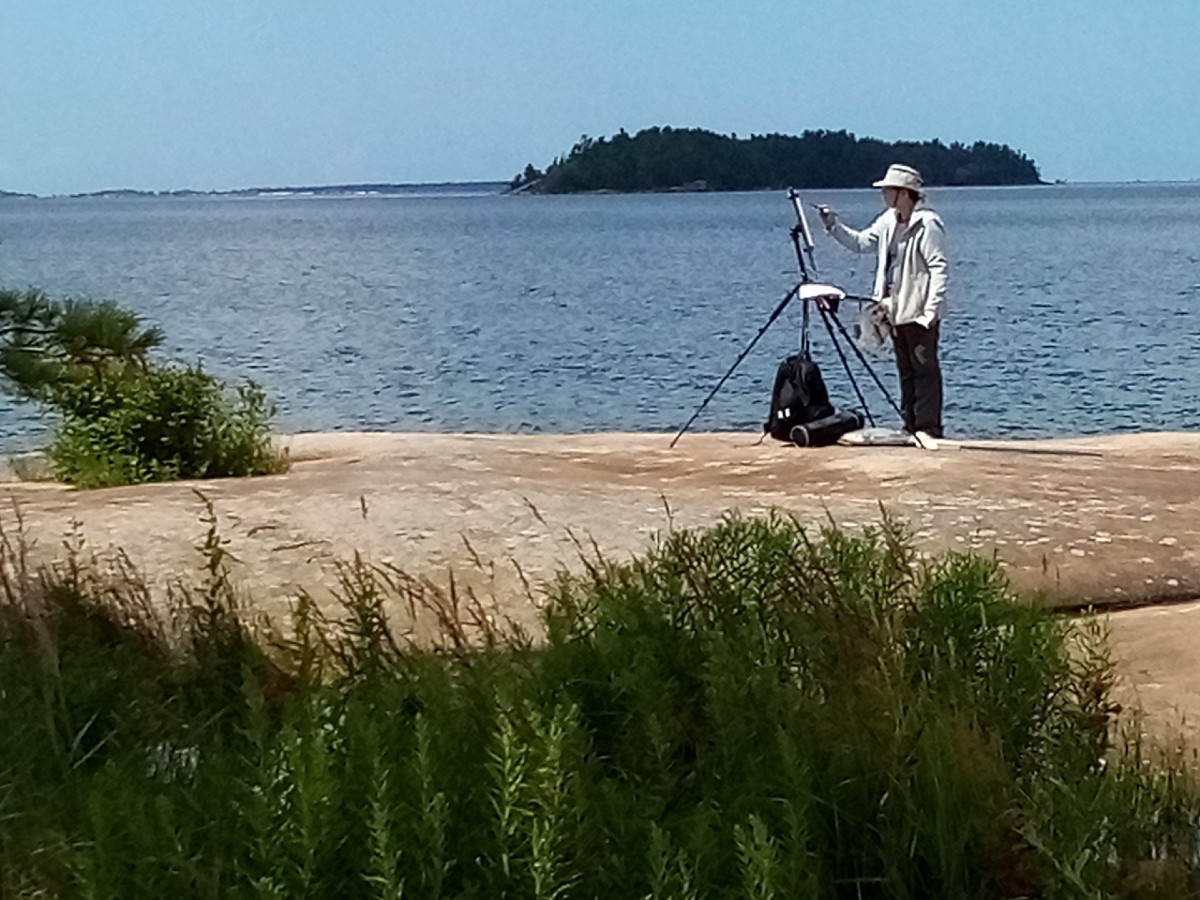
 

That’s the beauty of plein air art. Every moment is treasured and fully experienced. Even better is when the journey is shared with art lovers and adventurers; locally and from around the globe.

Little Island, Petite Saguenay” plein air oil by Anne Wedler

Our trek’s stories, artwork, videos, and interactive map are on our website at Footsteps East.

So what adventures await? 

Footsteps Farther East” is where we tented and painted the landscapes of Newfoundland and Labrador in the summer of 2024. For 2025 it may be rural France and Ireland — even farther east.

Originally submitted to Plein Air Magazine’s “Postcards on the Road”
(now revised including images) by Anne and Edward Wedler
“A Plein Air Pair”
wedlerfineart.com
Posted in Art, Common Place, New thinking

My Mind is Racing: looking at geography through a refreshing lens

MY EMAIL THREAD WITH Dr BOB MAHER:

Tonight, I plan to attend a discussion panel at Dal University triggered by an article in The Coast, “In This Economy, Try Art“.

The panelists will pull on narrative threads in “Strange Birds”, including creative ways to engage with the climate crisis, and add their perspectives on curation, academic perspectives on environmental sustainability and the ways art can bring awareness, action and optimism to the struggle for the planet’s future.

I explored the backgrounds of the panelists, particularly, celebrated exhibition curator Ray Cronin and Dal U environmental studies professor Melanie Zurba. They approach geography through a very different lens than I have been used to — Ray Cronin through place-based art and artists, and Zurba through community and indigenous collaborators of our environmental spaces.

Then, to continue this thread, I could not then help but explore who, to me, is one of the most interesting professors I HAVE NEVER MET — Acadia U prof Dr Jon Saklofske. If there is one thing I would ask of you today is to grab a coffee and watch his 17-minute YouTube video “Creating Worlds Together“.

Here, is a really exciting way to view geography, literature, books, virtual worlds, and place-based stories; together. The type of work he does with undergraduates and a COGS-Acadia collaboration would blow my mind [I would jump at the chance to be one of his students].

How do I know of Jon Saklofske? He once requested some promotional literature/book posters we had when I ran The Inside Story bookstore. Again, I have never met him but his research mind-space excites me.


This then got me thinking … this time following a Jon Saklofske-thread into an Esri and virtual world.

Since Saklofske has delved into the geographic world of gaming, has Esri ever explored or embraced the type of geographic-gaming explored by Saklofske — especially since the entertainment world is such a large part of current culture?

I wonder where an Esri-Saklofske collaboration would lead — hmmm, maybe a COGS-Esri-Saklofske collaboration.

Let’s explore the ending “S” in “Centre for Geographic Sciences“.

Posted in Art, Book Review, Nature

Giving Thanks

On Sunday we had a beautiful, blue sky day. Heather and I decided it was a day for a walk in Kejimkujik National Park.

Early, we headed down Highway #8. Our destination was the Peter Point Trail. It was a delightful six kilometer stroll. The trail was covered in pine needles. The yellow, orange and red deciduous leaves were stunning.

Afterwards, it was time for a different route home. We headed down to South Brookfield, where we turned east on Highway #268, and cross-country through Pleasant River-Compton-Hemford-New Germany. At. New Germany, we turned North on Highway #10 to Middleton.

Two observations on the day:

  1. The colours on November 13 in rural Nova Scotia were fantastic because of the mix of hardwood tree species.
  2. The landscape mosaic of rural Nova Scotia is remarkable. If only, we would follow the practices of sustainable forestry.

This weekend, I received an inter-library loan notice from the Middleton library.

Jack Dangermond at Esri had recommended Our Towns by Jim and Deborah Fallows. A 100,000-mile journey into the Heart of America. A quick glance took me to the chapter on Redlands, California (also see the video in my post West Dalhousie Visit).

Redlands is the home town of Jim Fallows. It is also the headquarters of Esri and home town of Jack and Laura Dangermond.

We went with our young family to Redlands in the late ’80s. I had spent the early ‘80s designing and delivering new programs at COGS. After a year with EMDI in Jakarta, we landed in Redlands. Heather took graduate courses in Biology at the University of California, Riverside.

Thank you Jack for the reference, and the opportunity to spend time in Redlands., your town.

Reference

James and Deborah Fallows, 2028, Our Towns, Pantheon Books.

Acknowledgements

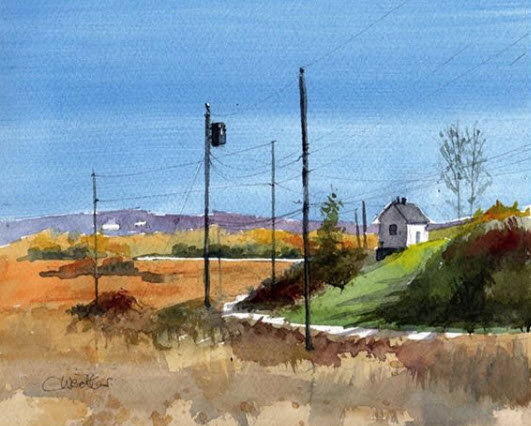
Head of Chezzetcook intertidal area painted in watercolour by Edward Wedler

Thank you , Edward. I know you were able to paint and capture the colours of the Nova Scotia landscape this weekend.

Posted in Art, New thinking, Travel

Pictou Visit

This weekend, we were in New Glasgow, visiting Heather’s family. On Saturday afternoon, we joined Sandy and John on a visit to the deCoste Performing Arts Centre on the Pictou waterfront. This Summer is the Grand Reopening.

A new cultural hub combines the Pictou-Antigonish Regional Library (PARL) and the deCoste Performing Arts Centre. We enjoyed the new library facilities, the indigenous paintings, and the sculpture on the waterfront by Alan Syliboy.

The collaboration across the Arts spectrum, combined with a beautiful library space, and theatre offer a new model for the ‘Creative Rural Economy’ (see also A Community Brains Trust and Landscape and Food: hidden gems of the Creative Rural Economy) .

Driving up from the Annapolis Valley, Pictou demonstrates what is possible for other small towns in Nova Scotia.

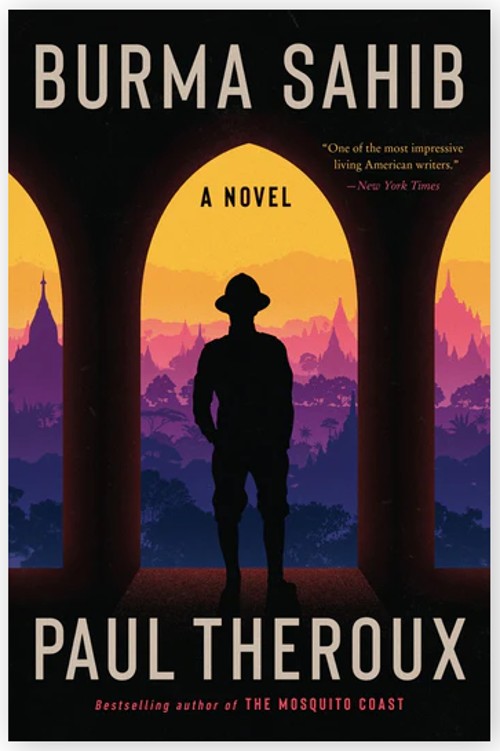
At the Library I was able to sign out David Suzuki’s ‘The Sacred Balance’. Heather picked up Paul Theroux’ ‘Burma Sahib’.

Returning to New Glasgow, the day was completed with homemade shepherds pie, beets and chard from Sandy’s garden, PBS’ Maine Saturday night fare ‘As Time Goes By’ and ‘Doc Martin’.


Sunday.

Time for the beautiful three hour drive back through the Rawdon Hills. At home, we were immersed again in the challenges of real estate sales. But we took time out for a stroll around the French Basin Trail (view my post Walking Paths). It was deserted, on a holiday weekend.

Acknowledgements

Sandy suggested the visit to the Pictou waterfront.

References

David Suzuki, 2022, The Sacred Balance: Rediscovering our Place in Nature, Greystone Books.

Paul Theroux, 2024, Burma Sahib, Marina Books

Postscript

Pictou Library offers special programs. They also offer Virtual Care and have a Virtual Care Navigator. The Library is a ‘Community Information Utility’, combined with the deCoste Centre. Together they continue to support the Creative Rural Economy of the region.

Posted in Art, Book Review

Place Matters

Roger Lewis is Professor Emeritus in English Literature at Acadia University. He has retired and now lives in Slocan, BC.

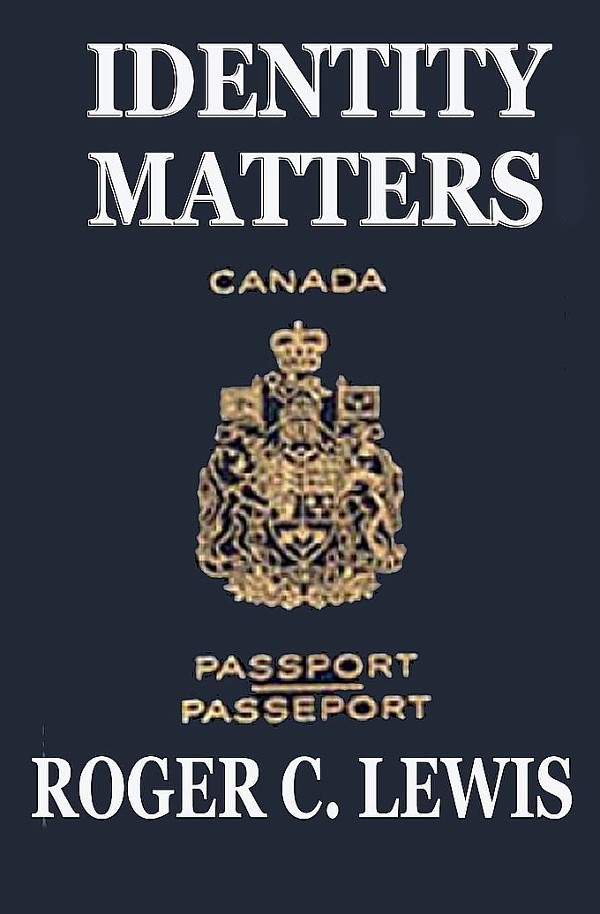
 His publication, ‘Identity Matters‘ is a collection of short stories. Some stories are set in Fundyville (aka Wolfville). Others are set in the mountains in British Columbia.

Lewis raises questions about identity and the effects of ‘place’. Given we have just spent two weeks in BC (Port Moody and Rossland). It proved to be a very thought-provoking read.

Aside from the references to the familiar geography of the Annapolis Valley, the descriptions of BC mountain culture – skiing, climbing and cannabis culture seemed very accurate.

It is somewhat insightful to realize the difference between North Mountain/South Mountain life in the Annapolis Valley and the concept of mountain life in West Kootenay, BC.

The ‘mountain’ landscape of Nova Scotia is much easier for our generation than the mountain landscapes of British Columbia.

I found the most poignant short story to be #14, A Father’s Diary. It is a description of an avalanche accident in Revelstoke. Lewis quotes, Group of Seven painter, JEH MacDonald as an epitaph:

He lived humbly but passionately with the wild. It made him brother to all untamed things of nature. It drew him apart and revealed itself wonderfully to him … and it took him to itself at last.” p.150.

This was epitaph to artist Tom Thompson, drowned accidentally in Canoe Lake, Algonquin Park, Ontario, even though he was an expert canoeist and swimmer.

Lewis uses the concept of identity in many different ways, however in all cases ‘the real question defining Canadian identity is not ‘who are we?’ but ‘where is here?’; from renowned Canadian thinker, Northrop Frye.

Acknowledgement

Heather shared the BC adventure. She is now reading, Identity Matters. Edward has just returned from Florida, arriving in a snow storm.

Reference
Roger C. Lewis, 2017, Identity Matters, Custom Books Publications

POSTSCRIPT

Anne Wedler’s plein air oil painting, “Achray” and Edward Wedler’s watercolour, “Achray Stone House” were created close to the sites of Tom Thomson’s paintings in the Algonquin Park (see their Footsteps East Map paint-out site 46).

(Left) “Achray” plein air oil painting by Anne Wedler
(Right) “Achray Stone House” plein air watercolour by Edward Wedler
Posted in Art, Event Review, New thinking

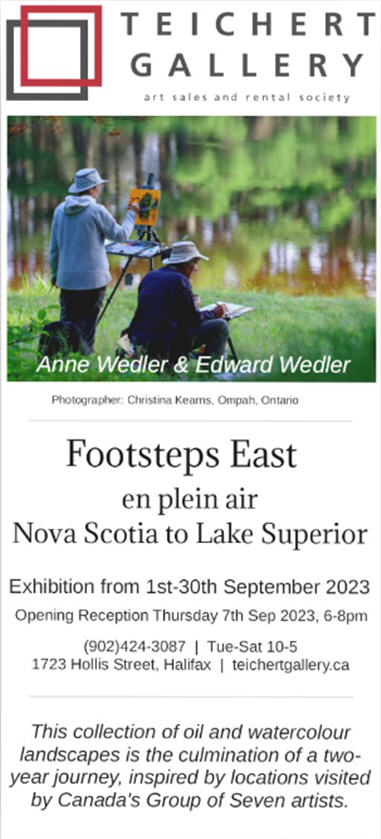
5,000 km ends at The Teichert Gallery

Anne and I are back from our two-year project. Footsteps East took us to places throughout Nova Scotia, Quebec, and Ontario.

This June 2023 started out rocky. Storms greeted us near Québec’s Lac Témiscouata.

While painting at Petite Saguenay, a sudden storm thundered 20 km away at our campsite at Baie Eternity. Multiple road washouts trapped over 200 people at the campsite. Many were airlifted out and escaped by boat. Overland flooding, tragically, washed two people to their deaths. It took us over a week to be able to follow a Saturday convoy to our site and recover our belongings. More heavy rains prevented further recovery of cars, RVs, and camping gear for 2-3 weeks.

Over twenty times we set up and broke camp during our journey — only a few times, thankfully, in the rain.

A typical rainy end in this short video.

Our journey was filled with adventures — tenting, painting, hiking, canoeing, riding the rails, and visiting art galleries. We filled two sketchbooks and submitted over 40 original paintings to the Teichert Gallery, adjacent to the Nova Scotia Art Gallery in downtown Halifax for our exhibition in September.

So, what’s next? What can grow our love of art and geography in Canada?

We figured an artist residency where we could explore the boundaries between spatial technologies (GIS, remote sensing, drones, etc.), the visual arts, and the culture of Place, would be a fruitful challenge. I’d love to develop a project, say, on “The Nooks and Crannies of Fogo Island”. Maybe you could help me out here.

Posted in Art, Event Review, New thinking

When Worlds Collide: Unicycles, Plein Air, and the Ultimate Tenting Expedition

This time of the year holds immense significance for me.

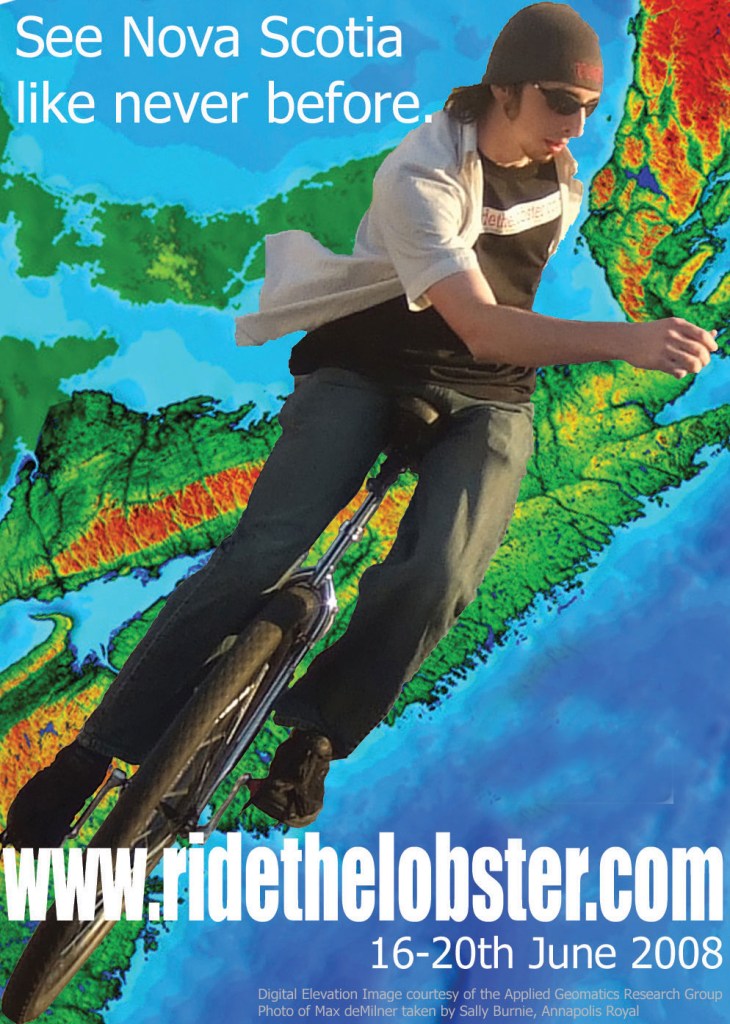
Fifteen years ago, almost to the day, we held Ride The Lobster — the world’s longest unicycle race in history, run in Nova Scotia — 500 miles and 5 days with the support of COGS, AGRG, Britec, the Government of Nova Scotia, and many, many other groups and individuals. Heather LeBlanc, Andy Cotter, Nathan Hoover, Brian Reid, and Bob Maher were instrumental in believing in this wild adventure and in convincing others to join. Max deMilner’s (Unicycle Max) New England trip triggered the idea.

Starting next week, Anne and I enter the Parrsboro International Plein Air Festival (PIPAF) alongside 28 talented artists across North America. This is our third juried entry into this prestigious event. Our painting colleagues are world-class. Not only are we in awe of them but are honoured to be participating with them.

Immediately following PIPAF, we embark on FootstepsEast (FSE), our 5,000 km tenting and painting trip through Nova Scotia, New Brunswick, Quebec, and Ontario to Lake Superior, and back. For two months, we log our journey that culminates in an exhibition of 40+ original works from our trip at the Teichert Gallery in Halifax through September.

The next few months will be hectic but exciting. Yes, this time of the year holds immense significance for me.

Acknowledgments

To Bob Maher for his continued moral support and geographic advice. To Anne for both tagging along and leading the way. To the many artists who send their best wishes and who will follow us on our journey. To those at the Teichert Gallery who believe in us. To all those who helped make Ride the Lobster work many years ago.

Posted in Art, Event Review

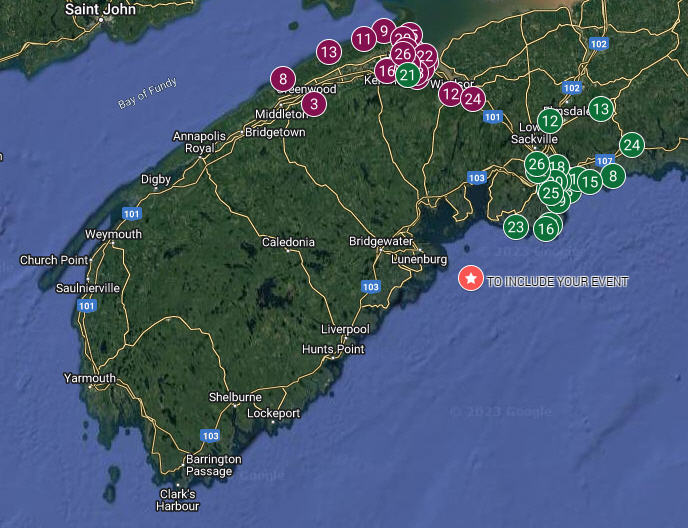
Plein Air Paint-Out Map for 2023

Our Nova Scotia plein air art map grows with community user input. It currently has 19,000+ map views.

The map shows paint-out locations for the upcoming, outdoor (en plein air) painting season.

According to Plein Air Magazine, the plein-air painting movement is the fastest-growing movement in the art world today.

Editor, Eric Rhoads, calls it “the new golf”. Many tens of thousands of artists, worldwide, are involved in this movement.

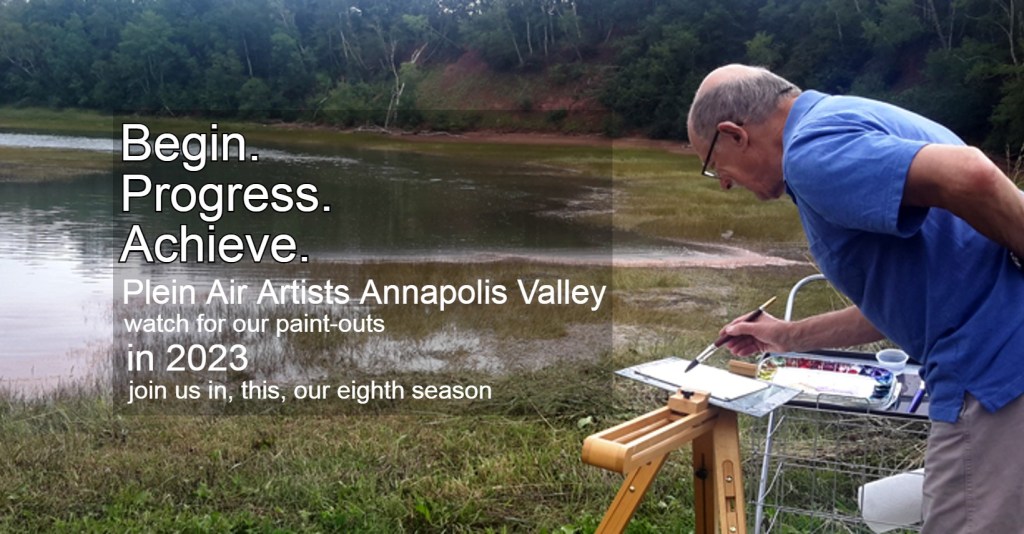
Anne and I have founded two groups in Nova Scotia (Plein Air Artists of the Annapolis Valley, PAAAV in 2016, and Plein Air Artists HRM, PAAHRM in 2019).

We participate in a third group, Halifax Urban Sketchers, HUSk, and have collaborated with the Nova Scotia Association of Architects to hold sketch-outs.

The map, and associated schedules, keep member artists, event organizers, art lovers, collectors, residents, and out-of-Province tourists aware of what, when, and where events are held. We have had visitors from Europe, across Canada and the USA join us based on this knowledge. Last year I created an icon on the map to allow others to place their event on the map. It’s crude (using Google Forms) but it works.


I use the Google Map platform because it is popular, and well-integrated with its suite of products (Google Sheets, Google Docs, Google Forms, Google Calendar, YouTube, etc.). Such a platform forms the basis of another map I am building for “Footsteps East”.

Our Footsteps East map tells the story of our 6,000+ km tenting and painting trek that Anne and I are undertaking from Nova Scotia to Lake Superior, and back. This organic, interactive map grows with text, and links to YouTube, Spotify, a Calendar, and sketches as we camp at each paint-out site. Anne looks after Instagram, Facebook, and Google Calendar.

On a final note, I’d like to say there are a number of improvements that would make such maps more valuable and scalable (and be monetized). If there is anyone out there who’d love to work with me on this let me know or refer me to some Google Map developers.

References

Link: Plein Air Map (tinyurl.com/PleinAirMap)
Link: 2023 Paint-Out Schedule PAAAV (https://bit.ly/3ZvR5Zz)
Link: 2023 Paint-Out Schedule PAAHRM (https://bit.ly/3ZvR5Zz)
Link: “Footsteps East Launch Pad(https://www.wedlerfineart.com/page/36519/footsteps-east-launch-pad)

Acknowledgments

Dr. Bob Maher as our Footsteps East Geographer Mentor and Advisor
Jesse Millican as our Footsteps East field video and audio recording Advisor
Techert Gallery as our host venue for the Footsteps East original art exhibition, September 2023
A global community of artists supporting and following us on our Footsteps East trek.

POSTSCRIPT
A recent plein air oil painting created by Anne in Florida.

Posted in Art, Nature

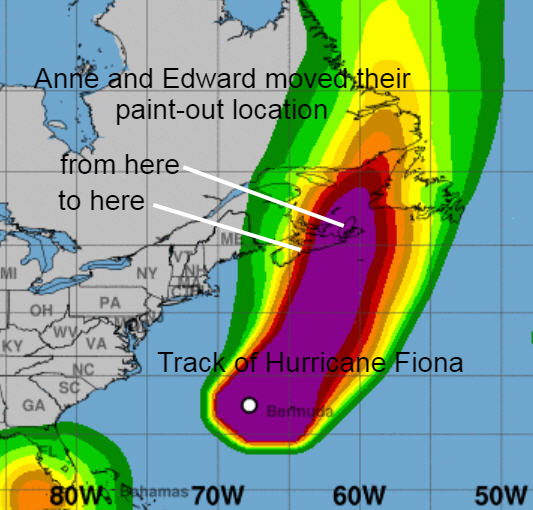
Fiona

As of this writing, I am awaiting the approach of Hurricane Fiona.

Even after driving for about five hours yesterday, away from our Cape Breton paint-out base at Margaree Harbour to Halifax, we still seem to be headed for a difficult time. This is the second time a hurricane has affected our plein air plans; the previous storm was named Dorion.

We still got in two days of painting at the coastal community of Margaree Harbour and Inverness and on the gravel bars of the salmon fishing Margaree River. These paintings will form the early part of our Footsteps East project (see our current map at tinyurl.com/FootstepsEast).

For those in Fiona’s path, stay safe.

Posted in Art, Event Review

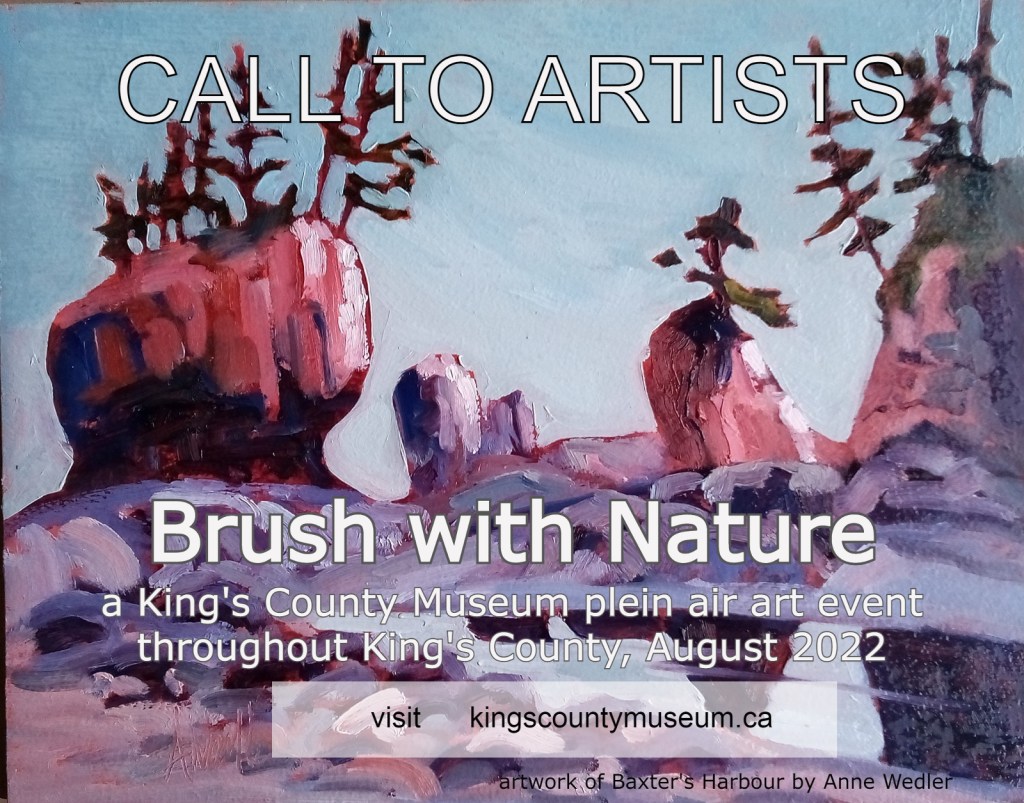
Brush with Nature

Kings County is large — stretching from the Bay of Fundy and Minas Basin to the deep interior of Nova Scotia. That’s over 2,000 square kilometres of territory.

Beginning in August, artists will be spread out across the county painting landscapes as part of “Brush with Nature” — an inaugural event hosted by King’s County Museum.

Anne and I have been collaborating with the Museum in the design and operation of this three-week plein air painting event.

The goal is to support both the museum and regional artists while celebrating the natural and historic features of the County. Artwork will be available for sale, auction and draw.

Any time between the 1-18th of August, artists can paint outdoors, anywhere within the County. We call this the “LONG BRUSH”. On Saturday the 20th of August the Museum hosts the “SHORT BRUSH” at Miner’s Marsh in Kentville. This is where artists will congregate to paint in and around the picturesque marshlands within a 2-3 hour window.

An early “Call to Artists” has already attracted some serious local talent.

Anne and I belong to six plein air art groups, three in Nova Scotia (founding two) and three in the USA (co-founding one), and have participated in many plein air events. We believe Kings County Museum and artists in “Brush with Nature” will have a successful and enjoyable event.


The size of Canada’s Northwest Territories dwarfs Kings County. This, I learned, is the location of Canada’s 44th Remote Sensing Symposium, 19-22nd June, 2023.

LINK to Yellowknife promotion.

How time flies. I recall the early days of these RS conferences when conference images were printed out via typewriter overwriting symbols. Now we have hyperspectral imaging from drones (UAVs) and satellites delivered to mobile devices that complement GIS and AI systems (I could deliver a stand-up comedy routine on these changes).

The more I learn about co-chair Chris Hopkinson, professor at the University of Lethbridge and Google Scholar, the more I fathom his teaching and communication skills (he does reveal a sometimes awkward and dry sense of humour). He has built a potent remote sensing program. I could spend (and have spent) hours watching his YouTube Playlists.

Such as his “Airborne Lidar Field Operations Lecture“. Lucky students!

I wish Chris Hopkinson, his colleagues and students, along with attendees from across the country, all the best and much success at Canada’s 44th Remote Sensing Symposium.

While this symposium is taking place I will be preparing for my art trek with Anne, Footsteps East, through New Brunswick, Quebec and Ontario.


Bob kindly sent me a reference to nature writer, Richard Mabey’s audiobook, “A Brush with Nature“. This represents 25 years of personal reflections on nature —  from observational reflections on nature to questions about its relationship with language, art and life.

Acknowledgements
To Bob Maher for his continued encouragement to write about my art experiences and reflections on RS. To Chris Hopkinson for his engaging online videos and promotion of ULethbridge and Canada’s 44th RS Symposium.