Posted in Art

First Steps

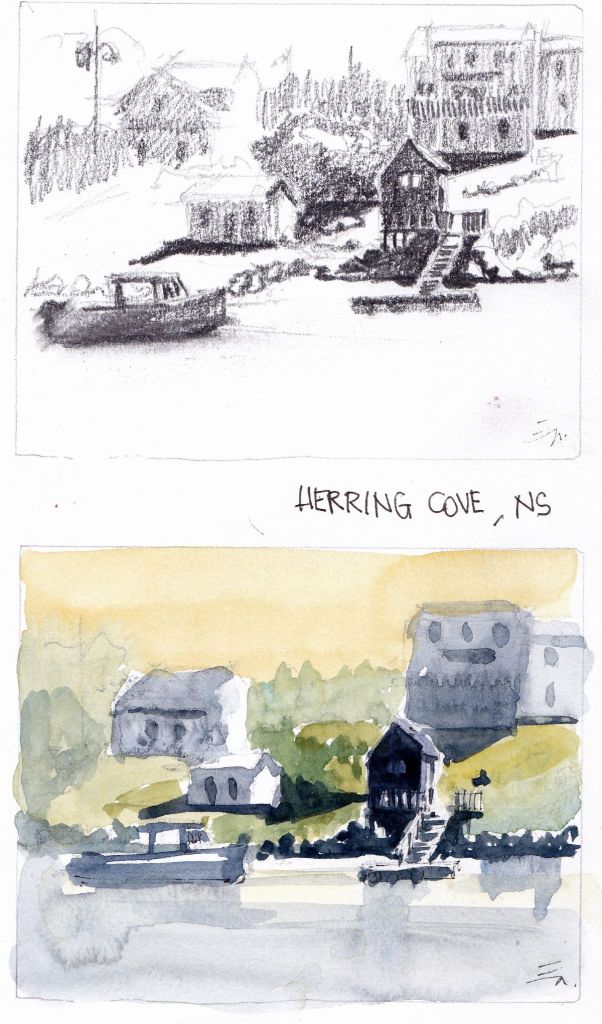
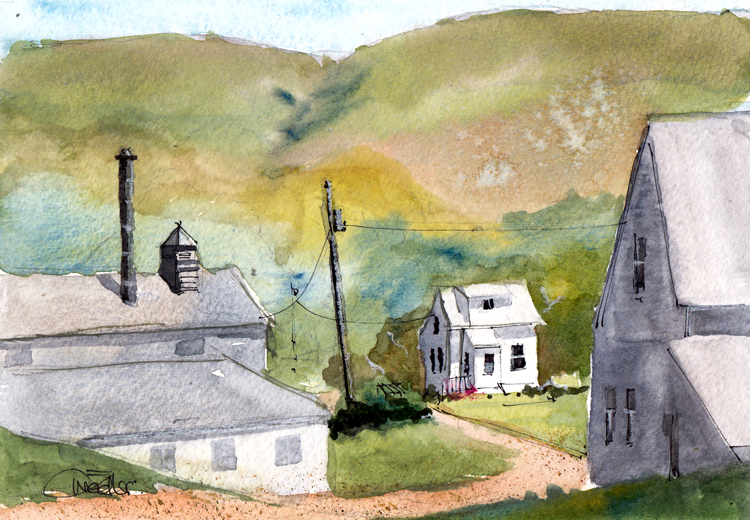
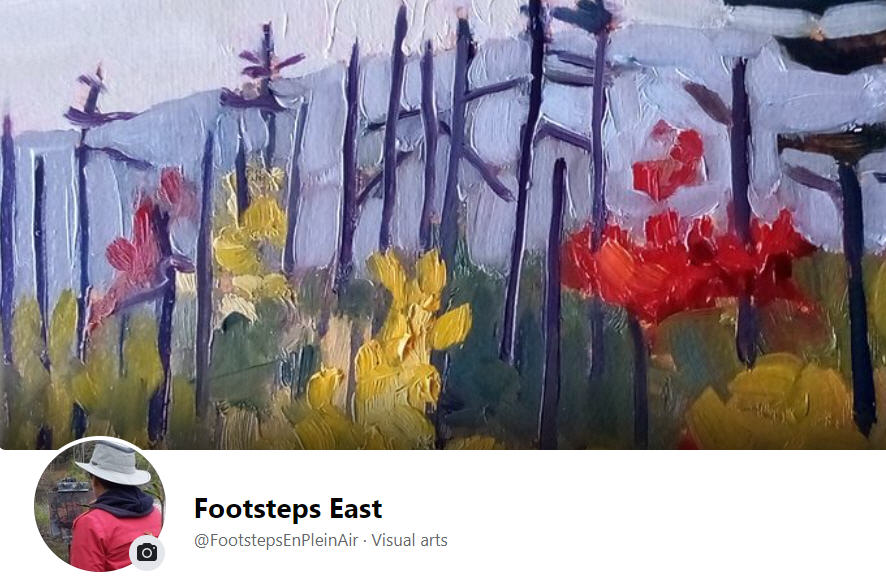
About two weeks ago, Anne and I began our two-year FootSteps East journey in Herring Cove, Nova Scotia — the area in which artist A.Y. Jackson painted back in 1919. We logged this paint-out to our newly-created FootstepsEast Facebook Page, to our ESRI Footsteps East StoryMap and to our Google FootSteps East Map.

Here is an excerpt from the first map I have created in preparation for Footsteps East. The map pins look a bit strange, but let me explain.
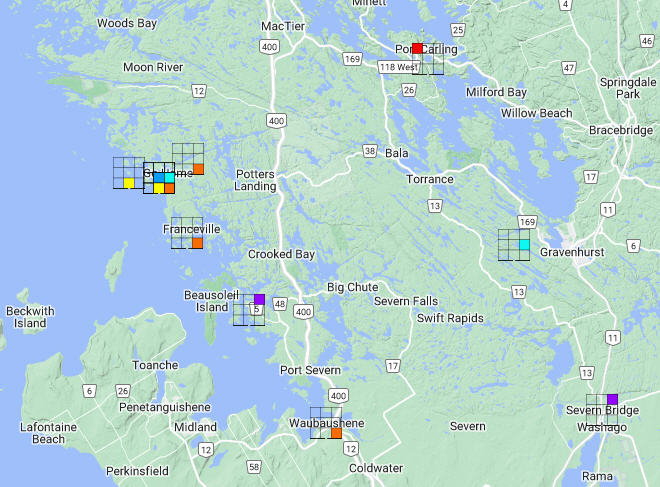
The pins sit over some of the paint-out locations of members of Canada’s Group of Seven Artists. Each coloured square represents a different member. I experimented with several different pins and ended up with this design in order that multiple artists could be shown at the same location, without overlapping/obscuring map pins.

This map will help plan a travel route through Eastern Canada.

Zeroing in on Herring Cove (our first step), you can see that I have included our journey’s log and sketch on the map.

Also shown at Herring Cove is the A.Y. Jackson map pin.
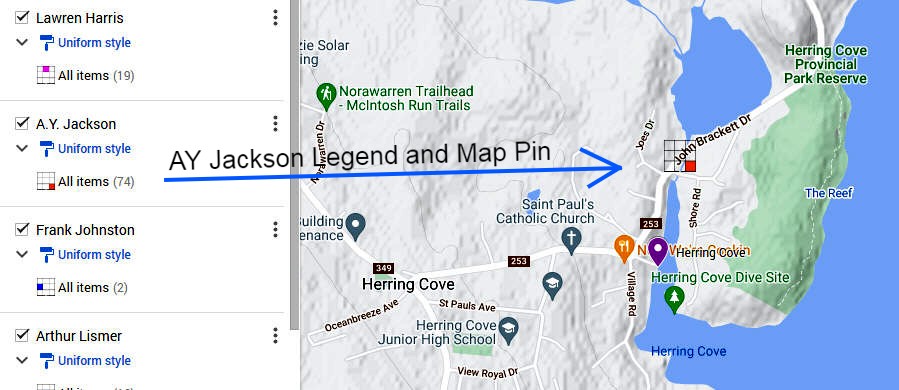
Once we have painted at three locations, I will make the map and social media links public.


This coming week (21-26th June 2022) we get to meet plein air artists from across Canada and the USA, in a competition to paint the landscapes around Parrsboro, Nova Scotia (Parrsboro International Plein Air Festival). We are up against some seriously talented pros.

For August, Anne and I have collaborated with King’s County Museum to design “Brush with Nature“. This is where regional artists come to paint features of natural/historical interest in a LONG BRUSH event (01-18th August 2022) within Kings County and a SHORT BRUSH event (Saturday, 20th August 2022) at Miner’s Marsh in Kentville. The first Call to Artists has already attracted some great local talent.

ACKNOWLEDGEMENTS

Anne is my painting buddy and we share this Footsteps East journey. Bob is my Geographic Mentor sharing his wit and wisdom.

REFERENCE

McMichael Gallery, Group of Seven website
https://mcmichael.com/collection/group-of-seven/
Posted in Art

Footsteps East

This week I received a notice from Edward Wedler. He and his wife Anne are embarking on a two-year painting project. It is an en Plein Air trek inspired by the Canadian Group of Seven. This will take them through Nova Scotia, Quebec and Ontario.

This ambitious project takes me back to earlier projects. For example, Ride the Lobster — an 800 km uni-cycle relay race through Nova Scotia. Or later, the Road to Georgetown, walking trails between Yarmouth and Georgetown, PEI to attend a conference on Redefining Rural. Along the way, there were many stories and places.

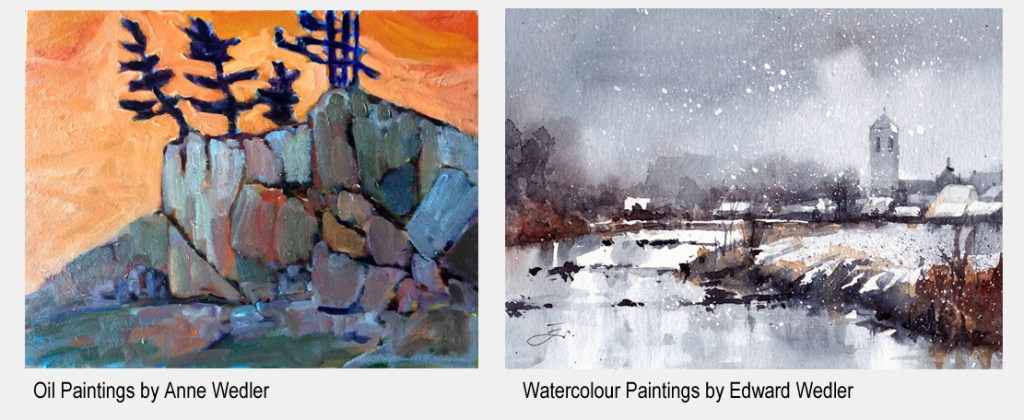
Of particular interest in Footsteps East will be the depiction of landscape and the changes over time. Edward will paint in watercolours. Anne will be painting in oils. The results will be on display at an art gallery in Halifax. All artwork that is to be shown at the gallery will be “under wraps” until after their trek is completed.

Another memory is from the 1980s. At COGS, Edward was teaching Remote Sensing. I was teaching Scientific Computer Programming. Later, my interest centred on the application of GIS software. My relationships with the industry included ESRI and ESRI Canada. Edward developed similar relationships with DIPIX and PCI. We both shared a common interest in sharing software/ computing skills to enhance understanding and application.

Subsequently, Edward and Anne purchased the bookstore, ’The Inside Story’ in Greenwood. Again, a shared interest.

With Footsteps East, the art of their paintings will share the landscape and the story of the landscape. This complements my interest in stories and living within the landscape.

Shown here is a sketch-out at the first stop on their journey — Herring Cove, Nova Scotia — the location where Group of Seven artist, A.Y. Jackson painted back in 1919.

I look forward to our collaboration, as we attempt to bring together landscape, community, art and story, within a shared accessible digital environment. I anticipate Edward will contribute a number of blogs to EBE, as they make their journey — camping and all.

Acknowledgements

Edward and Anne Wedler as they show the way — active living in the landscape, through art. Check out their website at wedlerfineart.com

Posted in Art, Event Review

PIPAF Atlantic Edition 2021

Last week, for three days, twenty artists competed in the Parrsboro International Plein Air Festival Atlantic Edition (PIPAF).

The spectacular Parrsboro coastline offers artists great inspiration.

For the first time, Anne and I were juried in to compete alongside great talent from across the region — from Weymouth, Nova Scotia, to St Andrews, New Brunswick.

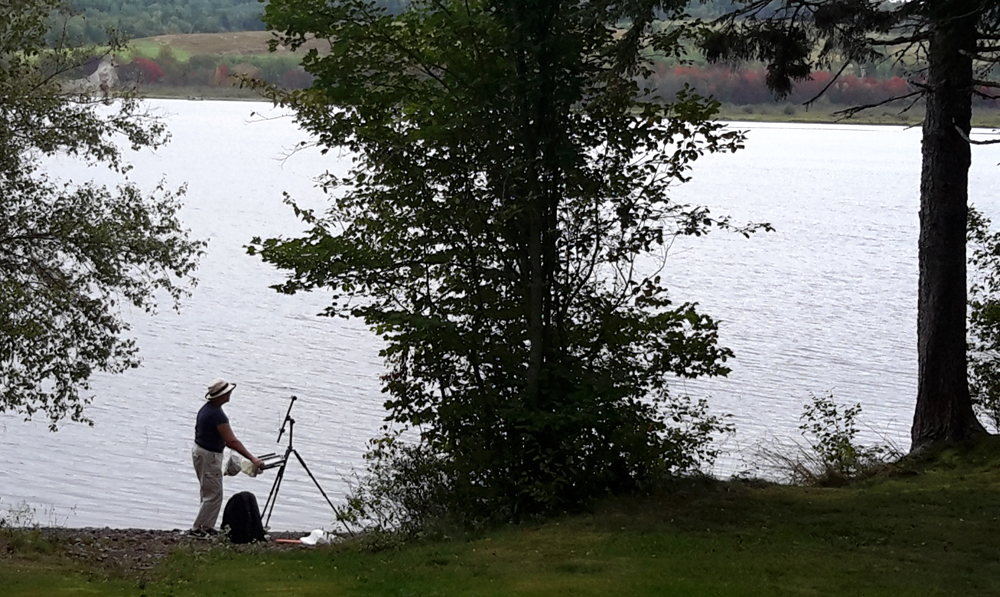
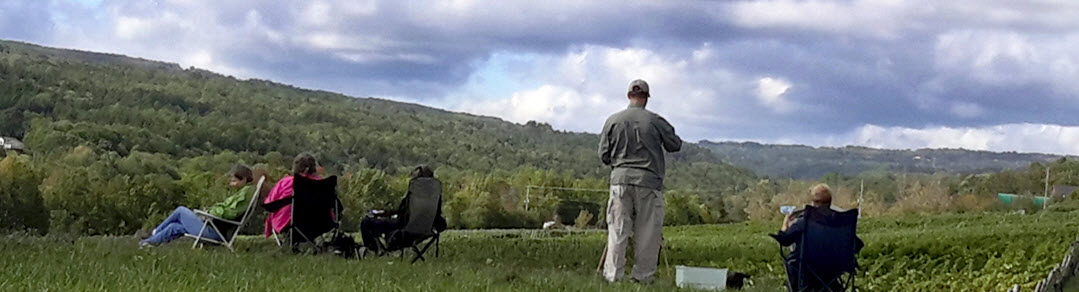
Each morning and afternoon we scattered out between Advocate Harbour to Five Islands to pick our spot and paint the landscape. One day, Anne painted inland at Newville Lake, north of Parrsboro.

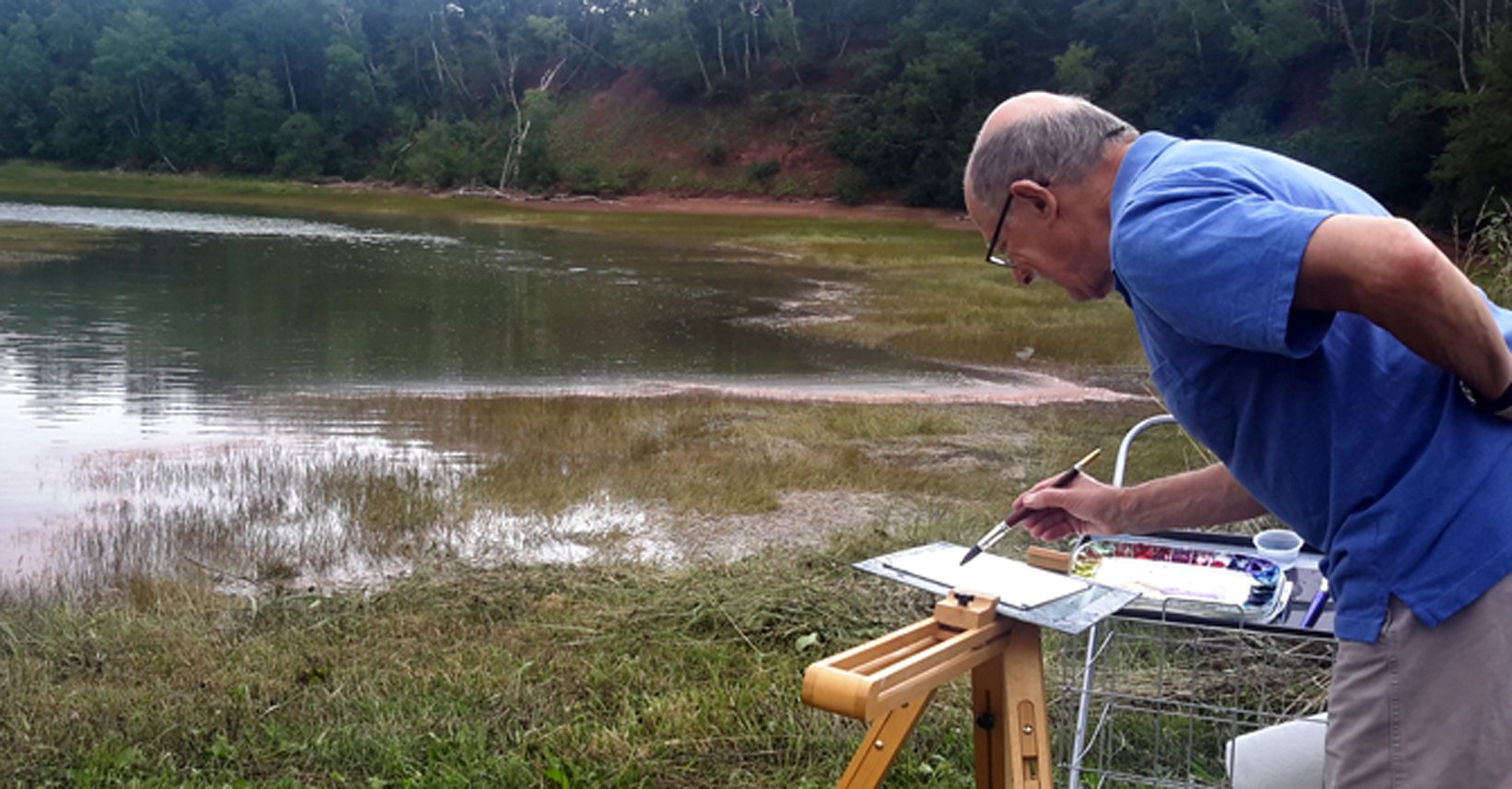
I seemed to gravitate to the built (and decaying) environment. Two of my watercolours captured abandoned buildings and trucks at “Parrsboro’s Bone Yard“. Others avoided this site. Once completed, we posted our artwork online at the PIPAF website and also to our online gallery.

On Saturday evening at “The Gala”, artists’ entries were judged by the owner of Zwicker’s Gallery in Halifax, Ian Muncaster. Aside from “Best in the Show”, categories included “Best Use of Light”, “Best Seascape”, “Best Nocturne” and more.

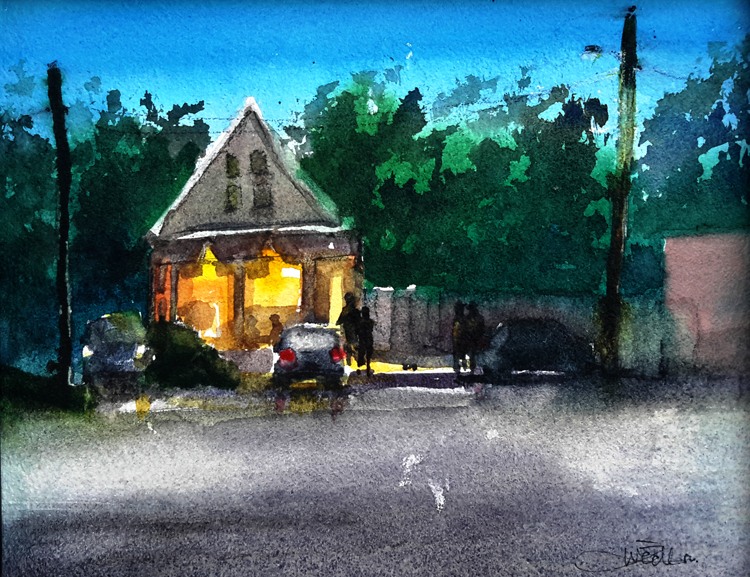
My nocturne entry, “Late Night Donuts“, was painted at night opposite Tim’s. People claim I left Anne stranded on a dark rural road to paint Partridge Island bathed in moonlight. Not true. She insisted I leave her there to paint. Her painting resulted in, “I Might Have Heard a Bear“.

Sunday, the last day of the competition, saw these twenty artists joined by others to paint in the Quick Draw event.

PIPAF 2021 Quick Draw Event attracted other artists and art lovers.

In addition to seeing our art-loving friends from the Annapolis Valley, we got to see our Halifax Urban Sketcher friends from Halifax who join in on the Quick Draw event.

While Anne and I did not win any prize, we reached an important milestone in our art journey. We were “juried in” to compete against the best in Atlantic Canada. We grew our network of like-minded artists, met new friends, discovered friendly townsfolk, and grew to love the land. So much so, that Anne booked us a cabin to return at the end of the month to capture the colours of fall in Parrsboro.

REFERENCE

PIPAF 2021 Special Edition: Anne & Edward Fine Art Newsletter XVIII
(Here, is included the full story behind “I Might Have Heard a Bear”, several of our paintings, and more.)

Posted in Art, New thinking

Mapping Nova Scotia Artists’ Plein Air Sites

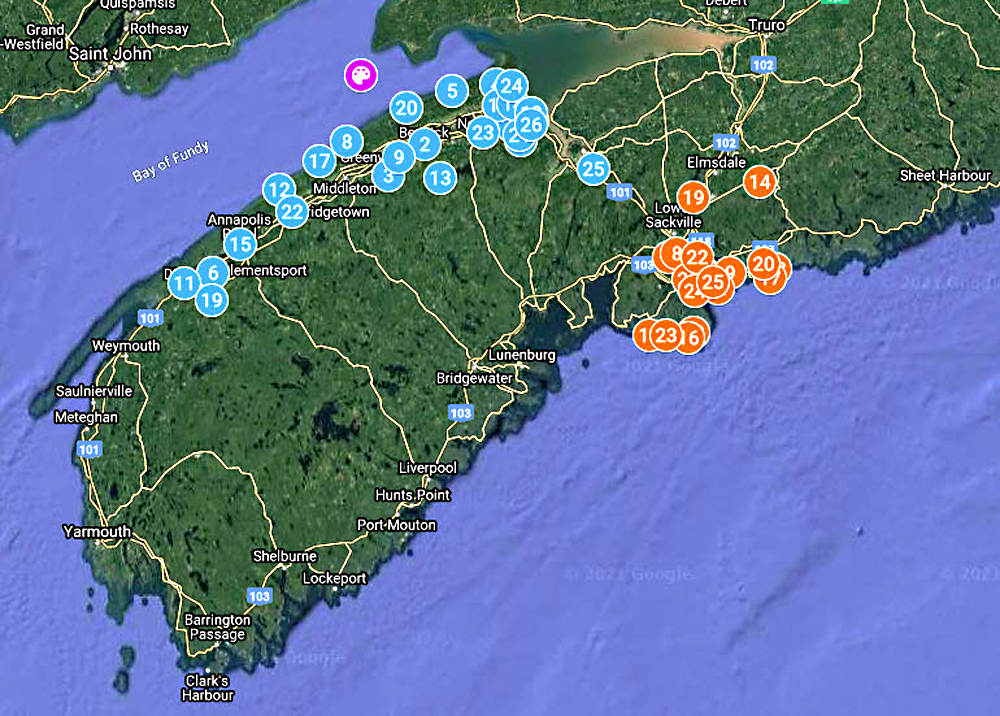
Fifty-two paint-out sites are planned for this season’s plein air artists in the Annapolis Valley and HRM.

For location details, click the map link: http://tinyurl.com/PleinAirMap then click a map pin or legend.

The one valued attribute of those artists who paint outdoors, on location (en plein air) is “extended geographic memory”. We watch, listen, smell, taste and touch our surroundings — for 2-3 hours. Geography becomes imprinted. As we gain artistic skills, we paint more than what we know. We paint more than what we see. We paint what we feel.

Eric Rhoads, publisher of Plein Air magazine and Fine Art Connoisseur magazine in the USA, states that the plein air movement is currently the fastest growing art movement in the world. There are tens of thousands of plein air artists in the world. So when they reacted positively to my interactive Google map that was a big deal for me. This is probably the first such map for plein air artists in the world, and so much more is possible.

Wow, that is very cool!

— Plein Air Magazine

I wrote back to Plein Air magazine, “Thanks. I did this on my own but with the right development team in place [thinking COGS’ student project] a plein air map could be scaled globally so artists could see when and where paint-outs are located, with contact and other information. This would go a long way to network the plein air community on their travels.“. They are now looking into this further.

Reactions from elsewhere have also been very positive.


POSTSCRIPT

Not many of our readers know we have a celebrated, world-class plein air artist living in Digby, Nova Scotia; just down the road.

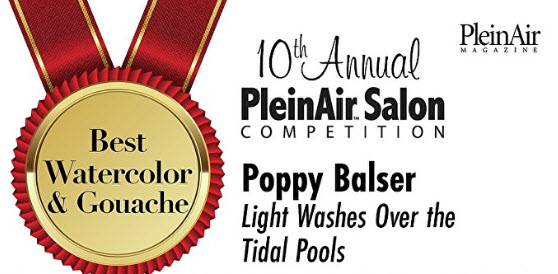
Poppy Balser recently received yet another prestigious international award. This time it was for her watercolour “Light Washes Over Tidal Pools”, inspired by her many visits to Point Prim and area.

Oh, why not toot my own horn? A website I share with Anne is located at wedlerfineart.com
95% of our work is en plein air.

Posted in Art

Back in Time

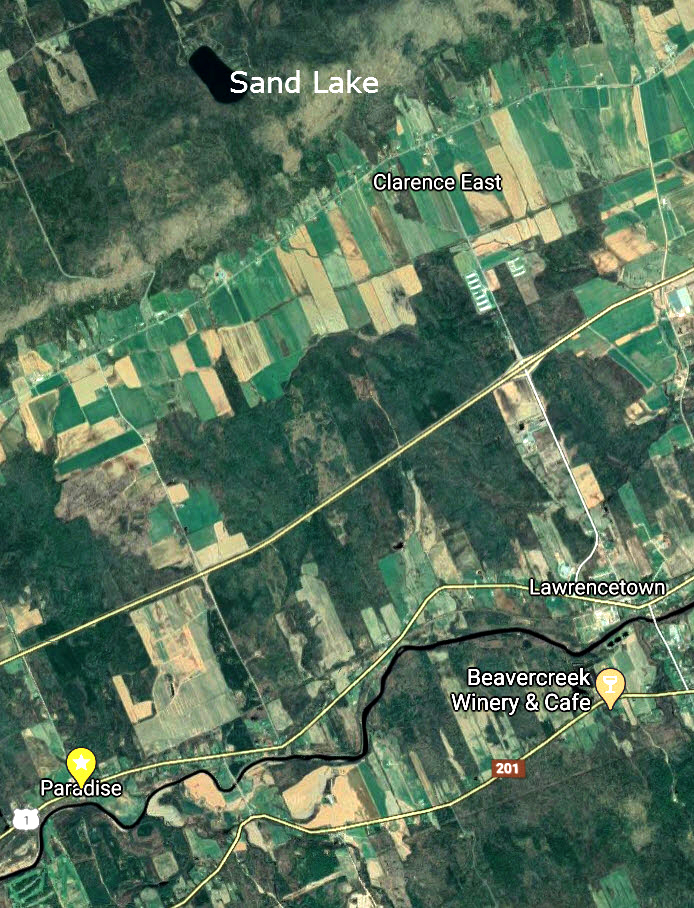
With the latest spell of hot, humid weather, we have been taking Siqsiq on a fairly regular basis for an afternoon swim at Sand Lake. Sand Lake lies perched on the top of North Mountain, just above Central Clarence.

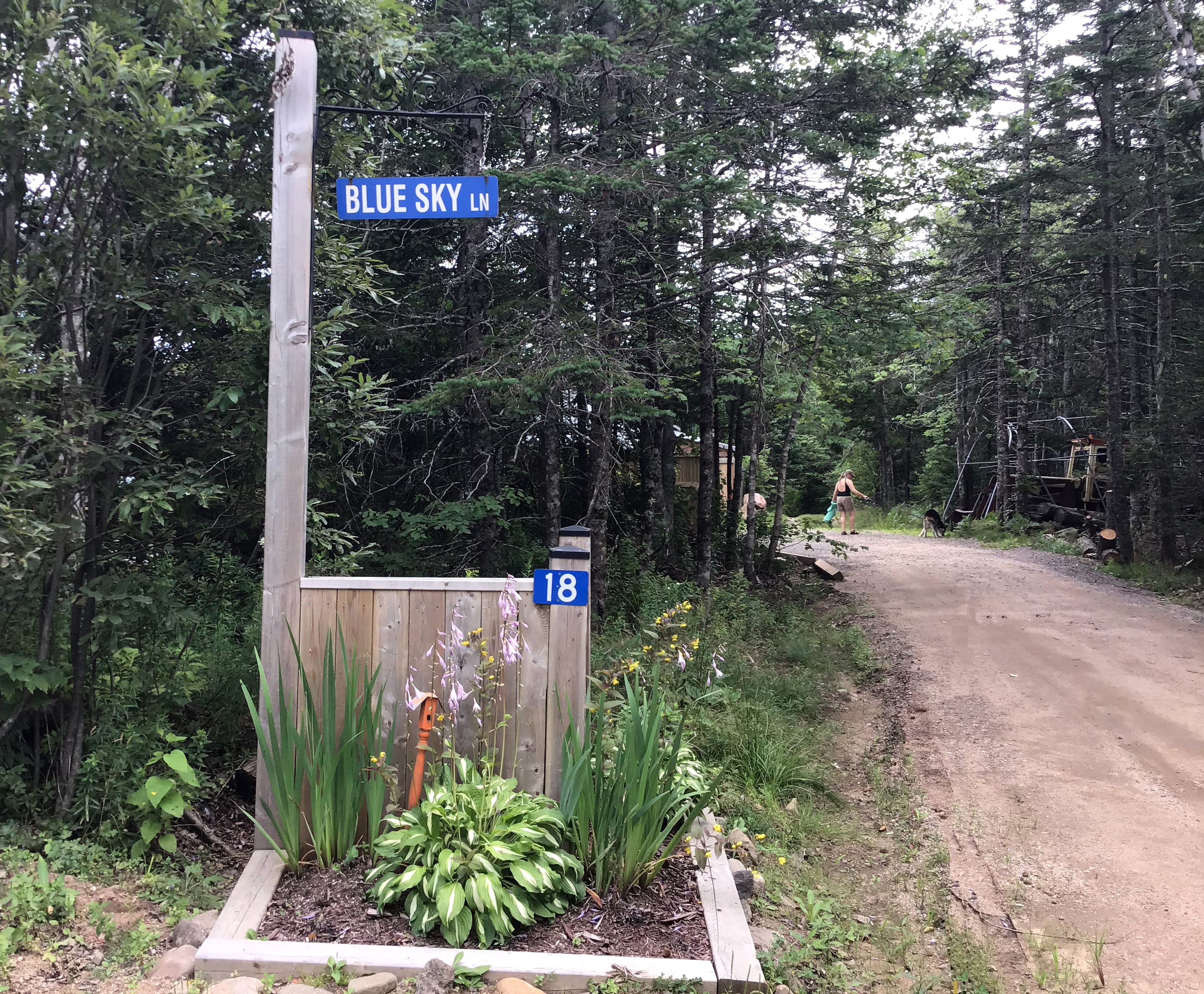
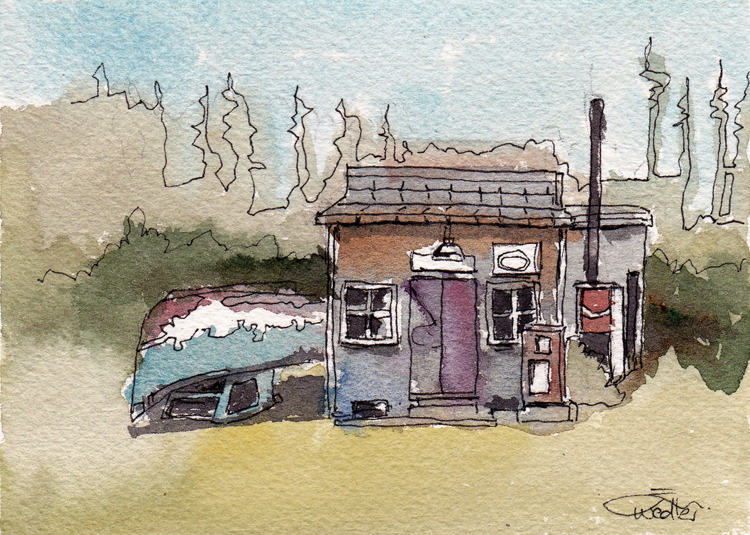
On Blue Sky Lane, I noticed an old gas station, from a previous era.place_sandyLakeGarage I shared the photograph with Edward. He replied that he had completed a watercolour sketch of the same building, several years ago.place_sandyLakeGarage_sketch
Coincidence or serendipity?

Looks like we will have more dog paddle in August if the weather stays this way.
place_sandyLakeGarage_2

map_sandLake_satelliteView

BTW. We had a lovely lunch at the Beavercreek Winery Café today. It’s open Wednesday to Sunday, 11 am – 3 pm. Highly recommended.

Posted in Art, Creative writing, Poetry

One, Two, Three

Sandra Barry from Middleton sent me a notice on the Elizabeth Bishop Society of Nova Scotia (EBSNS) Virtual Exhibit 2020 fundraiser.banner_EBS This year’s exhibit, Two Arts, is comprised of twelve Elizabeth Bishop inspired drawings by Natallia Pavaliayeva (NP) from Minsk, Belarus. Sandra curates the exhibition and also interviews the artist.

EBSNS
“Elizabeth Bishop is known as a poet of geography and place. How does your own sense of place influence your response to Bishop’s work ?”

NP
“This is one aspect of Bishop’s poetry that resonates powerfully with me. I love travelling very much – and I fully understand Bishop’s keenness for changing places, along with the opposite keenness to have a ‘home’, a place where she belongs to.”

From Sandra Barry’s curatorial statement :

“It was a difficult task to select only twelve images, but the idea of ‘home’ and ‘journey’ anchor the selection. Bishop once said that the poet carries home inside, and her sense of home comprised in a large part from elements and memories of Great Village and her childhood.”

From One Art, Elizabeth Bishop Letters, I was interested in her final collection of poems (1976). “It is to be called Geography III and looks like an old fashioned school book.” p.602.

“The poems in this small volume are some of the most important of her life: In the Waiting Room, Crusoe in England, The Moose, 12 O’Clock News, Poem, One Art, The End of March. They are also some of her most directly autobiographical poems, contemplation of her life as an artist.” p.96 Sandra Barry.

From here you can join the dots to Harry Thurston, Keeping Watch at the End of the World.bookCover_ThurstonEndOfTheWorld He has a poem ‘Geography: on first discovering Elizabeth Bishop in a Used Bookstore in Manhattan’. Dedicated to Sandra Barry. It starts:

“Geography III
(So plain but for the oddity
of Roman numerals),
I lift it down and begin,
by chance, From narrow provinces … “.
p.100

Thurston lives in Tidnish, Nova Scotia.

Andrew Spacey (online) provides an analysis of the poem ‘One Art’

“Elizabeth Bishop’s poem One Art is in the form of a villanelle, a traditional repetitive poem of nineteen lines. In it she meditates on the art of losing, building up a small catalogue of losses which includes house keys and a mother’s watch, before climaxing in the loss of houses, land and a loved one.”

pic_ladySlipper
Cypripedium acaule (Lady Slipper Orchid)

Postscript
This week with the rain showers we are seeing more flowers. On my walks with Siqsiq along the Annapolis River, I found the Pink Lady’s Slipper Orchid (Cypripedium acaule).

1-2-3

One Art, Two Arts, Geography III

Acknowledgements

Sandra Barry for her curatorial work on the EBSNS web site and blog. Edward Wedler for his artwork. Heather Stewart for her love and support.

References
Robert Giroux (Ed.), 1994. One Art, Elizabeth Bishop Letters. Farrar, Strauss and Giroux.
Sandra Barry, 2011. Elizabeth Bishop: Nova Scotia’s Home-made poet. Nimbus Publishing.
Harry Thurston, 2015. Keeping Watch at the End of the World. Gaspereau Press.

Posted in Art, New thinking, Opinion

Robert Waddell Art Awards

I propose creating an annual Robert Waddell Art Awards Event for excellence in art — something that can be launched jointly by the Municipality of Annapolis County and the Town of Annapolis Royal.

Robert Waddell was an art master at the Gordonstoun School in Scotland.gordonstounSchoolScotland Waddell inspired Prince Charles, then a student at Gordonstoun School, to paint in the 1970s. As a result of that inspiration, Prince Charles has become one of the UK’s most successful living artists, where he paints en plein air (outdoors) and exclusively in watercolours, according to Insider.
With the announced expansion of the Gordonstoun School into North America, and into Nova Scotia, in particular, a fitting tribute to Robert Waddell could excite our Maritime visual art movement. Could Annapolis County and the Town of Annapolis Royal help host/showcase such an event in collaboration with the Gordonstoun School, to celebrate the school’s Nova Scotia roots?

banner_2019_paint-outSEASON The Plein Air Artists Annapolis Valley group, now in its fifth year painting at outdoor locations throughout the Valley, could help organize the launch of such an event alongside ARTsPLACE, Paint The Town, and NSCAD.

Thinking even more inclusively,banner_KingsTheatre  connections could be made with performing arts, considering … the rich arts culture in the region, Annapolis Royal’s historical link to “L’Ordre de Bon Temps“, storytelling/plays/music at King’s Theatre, talk of a Liberal Arts University, and workshop/conference facilities such as those at Cornwallis Park. You see, “English master, Eric Anderson—like the art teacher Waddell, also in his 20s … encouraged Charles to act in several of Shakespeare’s dramas” (Vanity Fair).
Maybe this is where our Valley’s cultural history and environment can fuse with the traditions of the Gordonstoun School to make for exciting times.

References

Zoë Ettinger, Insider. Prince Charles is one of the UK’s most successful living artists. Here are 15 of his works, 30 March 2020.
Lawrence Powell, Spectator/Chronicle Herald, Gordonstoun a Go, 17 March 2020.
Plein Air Artists Annapolis Valley. 2020 Paint-out schedule.
Sally Bedell Smith in Vanity Fair. The Lonely Heir. April 2017.

Postscript

It would be excellent if Prince Charles joined Tom Forrestall and Geoff Butler on the inaugural judging panel. (Bob Maher)

Posted in Art, Event Review

From Snowshoes to Snowdrops

bookCover_healingWalksAnne and I arrived in Halifax by plane in the wee hours of last Saturday and were instructed by border officials to self-isolate for 14 days. We had returned from our stay in Bradenton, Florida. I read the interesting article Bob’s brother, Peter Maher, sent on confinement from “The Book of Life”. This got me thinking. Where and what is your geography when you are confined?

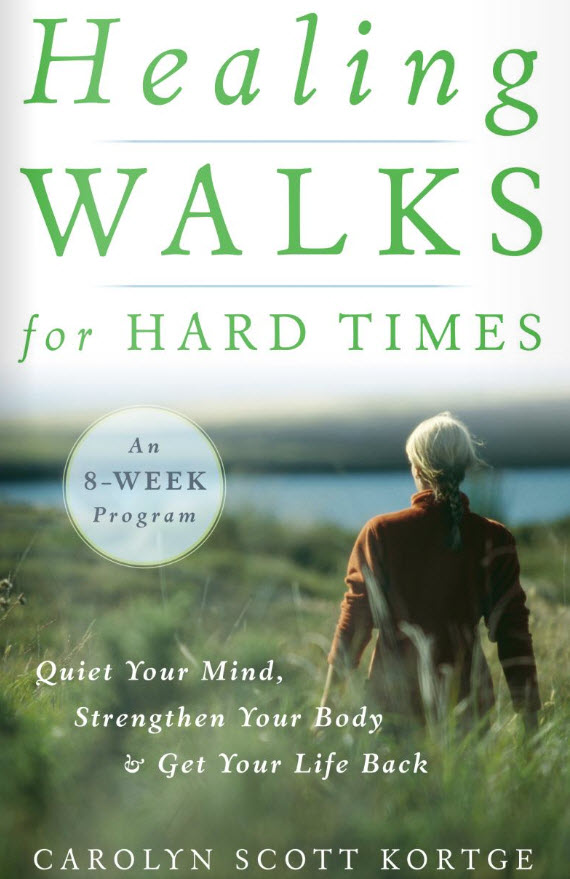
Bob and Heather, I thought, were fortunate to freely survey their property on snowshoes during this call to self-isolate and to physically distance ourselves. I suggested he take a camera with him when he goes on his outings alone or with Heather. Check out this free Shambala title, “Healing Walks for Hard Times” … “Walking awakens the profound healing power of the human spirit“.

I used to carry a (Zoom H4) field audio recorder with me on my walks and travels. I noticed how different the experience was to replay a walk/trip captured in audio versus captured in images — the clickity-clack of the narrow-gauge Skagway train; the sound of a 1890s replica gold-rush saloon; the passing of a Prairie train in the wee early morning hours outside our motel room; the soothing lapping of water on a lake’s shoreline near Petit-Saguenay; announcements at an airport waiting-area in Halifax; the crunch of soldiers’ footsteps on gravel at the Fortress of Louisburg or our own footsteps on our walks.

map_montrealSoundMap

How many of us truly listen to our geography? I once thought about how exciting it would be to explore a “sonic map” of Canada or Nova Scotia and then I discovered Sound Maps, as in the Montreal Sound Map. “The Montréal Sound Map is a web-based soundscape project that allows users to upload field recordings to a Google Map of Montréal“.

My wife, Anne, created some spontaneous “sound art” during a walking tour last October 2019, inside the Halifax Central Library, headed by a Dalhousie University architecture student as part of a Sketching Tours event with the Nova Scotia Association of Architects.

banner_PoppyBalserNewsletterIn these turbulent times, I notice how people are, lately, appreciating the little things in life. One of my favourite artists, Poppy Balser from Digby, for example, has been busy in her backyard garden, preparing for spring. She writes in her latest email newsletter, “Hope Springs Eternal“,

I found these snowdrops buried deep within a blackberry bramble in a neglected part of my garden.  I’m making an effort to get outside every day as we wait all this out. One of the projects I’ve undertaken is to clean up that portion of my garden and that is how I found the snowdrops“.

Anne and I are doing well. We exercise, dance, paint, illustrate, solve puzzles, read, write and think while being grounded. Today, I bake rustic bread and continue to illustrate Marshall Ennis‘ upcoming book, “The Legend of Great Uncle Arthur”, about a strong fisherman who once lived in a small outport on the northeast coast of Newfoundland.

Acknowledgements

Bob Maher for continuing to fire my imagination and motivating me to connect the dots. To my field recorder taken with me on my sonic-travels across Canada. To the many diversions on the internet, books and art that keeps us occupied during periods of self-isolation. Poppy Balser for bringing her outstanding watercolour paintings into my life. Marshall Ennis for helping me be strong in body and mind.

References

Healing Walks for Hard Times. Carolyn Scott Kortge. Shambala Publications.
Canadian Geographic. 8 July 2011. Surround Sound. by Samia Madwar.
Montreal Sound Map.
Poppy Balser Newsletter. Hope Springs Eternal.
MelsKitchenCafe.com. Rustic Bread.
Marshall Ennis Website.

Postscripts

RUSTIC BREAD

My rustic bread turned out well and was delicious — crunchy crust and the chewy centre. Next time I’ll add more whole grain flour and flaxseed for an even heartier bread.rusticBread

#PLANKTHECURVE


Posted in Art, Event Review, New thinking

AI in Plein Air Art

pleinAirArtists
My goal at the recent Art Impact AI workshop held in Dartmouth, Nova Scotia, was to see how AI (Artificial Intelligence) might play a role in plein air art. The workshop was headed by Valentine Goddard and Jerrold McGrath.

The participant numbers were of a convenient size that we could delve into the subject matter at some depth. What struck me first was the diversity of backgrounds in attendance — from wood sculptor to theatre-savvy software developer, from cellular biologist to explorers of biologic/geologic forms, from filmmaker to former art director. But we all had the creative artistic mind and AI interest in common.

I learned all sorts of AI concepts such as Neural Networks, Machine Learning, CV, and Deep Learning, and dominant AI values such as transparency, fairness, accountability, and more. We were shown a book entitled Neural Networks for Babies by Fernie and Kaiser. We played games to immerse ourselves in the mechanism of AI thinking. “Finding the Criminal” game taught us about the significance of algorithm development, application, confidence, bias, and use/abuse. That type of game, upon later discussions with filmmaker Kimberly Smith from Canning, could have implications in his Movie Games project.

So, how does AI apply to my plein air art world? In the short term, I do not see AI having immediate impact. I do see where AI has the potential for the visual artist; playing a role in my art, down the road, as mentor, coach, teacher and critic. I do not see AI in art as something to be feared. I see AI as something to augment the creative learning process and development of the human artist — where AI and human collaborate.

In plein air art that AI augmentation also includes the process of seeing and interpreting the geography that surrounds us as an artist.

ACKNOWLEDGEMENTS
Participants in the Art Impact AI Dartmouth workshop, for their lively and insightful discussions.
Valentine Goddard and Jerrold McGrath for heading the Art Impact AI workshop.

REFERENCES

Neural Networks for Babies, by Chris Ferrie and Dr Sarah Kaiser,  Sourcebooks, March 2019
Movie Games, by Kimberly Smith

Posted in Art, Nature, Opinion

Behold Cape Breton

Anne and I recently spent a week travelling through picturesque Cape Breton, Nova Scotia, taking in the popular sites, such as the Fortress of Louisbourg, and discovering some underrated nooks and crannies.

pleinair_margareeRiverFishHatchery_Sep2019_750w96dpi
Fish Hatchery on the  Northeast Margaree River, watercolour by Edward Wedler

We couldn’t help but notice the various ways people move through and note the landscape. As artists, we spent several hours documenting specific sites en plein air — Anne with her oils and me with my watercolours. Spending time at each location lets us absorb the landscape with all our senses. Our recall for detail is heightened.

20190919_110952_2While painting Pillar Rock from Presqu-île, near the southern part of the Cape Breton Highlands National Park, we noted dozens of visitors come for a few minutes to snap photos then move on. Did they see the otters swim the nearby pond? Did they note how the sun lit up the rocky shoreline as it rose above Jerome mountain? Did they hear the high-pitched piping notes of the eagle?

appleMapVehicleAt the other extreme, we were greeted several times by the “Apple Map vehicle” taking rapid-fire snapshots of the landscape as it motored throughout the Cape Breton Highlands. We were surprised to see it in the small northern community of White Point. It had a different purpose — to engorge its databanks with a future, retrievable, online, photo and map record of the region.

Whether painting, hiking, photographing, video-recording or “apple-mapping” we all move through the landscape at different rates and with different pursuits in mind. How do you move through the landscape? How much do you absorb from your travels? What record do you log and keep?

ACKNOWLEDGEMENTS
Anne Wedler for being my supportive, painting buddy. All those Cape Breton visitors we met attached to their iPhones and smartphones.