 Anne and I arrived in Halifax by plane in the wee hours of last Saturday and were instructed by border officials to self-isolate for 14 days. We had returned from our stay in Bradenton, Florida. I read the interesting article Bob’s brother, Peter Maher, sent on confinement from “The Book of Life”. This got me thinking. Where and what is your geography when you are confined?
Bob and Heather, I thought, were fortunate to freely survey their property on snowshoes during this call to self-isolate and to physically distance ourselves. I suggested he take a camera with him when he goes on his outings alone or with Heather. Check out this free Shambala title, “Healing Walks for Hard Times” … “Walking awakens the profound healing power of the human spirit“.
I used to carry a (Zoom H4) field audio recorder with me on my walks and travels. I noticed how different the experience was to replay a walk/trip captured in audio versus captured in images — the clickity-clack of the narrow-gauge Skagway train; the sound of a 1890s replica gold-rush saloon; the passing of a Prairie train in the wee early morning hours outside our motel room; the soothing lapping of water on a lake’s shoreline near Petit-Saguenay; announcements at an airport waiting-area in Halifax; the crunch of soldiers’ footsteps on gravel at the Fortress of Louisburg or our own footsteps on our walks.
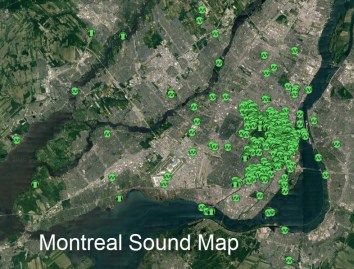
How many of us truly listen to our geography? I once thought about how exciting it would be to explore a “sonic map” of Canada or Nova Scotia and then I discovered Sound Maps, as in the Montreal Sound Map. “The Montréal Sound Map is a web-based soundscape project that allows users to upload field recordings to a Google Map of Montréal“.
My wife, Anne, created some spontaneous “sound art” during a walking tour last October 2019, inside the Halifax Central Library, headed by a Dalhousie University architecture student as part of a Sketching Tours event with the Nova Scotia Association of Architects.
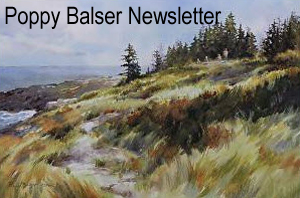 In these turbulent times, I notice how people are, lately, appreciating the little things in life. One of my favourite artists, Poppy Balser from Digby, for example, has been busy in her backyard garden, preparing for spring. She writes in her latest email newsletter, “Hope Springs Eternal“,
“I found these snowdrops buried deep within a blackberry bramble in a neglected part of my garden. I’m making an effort to get outside every day as we wait all this out. One of the projects I’ve undertaken is to clean up that portion of my garden and that is how I found the snowdrops“.
Anne and I are doing well. We exercise, dance, paint, illustrate, solve puzzles, read, write and think while being grounded. Today, I bake rustic bread and continue to illustrate Marshall Ennis‘ upcoming book, “The Legend of Great Uncle Arthur”, about a strong fisherman who once lived in a small outport on the northeast coast of Newfoundland.
Acknowledgements
Bob Maher for continuing to fire my imagination and motivating me to connect the dots. To my field recorder taken with me on my sonic-travels across Canada. To the many diversions on the internet, books and art that keeps us occupied during periods of self-isolation. Poppy Balser for bringing her outstanding watercolour paintings into my life. Marshall Ennis for helping me be strong in body and mind.
References
Healing Walks for Hard Times. Carolyn Scott Kortge. Shambala Publications.
Canadian Geographic. 8 July 2011. Surround Sound. by Samia Madwar.
Montreal Sound Map.
Poppy Balser Newsletter. Hope Springs Eternal.
MelsKitchenCafe.com. Rustic Bread.
Marshall Ennis Website.
Postscripts
RUSTIC BREAD
My rustic bread turned out well and was delicious — crunchy crust and the chewy centre. Next time I’ll add more whole grain flour and flaxseed for an even heartier bread.


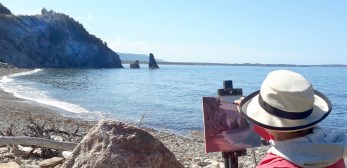 While painting Pillar Rock from Presqu-île, near the southern part of the Cape Breton Highlands National Park, we noted dozens of visitors come for a few minutes to snap photos then move on. Did they see the otters swim the nearby pond? Did they note how the sun lit up the rocky shoreline as it rose above Jerome mountain? Did they hear the high-pitched piping notes of the eagle?
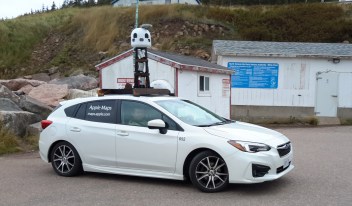 At the other extreme, we were greeted several times by the “
 Click on any numbered site to see details of when paint-out is/was scheduled.
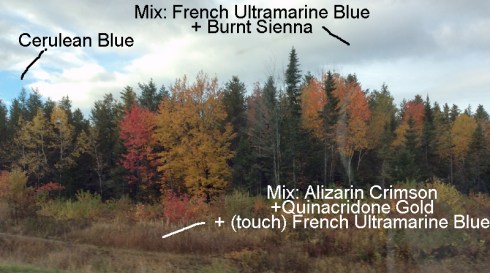 The sky wasn’t just overcast or sunny. The sky was a mix of Burnt Sienna with a touch of French Ultramarine Blue or was a variegated wash from Cerulean Blue to Cadmium Yellow. We were not just engulfed in fall foliage of colours. Hills became brushstrokes of Alizarin Crimson, Quinacridone Gold (I love that colour) and Prussian Blue.
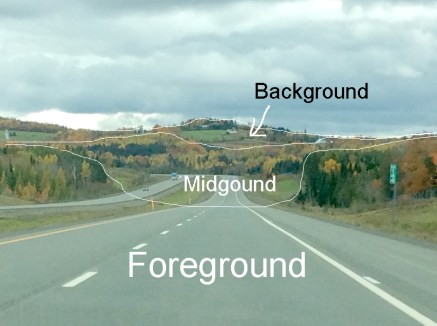 We divided the landscape into zones (foregrounds, mid-grounds, and backgrounds) and described how we would paint aerial perspective, “treat edges” and change tonal contrasts, to give a sense of distance.
 Many times we would identify a focal point in the landscape (almost with “eye-spy-with-my-little-eye enthusiasm) and would suggest ways to direct viewers’ eyes to that point. Would it be the slope of the hills, the line of our winding road, edges of forest stands or the illumination of light breaking through the clouds? How would our favourite artists, or The Group Of Seven treat that focal point?
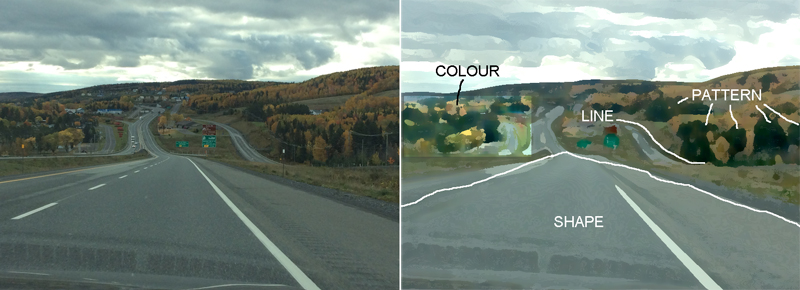 As we drove, we unpacked our landscape NOT in terms of “things” (such as houses, fence rows, barns, silos or cows) but in terms of shape, line, colour, patterns, gradation and composition. We became exhilarated, as artists, to not only view the landscape but to offer ways to interpret the landscape — whether it be as a realist, impressionist or abstract artist — in oils, acrylics, watercolours or inks.
 POSTSCRIPT:

