Posted in Book Review, Opinion

Small Details

banner_dAubinMeats_3In these unusual times, it is the small details that catch one’s attention. Going to the grocery store is a different experience. Once a week, I stop at D’Aubin Meat Market in Bridgetown. This week, we needed a hambone to make our split pea soup. They had run out of bacon but offered instead a ham end, as a substitute. While there, I grabbed a bag of pea shoots, and goat cheese scones with chives and cranberries.

We are seeing changes in the availability of news from the Saltwire network. They publish the Annapolis Spectator and the Chronicle Herald. Instead, I notice an increase in online blogs – The Virus Diary (Anne Crossman), The Groundhog (Roger Mosher) and Ernest Blair Experiment (Bob Maher, Edward Wedler).
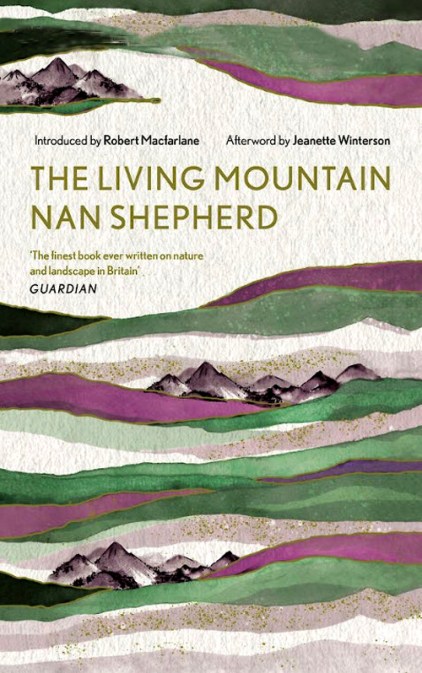
bookCover_livingMountainTwo years ago, I was in England and picked up Nan Shepherd’s The Living Mountain from the Weybridge Bookshop. After listening to Robert MacFarlane on CBC Radio, a couple of weeks ago, it was time to try to find my copy. The book, written towards the end of the Second World War but not published until 1977, describes her relationship with the Cairngorms in Scotland. It is considered a classic of nature writing. Twelve short chapters ranging from the Plateau through Water, Snow and Ice to Life (Plants, Birds, Animals, Insects and Man). She concludes with Being.

“I believe that I now understand in some small measure why the Buddhist goes on a pilgrimage to a mountain. The journey is itself part of the technique by which God is sought. it is a Journey into Being; for as I penetrate more deeply into the mountain’s life, I penetrate also into my own”. p.108.

In many ways, it is a Geography text.
MacFarlane provides an excellent thirty-page introduction to this slender book.

Acknowledgements

Ralph and Jennifer D’Aubin for their successful meat market and value-added products. Anne Crossman, Roger Mosher and Edward Wedler for their contributions to community blogs. Heather Stewart for her cuisine.

References
Nan Shepherd. 2011. The Living Mountain. Canongate Books
Posted in Art, New thinking, Opinion

Robert Waddell Art Awards

I propose creating an annual Robert Waddell Art Awards Event for excellence in art — something that can be launched jointly by the Municipality of Annapolis County and the Town of Annapolis Royal.

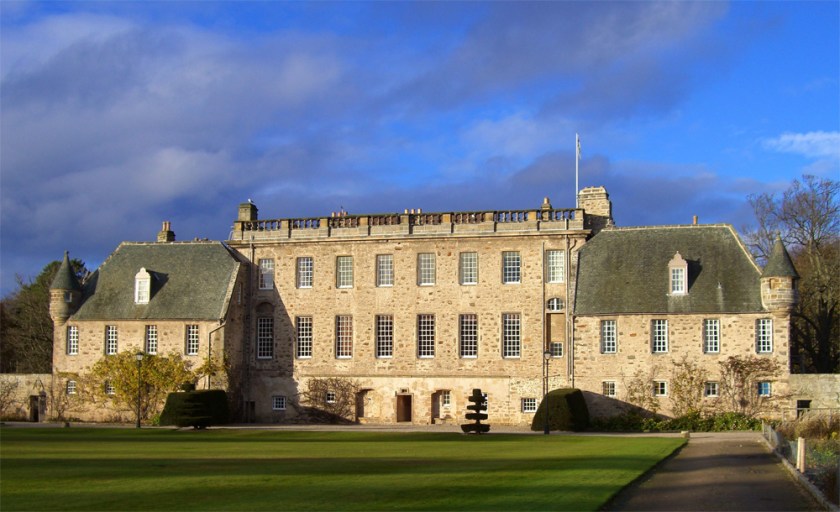
Robert Waddell was an art master at the Gordonstoun School in Scotland.gordonstounSchoolScotland Waddell inspired Prince Charles, then a student at Gordonstoun School, to paint in the 1970s. As a result of that inspiration, Prince Charles has become one of the UK’s most successful living artists, where he paints en plein air (outdoors) and exclusively in watercolours, according to Insider.
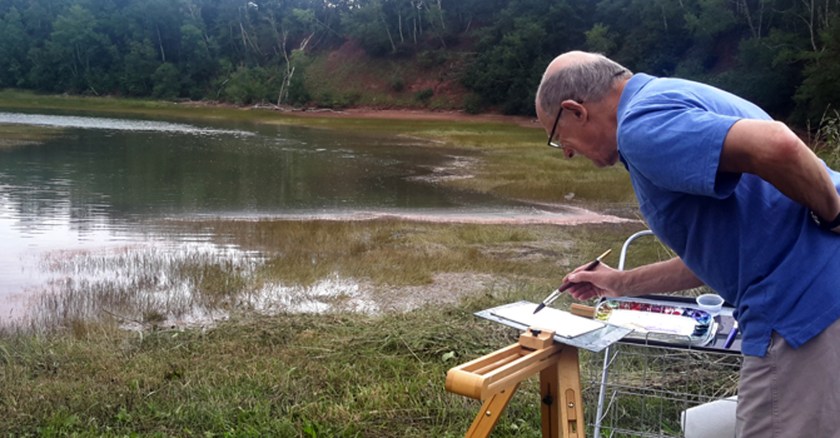
With the announced expansion of the Gordonstoun School into North America, and into Nova Scotia, in particular, a fitting tribute to Robert Waddell could excite our Maritime visual art movement. Could Annapolis County and the Town of Annapolis Royal help host/showcase such an event in collaboration with the Gordonstoun School, to celebrate the school’s Nova Scotia roots?

banner_2019_paint-outSEASON The Plein Air Artists Annapolis Valley group, now in its fifth year painting at outdoor locations throughout the Valley, could help organize the launch of such an event alongside ARTsPLACE, Paint The Town, and NSCAD.

Thinking even more inclusively,banner_KingsTheatre  connections could be made with performing arts, considering … the rich arts culture in the region, Annapolis Royal’s historical link to “L’Ordre de Bon Temps“, storytelling/plays/music at King’s Theatre, talk of a Liberal Arts University, and workshop/conference facilities such as those at Cornwallis Park. You see, “English master, Eric Anderson—like the art teacher Waddell, also in his 20s … encouraged Charles to act in several of Shakespeare’s dramas” (Vanity Fair).

Maybe this is where our Valley’s cultural history and environment can fuse with the traditions of the Gordonstoun School to make for exciting times.

References

Zoë Ettinger, Insider. Prince Charles is one of the UK’s most successful living artists. Here are 15 of his works, 30 March 2020.
Lawrence Powell, Spectator/Chronicle Herald, Gordonstoun a Go, 17 March 2020.
Plein Air Artists Annapolis Valley. 2020 Paint-out schedule.
Sally Bedell Smith in Vanity Fair. The Lonely Heir. April 2017.

Postscript

It would be excellent if Prince Charles joined Tom Forrestall and Geoff Butler on the inaugural judging panel. (Bob Maher)

Posted in Opinion

On St Patrick’s Day

There was good news on St Patrick’s Day. Timothy Habinski, Warden for Annapolis County, announced that Gordonstoun School had purchased Upper Clements Park for the new campus. It could be open as early as September 2021.

That same day, Esri Canada shared the link to their COVID-19 Canada Resource Hub. Later, we received an email from Brent Hall on the options for the virtualization of access to the Esri software.coVid19_ESRIcanada

Meanwhile, Heather and I continued our vendetta on the multiflora rose. This action could form the basis of a Permablitz — a concept championed by Rick Ketcheson (see Food Action Coalition)  from the Good Cheer Self-sufficiency Society.

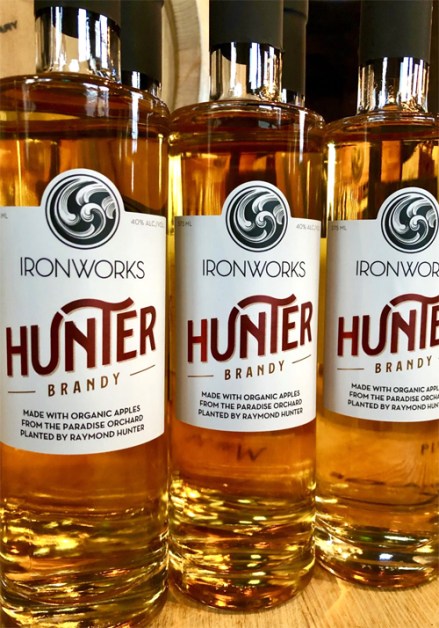
hunterBrandyAfter lunch, as I was preparing for another burning, a white car stopped at our driveway. Charlie Hunter stepped out and explained that he, and his family, were taking a ‘trip down memory lane’. We discussed Hunter Brandy, Geography at Mount Allison University, as well as the future biography of Raymond Hunter. Charlie mentioned that Raymond had built a cabin down towards the river. We think that we have located the remains.

Now, let me try to join the dots. Clearly, COVID-19 has encouraged us to move towards online learning. For over thirty years, COGS has maintained a close relationship with both Esri and Esri Canada in the application of GIS technology.
Would it not make sense for COGS to apply this technology to improve the quality of landscape management and community planning in the Annapolis Valley? This expertise and virtualization could form the basis of an educational relationship with Gordonstoun Nova Scotia. For indeed, we share the same Geography.

Footnote

Have you noticed on Highway #101, as you enter Annapolis County (Naturally Rooted) from the East, there is now a new sign, acknowledging that you are entering the UNESCO Southwest Nova Biosphere Reserve?

It seems that the songbirds are back. I wonder what they think about the quiet of the human population.

Acknowledgements

Rick Ketcheson for the Permablitz concept. Charlie Hunter for the conversation about his father, Raymond. Brent Hall and Susie Saliola at Esri Canada. Cliff Drysdale for the new sign on the highway. Heather Stewart for her determination to tackle multiflora rose.

References

Lawrence Powell. Gordonstoun a go: Scottish school to be built on site of Upper Clements Parks. Annapolis Spectator March 17, 2020.
COVID-19 Canada Resource Hub. https://resources-covid19canada.hub.arcgis.com
Brent Hall. Email March 18th. Virtualization of ArcGIS.

Posted in Opinion

Community Interests

The antithesis of Corporate Interests might be Community Interests. Although we don’t necessarily need to make such a distinction. What examples of Community Interests exist in Annapolis County? Last weekend, the Nova Scotia Extinction Rebellion hosted a gathering on Natural Climate Solutions at the Bridgetown Library. Topics, as part of their Forestry Self-education Series, included tax incentives for private woodlots owners, land buying clubs, land trusts, and community gardens. What mechanisms exist at the municipal level to support these community interests? What mechanisms exist at the provincial level?

bookCover_doughnut EconomicsIn response to my previous blog post, I did receive feedback on transportation solutions. This included other parts of Nova Scotia; e.g. Community Wheels in Chester or the Trans County Transportation Society in the Valley. Or from England, the link to Connected Places Catapult.

Other feedback was the reference to Doughnut Economics by Katie Raworth (see the Guardian Review by Richard Toye, June 8, 2017)

“What if we started economics not with its long-established theories, but with humanity’s long-term goals, and then sought out the economic thinking that would enable us to achieve them ?”

One approach could be for the ‘community’ college to solicit from the community a suite of topics for a public education series. This might cover many domains: forestry, transportation, agriculture, climate change, doughnut economics, citizen science, mapping.

Could COGS work with the Municipality to research different rural transportation solutions?

Could COGS provide online maps of the Valley showing recent changes in land use (e.g. through forest harvesting, agricultural planting)?

Acknowledgements

Nina Newington for hosting the gathering in Bridgetown, Rick Ketcheson for his thoughts on doughnut economics, Andrew Ronay for the England link, Brian Arnott for the view from Lunenburg.Edward Wedler for the added graphics and links.

References
Connected Places Catapult
Katie Rowarth. 2017.Doughnut Economics. Chelsea Green Publishing.

Posted in Opinion

Corporate Interests

This week, I have had two meetings with local politicians: Stephen McNeil on Monday and Gregory Heming on Tuesday. My general intent was to make the case for citizen input into the planned Innovation Hub at COGS in Lawrencetown.

mcNeilandHemming
Premier Stephen McNeil (left), Councillor Gregory Heming (right)

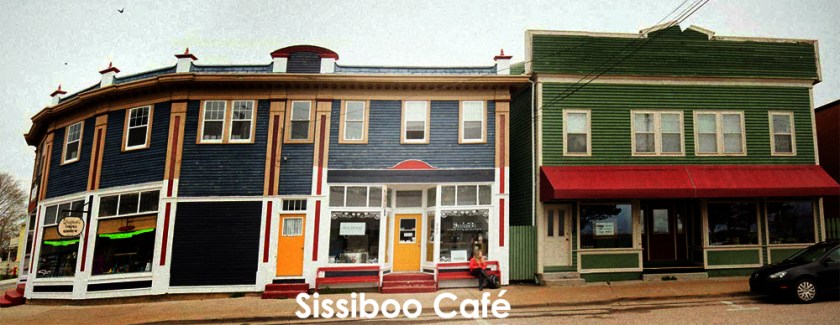
For the meeting with McNeil, I took the 8:11am bus to Middleton, had a half-hour meeting, then bussed and walked home by lunchtime. For the meeting with Heming, I drove to Annapolis Royal, had a one-hour meeting at the Sissiboo Cafe, again returning home for lunch.sissibooAnnapolisRoyal

From the two meetings, I gained the impression that the focus of the Innovation Hub would be on corporate, business interests. This realization coincided with my recent discovery (see previous blog post) of Powe’s book Towards a Canada of Light.

He offers three meditations.

First meditation: In a Communication State
Second meditation: Alternative Current
Third meditation: Towards a Canada of Light

From the book, the following quotations seemed relevant.

“ We can see the corporate state of mind, conditioned by financial structures and their compulsions of time, appears to have lost its soul-root in the imagination. What I mean by this is the loss of the ability to sympathize with suffering and confusion, weakness and fear – that awful fear that may stall the movements of spirit and mind – to feel for people and what they do and can’t do … “ p100.

“So in Canada, without a visionary inkling, a breakthrough, we will be without strangeness, little more than another greedy place …” p.101.

There is much more to the book. It was pure happenstance that I was reading it this week. Many of his ideas apply equally well, today, to Canada, and Annapolis County, Nova Scotia.

Acknowledgements

To Stephen McNeil and Gregory Heming for agreeing to meet with me on the subject of citizen input to the Innovation Hub in Lawrencetown. Edward Wedler for his graphics input.

Reference

B.W.Powe. 2006. Towards a Canada of Light. Thomas Allen Publishers.

Posted in Opinion

A Community Brains Trust

This week, I have been researching the concept of an Innovation Hub in Lawrencetown. Within the NSCC context, we have two examples: Centre for Ocean Ventures and Entrepreneurship (COVE) in Dartmouth and the Pictou Innovation Hub.banner_COVE The difference at COGS is that we have a specialized suite of technologies: Geomatics or Geographic Sciences, and we live in a more rural environment. (This rural environment provides a likely explanation for the residency component).
banner_pictouInnovationCentre
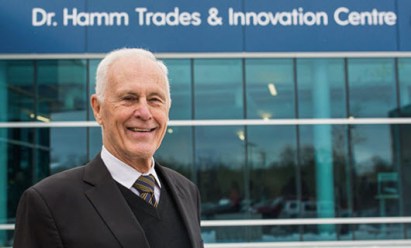
Pictou Innovation Centre

One of the characteristics of a rural environment is that it attracts a wide range of retired talent from across the country and beyond and those who have rejected the more urban lifestyle.

To reflect the diversity of knowledge and experience available to the Innovation Hub, my suggestion is that we need a community brains trust. This group could include:

  • current faculty/ research scientists
  • retired faculty/ research scientists
  • local business leaders
  • community members who have chosen Annapolis County
  • rural residents
  • members of the ‘creative rural economy’ (see CRE, for example)

We should not be exclusive. I can imagine GIS business interests in both California and Ontario. There are also supporters living outside of rural Nova Scotia, who would want to see an alternative model of community engagement succeed.

Check out the business interests at COVE and the Pictou Innovation Hub.
Can we imagine a similar suite of business interests in Lawrencetown?
Or does the rural setting bring forward a different relationship to land and life?

bookCover_landAndLifeI found the following quotation from Carl Sauer in Land and Life: A Selection from the Writings of Carl Ortwin Sauer. From ‘The Education of a Geographer’ (1956).

“We are aware that what we do will determine for good or evil the lives of those who will come after us. And therefore, we geographers, least of all, can fail to think on the place of man in nature, of the whole of ecology. Man’s intervention in and disturbance of the organic and inorganic world has become so accelerated that we may be tempted to escape from the present into a future in which technology has mastery over all matter, and thus promises forgiveness and redemption. But will it? Is that our fated way? Is that the sort of world we want?” p.404.

Reference
Carl Ortwin Sauer. From ‘The Education of a Geographer’ 1956. University of California Press.

Acknowledgements

Wayne St-Amour provided the links to COVE and the Pictou Innovation Hub.
Brian Arnott has discussed the importance of trust in the community context.
Heather has shared the joys of dog walking, as well as taking care of feeding the birds.
Edward Wedler did his enthusiastic bit with the graphics.

Posted in New thinking, Opinion

A Vision for the Annapolis region

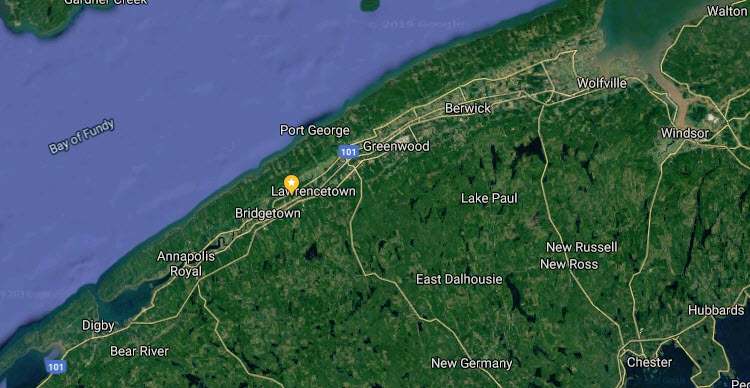
As a Geographer, I think of the Annapolis Valley as a physiographic unit. Travelling from Halifax, you enter the Valley around Windsor on Highway #101. It is bounded on two sides by North Mountain and South Mountain and extends down towards Digby. It also includes the Fundy shore.map_annapolisValley_satelliteView

Despite, the recent i-Valley definition, my definition includes Annapolis County and Annapolis Royal.

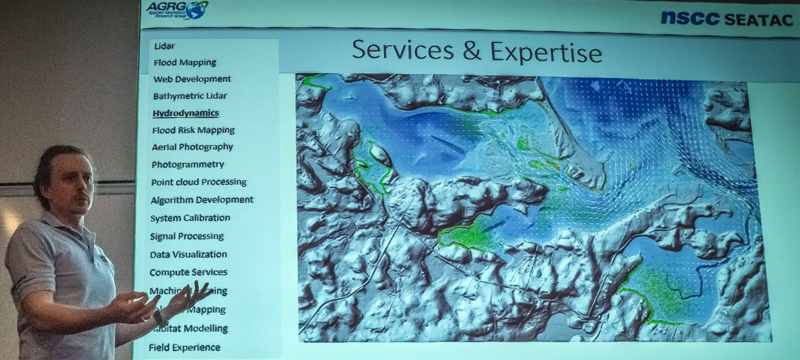
From an educational perspective, Annapolis County has much to offer the region. At the recent COGS conference, the resources at both Middleton and Lawrencetown demonstrated national significance. Middleton campus is the home to the Applied Geomatics Research Group (AGRG). The Lawrencetown site has a long tradition of teaching Geographic Sciences (Surveying, Cartography, Planning, GIS, Remote Sensing and the associated IT). There is now a plan to establish an Innovation Hub and residence at COGS.

Other educational dimensions include the Environment and Agriculture Technology Laboratory (EATLAB) and access to Geomatics technologies as part of the corporate NSCC SEATAC initiative.

All of these activities bode well for education and research in the Annapolis Region. It links to high school activities in Annapolis Royal. If we are successful with Gordonstoun School, the resident expertise in the County can offer pathways from secondary school through to graduate work. There is an existing joint Masters degree in Applied Geomatics between Acadia University and the NSCC.

What is needed to support this vision?

1) we need to extend the Valley Computer Fibre Network and high-speed Internet throughout the Valley region.
2) the expertise at i-Valley should not stop at Middleton.
3) the Innovation Hub at Lawrencetown needs to be part of the Valley network.
4) Municipal government needs to work with the existing educational institutions to support all citizens in the larger geography.
5) the Geomatics technologies at the NSCC should be used to address sustainability issues in the region.

Ultimately, better collaboration, better communication, and leadership that respects the needs of all citizens in the larger region.

Many years ago, John Wightman, former Principal at COGS, created a non-profit entity, CANMAP. That acronym remains relevant today!

Acknowledgements

To those colleagues who have worked hard, to build up the educational resources in the region.

Posted in Event Review, Opinion

COGS Conference 2020

This week, I attended a two day Winter conference at COGS on Geotechnologies and Resource Management.Image result for Winter conference at COGS on Geotechnologies and Resource Management (Photograph from 2019 conference).
As a trade for free registration, I have written a blog for GoGeomatics. This should be available later in the week. Meanwhile, I would like to highlight a few citizen lessons from the event. The conference is in January to coincide with the industry expo at COGS. This is the opportunity for COGS students to arrange interviews with government and private sector employers.

Community Connections!The takeaway message from Hugh MacKay, MLA for Chester- St. Margaret’s Bay, and previously, Geomatics businessman, is that we need to create more Geomatics jobs in Nova Scotia. Part of that agenda is the building of an Innovation Hub at COGS in Lawrencetown. Scheduled for completion in 2021. Another part is the commitment by the provincial government to high-speed Internet throughout Nova Scotia. To my mind, this means collaboration across the three levels of government: federal, provincial, municipal. Unfortunately, multi-layers of government does not bode well for quick, efficient solutions that serve the needs of the citizens.

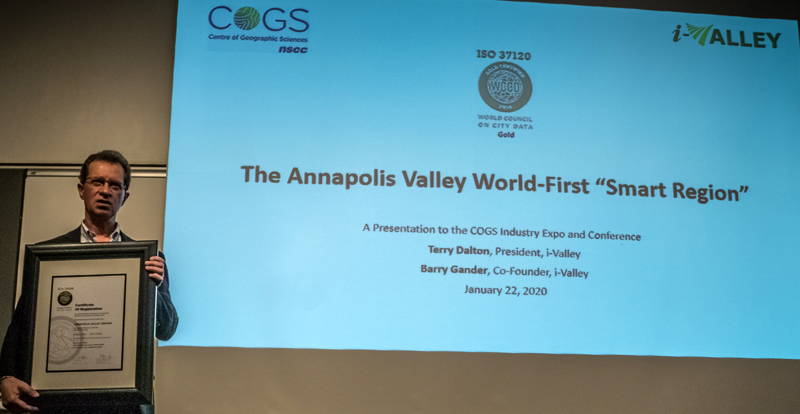
Another presentation by Terry Dalton from i-Valley sharply illustrated the same point. i-Valley is defined as the world’s first ‘smart and sustainable region’.M.Bickford / COGS / Jan 2020
Do we recognize ourselves in this profile? Are we doing well on sustainable resource management — forestry, agriculture, mining, fisheries, health services? Unfortunately, the geography of i-Valley is currently defined by the participants who are part of the Valley Regional Enterprise Network (VREN). This means the ‘valley’ is defined as the region between Windsor and Middleton. It does not include Annapolis County or the other towns and villages in the county.

M.Bickford / COGS / Jan 2020As informed citizens, we need to WAKE UP. We need to be talking about an Innovation Hub in Lawrencetown, evidence-based decision making, the use of current Geotechnologies. The new SEATAC (Sensing, Engineering and Analytics Technology Access Centre) is one of thirty centres funded through the federal government. The NSCC in Halifax/Dartmouth will be the main business presence.
Please, can someone shake some ‘remote sense’ into our Annapolis County councillors !!

Posted in Opinion

Little Libraries

Little libraries have popped up across the country. On Haida Gwaii, there is one along the roadside between Queen Charlotte and the ferry terminal. In the Annapolis Valley, they can often be found in banks and post offices.

bookCover_voluntarySimplicityToday, I picked up Duane Elgin’s Voluntary Simplicity at the Bridgetown post office. Seems like a good message for 2020!

“Voluntary Simplicity. Towards a way of life that is outwardly simple, inwardly rich”.

Merry Christmas and a Happy, (Simple) New Year.

Acknowledgements

Thank you to the followers of my blog. Edward for his feedback. Heather for her patience and support.

Reference

Duane Elgin. 1993. Voluntary Simplicity. Revised Edition.Quill, William Morrow, New York.

Posted in Opinion

Rural Delivery

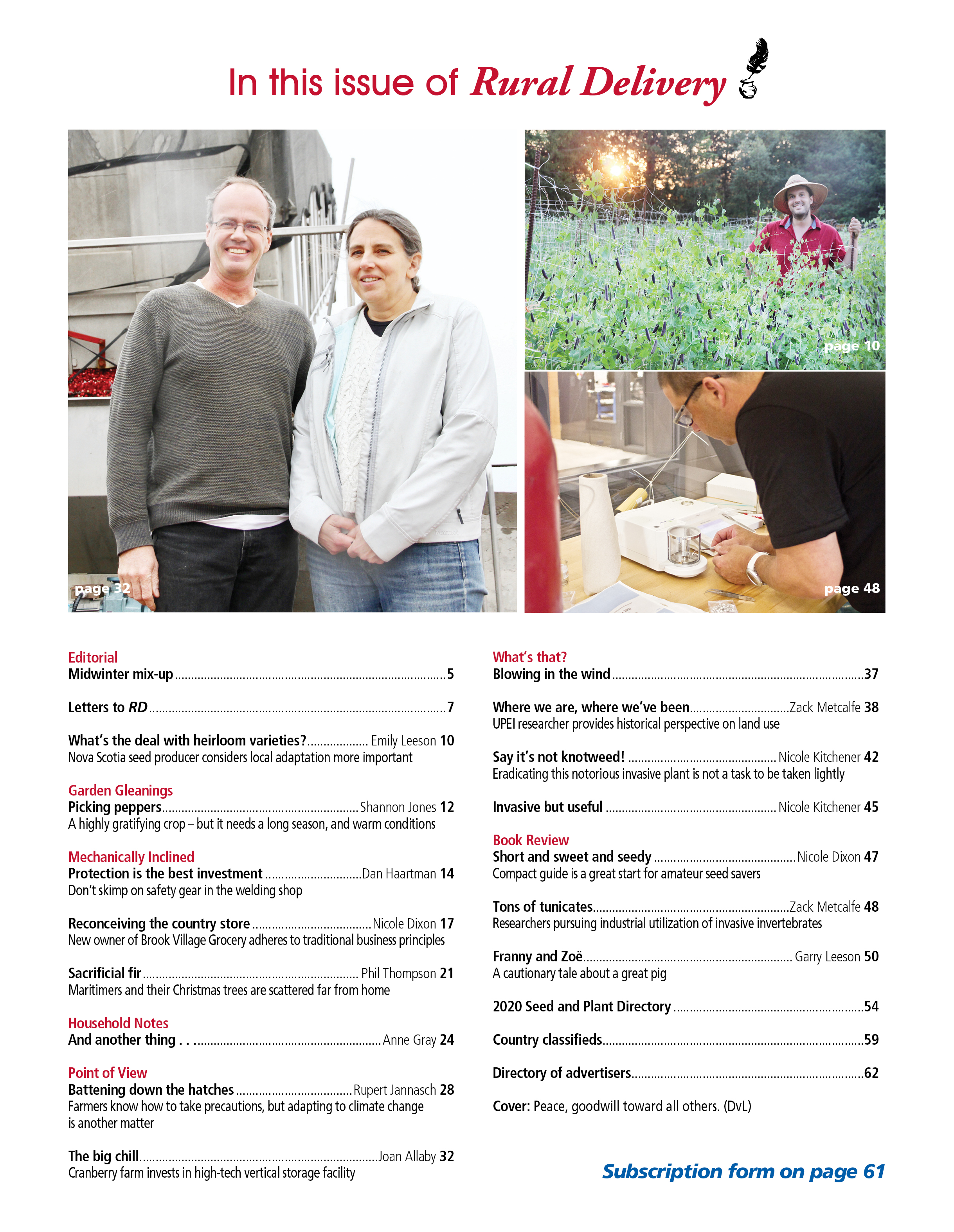
In Kentville, I picked up the December issue of Rural Delivery; a publication started by Dirk van Loon in Liverpool, Nova Scotia.bookCover_ruralDelivery It contained two articles of particular interest to me: an interview with Owen Bridge, Annapolis Seeds, Nictaux (p.10-11) and second, a review of the historical research by Josh MacFadyen at UPEI (p.38-41).

‘Annapolis Seeds is one of just a handful of 100% regional seed companies. His goal is to help maintain and further cultivate the largest possible diversity of seeds for the Maritime bio-region’.

‘All the seed he offers are grown in Nova Scotia. Because they are grown here, they are going to be well adapted for here’.

Zack Metcalfe describes the research of Josh MacFadyen at UPEI. Josh holds a Research Chair dedicated to the study of ‘geospatial humanities’. This involves historical maps of the land use. He has mapped the land use of PEI under the Back50 Project, using aerial photographs since 1969.banner_geoReachUPEI

‘It is pretty important to understand, at a bare minimum, a 50-year history of how land use has changed. I think a better view of the past will help us plan more resilient agriculture and communities in PEI and other parts of Atlantic Canada’. p.41.

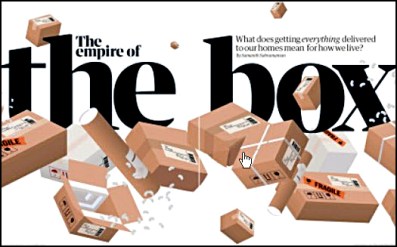
cover_empireOfTheboxMeanwhile, in the Guardian Weekly (Nov 29, 2019) Samanth Subramanian provides a long article on ‘The Empire of the Box’ or ‘what does getting everything delivered to our homes mean for how we live’. This is the world of online retail.

‘The great trick of online retail has been to get us to do more shopping while thinking less about it – thinking less, in particular, about how our purchase reach our homes’.

‘While we buy our purchases with mere movement of our thumbs, they are busy rearranging the physical world’.

At the local level in rural Nova Scotia, have you noticed the increase in courier trucks on Highway 101 or 201? This is the new definition of ‘rural delivery’.

Acknowledgements

To Dirk van Loon for his commitment to the magazine, Rural Delivery. To Edward Wedler for his online graphic skills.

References

Rural Delivery. December 2019. Volume 44 #6
What’s the deal with heirloom varieties by Emily Leeson p.10-11.
Where we are, where we’ve been. UPEI researcher provides a historical perspective on land use. by Zack Metcalfe p.38-41.
The Guardian Weekly November 29,2019. Vol 201 #25.
The Empire of the Box. What does getting everything delivered to our homes mean for how we live? by Samanth Subramanian