Posted in Opinion

Crown Lands

This weekend, I had the time to read carefully Gary Snyder’s essay, The Place, the Region and the Commons in The Practice of the Wild.

David Foreman, founder of the Earth First ! Movement recently (1990) states his radical provenance. ‘It came from the Public Lands Conservation movement – the solid, stodgy movement that goes back to the thirties and before. Yet these land and wildlife issues were what politicized John Muir, John Wesley Powell and Aldo Leopold — the abuses of public land.” p.29.

“American Public lands are the twentieth-century incarnation of a much older institution known across Eurasia – in English, called the ‘commons’ – which was the ancient mode of both protecting and managing the wilds of the self-governing regions. It worked well enough until the age of market economics, colonization and imperialism.”:

“Because it is traditional and local, it is not identical with today’s ‘public domain’ which is land held and managed by a central government. Under a national state such management may be destructive or benign – but in no case is it locally managed. One of the ideas in the current debate on how to reform our public lands is that of returning them to regional control.”

“In the United States, an enormous area was de facto public domain and the Forest Service, the Park Service and the Bureau of Land Management were formed to manage it. (The same sorts of land in Canada and Australia are called ”Crown Lands”, a reflection of the history of English rulers trying to wrest the Commons from the people.”

“The commons is a curious and elegant social institution within which human beings once lived free political lives while weaving through natural systems. The commons is a level of organization of human society that includes the non-human. The level above the local commons is the Bio-region. Understanding the Commons and it’s role within the larger regional culture is one more step towards integrating ecology with economy.” p.37.

From my conversations with David Sollows and Cliff Drysdale (both with SNBRA) it appears that we need to have a similar discussion about Crown lands in Nova Scotia.
Perhaps a starting point would be for the key players: SNBRA, NS Department of Lands and Forestry, Municipal governments and WestFor to check out Gary Snyder’s essay: The Place, The Region and the Commons.

Acknowledgements
David Sollows and Cliff Drysdale for their interaction. Edward and Heather for their support.

Reference

Gary Snyder, 1990. The Practice of the Wild. North Point Press.

Postscript

Memories of Haida Gwaii


Posted in Book Review

Rereading History

Monday, we headed up to Wolfville. I could not resist a quick stop at the Odd Book. Within minutes, I had found two keepers.

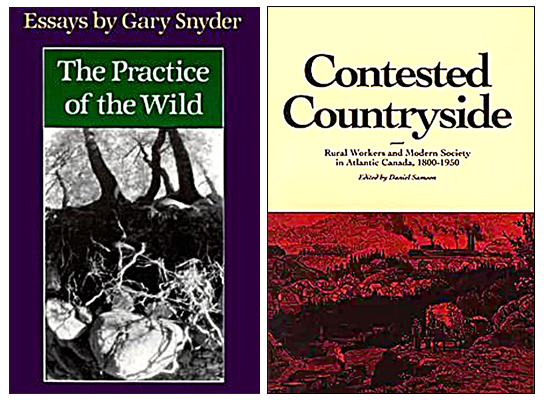
The Practice of the Wild, essays by Gary Snyder. It seemed very appropriate to the battle we face trying to preserve the forested landscape in Nova Scotia. The first essay, The Etiquette of Freedom talks about the words, Nature, Wild and Wilderness. The second essay, The Place, the Region and the Commons covers the world is places, understanding the Commons and Bio-regional perspectives.

The second book published by Gorsebrook Studies in the Political Economy of the Atlantic region, Contested Countryside : rural workers and modern society in Atlantic Canada 1800-1950, edited by Daniel Samson. Within the chapter by Erik Kristiansen, Time, Memory and Rural Transformation: Rereading History in the Fiction of Charles Bruce and Ernest Buckler, it places Buckler into the economic context after the Second World War. Not an easy read, but thought provoking. There is also an Afterword by Daniel Samson Capitalism and Modernization in the Atlantic Canada countryside. With that in mind, move forward to 2020.

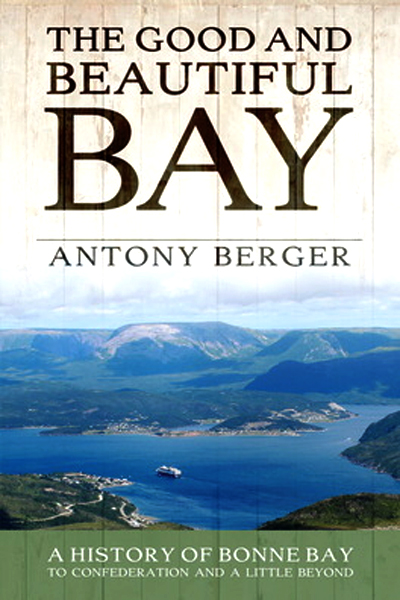
The third book is by Antony Berger and is the biography of his mother, Ella Manuel. This one came from the Lawrencetown library. Heather has snagged it, so this is an indirect review. It describes her life in Western Newfoundland, after the Second World War, a single Mother with young children, and the economic life in Lomond and Bonne Bay. Interestingly, Berger has also written about Bonne Bay: This Good and Beautiful Bay, a History of Bonne Bay to Confederation and a little beyond. Berger now spends his time between Wolfville and Woody Point.


All three books raise the question: what is the impact of the surrounding landscape and rural economy on the writers view of the world?

In the case of Gary Snyder, it is the Yuba River country in the Sierra Nevada of Northern California. For Ernest Buckler, it is the Annapolis Valley. For Ella Manuel and Antony Berger it is Bonne Bay, Western Newfoundland.

I would encourage reading the chapter in Contested Countryside, Rereading of History, by Eric Kristiansen; challenging, but definitely relevant to our times.

Last weekend, we attended the Dave Gunning concert in Bridgetown. We came away with two CDs. This week, I have been listening to ‘These Hands’ and ‘Circle of Boots’.


Finally, I had the chance to drop off some excess books at Endless Shores in Bridgetown and thus obtain a credit. The ones that were not of interest to Jennifer, I took to the Bridgetown post office.

Acknowledgements

The Odd Book in Wolfville, close to the university, is a readers’ goldmine. Jaki at the library obtained the Ella Manuel biography. Heather for her comments on the book. Edward for his graphics.

References

Gary Snyder, 1990. The Practice of the Wild. North Point Press.

David Samson (Ed.), 1994. Contested Countryside. Rural workers and modern society in Atlantic Canada 1880-1950. Acadiensis Press.

Antony Berger, 2014. The Good and Beautiful Bay: A History of Bonne Bay to Confederation and a little beyond. Flanker Press.

Antony Berger, 2020. No Place for a Woman. The life and Newfoundland stories of Ella Manuel. Breakwater Books.

Dave Gunning CDs No more Pennies 2012. Up against the Sky. 2019.

Posted in Creative writing

The Nova Spy

Bob Bent, local author, recently published a novel Spy on Ice. It is the story of a Canadian hockey player who is recruited by the Ottawa Senators to spy on a Russian player whose father is Head of Russian Intelligence.

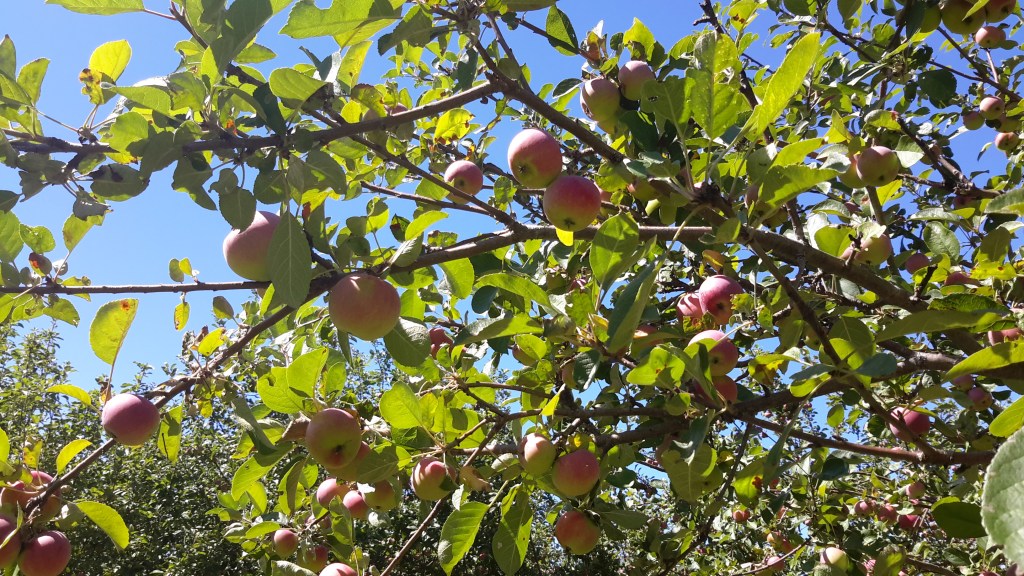
This week, we picked the last Nova Spy tree in the orchard. Afterwards, we sent a selection of apples to Andrew and family in Iqaluit.

Thinking about the Nova Spy, it seemed like a good idea to seek out heritage varieties in the Annapolis Valley. I found one example on the West Inglisville Road. Interestingly, these four large trunk trees stand on a property, once owned by Bob Bent.

I recall writing a blog in November 2017 Apple Pressing and the Ghost Orchard. It contains references to the writing of Tom Burford, Julian Gwyn and Helen Humphreys. It concludes with a Robert Frost poem, ‘AfterApple-picking’.

Perhaps there is a novel in The Nova Spy, based on the search for heritage apple varieties in rural Nova Scotia.


Postscripts

Through inter-library loan, I received Antony Berger (Ed.) No Place for a Woman: The Life and Newfoundland Stories of Ella Manuel. Heather and I both recall visiting her home above Woody Point in 1975. Heather was working at Gros Morne National Park. I was teaching at Memorial University and supervising Biogeography graduate students on the West coast.

Blessings, A visual journey through the Irish landscape, Emergence Magazine.

Acknowledgements

Edward for encouraging the link between Ice Spy and Nova Spy. Jaki at the Lawrencetown library for the inter-library loan service. Heather continues to pick MacFree in the orchard. Perhaps, we can conduct an organic cider taste test, using all three varieties.

References

Bob Bent, 2020. Spy on Ice, Nevermore Press.

Antony Berger, 2020. No Place for a Woman, Breakwater Press.
(LINK to Book Launch)

Posted in biographical sketch

Harvest Over

We can officially announce that our apple harvest is over for another year.

Brian Boates has transported twenty three bins to his processing facility in Woodville. We are left with the final clean up: a few late apples still on the trees, a fair number of drops to be put into bags and given to local farmers for their animals. Perhaps, a few Nova Spy for pies, and some fresh pressed apple cider. The extra large harvest has taken its toll. Now, I have physiotherapy sessions to straighten out my sore back.

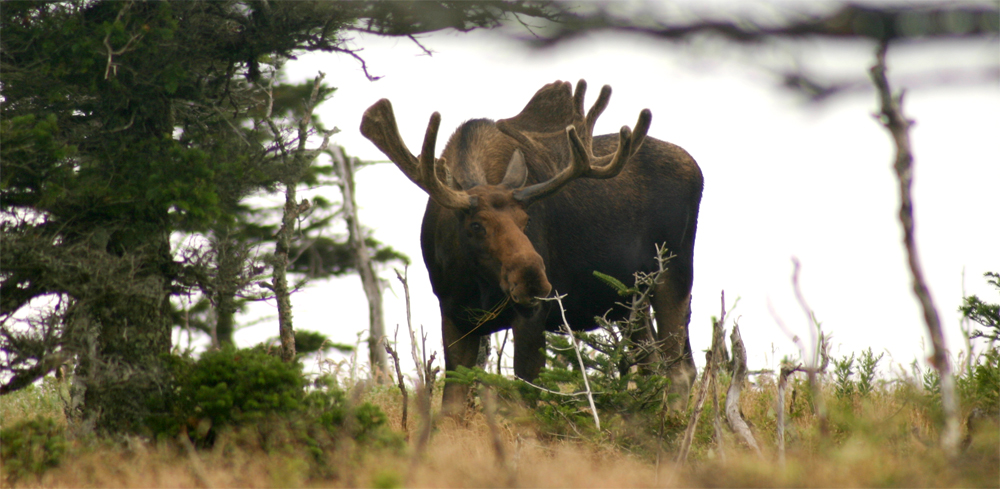
With the end of the harvest, I received notice of a new protest against industrial forestry in the Tobeatic region of Digby County. This area forms part of the habitat for the endangered Mainland moose (hear CBC Information Morning podcast interview).

Creative Commons attribution – ShareAlike 2.0 Generic (CC BY-SA 2.0)

It is disheartening to hear about these Forestry practices, just a few weeks before the airing of the Striking Balance episode on the Southwest Nova Biosphere Reserve (see previous Blog Post). All the hard work to obtain the UNESCO Man and Biosphere designation obviously carries no weight with the Nova Scotia Department of Lands and Forestry. It seems like a life time ago, when we used to meet at the Mersey Tobeatic Research Institute (MTRI). Surely, we cannot allow these forestry practices and retain our biosphere reserve status?

Under the COVID regime, we see a provincial government, and all its departments fixated on the bottomline. This includes forestry, fisheries and mining. The landscape is solely for exploitation. There is no interest in ‘striking balance’ or investing time and money in new ideas that can engage the skills and resources found in the larger community.

Wearing a mask is essential as the province attempts to keep its citizens healthy. Wearing a mask should not be seen as a symbol for not hearing the voices of its citizens. Or conversely, for not providing full explanations of government departments action or inaction. [contact Nova Scotia Deputy Minister Department of Lands and Forestry]

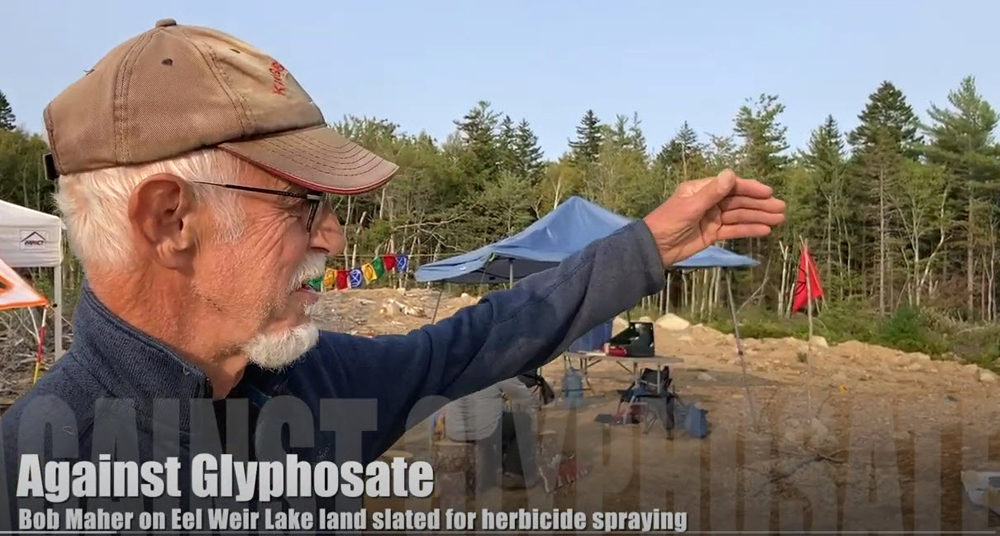
It seems odd. We delayed our apple harvesting because of the threat of glyphosate spraying. Now, at the other end, we see once again, a threat to our forested landscape and associated habitats. Surely, we can do better.

Acknowledgements

Nina Newington for bringing our attention to Mainland moose habitat issue. Heather Stewart and others who championed the Southwest Nova Biosphere Reserve designation. Edward for his support. In memory of Fred Roots, a strong proponent of the UNESCO MAB program.

References
CBC interview Information Morning October 20th. 2020 with Richard Amero

Posted in New thinking

Electoral Reform

By the time this blog is posted, we shall know the results of the Municipal Election in Annapolis County. We shall know in the words of The Reader editorial whether ‘Small Things Matter’. We will see the impact of online voting. At this critical juncture, I wonder whether we need electoral reform.

Do we need eleven Councillors in Annapolis County?
Do we need separate elections for the towns, e.g. Annapolis Royal, Middleton?
Is the management of the natural resources in this province independent of the municipalities?

In the past, I have expressed concern about the management of our landscape, and its relation to climate change.

Looking for solace, in these difficult times, I picked up again, Daniel Botkin’s No Man’s Garden: Thoreau and a new vision for civilization and nature. In the book, Botkin identifies three types of expert (p.111):

  1. Contemporary professional experts
  2. The great thinkers of the past.
  3. Experiential experts – local people with local knowledge based on their experience of living in an area and observing carefully.

My thesis would be that we need a combination of all three. Likewise on municipal council we need all three.

It would be a mistake, in my mind, if we focussed only on the small things, and did not understand the larger context. Or what was happening in our larger geography.

There are many good resources available. This morning, I visited Dawn Oman’s gallery in Bridgetown to ask about tickets to the Dave Gunning concert on October 24th.

While there, I had the chance to pick up the latest issue of Up Here magazine, devoted to Northern Canada.

From Celes Davar, we received the recommendation to watch Kiss the Ground , starring Woody Harrelson on Netflix. It defines the importance of the soil to our global ecosystem.
From Anne Crossman, I was sent the link to Striking Balance, a series on Canada’s biosphere reserves.

They are filming the episode on the Southwest Nova Biosphere Reserve, to be aired at the end of November on the CBC. Finally, we received an update from Larry Powell on the Gordonstoun project. This offers employment opportunities for local business. It emphasizes ‘place-based’ education. Our geography, the Annapolis Valley, fits within the Atlantic Canada bubble, as well as the Canada nation.

Acknowledgements

To all those friends who continue to share ideas and experiences: Dawn Oman, Celes Davar, Anne Crossman. Heather, who has helped shoulder the burden of a bumper apple crop in the orchard. Edward for ongoing support.

References

Daniel Botkin, 2001. No Man’s Garden: Thoreau and a new vision for civilization and nature. Island Press.

Posted in Book Review

Fall Magazines

Visiting New Glasgow for the Thanksgiving Weekend, I had the opportunity to catch up on the October/November magazines from Saltscapes, Volume 21 #5.

Saltscapes Magazine
“Some would make us just names on a list. But we are people in a place - and resist.” 

This seemed very appropriate at the time of our municipal elections.

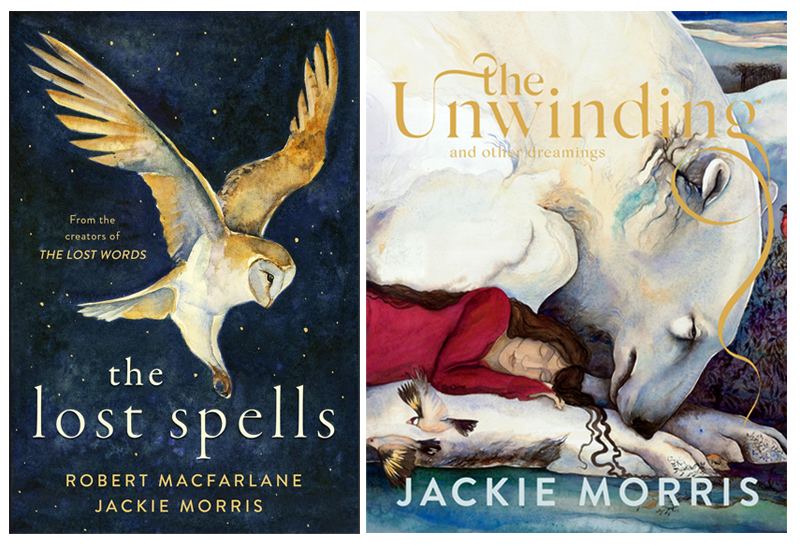
From Walrus, there is notice of a new book by Robert MacFarlane, illustrated by Jackie Morris, published by Anansi Press, The Lost Spells. In the latest Brain Pickings, see too, The Unwinding by Jackie Morris published in July 2020.

From Canadian Geographic, Volume 140 #5, there is a rich trove of articles.

  • Michif Revitalized: How to save an endangered language.
  • Mapping Canada’s biggest islands.
  • How to avoid the sixth extinction.
  • Keeping the inlet wild – Princess Louisa Inlet raised $3m in 3 months .
https://play.google.com/music/listen#/ps/I4q4mklvfb4sd6ho2jv3f55ecbu

Meanwhile online, Emergence Magazine Episode 6. The Power of Revitalization of Language Keepers: The struggle for Indigenous language survival in California. (Podcast link HERE)

From Chelsea Green Publishing, Chris Smaje’s book, A Small Farm Future. ‘Chris Smaje has worked a small farm in Somerset, southwest England for the last seventeen years. Previously, he was a university-based social scientist’.

At resilience.org you can find Podcast from the Prairie: Respecting your tools. A conversation with Wes Jackson, now 84 years old, from the Land Institute.

Acknowledgements

John Stewart for his rich collection of magazines. Heather Stewart and Siqsiq, my travel companions. Sandra Stewart and Don Higgins for the wonderful Thanksgiving Dinner. Edward for searching out the links and associated graphics.

Posted in Opinion

A Green Future?

See blog post, “What is Truth?”

As part of the no spraying of glyphosate in Annapolis County, the Warden sent a letter to the Minister of Lands and Forestry, Ian Rankin and the Minister of Environment, Gordon Wilson. This week, he shared the response from Wilson:

He quoted Health Canada, “it does not present risks of concern to human health or the environment when used according to the revised label directions”.

This response does not answer my concern. My concern is that the spraying of the forest with a herbicide is part of the clear-cutting, industrial approach to forest management. This approach does not recognize the value of all the other species which co-exist in this landscape. We have not heard from Minister Rankin.

Except, that he is running to replace Premier Stephen McNeil on an ‘environmental’ agenda!

Video Link

Over ten years ago, I was directly involved in the recognition of the value of Southwest Nova as a Biosphere Reserve (SNBR) under the UNESCO Man and Biosphere program. Today, you see the signage on the Highway #101. This reserve includes a core protected area: Kejimkujik National Park and the Tobeatic Wilderness Area, a buffer zone and the working landscape.

How is this part of the province being impacted by the different forestry practices: clear-cutting, selective cutting and ecological forestry?

Again, it would make a wonderful GIS student project to undertake a polygon on polygon overlay between the SNBR zones, and the forested parcels in Southwest Nova Scotia.
To conduct this analysis, we would need a map of the forest stands and their harvest history. This type of analysis should be of interest to our environmental NGOs e.g. MTRI, CARP and UNESCO MAB.

What does it mean for our ‘island of hope’ – Annapolis County, at a time of municipal election ?

Orchard Experience

It has been a hot , dry Summer. This has led to a bumper apple crop. It now looks like we will exceed 21 bins of NovaMac/MacFree apples. There is no spraying. It is a certified organic product which will be used to make apple cider, cider vinegar and apple brandy.

Acknowledgements

Heather and I wish to thank the collaborators with the harvest: Rick and Kathy, Neil Bent and Brian Boates. It could not have been done without your encouragement.

Postscript

We watched David Attenborough’s “A Life on Our Planet” on Netflix. He is 93 years old. The film emphasized the need for rewilding our landscape, for attention to our ocean environment and for the move to alternative renewable energy : solar, wind and hydro.

Posted in Book Review, Event Review

Apple Drops

You likely know the saying, “the apple does not fall far from the tree“. With the warm temperatures, rain and wind, I have gained insight into the way different varieties of apple drop from the tree. The MacFree stays on much longer than the NovaMac.

While waiting at the dentist in Bridgetown, I finished reading Gretel Ehrlich’s book on life in Wyoming. The following quotation caught my attention.

“We live in a culture that has lost its memory. Very little in the specific shapes and traditions of our grandparents’ pasts instructs us how to live today, or tells us who we are or what demand will be made on us as members of society.” p.103.

From the essay, ‘To live in two worlds: Crow Fair and a Sun Dance’ p.102-125.

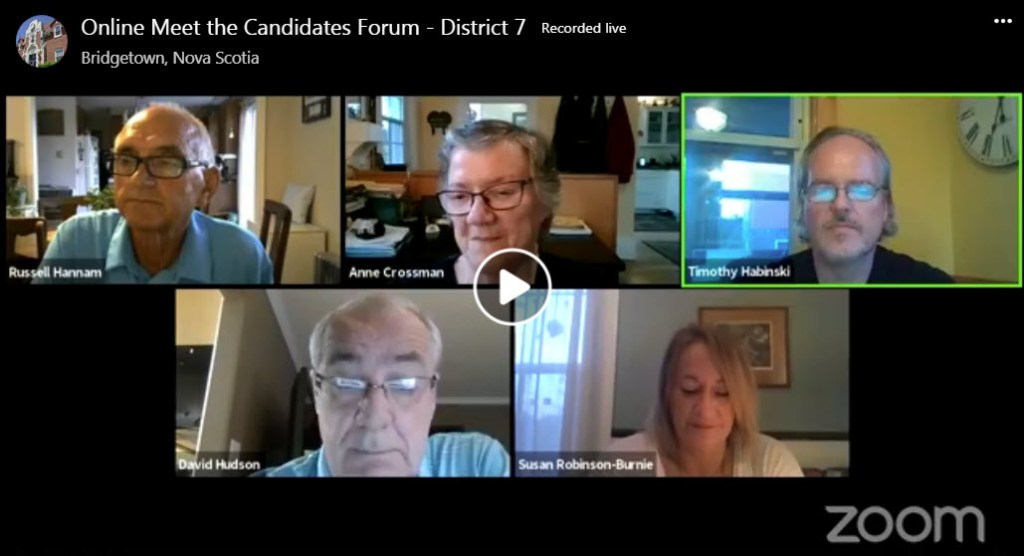
This evening, I was able to watch on Facebook four candidates for District #7: Timothy Habinski, Russell Hannam, David Hudson and Susan Robinson-Burnie (missing was Mike Taylor) answer a series of questions on the Environment, health services, economic development, engaging the next generation and the Bridgetown Town Hall.

Top row, l to r: Russell Hannam, Anne Crossman (moderator), Timothy Habinski
Bottom row, l to r: David Hudson, Susan Robinson-Burnie
(missing: Mike Taylor)

I find it geographically remarkable that the town of Bridgetown is divided into two districts #3 and #7, either side of Highway #1.How does that help us with a ‘sense of community’?

Kudos to Steve Raftery, Andy Kerr and Anne Crossman for putting the event together. It helped my thinking, in a world without newspapers.

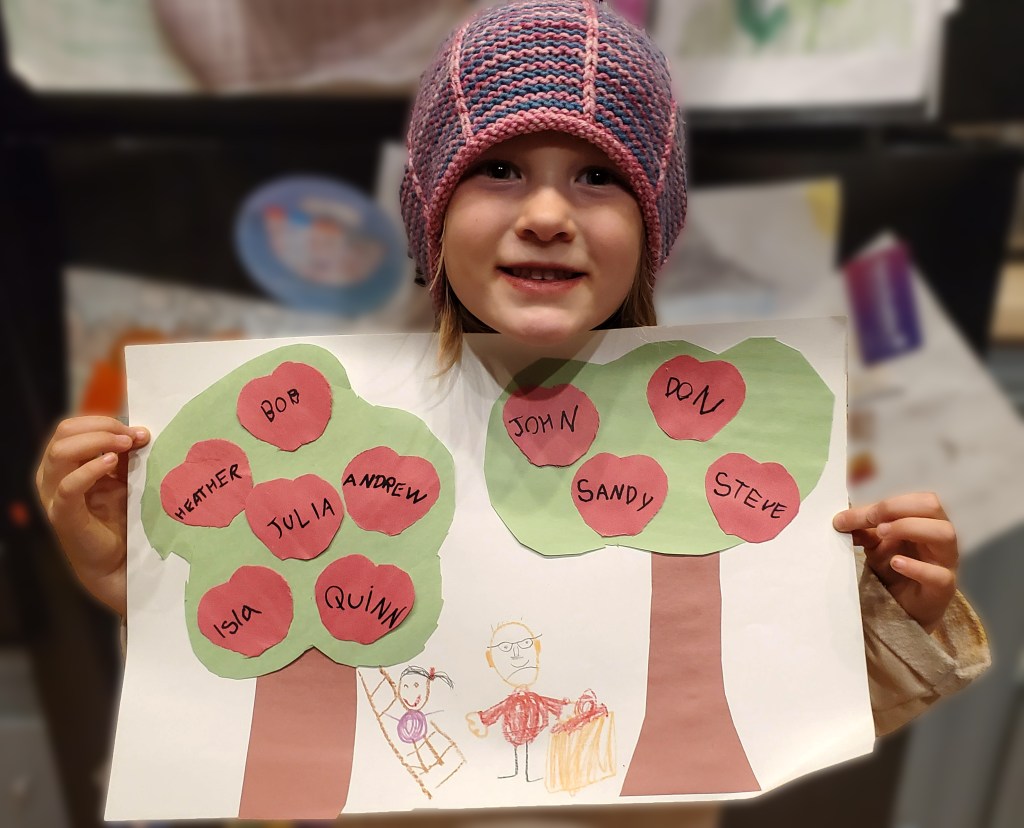
Later, the same evening, I received the following email from Andrew on Baffin Island, entitled ‘Harvest Time’.

“Isla wanted to do a harvest craft of what is happening in Nova Scotia. It’s Bob and Heather doing the picking.”

Here is my reply.
“Yes. We have two types of apple tree: NovaMac and MacFree. The NovaMac produces wonderful sweet, deep red apples.The MacFree is a later apple, stays on the tree longer. It looks more ‘green/orange’. Apparently the two varieties encourage cross-pollination (Raymond Hunter).”

Acknowledgements

Heather and I had a good day in the orchard, picking from the tree, and the ground. Andrew sent us the photograph of Isla Rose. Anne Crossman moderated the all-candidate event.

Reference

Gretel Ehrlich, 1985. The Solace of Open Spaces. Penguin Books.

Postscript

Where’s Stephen?

Posted in Article Review, Video Review

Times have changed

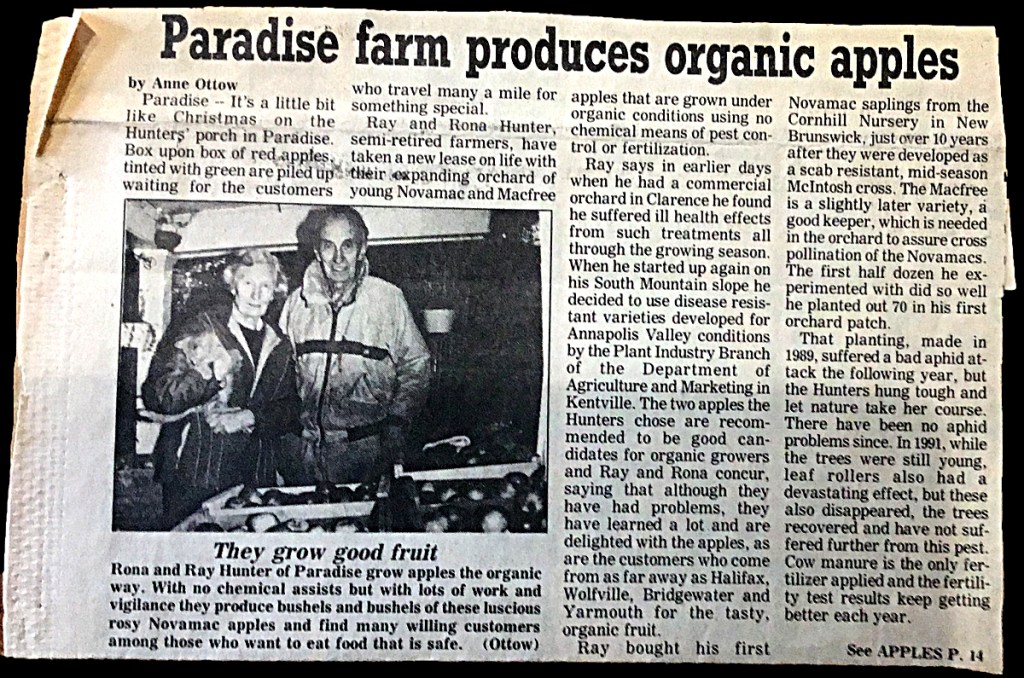
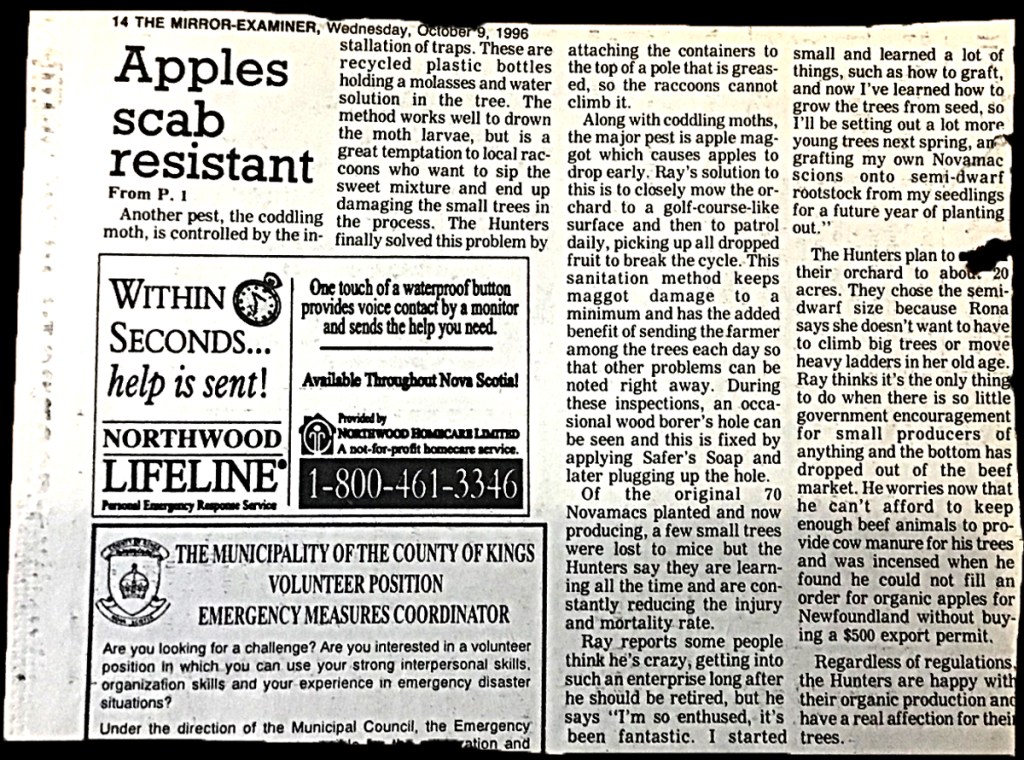
Do you remember when we had a weekly local newspaper in Bridgetown (The Monitor) and in Middleton (The Mirror-Examiner)? Do you recall reading the column written by Anne Ottow?

As we were completing the organic certification and inspection process with Allison Grant, I discovered in my filing cabinet a copy of Ottow’s interview with Raymond and Rona Hunter. It was published on October 9th, 1996. I hope that you can read it.

After the Hunters, the farm was briefly in the care of Rob and Clara Flanagan. Andrew, my son, purchased the property in 2005. And here we are in 2020, maintaining and harvesting organic apples from trees planted by Raymond.

The news media has changed significantly in the Valley, partly in response to the Internet. Larry Powell, who was a reporter with the Saltwire network is now employed by the municipality of Annapolis. His latest contribution is a YouTube video with Gregory Heming. Gregory has decided to withdraw, and not defend his seat in the forthcoming municipal election. Meanwhile, in Lawrencetown, I received a flier in my mailbox about the voting patterns of Councillor Martha Roberts. The author was Ron Habinski, father of the warden, Timothy. Not sure exactly what this means.

The best source of information for the forthcoming election, meetings and gatherings,and items for sale and service is The Reader. Steve Raftery and Andy Kerr are maintaining an election web site.

In conclusion, I did receive an email from Nina Newington about a moratorium on spraying on private forest land this year. However, it still leaves unanswered a number of questions about forest management in Annapolis County:

How much forested land exists in Annapolis County?
How much forested land in the County has been clear-cut and sprayed? When and where?
If there is a moratorium on clear-cutting/spraying, what is the impact on the forestry sector?
How much of Annapolis County is crown land?
How much is private woodlots?
How much is forested but conserved for outdoor recreation, e.g. parks?
How much is forested but protects the water supply, e.g. Lawrencetown?
How much is forested wetland or deciduous woodland at the slope of North Mountain

This is the type of analyses that the county needs to undertake on behalf its citizens — if, indeed, it believes in ecological forestry. I have suggested to Timothy Habinski that the Municipality should collaborate with COGS to conduct this type of geographic analysis, with maps, imagery and statistics.

Postscript

Raymond and Rona Hunter were strong advocates for organic agriculture. This means NO SPRAYING on our agricultural land.

Acknowledgements

Edward and Heather for their abiding interest in the landscape of Annapolis County and the species that live there. The potential for evidence-based management. Anne Crossman for moderating the all-candidate meetings for Districts 3 and 7.

References

Larry Powell, YouTube video.
Steve Raftery and Andy Kerr for the municipal election web site via The Reader.


Posted in biographical sketch

Two Kinds of Thinking (Updated)

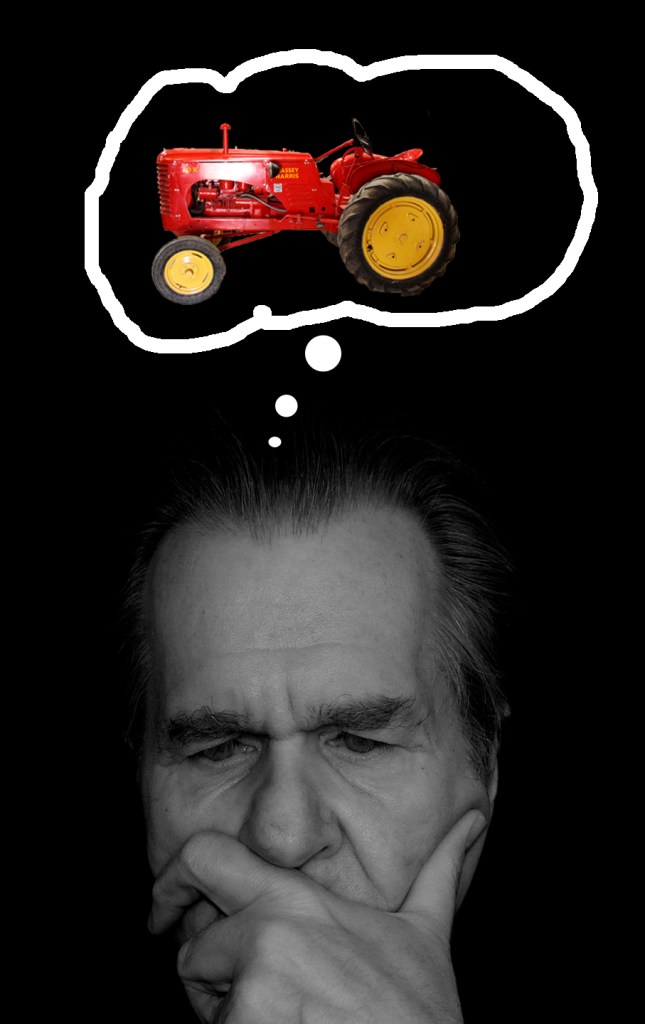
July 15, 2017, I wrote a blog ‘Two Kinds of Thinking’. It described the difference between an academic focused on abstract ideas and the practical, focused on understanding the mechanics of a tractor and it’s related parts.

Two kinds of thinking

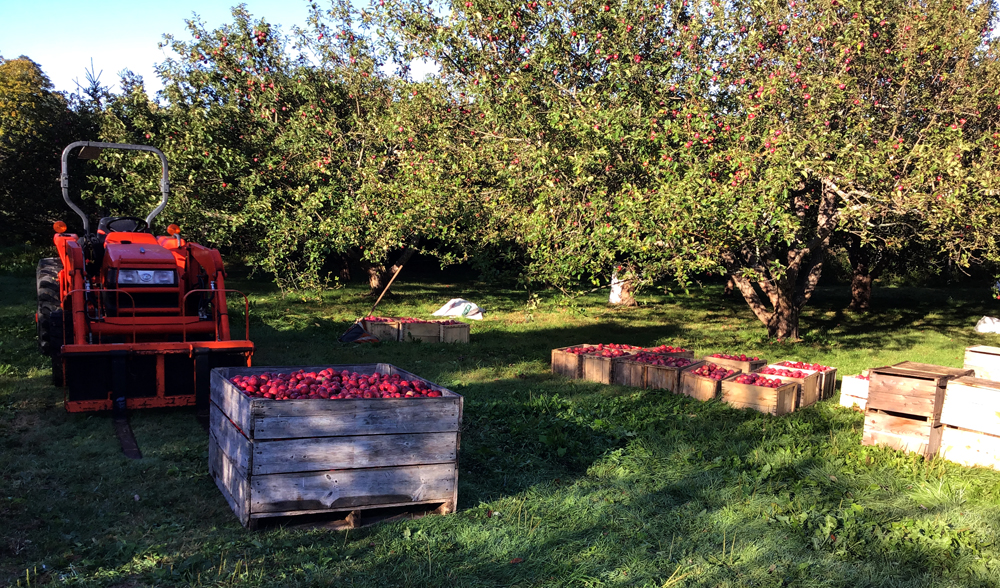
Move forward to September 26, 2020 we are harvesting a bumper crop of apples. The requirements are the same: pick into bushel boxes; 20 bushel boxes per bin.

I estimate that this year we will fill at least twenty bins. They will be transported to Boates Farm in Woodville. The drops will go to vinegar. The hand-picked apples from the tree will go to brandy.

The challenge is that I only drive the tractor in the orchard season. I need to move fully loaded bins from the orchard to the yard. Brian loads them onto a flat-bed and transports the apples to his farm for processing into juice.

The task of moving apples from trees to picking bags to boxes to bins to tractor to flatbed to processing plant to bottles of deliciousness.

The solution, as mentioned in 2017, is to find a mentor. Neil Bent, from Lawrencetown, has agreed to move the loaded bins from the orchard to the yard. The challenges are uneven ground, the counterweight of the bush hog mower, with the bins on the front fork lift. Plus the fine motor controls to place the bins on the flatbed.

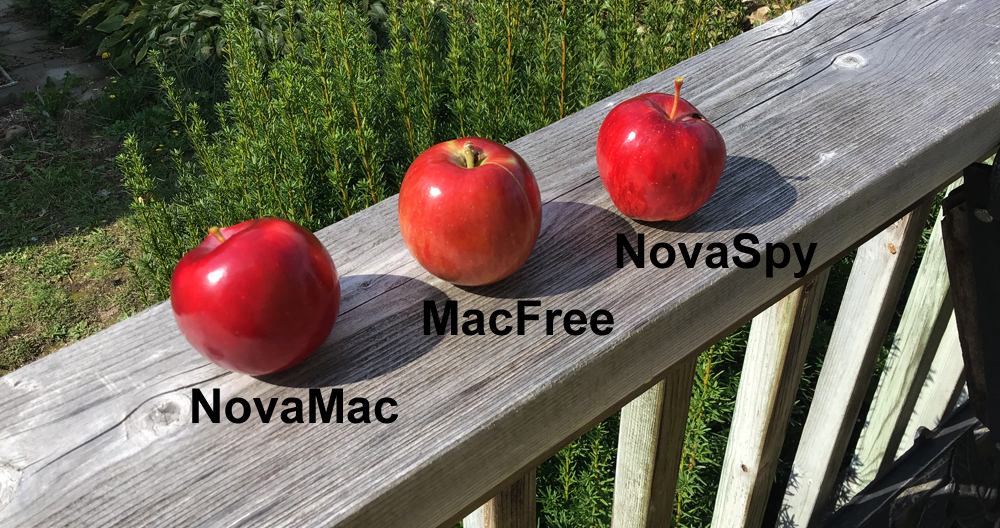
Some new lessons from this year. We have four varieties of apple : NovaMac, Liberty, Nova Spy and MacFree. The Apple varieties ripen in the same order. Interestingly, Raymond Hunter planted the trees in rows But the diagonal follows each variety.

The third lesson is finding the noxious weed, Wild Parsnip in the north east corner of the orchard. This weed seems to have spread from Lawrencetown, along the roadside of Highway #201.

Three of the four apple varieties in my organic apple orchard (missing is Liberty)

As the reader can attest, it has been a dry, sunny Summer. The result has been a bumper crop. Excellent pollination. The apples seem pest-free and have a beautiful coloration. The lack of rainfall at a critical time may have caused some reduction in apple size.

We are hoping to have everything harvested in the next two weeks. Perhaps a bit later than normal. Partly because we lost a week with the Spray Protest.

Acknowledgements

The harvesting of an orchard requires considerable fortitude from both Heather and myself. We thank Neil Bent and Brian Boates for their practical expertise. Edward for his encouragement and online graphics.

Postscript
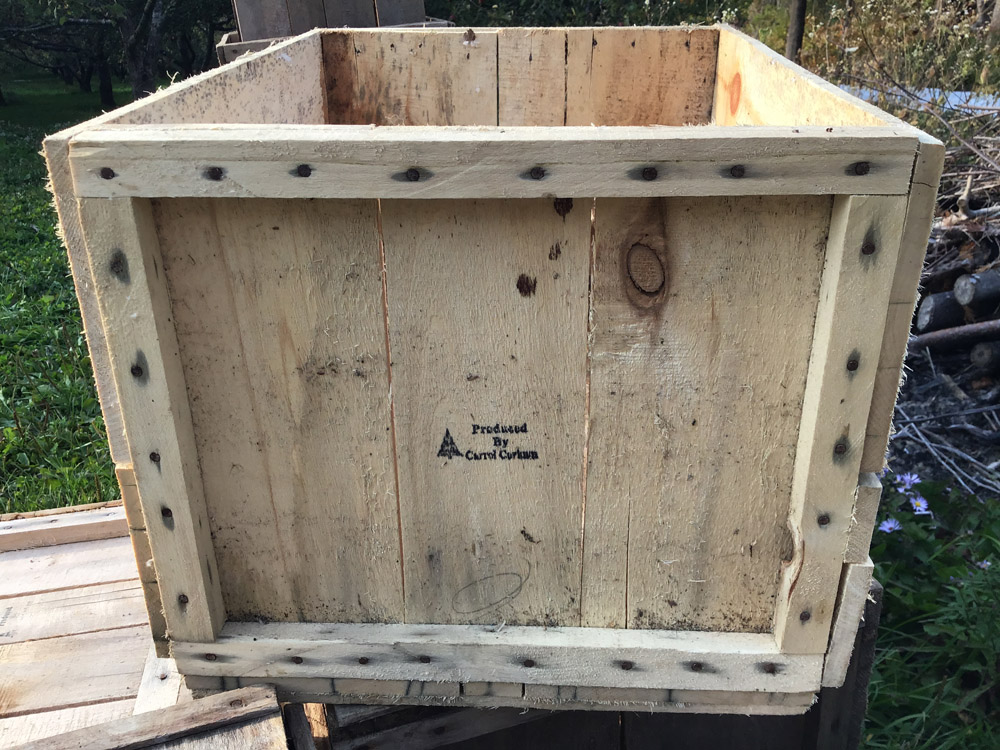
Our bushel apple boxes are made by Carrol Corkum in Inglisville