Posted in New thinking, Opinion

New Localism

bookCover_livingMountainShepherd was a localist of the best kind: she came to know her chosen place closely, but that closeness served to intensify rather than limit her vision

Robert MacFarlane p.x. The Living Mountain.

Yesterday (Sunday) we joined a Zoom conference with Nina Newington and a small group from the Extinction Rebellion. The topic was Forestry and the position of the Provincial government. Today, there are additional topics of local concern, particularly access to Health Services and the Internet.

Thinking about the relationship of citizens and community groups to these global concerns it struck me that you have to start at the local level. If we are going to develop a new ‘land ethic’ then perhaps we should be expressing these concepts to the municipal government. If we want to change the political process, more openness, decisions based on best practices and science, let us work at the local level.

banner_annapolisCountyIf we want to understand our Geography, let’s start with Annapolis County. Let us map the changes in our land use, whether Forestry, Agriculture, Fisheries, Mining. If we are concerned about the health of our citizens, let us map our demography; let us know the location, number and size of long-term care facilities in the County. Let us know and understand the population at risk.

Nan Shepherd described her relationship to the Cairngorms. Ernest Buckler described his relationship to the Mountain and the Valley. Can we not start with the Geography of Annapolis County? Can we not develop a different relationship between the Municipality, the landscape and its citizens. If we conducted that experiment in this county, we could share the lessons, positive and negative, with other counties. Make comparisons, and hence improve the overall provincial picture.

In Annapolis county, we have the added advantage of access to the Centre of Geographic Sciences (COGS).

Although today, Lawrencetown is a ‘ghost town’. Nothing is open. NO post office. NO XTR gas station. NO Shakes on Main, NO In Your Back Pocket Thrift store. NO Winemakers Tavern. NO COGS. And yet, we anticipate a new Health Centre later in the year. That is a fine example of citizen engagement.

Acknowledgements

Nina Newington for hosting the Zoom meeting. Municipality of Annapolis for their comments on previous blogs. Edward Wedler for his graphics touch.

References
Nan Shepherd. 2011. The Living Mountain. Canongate Books
Ernest Buckler.1952. The Mountain and the Valley. Henry Holt. NY.

Posted in Book Review, Opinion

Small Details

banner_dAubinMeats_3In these unusual times, it is the small details that catch one’s attention. Going to the grocery store is a different experience. Once a week, I stop at D’Aubin Meat Market in Bridgetown. This week, we needed a hambone to make our split pea soup. They had run out of bacon but offered instead a ham end, as a substitute. While there, I grabbed a bag of pea shoots, and goat cheese scones with chives and cranberries.

We are seeing changes in the availability of news from the Saltwire network. They publish the Annapolis Spectator and the Chronicle Herald. Instead, I notice an increase in online blogs – The Virus Diary (Anne Crossman), The Groundhog (Roger Mosher) and Ernest Blair Experiment (Bob Maher, Edward Wedler).

bookCover_livingMountainTwo years ago, I was in England and picked up Nan Shepherd’s The Living Mountain from the Weybridge Bookshop. After listening to Robert MacFarlane on CBC Radio, a couple of weeks ago, it was time to try to find my copy. The book, written towards the end of the Second World War but not published until 1977, describes her relationship with the Cairngorms in Scotland. It is considered a classic of nature writing. Twelve short chapters ranging from the Plateau through Water, Snow and Ice to Life (Plants, Birds, Animals, Insects and Man). She concludes with Being.

“I believe that I now understand in some small measure why the Buddhist goes on a pilgrimage to a mountain. The journey is itself part of the technique by which God is sought. it is a Journey into Being; for as I penetrate more deeply into the mountain’s life, I penetrate also into my own”. p.108.

In many ways, it is a Geography text.
MacFarlane provides an excellent thirty-page introduction to this slender book.

Acknowledgements

Ralph and Jennifer D’Aubin for their successful meat market and value-added products. Anne Crossman, Roger Mosher and Edward Wedler for their contributions to community blogs. Heather Stewart for her cuisine.

References
Nan Shepherd. 2011. The Living Mountain. Canongate Books

Posted in Art, New thinking, Opinion

Robert Waddell Art Awards

I propose creating an annual Robert Waddell Art Awards Event for excellence in art — something that can be launched jointly by the Municipality of Annapolis County and the Town of Annapolis Royal.

Robert Waddell was an art master at the Gordonstoun School in Scotland.gordonstounSchoolScotland Waddell inspired Prince Charles, then a student at Gordonstoun School, to paint in the 1970s. As a result of that inspiration, Prince Charles has become one of the UK’s most successful living artists, where he paints en plein air (outdoors) and exclusively in watercolours, according to Insider.

With the announced expansion of the Gordonstoun School into North America, and into Nova Scotia, in particular, a fitting tribute to Robert Waddell could excite our Maritime visual art movement. Could Annapolis County and the Town of Annapolis Royal help host/showcase such an event in collaboration with the Gordonstoun School, to celebrate the school’s Nova Scotia roots?

banner_2019_paint-outSEASON The Plein Air Artists Annapolis Valley group, now in its fifth year painting at outdoor locations throughout the Valley, could help organize the launch of such an event alongside ARTsPLACE, Paint The Town, and NSCAD.

Thinking even more inclusively,banner_KingsTheatre  connections could be made with performing arts, considering … the rich arts culture in the region, Annapolis Royal’s historical link to “L’Ordre de Bon Temps“, storytelling/plays/music at King’s Theatre, talk of a Liberal Arts University, and workshop/conference facilities such as those at Cornwallis Park. You see, “English master, Eric Anderson—like the art teacher Waddell, also in his 20s … encouraged Charles to act in several of Shakespeare’s dramas” (Vanity Fair).

Maybe this is where our Valley’s cultural history and environment can fuse with the traditions of the Gordonstoun School to make for exciting times.

References

Zoë Ettinger, Insider. Prince Charles is one of the UK’s most successful living artists. Here are 15 of his works, 30 March 2020.
Lawrence Powell, Spectator/Chronicle Herald, Gordonstoun a Go, 17 March 2020.
Plein Air Artists Annapolis Valley. 2020 Paint-out schedule.
Sally Bedell Smith in Vanity Fair. The Lonely Heir. April 2017.

Postscript

It would be excellent if Prince Charles joined Tom Forrestall and Geoff Butler on the inaugural judging panel. (Bob Maher)

Posted in Article Review

On April Fool’s Day

Serendipitously, I noticed in Orion magazine, besides the article on David Quammen, that there was an article on a conversation between Tim DeChristopher and Wendell Berry, To Live and Love with a Dying World. DeChristopher is a Climate Activist, Berry is a writer and poet.deChristopherBerry

From their conversation, I took away Berry’s concern about machine civilization and the role of the state.

“Live so far as you can in opposition. You’ve got to live and love. You’ve got to find the answers in your heart”

And a couple of short poems.

“O when the world’s at peace and every man is free
Then will I go down unto my love.
O and I may go down several times before that.”

“Something better, something better!
Everybody’s talking about something better!
The important thing is to feel good
And be proud of what you got, don’t matter if it ain’t nothin’ but a log pen.”

After my last blog, I asked Andrew for a current photograph from Iqaluit.conditionsUpNorth In the background, you can see the roof of the arena. You can also see that there are not many people around. Social isolation.

For several weeks, I have been burning materials from the hedgerows. Every day, I would check the burn ban website, to see whether burning was permitted between 2 pm and 8 am. Then I noticed in the SaltWire-Spectator that someone was charged for ignoring the burn restrictions in the Village of Lawrencetown. Unbeknown to me, the Minister of Lands and Forests had put out a no-burn order until May.
To free up the Fire Departments in this time of crisis. Oh well, no rush!

Earlier in the week, I contacted Brent Hall at Esri Canada.person_BrentHall My interest was the impact of COVID-19 on teaching GIS in the universities. Brent observed that this pandemic will change the relationship between education and online learning. This caused me to reflect on Wendell Berry’s comment about ‘machine civilization’.

Postscript

Listening to The Jerry Cans CD, Nunavuttitut , to remind us of life in Iqaluit. Feels good!
And received our first email from grandson, Fraser Root-Maher, he deserves a special mention too. I hope he will become a blogger.

Acknowledgements

Andrew Maher for the new photograph. Brent Hall, Director, Education and Research at Esri Canada for his perspective on COVID-19 and Education. Edward Wedler for his graphics contribution. Heather for her long-distance walking, in the rain.

References

Orion Magazine. March 2, 2020. To Live and Love with a Dying World.Tim DeChristopher and Wendell Berry.
Nova Scotia Burn Restriction web site.
The Jerry Cans. CD Nunavuttitut.

Posted in Book Review

The Song of the Dodo

In the last few days, David Quammen’s name has come to my attention, twice.bookCover_spillover_2 The first was a podcast, available through Emergence Magazine. The second was from Sandra Barry about an article in Orion magazine. In both cases, they refer to his book, Spillover: animal infections and the next human pandemic. It was published in 2013.

My interest in Quammen’s writing goes back to the mid-’90s.bookCover_songOfTheDodo After finishing graduate work in Biogeography, and spending time in Indonesia, I could not resist the Song of the Dodo, with its subtitle, Island Biogeography in an Age of Extinction. Today, we continue to divide our landscape into islands. For example, consider the continued forestry practices in Nova Scotia.

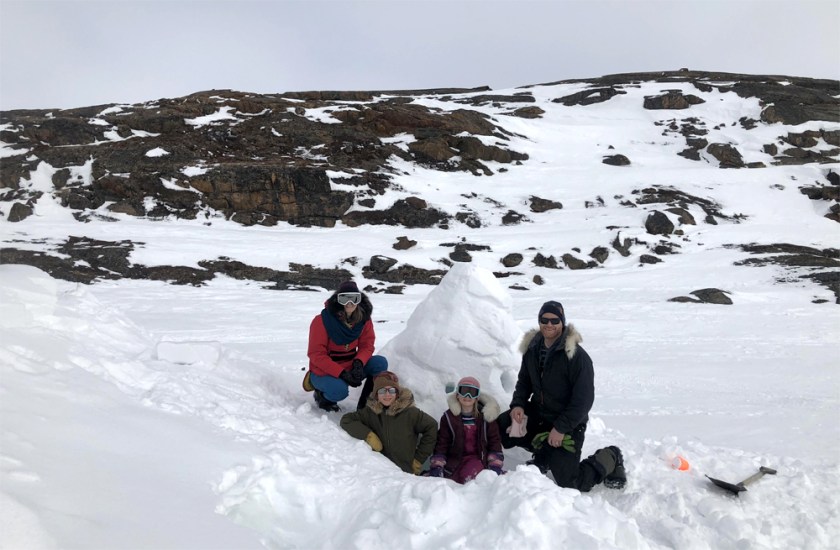
This Tuesday (March 31st) Heather and I were scheduled to visit grandchildren in Iqaluit.upNorthDogTeamSelfie Talking to Andrew (my son) on the weekend, the current procedure for visitors to Nunavut is two weeks quarantine in a designated hotel in Ottawa (or another transit centre) BEFORE travel. If the quarantine is successful, then one can visit. This provides a clear measure of the vulnerability of these Northern communities from the COVID-19 virus.

Today, Heather was noticing the lack of traffic on Highway #201. We were able to hear the songbirds that are arriving back in the Valley. On a beautiful morning, I had to break the silence, by getting the chainsaw out of the garage. There were yard chores — cutting off the larger dead branches from the Apple trees and trimming the silver maple in the front yard before it extends upwards to the Nova Scotia Power lines. The privet hedge contains too many old dead branches at their core.

The end result was a full day outside. If we can use this month of April (normally spent in the North) to clear out the old growth, then we can begin to imagine a larger garden and greater food self-sufficiency. At the same time, we add biomass to the compost pile and additional wood and kindling for the woodshed. This will warm us, sometime, next Winter.

Acknowledgements

Sandra Barry for resurrecting memories of David Quammen’s writing. Heather for sharing both the hard work and dreaming of a different future. Edward Wedler for his weekend blog, as well as his support and good humour.

References

David Quammen, 2013. Spillover: Animal Infections and the Next Human Pandemic WW Norton & Co.
Emergence Magazine podcast. Shaking the Viral Tree.
Orion Magazine. 17 March 2020. Why David Quammen is nor Surprised.
David Quammen. 1997. The Song of the Dodo. Island Biogeography in an Age of Extinction. Simon & Schuster.

Posted in Art, Event Review

From Snowshoes to Snowdrops

bookCover_healingWalksAnne and I arrived in Halifax by plane in the wee hours of last Saturday and were instructed by border officials to self-isolate for 14 days. We had returned from our stay in Bradenton, Florida. I read the interesting article Bob’s brother, Peter Maher, sent on confinement from “The Book of Life”. This got me thinking. Where and what is your geography when you are confined?

Bob and Heather, I thought, were fortunate to freely survey their property on snowshoes during this call to self-isolate and to physically distance ourselves. I suggested he take a camera with him when he goes on his outings alone or with Heather. Check out this free Shambala title, “Healing Walks for Hard Times” … “Walking awakens the profound healing power of the human spirit“.

I used to carry a (Zoom H4) field audio recorder with me on my walks and travels. I noticed how different the experience was to replay a walk/trip captured in audio versus captured in images — the clickity-clack of the narrow-gauge Skagway train; the sound of a 1890s replica gold-rush saloon; the passing of a Prairie train in the wee early morning hours outside our motel room; the soothing lapping of water on a lake’s shoreline near Petit-Saguenay; announcements at an airport waiting-area in Halifax; the crunch of soldiers’ footsteps on gravel at the Fortress of Louisburg or our own footsteps on our walks.

map_montrealSoundMap

How many of us truly listen to our geography? I once thought about how exciting it would be to explore a “sonic map” of Canada or Nova Scotia and then I discovered Sound Maps, as in the Montreal Sound Map. “The Montréal Sound Map is a web-based soundscape project that allows users to upload field recordings to a Google Map of Montréal“.

My wife, Anne, created some spontaneous “sound art” during a walking tour last October 2019, inside the Halifax Central Library, headed by a Dalhousie University architecture student as part of a Sketching Tours event with the Nova Scotia Association of Architects.

banner_PoppyBalserNewsletterIn these turbulent times, I notice how people are, lately, appreciating the little things in life. One of my favourite artists, Poppy Balser from Digby, for example, has been busy in her backyard garden, preparing for spring. She writes in her latest email newsletter, “Hope Springs Eternal“,

I found these snowdrops buried deep within a blackberry bramble in a neglected part of my garden.  I’m making an effort to get outside every day as we wait all this out. One of the projects I’ve undertaken is to clean up that portion of my garden and that is how I found the snowdrops“.

Anne and I are doing well. We exercise, dance, paint, illustrate, solve puzzles, read, write and think while being grounded. Today, I bake rustic bread and continue to illustrate Marshall Ennis‘ upcoming book, “The Legend of Great Uncle Arthur”, about a strong fisherman who once lived in a small outport on the northeast coast of Newfoundland.

Acknowledgements

Bob Maher for continuing to fire my imagination and motivating me to connect the dots. To my field recorder taken with me on my sonic-travels across Canada. To the many diversions on the internet, books and art that keeps us occupied during periods of self-isolation. Poppy Balser for bringing her outstanding watercolour paintings into my life. Marshall Ennis for helping me be strong in body and mind.

References

Healing Walks for Hard Times. Carolyn Scott Kortge. Shambala Publications.
Canadian Geographic. 8 July 2011. Surround Sound. by Samia Madwar.
Montreal Sound Map.
Poppy Balser Newsletter. Hope Springs Eternal.
MelsKitchenCafe.com. Rustic Bread.
Marshall Ennis Website.

Postscripts

RUSTIC BREAD

My rustic bread turned out well and was delicious — crunchy crust and the chewy centre. Next time I’ll add more whole grain flour and flaxseed for an even heartier bread.rusticBread

#PLANKTHECURVE


Posted in New thinking

School of Life

Peter, my brother, sent me the link ‘On Confinement’ from the Book of Life. There is also a reference to Xavier de Maistre ‘A Journey Round my Room‘, written in 1790. At this time, we are all learning from the School of Life.banner_schoolOfLife

In response to the conversation between Janice Stein and Jane Jacobs, I received the following astute observations from Willy Hunter.

“Citizenship is a part-time job for us all. Some people express it via social works, and other’s via committee work, and others by being elected. Some people get to do it more or less in their jobs. Like teachers and nurses etc..

Forgiveness is actually for the forgiver and service is for the server “

bobsDogs_2This week, we have tried to maintain our fitness regime through snowshoeing and walking. Unfortunately, the private gym at FE (Fitness Experience) in Middleton has been closed down. Similarly, the province has closed parks and trails. From Cathy, my personal trainer, I am beginning to understand my body. Now, I need to understand my mind. That seems to be one of the premises of The School of Life. Interestingly, there are several School of Life sites in Europe, but none in North America.

bookOfLifeActivitiesEmergence Magazine is offering a set of activities for the online community: a monthly book club, contributor conversations, biweekly Nature Writing course, and a facilitated workshop on the theme of vulnerability.

Before today’s snowfall (Tuesday) I was able to spend time clearing multiflora rose from the hedgerows. It was remarkable to see how different species grow together. Their form dictated by their interaction e.g. deadly nightshade, high bush cranberry. We continue to prune in the orchard, as well as topping the conifers which reach towards the overhead power lines. Today, for the first time, we were able to snowshoe down through the property.

bookCover_knittedBirdsPostscript

My favourite book on the coffee table is Arne and Carlos. 2017. Field Guide to Knitted Birds. Trafalgar Square Books.

Acknowledgements

Willy Hunter for the OK to quote from his email. Cathy Bruce West for her Healthy Bodies advice. Peter Maher for the link to The Book of Life. Heather for her companionship and custodian of the pruning instruments. Edward Wedler for his graphics contributions

References

On Confinement from The Book of Life.
Xavier de Maistre. A Journey Round my Room.
The School of Life. theschooloflife.com
Emergence Magazine. March 24,2020. Contributor Conversations, Book Club, Nature Writing Course, Embracing Vulnerability and Connection. New podcast released every Tuesday.

Posted in Book Review

Reading Time

Over Christmas, we visited my brother’s family in Toronto. While there, I chanced to pick up Jane Jacobs’ book Vital Little Plans.bookCover_vitalLittlePlans One of the essays centres on a conversation between Janice Stein and Jane Jacobs at the ‘Grazing in the Commons’ conference in Toronto, November 15,2001. It is titled ‘Efficiency and the Commons’. In particular, I appreciated the following exchange.

p 379. Stein:

“I think we need to think about citizenship not just as voting in an election. We need to start thinking about citizenship as a part-time job that we all have. And then ask ourselves.
‘OK, which job am I going to take on?
Am I going to go to work in my local school?
Am I going to go help out in the local clinic?
Am I going to help out with a community issue?
Because it seems to me that’s what crosses that bridge that we build between states and markets.

We know states do some things and markets do others. How do we fit this part-time citizen into our economy ?”

Jacobs:

“I think what you are describing has a great deal in common with art, which has always been a big question mark. Art done for art’s sake is outside of economic life. Artists do need, somehow or other to eat, but that’s not why they do art. They do it because they’re driven to do it. And it’s a gift. And I think that community things are done not for livelihood and not for power. That’s where that work belongs.”

Before heading home from Florida, Edward forwarded this link from The Atlantic.
Anne Applebaum The Coronavirus Called America’s Bluff.CoVid19AmericasBluff

Another perspective on the current crisis can be found in Paul Kingsnorth contribution to this week’s Emergence Magazine. The op-ed piece is called Finnegas.

bobNhunterSocialDistancingFinally, at the end of the week, Charlie Hunter forwarded a photograph of our St. Patrick’s Day meeting, with the caption ‘You and I received more compliments on our social distancing than on our good looks !

Reading time should allow us some ‘deep thinking’ about government, capitalism and citizenship. On Sunday morning, CBC The Sunday Edition included interviews with both Robert MacFarlane and Rebecca Solnit, a couple of my favourite authors.

Acknowledgements

Edward Wedler for forwarding The Atlantic link, before heading home to Nova Scotia (now in mandatory self-isolation). Charlie Hunter for the photograph. Heather Stewart for her feedback.

References

Samuel Zipp and Nathan Storring(Ed) 2016. Vital Little Plans. The Short Works of Jane Jacobs. Vital Little Plans. Penguin Random House Canada.
Anne Applebaum. The Coronavirus Called America’s Bluff. The Atlantic.
Paul Kingsnorth. Emergence Magazine. March 20,2020. Finnegas.

Posted in Opinion

On St Patrick’s Day

There was good news on St Patrick’s Day. Timothy Habinski, Warden for Annapolis County, announced that Gordonstoun School had purchased Upper Clements Park for the new campus. It could be open as early as September 2021.

That same day, Esri Canada shared the link to their COVID-19 Canada Resource Hub. Later, we received an email from Brent Hall on the options for the virtualization of access to the Esri software.coVid19_ESRIcanada

Meanwhile, Heather and I continued our vendetta on the multiflora rose. This action could form the basis of a Permablitz — a concept championed by Rick Ketcheson (see Food Action Coalition)  from the Good Cheer Self-sufficiency Society.

hunterBrandyAfter lunch, as I was preparing for another burning, a white car stopped at our driveway. Charlie Hunter stepped out and explained that he, and his family, were taking a ‘trip down memory lane’. We discussed Hunter Brandy, Geography at Mount Allison University, as well as the future biography of Raymond Hunter. Charlie mentioned that Raymond had built a cabin down towards the river. We think that we have located the remains.

Now, let me try to join the dots. Clearly, COVID-19 has encouraged us to move towards online learning. For over thirty years, COGS has maintained a close relationship with both Esri and Esri Canada in the application of GIS technology.
Would it not make sense for COGS to apply this technology to improve the quality of landscape management and community planning in the Annapolis Valley? This expertise and virtualization could form the basis of an educational relationship with Gordonstoun Nova Scotia. For indeed, we share the same Geography.

Footnote

Have you noticed on Highway #101, as you enter Annapolis County (Naturally Rooted) from the East, there is now a new sign, acknowledging that you are entering the UNESCO Southwest Nova Biosphere Reserve?

It seems that the songbirds are back. I wonder what they think about the quiet of the human population.

Acknowledgements

Rick Ketcheson for the Permablitz concept. Charlie Hunter for the conversation about his father, Raymond. Brent Hall and Susie Saliola at Esri Canada. Cliff Drysdale for the new sign on the highway. Heather Stewart for her determination to tackle multiflora rose.

References

Lawrence Powell. Gordonstoun a go: Scottish school to be built on site of Upper Clements Parks. Annapolis Spectator March 17, 2020.
COVID-19 Canada Resource Hub. https://resources-covid19canada.hub.arcgis.com
Brent Hall. Email March 18th. Virtualization of ArcGIS.

Posted in biographical sketch

Pruning etc

burning permit
Cartoon by Edward Wedler

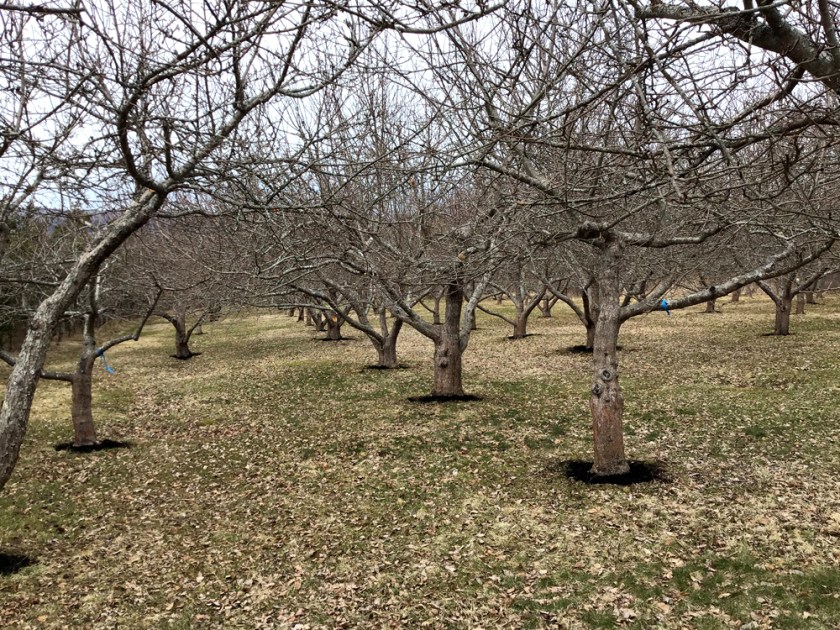
The main task over the last ten days has been pruning and burning. Pruning means cutting off the tall leaders that extend beyond our longest apple ladder, any dead or damaged branches and making sure we can mow between the rows. Almost, one hundred trees generate quite a pile of applewood. Given the fire ban notice, the season started March 15th. we were able to mix the apple with juniper and spruce prunings to create a manageable conflagration, before that date.

The other component was multiflora rose. In the hedgerows, along the field boundaries, multiflora rose can overtop the willow and alder. This invasive species has colonized a number of abandoned fields in this part of the Valley.

rose
Invasive Multiflora Rose

In the middle of all this activity, Heather had the opportunity to attend a Winter Pruning workshop offered by the Nova Scotia Nature Trust in Dartmouth. This resulted in super-sharp pruning equipment.

After much deliberation, we have decided to stay home and enjoy the Nova Scotia Spring. The risk of flying from Halifax-Ottawa-Iqaluit was not worth it. These remote communities have limited finite medical resources.

Meanwhile, a new book arrived at the Inside Story. Bokashi Composting by Adam Footer.bookCover_bokashiComposting This gives us the opportunity to address soil building on our property.
Online, I noticed today that Emergence Magazine’s latest issue is Vulnerability, Community and Connection. 

In preparation for our annual trip North, I had signed up for a personal fitness program with Cathy at Healthy Bodies. It won’t go to waste. I can see a lifetime of outdoor tasks around the combined one hundred acres, between Andrew’s property and our own. Yesterday, we walked the property line down from Inglisville Road. There are a number of downed trees from the Winter storms that need to be cleared with the chainsaw.

Acknowledgements

Heather for sharing the Spring cleaning tasks around the property. Edward for his remote input from the South (returning sooner than originally planned).

References

Adam Footer. 2014. Bokashi Composting. Scraps to Soil in Weeks. New Society Publishers.
Emergence Magazine. March 15,2020. Vulnerability, Community and Connection.