This weekend, it is the start of Toonik Tyme, a celebration of the start of Spring in the North.
It includes outdoor events: ski, snowmobile and dogsled races and the sharing of traditional food and crafts.
Last night, at the Visitors Centre, we went to see two classic NFB films, Land of the Long Day (1952) and People of the Ice (2003). The latter featured Sheila Watt-Cloutier and is a documentary on the effects of global warming on the Arctic environment and the Inuit culture. The film is now sixteen years old, pre-dating the argument in her book, The Right to be Cold.
Next week, Wayne Johnston comes to town. He will talk on Ten Cities: the past becomes the present. He will look at the relationship between place and memory through writing and drawing. In preparation, I picked up his novel, The Navigator of New York at the Iqaluit library.
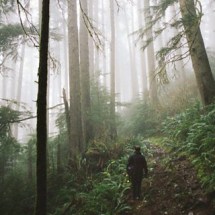 From my brother, I received another BBC podcast, Here be Dragons. It explores the relationship between poetry and maps. The most obscure was the idea of using a city map of Havana to navigate the landscape of the Isle of Angelsey.
I did manage to finish Rubinstein’s book Born to Walk. While I enjoyed the chapter on Creativity, I found the book overall, very uneven.
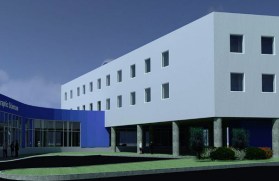 This week, I received an email about the expansion of the COGS campus. While the additional infrastructure will provide a short term economic boost to the village of Lawrencetown. There were no details on the impact on the curriculum, research and teaching, or the relationship to the larger community, and rural economic development. It continues to amaze me at the lack of connectivity with place.
In a different context, to quote Sheila Watt-Cloutier:
“A great disconnect has grown between our communities, our economies and our environment. This has resulted in rapid climate change that now spirals out of control and fundamentally threatens the world. Those who have traditionally lived closest to the land, and who today maintain the strongest connections to nature, are now at risk of becoming just a footnote in the history of globalization.” p.323.
I would add that we need to demonstrate much more holistic, inclusive thinking, especially from our educational institutions.
Acknowledgements
To Heather and Edward willing participants in the journey.
 In True North Rising, Whit Fraser describes meeting Mary Simon’s parents in the Arizona Desert (p.138). For nearly twenty years, the in-laws made winter camping trips. Bob May started work for the Hudson Bay Company at Arctic Bay, where he met his wife, Nancy. This story reminds me of the changes in technology, and its relation to elder travel.
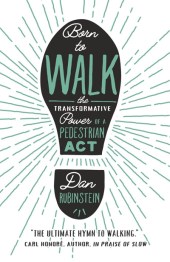 On our way North, we had a stopover in Ottawa. This was our chance to visit an urban Chapters bookstore. I picked up Dan Rubinstein’s
  April 1st. Twenty years ago,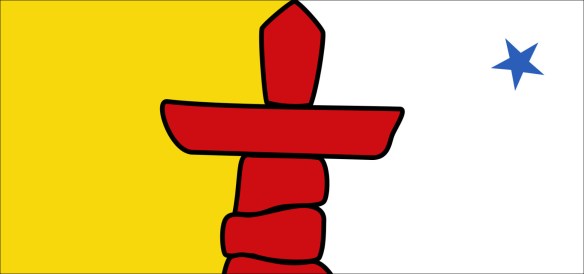
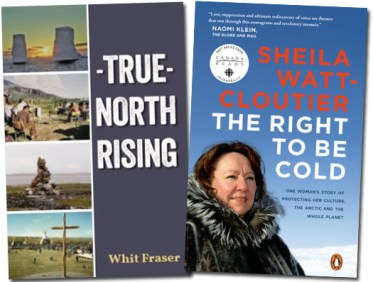 This week, I visited one of the book/craft stores in Iqaluit and purchased two new books: True North Rising by Whit Fraser (
 A final note. There is now a beer store in Iqaluit. Twenty-four
  Click on any numbered site to see details of when paint-out is/was scheduled.
 They mentioned the following objectives:
 In an earlier blog post (
 The next step in my David Manners research has been to track down his writing, after he moved to California, after the second world war. Fortunately, courtesy of Amazon, I am able to order David Morgan Jones (ed) The Wonder within You: From the Metaphysical Journals of David Manners and Awakening from the Dream of Me.
 Manners died in Santa Barbara, aged ninety-eight in 1998. I hope to find them in my mailbox when we return from Iqaluit.
 Yesterday, we held a meeting of the Ernest Buckler Literary Events Society (EBLES) board over on the Bay of Fundy shore. In preparation for the program design for June 29th, it was necessary to read some of the related literature.
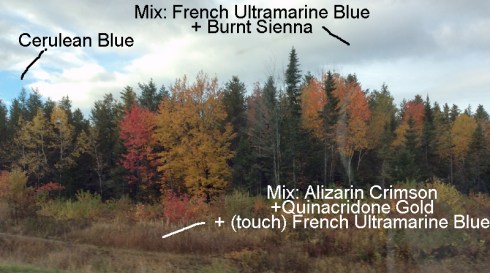 The sky wasn’t just overcast or sunny. The sky was a mix of Burnt Sienna with a touch of French Ultramarine Blue or was a variegated wash from Cerulean Blue to Cadmium Yellow. We were not just engulfed in fall foliage of colours. Hills became brushstrokes of Alizarin Crimson, Quinacridone Gold (I love that colour) and Prussian Blue.
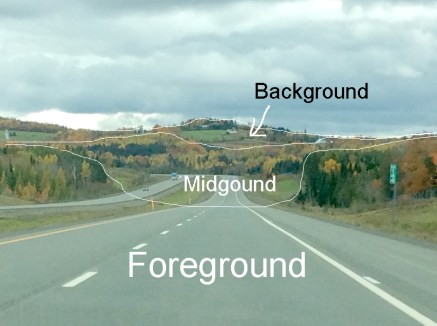 We divided the landscape into zones (foregrounds, mid-grounds, and backgrounds) and described how we would paint aerial perspective, “treat edges” and change tonal contrasts, to give a sense of distance.
 Many times we would identify a focal point in the landscape (almost with “eye-spy-with-my-little-eye enthusiasm) and would suggest ways to direct viewers’ eyes to that point. Would it be the slope of the hills, the line of our winding road, edges of forest stands or the illumination of light breaking through the clouds? How would our favourite artists, or The Group Of Seven treat that focal point?
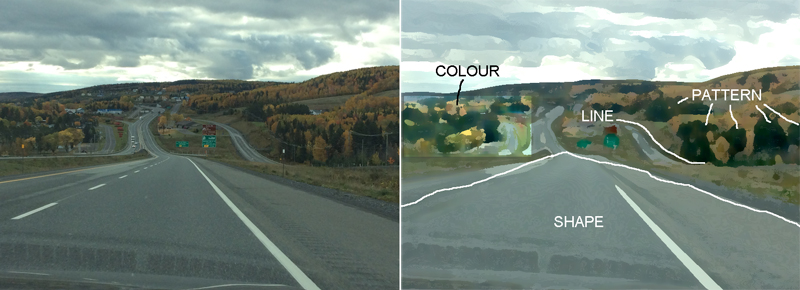 As we drove, we unpacked our landscape NOT in terms of “things” (such as houses, fence rows, barns, silos or cows) but in terms of shape, line, colour, patterns, gradation and composition. We became exhilarated, as artists, to not only view the landscape but to offer ways to interpret the landscape — whether it be as a realist, impressionist or abstract artist — in oils, acrylics, watercolours or inks.
 POSTSCRIPT:
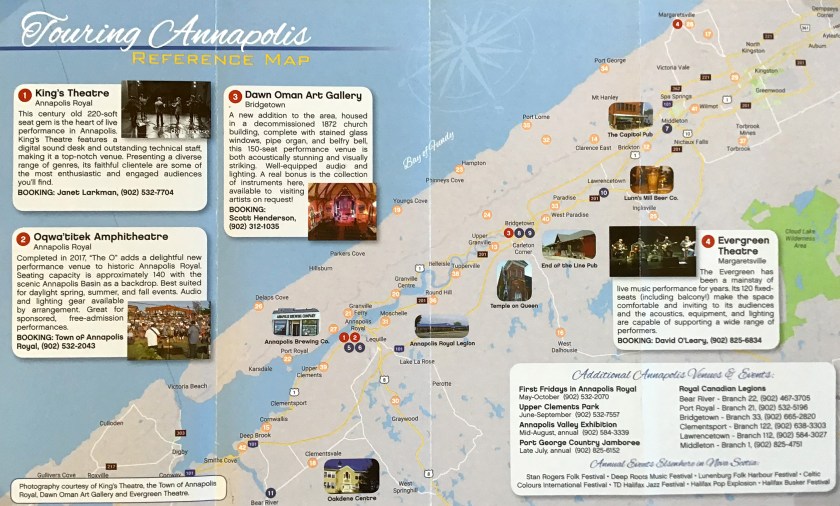 There are several examples of positive outcomes from this relationship e.g. MapAnnapolis, as well as local innovations. This week, I received a copy of Touring Annapolis, Venue guide for Artists produced by
 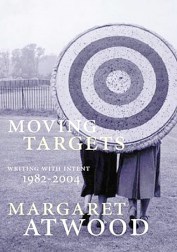 On the Ernest Buckler front, I want to share a couple of books that crossed my desk this week. Margaret Atwood published Moving Targets, Writing with Intent 1982-2004. It includes two essays that struck a chord.
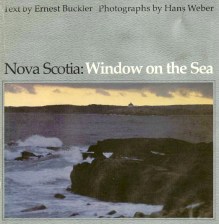 The second book is Nova Scotia: Window on the Sea. It combines a text by Buckler with photographs by Hans Weber. While the text and photography can stand alone, it would be interesting to see a map of the photo locations. The book was published in 1973 – forty-six years ago. Perhaps we need an updated photographic version for the fiftieth anniversary.
 Number #99 was by George Orwell Some Thoughts on the Common Toad. It contained eight essays, including a defence of PG Wodehouse, an examination of Gullivers Travels, and a commentary on Tolstoy and William Shakespeare.
 The Orwell essays complemented my reading of Ernest Buckler. I had the opportunity to read Glance in the Mirror. This quotation caught my eye.
 Ernest Blair Experiment