Sanger in his essay, Groundmass, describes the tidal bore on the Shubenacadie River from the diaries of Charles Lyell and William Dawson (p.83). He also links the phenomena to the Elizabeth Bishop’s poem The Moose p.84.
Last week, we attended a meeting of the Paradise Historical Society. Aaron Taylor gave a presentation on ‘Where did the First People live before the Europeans came? What patterns can be found that might predict these locations in our area?” Aaron described the results of his archaeological research on Paradise riverside land. In particular on the properties of Jack Pearle and David Whitman.
Much of the discussion concerned the location of the tide head on the river. This brings fish species on the tide up into the river valley. Today, of course, we have the tidal power dam on the river at Annapolis Royal. Imagine if we had the same natural conditions today between the Annapolis Basin (Bay of Fundy) and the Annapolis River.
This week, I was able to pick up three books by William Inglis Morse from the Frank Morse library in Lawrencetown. In Acadian Lays and other verse, the poem The Call of the Marsh Hen (p.8)
In creaking flight the marsh-hen flies
Along the old French road, where the vale of Paradise
lies,
And gently down from the ancient hills a rippling stream
Doth wend its way to song and Acadian dream”.
There is a footnote. ‘The location of the old French road is near the confluence of the Annapolis River and the Paradise Brook, Nova Scotia,. The tides, freshets and the lapse of time have practically obliterated this way, leaving only a few traces across the interval of marshy land’.
in Genealogie (p.24) we find a photograph of Burn Brae. It is still recognizable as the house on the Morse Estate.
From his poem, ‘Acadia’ p9.
Land of the dark forest and mountain
And tides that surging flow,
Land of the murmuring pine tree
And the romance of long ago.
Evidence suggests that both the Mi’kmaq and the French Acadians were intimately familiar with the relationship between the Fundy tides and the river systems of Nova Scotia. They located their settlements, permanent or seasonal, to take advantage of the concentration of the fish stocks in the rivers.
Acknowledgements
To John Wightman for sharing his copy of William Inglis Morse Limited Edition book.
Thanks to Edward Wedler for finding the video of the tidal bore on the Shubenacadie River.
References
Peter Sanger.2002. Spar: Words in Place. Gaspereau Press.
Elizabeth Bishop. 1983. The Complete Poems. p 169
William Inglis Morse 1908.Acadian Lays and other verse. William Briggs, Toronto
William Inglis Morse (ed). 1925. Genealogiae or data concerning the families of Morse, Chipman, Phinney, Ensign and Whiting. Nathan Sawyer, Boston. Limited Edition 200 copies.
 In Annapolis Royal at Bainton’s bookstore, I picked up Kent Thompson’s book Getting out of town by book and bike. It is an entertaining read, including the idea: “every now and again, I get on my bike and ride to a small town public library to look for Anna Karenina“. Thompson visits both the towns and writing of Ernest Buckler (Centrelea, West Dalhousie) and Elizabeth Bishop (Great Village). Writing of both EBs is of interest to me, and likely, to Nova Scotia.
 In this same spirit, Heather was reading Waterfalls of Nova Scotia. It describes one hundred waterfalls. Number #19 is Eel Weir Brook Falls up behind Lawrencetown on South Mountain. While a short hike, it gave us an excuse to ‘get out of town’.
 What did I hear? A number of stories, about pilot projects in Atlantic Canada. Specific Nova Scotia examples included the Cape Breton Food Hub, Energize Bridgewater. For import replacement, there were successful models in the UK (Preston, Lancashire) and in the USA (Cleveland). The concept is to replace the demand for goods and services by 10% (or more) by local procurement.
 Examples of local need and local producers included:
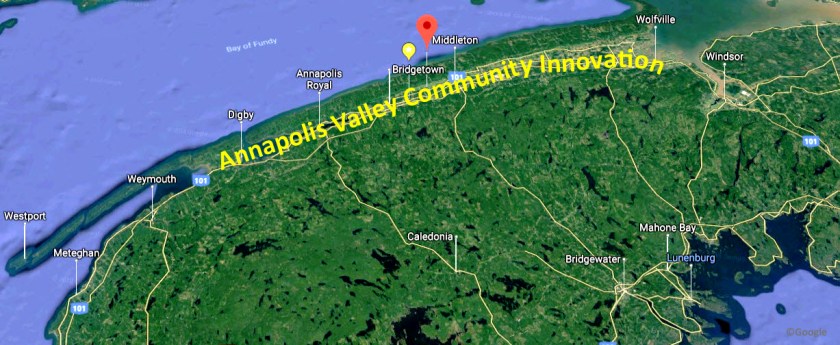 First, in last week’s Annapolis Spectator there was an interview with Bill Crossman about a project to install solar panels at the Centrelea Community Hall site. Second, at the latest Valley REN (Regional Economic Network) board meeting, Gerard D’Entremont was appointed Vice-Chair of the Board. In his introduction, Gerard described his position at (Nova Scotia Community College) NSCC Kingstec as the Community Innovation lead for the Annapolis Valley region. Intrigued, I requested a meeting this week with him at the Green Elephant in Kingston to learn more about this initiative.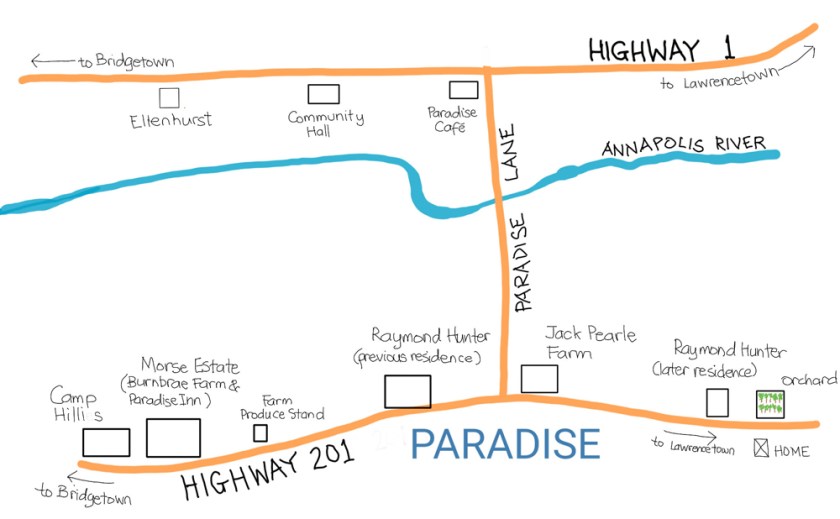
 It is awesome to imagine an event at Burnbrae Farm and Paradise Inn that looks at Buckler’s book The Cruelest Month in its modern context. Ideally, in April, which Buckler defined as the cruelest month. Now, its time to re-read the book.
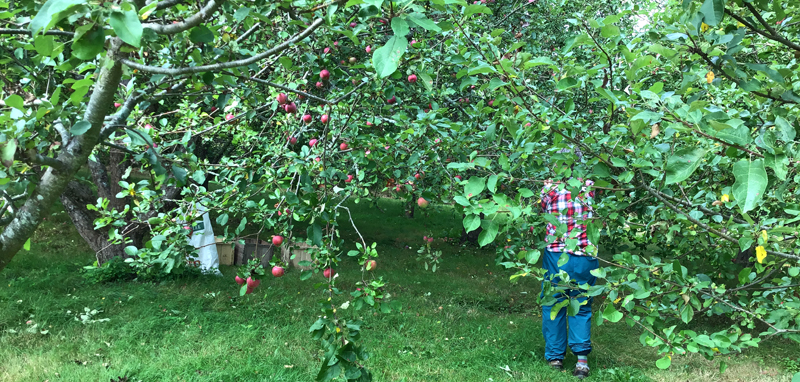 After a week in the orchard picking apples with ladder, picking bag and hook, I can appreciate the pleasure gained from low hanging fruit. However, it should be recognized that the best apples are found in the top branches of the tree. The low hanging fruit tends to be found on the side branches; smaller apples, more of them, but easily available for hand picking. There is no need for the combination of technology: ladder, picking bag and hook.
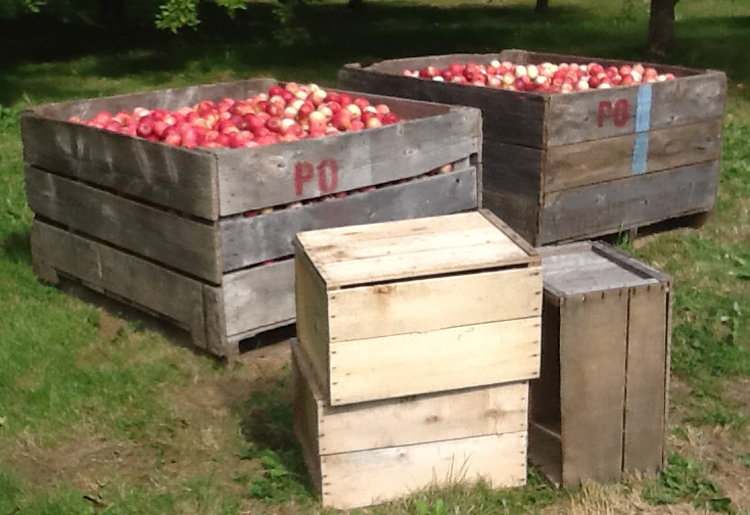 At the end of the week, we were able to celebrate ten bins shipped to Brian Boates for juice that will be a component of
 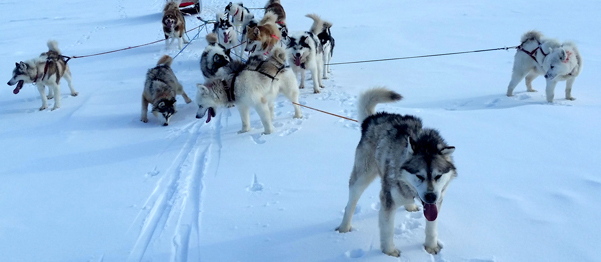 For the last few years, every Summer, we have provided a holiday camp for two retired Inuit sled dogs: Uke and Siq Siq. They were part of a litter born in Pond Inlet, Nunavut about twelve years ago, under the watchful eye of my son, Andrew. Later, they went to Prince George, where they provided Patrick, my eldest son, with the pulling power for ski-joring. They arrive in Paradise, in May and usually return home by early September.
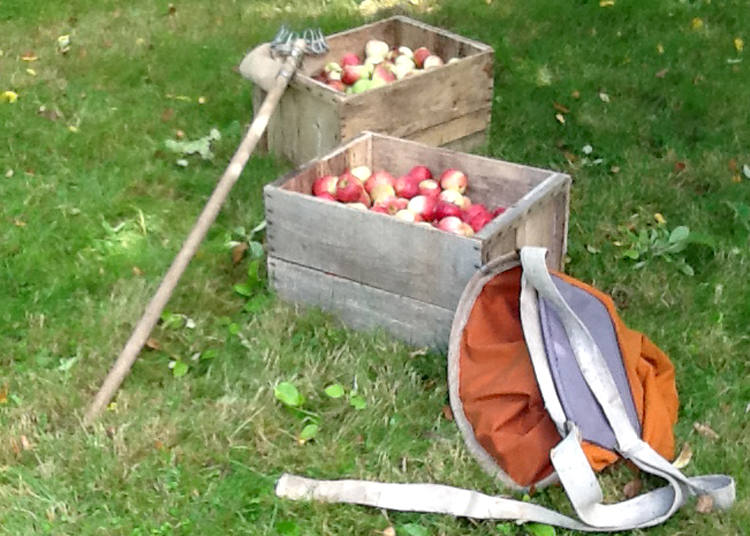 In the Valley, a late frost in early June impacted many of the apple growers in the region. Fortunately, for us, Raymond Hunter planted his trees in a tree protected area. This has allowed us to ship the early drops to Brian Boates in Woodville. Now we have started picking directly from the trees. The first cycle will be the Nova Mac variety, to be followed later, by the Mac Free. All of these organic apples will be juiced at Boates cider mill and then transported to Ironworks Distillery, Lunenburg as a key ingredient in their apple brandy. If we have a spell without too much rain, we should be able to pick a couple of bins per day. (note: one bin can hold between 18-20 bushel boxes).
 In the latest issue of Saltscapes, two articles caught my attention. Jodi DeLong reviewed Sandra Phinney’s book ‘Waking up in my own backyard. Explorations in Southwest Nova Scotia. Or as DeLong titled her article ‘ Celebrating our own spaces’
 There, I discovered:
