Six years ago I proposed a real-time, interactive, contact heat map to track deplaned passengers from flights arriving into Nova Scotia (contact tracing). The idea, in fact, could have been applied anywhere to track the movement of (potentially) virus-infected people.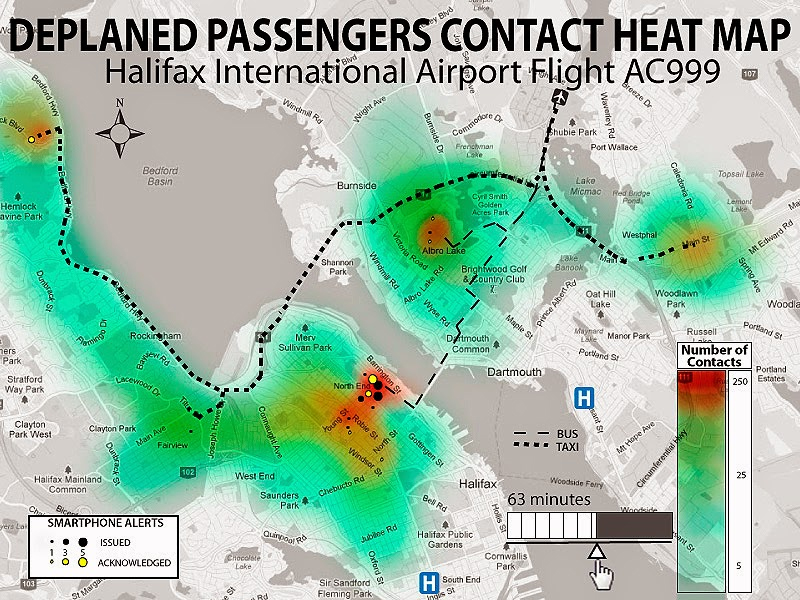
By October 2014, 4,500 people had died from a recent Ebola global outbreak. We had, in Canada, experienced H1N1 (Asian Bird Flu) and SARS. The SARS outbreak of 2002-2003 killed 800+ people worldwide and killed 44 Canadians. In our current CoVid-19 outbreak, Canada has suffered 300+ deaths to date. More Canadians have now died from COVID-19 than SARS. Viruses know few boundaries. Deadly viruses such as Ebola, MERS, SARS, Asian Bird Flu (H1N1) and COVID-19 can easily spread with today’s travel. Forensic Studies have shown that viral outbreaks mirror air travel.
“The role of mass air travel in the recent worldwide spread of a number of diseases … has been documented, analysed and discussed by transnational and governmental agencies … clinical practitioners … and academic researchers.” (ScienceDirect)
My proposed interactive map rests on the emergence of the Internet of Things (IoT), G5 cellular technology and Artificial Intelligence, where we can respond to contact and movement and predict a possible outbreak brought in by deplaned passengers from an airline flight; possibly offering a public alerts/warning system. This complements the arduous task of forensic tracking of people’s whereabouts.
Could future technology seek, track and map, in real-time, when and where infected people might come into contact with others and with sensor-embedded objects (taxis, other cell phones, public venues, stores, farm animals, etc.)? Can we react faster and more judiciously to these outbreaks and forecast/model viral outbreaks due to deplaned passengers and crew and their contacts? How can we balance privacy rights with public health needs?
A recent article notes that a team led by MIT researchers are working to do contact tracing using Bluetooth technology while retaining privacy.
References
Science Direct, Airports, Localities and Disease. July 2010.
TechXplore. Kelly Foy (MIT). Bluetooth Signals from Your Smartphone, 09 April 2020.
Postscript
Apple and Google just announced a joint effort to fight COVID-19 via Bluetooth contact-tracing technology.
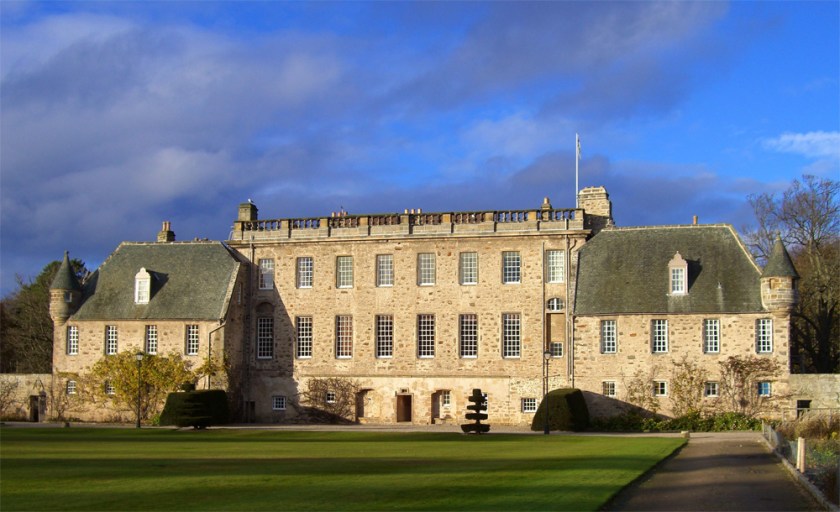 Waddell inspired Prince Charles, then a student at Gordonstoun School, to paint in the 1970s. As a result of that inspiration, Prince Charles has become one of the UK’s most successful living artists, where he paints en plein air (outdoors) and exclusively in watercolours, according to
  The
The  connections could be made with performing arts, considering … the rich arts culture in the region, Annapolis Royal’s historical link to “
 Anne and I arrived in Halifax by plane in the wee hours of last Saturday and were instructed by border officials to self-isolate for 14 days. We had returned from our stay in Bradenton, Florida. I read the interesting article Bob’s brother, Peter Maher, sent
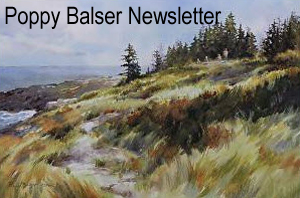 In these turbulent times, I notice how people are, lately, appreciating the little things in life. One of my favourite artists,


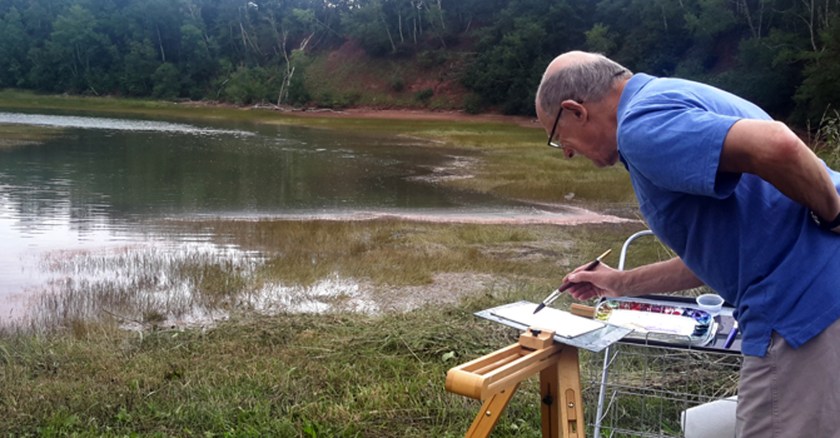
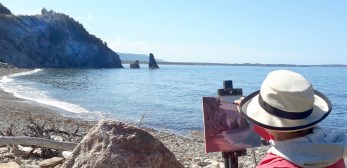 While painting Pillar Rock from Presqu-île, near the southern part of the Cape Breton Highlands National Park, we noted dozens of visitors come for a few minutes to snap photos then move on. Did they see the otters swim the nearby pond? Did they note how the sun lit up the rocky shoreline as it rose above Jerome mountain? Did they hear the high-pitched piping notes of the eagle?
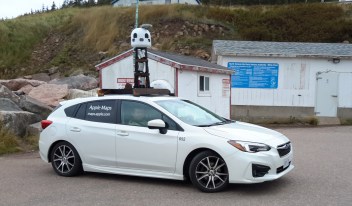 At the other extreme, we were greeted several times by the “
 Click on any numbered site to see details of when paint-out is/was scheduled.
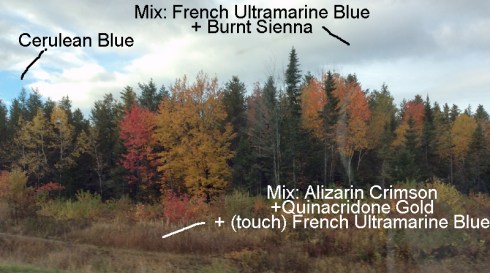 The sky wasn’t just overcast or sunny. The sky was a mix of Burnt Sienna with a touch of French Ultramarine Blue or was a variegated wash from Cerulean Blue to Cadmium Yellow. We were not just engulfed in fall foliage of colours. Hills became brushstrokes of Alizarin Crimson, Quinacridone Gold (I love that colour) and Prussian Blue.
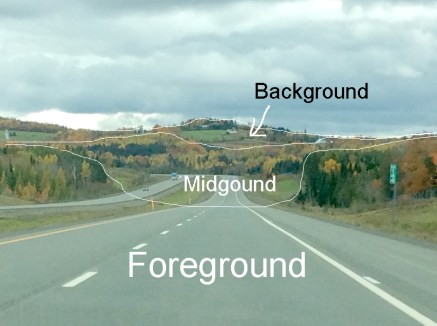 We divided the landscape into zones (foregrounds, mid-grounds, and backgrounds) and described how we would paint aerial perspective, “treat edges” and change tonal contrasts, to give a sense of distance.
 Many times we would identify a focal point in the landscape (almost with “eye-spy-with-my-little-eye enthusiasm) and would suggest ways to direct viewers’ eyes to that point. Would it be the slope of the hills, the line of our winding road, edges of forest stands or the illumination of light breaking through the clouds? How would our favourite artists, or The Group Of Seven treat that focal point?
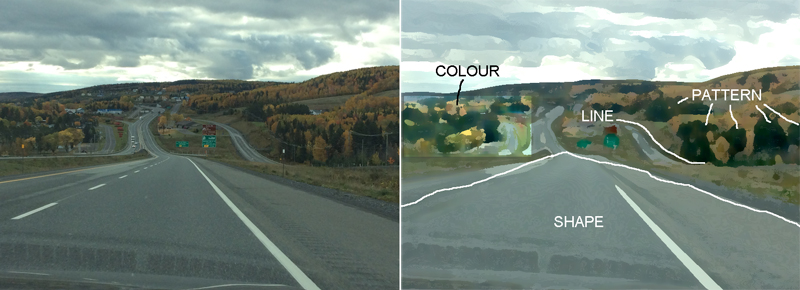 As we drove, we unpacked our landscape NOT in terms of “things” (such as houses, fence rows, barns, silos or cows) but in terms of shape, line, colour, patterns, gradation and composition. We became exhilarated, as artists, to not only view the landscape but to offer ways to interpret the landscape — whether it be as a realist, impressionist or abstract artist — in oils, acrylics, watercolours or inks.
 POSTSCRIPT: