With a lifetime of books in the basement, I am trying to determine which ones are ‘sustainable publications’ and those categories of books that are no longer necessary.
This set me thinking about newspapers and magazines. In the category of ‘sustainable’ I would include the weekly, Bridgetown Reader, and monthly, The Grapevine.
This week, we have learned that there will be a recount for the two Liberal ridings held by Zach Churchill and Carman Kerr (see Close Race).
For my last blog, I sent Edward three photographs from the Rotary Riverside Park in Middleton.
They showed the memorial tree placement,
the yoga stations
and the watch that Heather found on the trail and placed on a tree (shown circled). This is consistent with the treasure-hunting theme (see Treasure Hunting).
Acknowledgement
Heather, likewise, has a significant collection of sustainable publications. Edward added the photographs.
Saturday was a dreary wet day. In The Reader, I noticed a book signing at Endless Shores in Bridgetown. It was a good excuse for a short drive. We met Cate Wilding. She lives in Port Lorne and has written three novels.
While at the bookstore, I picked up a flier ‘Great Reading Ideas for the Holidays’. It features Allison Maher’s “The Last of Firsts“, DJ Wiseman’s “Cara Rosa” and Sheila Graham-Smith’s “The View from Errisbeg“.
This set me thinking, about the relationship between authors and landscape and goes back to my abiding interest in Ernest Buckler and ‘The Mountain and the Valley’ (read my post The Mountain and the Valley).
What is the relationship between ‘place’ and our perception of ‘geography’?
Given the physical location of COGS (The Centre of Geographic Sciences) in Annapolis County, would there be merit in a book on ‘The Geography of Annapolis County’? (see earlier post Geobiography and the Annapolis Valley)
How would I define Geography?
Going back to my days at the University of Birmingham, it would include: Physical Geography: Geomorphology, Biogeography, Climatology. Economic Geography: Transportation, Settlement Infrastructure, Land Use Resource Management: Agriculture, Forestry, Mining, Fishing. Historical Geography, Regional Geography plus the various methodologies: Cartography, GIS, and Remote Sensing.
Saturday evening, I shared my thoughts over a beer with John Wightman. In particular, I was interested in the different trajectories of the towns: Annapolis Royal, Bridgetown, and Middleton, and the lack of a coherent vision.
John, correctly, expressed a concern that today, rather than think in terms of a book, we need to think in terms of an ‘online electronic presence’.
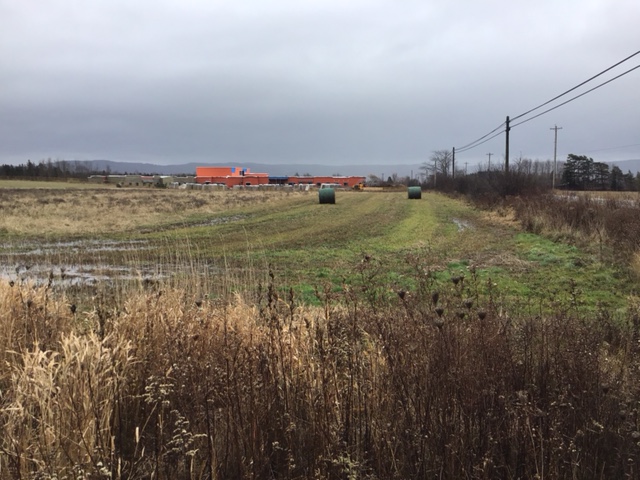
This led me to Bridgetown on a rainy Sunday afternoon. I wanted to photograph the site of the new building at Mountain Lea Lodge.
Photo by Bob Maher
What are the implications for the economic development of Bridgetown? If the Liberal party was successful in the provincial election, would we see a new hospital in town? Could Bridgetown become a centre of excellence in the long-term care for the elderly and infirmed? Would this attract a new generation of healthcare professionals to the Annapolis Valley? Would they be interested in understanding the Geography of Annapolis County? Would this expand the course offerings and the student population at the Annapolis Campus of the NSCC?
This weekend, we visited New Glasgow. I took time out to visit the Coles bookstore at the Highland Mall.
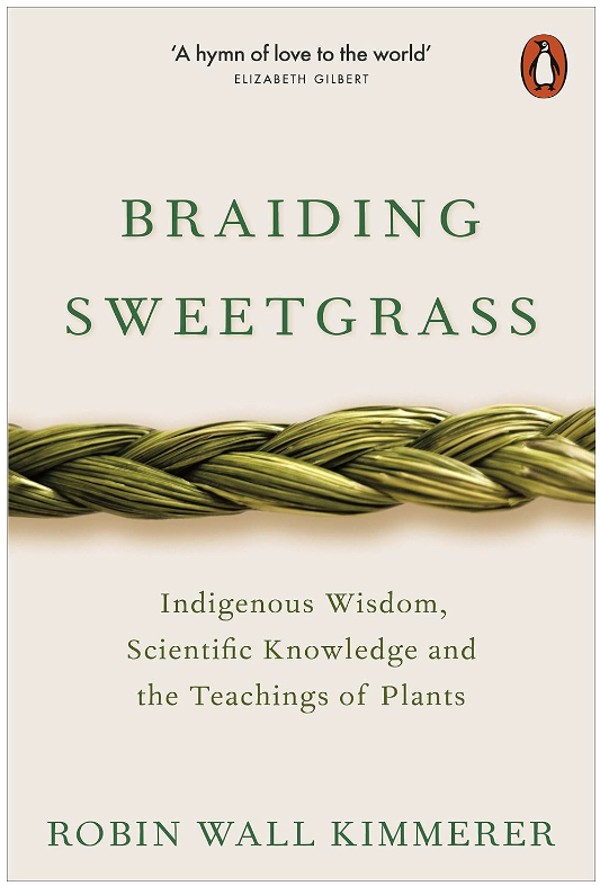
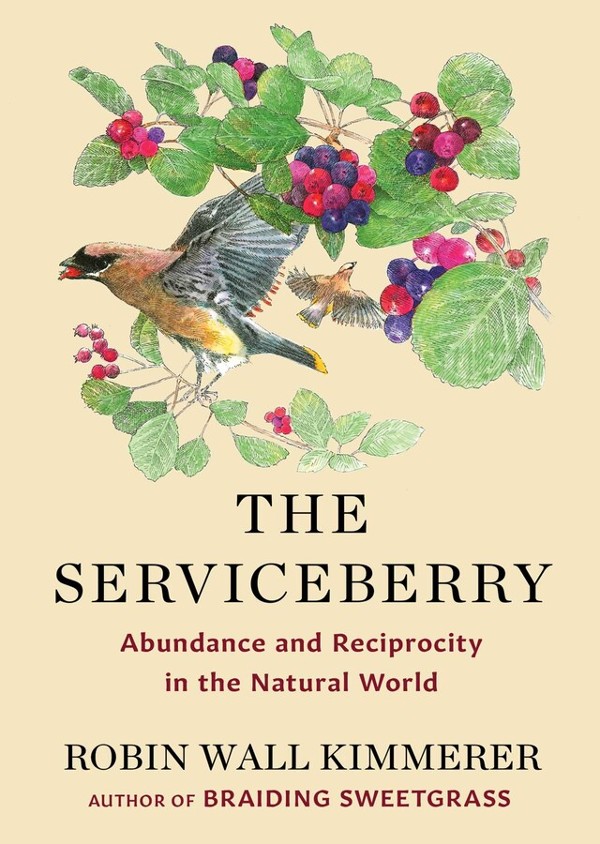
Fortuitously, I found a new book by Robin Wall Kimmerer, author of Braiding Sweetgrass.
The new book, The Serviceberry is a short but uplifting read on Abundance and Reciprocity in the Natural World.
As Kimmerer explains:
“ Serviceberries show us another model, one based on reciprocity rather than accumulation, where wealth and security come from the quality of our relationships, not from the illusion of self-sufficiency.”
We also enjoyed our Saturday evening with John watching PBS on the TV. It included ‘As Time Goes by’ and ‘Doc Martin’; both examples of community life in London and Southwest England. Given the programs come from Maine, it is easy to imagine the similarity of landscapes between rural Canada (Nova Scotia) and rural New England.
The emphasis, in both cases, is upon our sense of community.
Acknowledgements
Heather and I continue to enjoy the vibrant colours, especially the tamaracks, as we drive through the Rawdon Hills.
References
Robin Wall Kimmerer, 2024, The Serviceberry, Scribner/Simon&Schuster.
On Sunday we had a beautiful, blue sky day. Heather and I decided it was a day for a walk in Kejimkujik National Park.
Early, we headed down Highway #8. Our destination was the Peter Point Trail. It was a delightful six kilometer stroll. The trail was covered in pine needles. The yellow, orange and red deciduous leaves were stunning.
Afterwards, it was time for a different route home. We headed down to South Brookfield, where we turned east on Highway #268, and cross-country through Pleasant River-Compton-Hemford-New Germany. At. New Germany, we turned North on Highway #10 to Middleton.
Two observations on the day:
The colours on November 13 in rural Nova Scotia were fantastic because of the mix of hardwood tree species.
The landscape mosaic of rural Nova Scotia is remarkable. If only, we would follow the practices of sustainable forestry.
This weekend, I received an inter-library loan notice from the Middleton library.
Jack Dangermond at Esri had recommended Our Towns by Jim and Deborah Fallows. A 100,000-mile journey into the Heart of America. A quick glance took me to the chapter on Redlands, California (also see the video in my post West Dalhousie Visit).
Redlands is the home town of Jim Fallows. It is also the headquarters of Esri and home town of Jack and Laura Dangermond.
We went with our young family to Redlands in the late ’80s. I had spent the early ‘80s designing and delivering new programs at COGS. After a year with EMDI in Jakarta, we landed in Redlands. Heather took graduate courses in Biology at the University of California, Riverside.
Thank you Jack for the reference, and the opportunity to spend time in Redlands., your town.
Reference
James and Deborah Fallows, 2028, Our Towns, Pantheon Books.
Acknowledgements
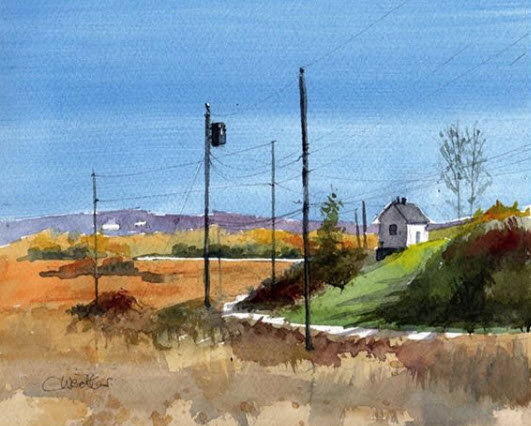
Head of Chezzetcook intertidal area painted in watercolour by Edward Wedler
Thank you , Edward. I know you were able to paint and capture the colours of the Nova Scotia landscape this weekend.
Last weekend, after our French Basin trail walk, we stopped at Mare Gold bookstore in Annapolis Royal (see also An Author’s Market). It is a real treasure. Heather found a book on botanical illustration. I saw a couple of interesting titles but decided to hold off. Why?
a) do we really need more books? b) managing two houses is a financial burden.
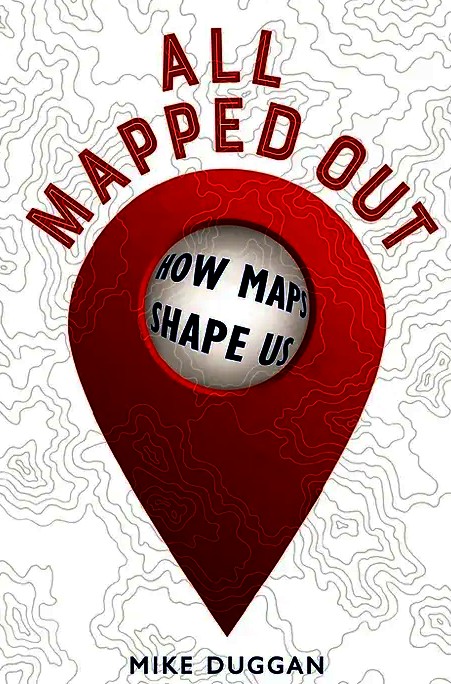
Later, I went online and researched Mike Duggan, Kings College, London.
The end result was that we returned to Mare Gold on Wednesday. I picked up two books.
From the back cover of Muir. Robert MacFarlane. “No other writer is so ceaselessly astonished by the natural world as Muir, or communicates that astonishment more urgently.”
From the back cover of Duggan: “Mike Duggan asks questions of our present reliance on digital mapping: how the technologies subtly pervade our lives, condition our consumption habits and even shape our experience of the world,” Veronica Della Dora, Professor of Human Geography, University of London.
For myself, it is a marvel that I can discover these books so close to home (Middleton to Annapolis Royal). Given my interests in ‘all things geographic’, I struggle with the impact of technology: GPS, and Google Maps. Duggan helps to put it in perspective. He also introduces me to happenings on the other side of the Atlantic, and authors like Phil Cohen, and Livingmaps Network.
Both Edward, and myself, appreciate and enjoy this perspective on our world. Do pay a visit to Mare Gold. They offer a unique resource in the region.
Saturday, it was time to step out of the Valley. We had not driven down Highway #10 to Bridgewater this Winter. I wanted a change of bookstores. After a short stop in Mahone Bay, we found ourselves at Block Shop Books in Lunenburg.
Of course, we did not leave empty-handed.
I found Rebecca Solnit’s A Paradise built in Hell.
Heather found Annie Proulx’s Fen, Bog and Swamp.
The last Solnit book, for me, was Orwell’s Roses (see post Orwell’s Roses, and Orwell’s Roses Part 2). Here we are a few years later – still living in Paradise – seeking optimism from the “extraordinary communities that arise in disaster” – will they include rural Nova Scotia?
Heather stayed closer to her roots with “a short history of peatland destruction and its role in the climate crisis”.
From the previous two blog posts (The Question and The Secret), I am looking for The Answer. Does it lie in Paradise? Or in the words of Bill McKibbon “The freshest, deepest, most optimistic account of human nature I’ve come across in many years“.
Acknowledgements
Edward continues to step up to the challenge. Heather remains closely connected to our garden, the greenhouse and the surrounding woodlots.
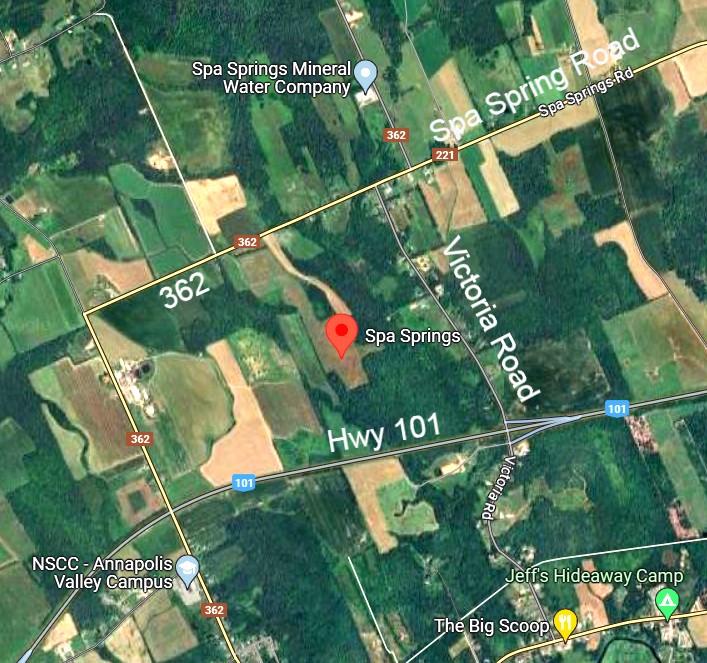
Before reading, we ventured to Spa Springs. We came from the Margaretsville side. I remembered the Vault Road, from the time when we lived in Clarence in the 1980’s. This time we found the Spring Bottling plant.
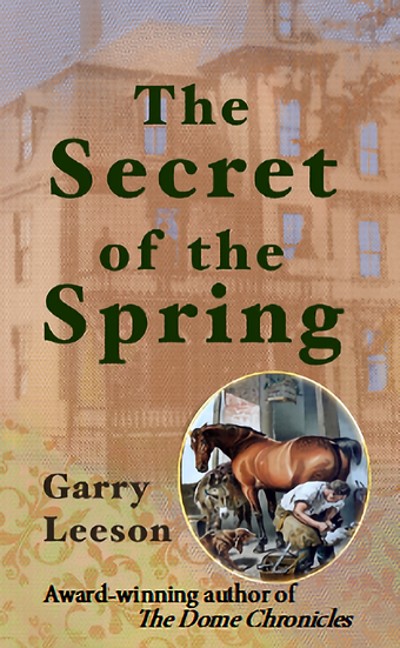
After reading Leeson’s book. I need a return trip to appreciate the location of the Spa Hotel, as well as the actual Spring. That will be another day.
What I gained from Leeson was how through historical research, it is possible to create a sense of livelihood, lifestyle over several decades in rural Nova Scotia.
It also generated an interest in Historical Geography. How much geographical fiction exists in the mountain and the valley? This will lead to my reading Leeson’s The Dome Chronicles describing the ‘back-to-the-land movement in the 1960’s and 1980’s.
After checking with Paul Colville, I made a side trip to The Inside Story. Not only did I find the Dome Chronicles, but also I discovered Dan Johnson’s Ashes, the sequel to the Secret of the Spring. A great success!
Acknowledgements
Paul Colville helped me locate Leeson’s books. Heather shared the drive through Spa Springs. Edward added the graphics.
At Endless Shores, I picked up Patti Callahan’s Becoming Mrs Lewis. This was for Heather, as a follow-up to last week’s movie ‘Freud’s Last Session’ (see post Busy Wednesday). Joy Davidman became the wife of C.S.Lewis.
While looking for brown bread at Bees Knees, I discovered David Suzuki’s The Sacred Balance: Rediscovering our Place in Nature. It was a revised edition. I recall reading the original years ago. This time, I forwarded it to Patrick in Peterborough, as a belated birthday present.
I finished the draft abstract for my talk for June’s CSRS conference in Halifax (see post 50 years of Remote Sensing and GIS at COGS). I continue to research and receive links on the use of AI and GIS.
Michael Goodchild, my graduate supervisor at UWO sent a link to a conference at UC Santa Barbara, last December, in part sponsored by Esri. Edward Wedler sent me another link via email, ‘Bayanat, Geospatial and AI’. For both Edward and myself, we wonder what is required to prepare COGS graduates in these new technologies.
Meanwhile, Heather and I had a micro-adventure on our property, snow-shoeing along the powerline and following the west property line — a good two hour work out on crusty snow.
Acknowledgements
Thanks to Michael Goodchild and Edward Wedler for forwarding the links between AI and GIS. Heather shared the micro-adventure snowshoeing.
This Wednesday evening (Feb 28) Arts for Life in Annapolis Royal, Kings Theatre 7pm, shows Films Celebrating the 40th anniversary of ARCAC and ARTSPLACE and Annapolis Royal’s Rural Renaissance.
It is a very thorough history of democracy in Canada and its impact on Maritime Canada. One quotation early on caught my eye.
”British-inspired political institutions are spatially blind because it suits England’s history and national character because England is a unitary state – and because its main political cleavages have not been around geography. Being spatially blind in England is one thing. Being spatially blind in Canada is quite another.” p.16.
Am I the blind leading the blind?
On the weekend, Heather and I snow-shoed through Andrew’s old property down to the Annapolis River, and then across to the Lawrencetown tree nursery. This reminded me of the potential at Lunn’s Mill. It is next door to the tree nursery. After snow-shoeing or cross-country skiing, one could return to the warmth of the brewery restaurant. Yet another micro-adventure (see post Explore Local).
For Valentine’s Day (my birthday) we will check out the fare at the Green Elephant in Kingston.
His publication, ‘Identity Matters‘ is a collection of short stories. Some stories are set in Fundyville (aka Wolfville). Others are set in the mountains in British Columbia.
Lewis raises questions about identity and the effects of ‘place’. Given we have just spent two weeks in BC (Port Moody and Rossland). It proved to be a very thought-provoking read.
Aside from the references to the familiar geography of the Annapolis Valley, the descriptions of BC mountain culture – skiing, climbing and cannabis culture seemed very accurate.
It is somewhat insightful to realize the difference between North Mountain/South Mountain life in the Annapolis Valley and the concept of mountain life in West Kootenay, BC.
The ‘mountain’ landscape of Nova Scotia is much easier for our generation than the mountain landscapes of British Columbia.
I found the most poignant short story to be #14, A Father’s Diary. It is a description of an avalanche accident in Revelstoke. Lewis quotes, Group of Seven painter, JEH MacDonald as an epitaph:
” He lived humbly but passionately with the wild. It made him brother to all untamed things of nature. It drew him apart and revealed itself wonderfully to him … and it took him to itself at last.” p.150.
This was epitaph to artist Tom Thompson, drowned accidentally in Canoe Lake, Algonquin Park, Ontario, even though he was an expert canoeist and swimmer.
Lewis uses the concept of identity in many different ways, however in all cases ‘the real question defining Canadian identity is not ‘who are we?’ but ‘where is here?’; from renowned Canadian thinker, Northrop Frye.
Acknowledgement
Heather shared the BC adventure. She is now reading, Identity Matters. Edward has just returned from Florida, arriving in a snow storm.
Reference Roger C. Lewis, 2017, Identity Matters, Custom Books Publications
POSTSCRIPT
Anne Wedler’s plein air oil painting, “Achray” and Edward Wedler’s watercolour, “Achray Stone House” were created close to the sites of Tom Thomson’s paintings in the Algonquin Park (see their Footsteps East Map paint-out site 46).
(Left) “Achray” plein air oil painting by Anne Wedler (Right) “Achray Stone House” plein air watercolour by Edward Wedler









 Ernest Blair Experiment