Posted in Event Review

Background story to the COGS and CCA relationship

I was an instructor at NSLSI from 1980-1988. Later, I returned to the NSCC as Senior Research Scientist at AGRG from 1999-2011. This blog explains some of the background behind the creation of COGS and its relationship to the CCA. For more details on the history of COGS go to thestoryofCOGS.castoryOfCOGS

In 1980, the Nova Scotia Land Survey Institute (NSLSI) was providing practical training in surveying, photogrammetry and cartography. My arrival coincided with a new program to teach Scientific Computer Programming. John Wightman had recognized the need for the new technology. We acquired a PRIME  mini-computer system. The intensive 48-week program emphasized the application of computer software. As a Geographer with a background in Biogeography and Computer Mapping, I was keen to find software that would run on PRIME. After a short search, I discovered Esri. We initially installed PIOS and GRID; later we were an early adopter of Arc/ Info.

In 1986, with input from Roger Tomlinson, Ray Boyle and others, the decision was made to change the name of NSLSI to the College of Geographic Sciences. By this time, we were offering an advanced diploma in GIS. As Esri Canada was selling new systems, they would come to COGS to recruit trained technical staff.

In 1987, there was a demand to offer a GIS Summer Institute. We matched up graduating students from the GIS program with new Geography university faculty interested in teaching the technology. CCA supported the Summer Institute. We brought in Tomlinson and Goodchild from Ontario. This was before  Michael headed to UCSB as part of the NSF funded National Center for Geographic Information and Analysis (NCGIA).

Attendees included Peter Keller, Brent Hall, Norm Drummond, Stephen Reader, Chris Gold, Simeon Roberts, Roger Wheate and others. It was a success and repeated a second time. Now over thirty years later, COGS and CCA are working together again. COGS is now the Centre of Geographic Sciences, as part of the NSCC.

Returning this year will be Michael Goodchild, Bob Maher, John Wightman, Roger Wheate plus faculty and ex-faculty from COGS, Dave Raymond, Mike Donnelly,  David Colville and Roger Mosher.
Plus a number of Esri employees.

We all look forward to John’s lobster boil on the Bay of Fundy.

Posted in Event Review, New thinking

Glimpse of a new economy

Saturday night, we were treated to Nature Night at Sugar Moon Farm. sugarMoonNights
Supper was pancakes, sausage, beans, blueberries and maple syrup. Sugar Moon Farm is an excellent example of value-added forestry products. For dessert, we had four talks related to private woodlot management. The audience was about forty persons. The introduction was provided by Matt Miller, followed by his father, Tom, President, The Friends of Redtail Society; Dale Prest from Community Forests International and then Greg Watson, North Nova Forest Owners Co-op.

The Friends of Redtail Society offered the following philosophical position ‘ The Land: from Commodity to Community’,  based on the Aldo Leopold quotation:

“We abuse land because we regard it as a commodity belonging to us. When we see land as a community to which we belong, we may begin to use it with love and respect”

Dale Prest described the concept of climate forests as a new paradigm for rural economies, where the forest is managed to capture and store additional carbon. Outside Sussex, New Brunswick, Community Forests International manages 705 acres. It provides a model for the purchase of carbon offsets. They have a two-pronged approach: privately-owned climate forests and community-owned climate forests. Recently, they have established a for-profit Climate Forest company.

Greg Watson explained the history of North Nova Forest Owners Co-op. Today they have 286 members and manage 69,600 acres. Greg used GIS to illustrate the distribution of these clients over time across Northern Nova Scotia. He also showed the application of new GPS and GIS technology by the contractors who are undertaking ecosystem-based management. The co-op manages the relationship between the local contractors and the woodlot owners.

It was a very positive evening. It showed how the next generation of forest managers are working with woodlot owners in the Maritimes. This offered a stark contrast to the current litany of media reports on clearcutting of crown lands in Nova Scotia.

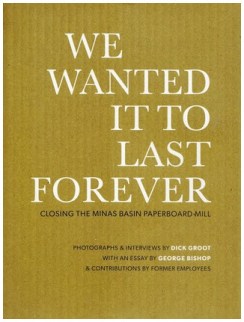
Last Thursday afternoon, we visited Dick Groot’s photographic exhibition at the Cedar Centre in Windsor. it is entitled Closure: a photographer’s eye on an old economyclosureDickGrootThe four closures were Windsor Wear, Fundy Gypsum Company, Britex and Minas Basin Paperboard Mill. The last closure is also described in a separate book, We wanted it to last forever. It includes both photographs and interviews with former employees at the mill.weWantedItToLastForever

In the Closure Epilogue, Dick is optimistic about the new economy.

” Here in Nova Scotia, we have seen significant growth in the wine producing industry where supporting research is being introduced in several universities and colleges. We also have the College of Geographic Science in Middleton, a truly world-class institution that can support a vast range of environmental and infrastructural enterprises and governments”.

( Indeed, the College of Geographic Sciences, now the Centre of Geographic Sciences, is in Lawrencetown. Middleton is the site of the Applied Geomatics Research Group and the Environmental and Agricultural Technologies Lab)

“Therefore I am optimistic for re-building the economy in a more sustainable, diversified manner than we have done in the past, based on a merging of existing competencies with a new digital world.”

My interpretation of these two events is as follows. There is an optimistic vision, following Friends of Redtail Society, based on community rather than a commodity. It can be applied to the land and the sea. It respects the changing climate. There are ways to combine ‘boots on the ground’ with ‘eyes in the sky’ to convert ‘problems’ into ‘opportunities’. This was well-illustrated by the talks from a single sector, Forestry, at Nature Night in Earltown. We also know that small-scale manufacturing in rural communities will not last forever, especially if they are dependent on external investments and the fluctuations in the global economy.

Afterthoughts.

I am concerned about the concept of ‘carbon offsets’. This seems to be yet another reductionistic idea. Reducing the complex forested landscape to carbon; carbon then becomes the commodity. This warrants more thought and a deeper understanding.

References

Sugar Moon Farm. https://www.sugarmoon.ca

Friends of Redtail Society www.friendsofredtail.ca (Tom Miller)

Community Forests International forestsinternational.org (Dale Prest)

North Nova Forest Owners Co-op Ltd. www.northnovaforestry.com (Greg Watson)

Dick Groot. 2018. Closure. A photographer’s Eye on an Old Economy. Gaspereau Press.

Dick Groot. 2015. We wanted it to last forever. South of the River Publishing.

Posted in Creative writing, Event Review

The Five Little Pigs

Do you remember the children’s’ nursery rhyme ‘ The Five Little Pigs’? Counted out on the toes or fingers of the child.

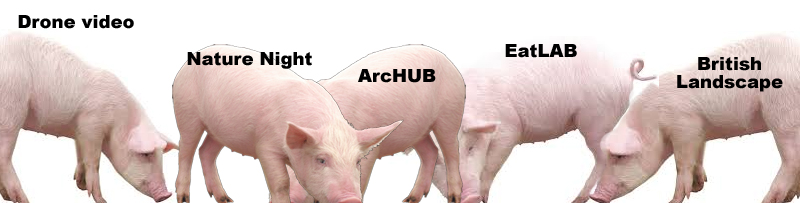
“This little pig went to market. This little pig stayed home. This little pig had roast beef. This little pig had none. This little pig went wee-wee all the way home.’ Here are my five little pigs.5pigs

  1. new drone video from Neil Green of forest cutting above the Inglisville road. You can compare it with the video shot in January.
  2. This Saturday evening there is Nature Night at Sugar Moon Farm. It includes talks by Dale Prest, Community Forests International, Greg Watson from North Nova Forestry Co-operative (NNFC) and Tom Miller, Friends of Red Tail. The event is designed to engage Nova Scotia’s small private woodlot owners in the fight against climate change. We are members of the NNFC and will attend.
  3. David MacLean at COGS sent me a link to the work of Scott Morehouse at Esri on ArcHUB. This is of interest for two reasons. ArcHUB is an industry-driven approach to the Community Information Utility concept. At the end of the article, there is a link to a video where Scott describes his early beginnings in GIS. This time frame coincides with the history of COGS.
  4. Yesterday I bumped into Wayne Regier. Wayne worked with me at AGRG.  He explained that there is now the EAT lab at NSCC, Middleton. EAT is Environmental and Agricultural Technologies.  There is the likelihood that the climate network established by David Colville will be extended across the province. This makes tremendous sense in the light of climate change. Secondly, the Lab is using drone and soil sensor networks to monitor the condition of vineyards in the province. Both excellent, supportable initiatives.
  5. Finally, I have now finished Nicholas Crane ‘s book The Making of the British Landscape. I have been lugging this tome around for the last month or so. It covers the last ten thousand years. In the last chapter, Crane talks about the changes in the British urban landscape over the last hundred years, post the industrial revolution and post the second world war. It reminded me how much land use is impacted by our industrial economy. This linked, in my mind, to Closure, Dick Groot’s photographic exhibit in Windsor on the demise of manufacturing in Nova Scotia. I plan to see his exhibit this Friday at the Cedar Centre in Windsor.

These are my ‘five little pigs’. I shall be able to report back on #2 and #5 next week. I have started to read Simon Winchester’s book. Unfortunately, the style is rather pedantic; however, I shall persevere, because I am interested in the field work necessary to produce that first Geology map of the United Kingdom. I think that I now understand why I could go to two second-hand bookstores and find the same book!

Not exactly sure, what the symbolism might be about those five pigs.

REFERENCES

Neil Green video link https://youtu.be/_X78Ei38_Wo

Nature Night at Sugar Moon Farm https://www.sugarmoon.ca

Link to ArcHUB http://www.esri.com/esri-news/arcwatch/0418/back-to-basics

Nicholas Crane. 2016. The Making of the British Landscape. From the Ice Age to the Present. Weidenfeld and Nicholson. Chapter 22 Interland 1920-2016.

Simon Winchester. 2001. The Map that changed the World. William Smith and the birth of Modern Geology. Harper Collins.

Posted in Book Review, Event Review

Merging: hopes and fears

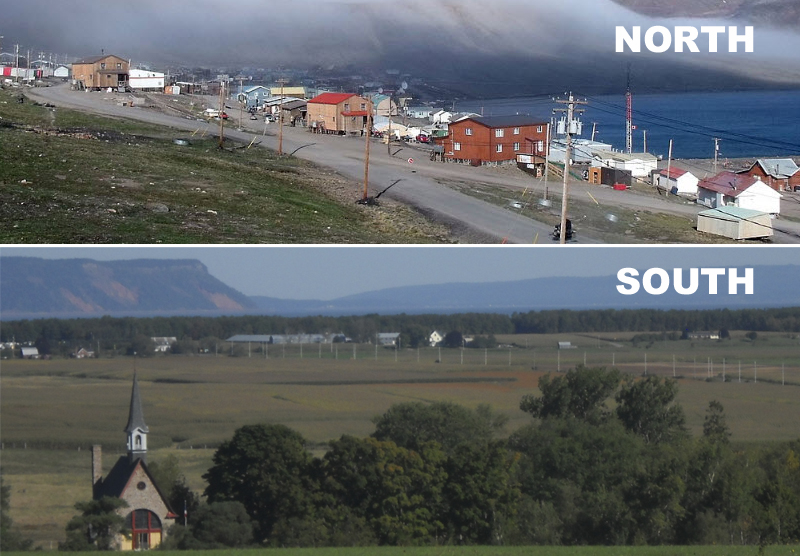
We have been back for a week. It has been a difficult time. When you move from one landscape to another, there seems to be a different rhythm in terms of how space and time are structured. northSouthFirst, we are back to the organic orchard: time to burn the prunings and brush; time to complete the paperwork for certification. Second, there are meetings related to community mapping, and the forthcoming Canadian Cartographic Association (CCA) symposium at COGS. The ‘to do’ list becomes overwhelming.
This week, I had the chance to hear Ed Symons talk about the accomplishments of the collaboration between COGS and the Age Advantage Association aka MapAnnapolis. The meeting was in Wolfville and thus there was talk about MapValley.
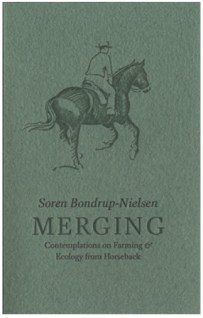
bookCover_mergingThe next evening, I went to Melvern Square to hear Soren Bondrup-Nielsen. He was presenting a CARP-sponsored (Clean Annapolis River Project) talk on “Riparian areas: natural filters and critical habitat in agricultural landscapes”. Luckily, I was able to purchase a copy of Soren’s beautiful book published by Gaspereau PressMerging: Contemplations on Farming and Ecology from Horseback. It inspired my blog title.

Friday evening at the End of the Line pub, meeting with friends, I was able to catch up on Tim Webster’s presentation “Sea level rise, Geomatics and Climate”. Bill MacDonald was at the talk, and apparently, mentioned the concept of a barrage at the Digby Gut.

On Friday, Andrea Vandenboer emailed me about the drone footage in my earlier blog (January 21, 2018). She was producing a video for the Centre for Local Prosperity. Via a recent interview with Tim Habinski, Warden, Annapolis County, she had become aware of the drone footage. I was able to connect her with Neil Green, the drone videographer.

Yesterday, it was time for a break. After a short visit to Annapolis Royal farmers market, and a coffee meeting with friends, to discuss the concept of the St. Mary’s Bay Community Centre: (the concept is to repurpose the school as a social enterprise), we headed off to Wolfville and Windsor.

I wanted to go back to The Odd Book in Wolfville where the week before I had noted an interesting book on the first geology map for the United Kingdom. I wanted to go to Windsor to see Dick Groot’s photographic exhibition. This is how things unfolded.

We dropped into The Odd Book but the book had been sold. It was Simon Winchester’s The Map that changed the world. We continued on to Windsor to the Cedar Centre, only to find that it is closed on the weekend. This was turning out to be ‘a dud’.

As we drove around Windsor, we noticed a large number of cars at the Schoolhouse Brewery. We also noted a second-hand bookstore on Gerrish Street. We stopped in, and I found a copy of Winchester’s book. Things were looking up!

Why my interest in this book?

It describes the life of William Smith. In Winchester’s words:

‘He noticed that the rocks he was excavating were arranged in layers, more important he could see quite clearly that the fossils found in one layer were very different from those found in another. And out of that realization came an epiphany: that by following the fossils, one could trace layers of rock as they dipped and rose and fell – clear across England, and, indeed clear across the world. Determined to publish his profoundly important discovery, by a creating a map that would display the hidden underside of England, he spent twenty years traveling the length and breadth of the kingdom by stagecoach and on foot, studying rock outcrops and fossils, piecing together the image of this unseen universe.’

Now transfer the concept to the Annapolis Valley, in the words of Bondrup-Nielsen p.73:

“The fissure that started separating North America and Africa, which ran up the Bay of Fundy, ceased for some reason and another fissure started further to the east, leaving what is now Nova Scotia, attached to North America.

When geologists examine the rock types in southern parts of Nova Scotia they find distinct similarities with the rock types of Morocco in North Africa. The rock types in Cape Breton are similar to rock types in Scotland. These massive geological events are continually shaping the world although at a slow pace. The land we interact with is not static; it is continually changing”.

My interest is the importance of the geology to our understanding of the Valley environment, as a fundamental layer in a community geographic information utility.

windsorMakersAt the second-hand bookstore, we noticed the Grand Opening of Makersa non-profit, social enterprise where the community can make, learn, teach, tinker, gather, collaborate, share, innovate, socialize, build, create, buy or sell’.

After a quick stop at the Schoolhouse Brewery for a small flight of local craft beers, we visited Makers. There, I bumped into Michael Caplan and his family. As part of Refresh Annapolis Valley, they are offering two programs: Creative Computing for kids, aged 8-12 and Exploring Computer Science for teenagers. For example, with the younger group, May 8, Animating Stories – interactive stories from Scratch. For the teenager, June 16, Teaching a Computer to see. Explore AI by learning how to build a program that can guess what it sees in a picture.

SUMMARY
Whether it is St Mary’s Bay or Windsor, there are grassroots, non-profit, social enterprises which are leading the change, across the generations. These are the hopes. The fears are the bureaucratic infrastructure that may distract us from these initiatives. Candidates for concern would be the expert opinion, tidal barrages, certification processes.

Or in the words of Bondrup-Nielsen, page 212:

“The perception is that the current game, the quantity game, is the only game in town, but that is not the case. If we think instead in terms of our quality of life, as measured by connections and the relationships we have with all life, the game will change. Nature operates as a system in balance – it is a dynamic, steady state. This philosophy needs to be the guiding principle of our human economy.”

Thanks again to Edward Wedler for his contribution to the graphics. Thanks too to the friends and family who unknowingly act as a source of inspiration.

REFERENCES
Ed Symons. MapAnnapolis could turn into MapValley.  Talk sponsored by Wolfville and Area Historical Society. April 25, 2018.

Soren Bondrup-Nielsen. 2014. Merging. Contemplations on Farming and Ecology from Horseback. Gaspereau Press.

St Mary’s Bay Community Centre. The Weymouth Events Newsletter. April 17,2018.

Simon Winchester. 2001. The Map that Changed the World. William Smith and the birth of Modern Geology. Harper and Collins.

Makers. go to website www.makerswindsor.com

Creative Computing and Hoist Annapolis Valley. go to website http://www.refreshannapolisvalley.org

Trailer for Climate Change and the Human Prospect: http://centreforlocalprosperity.ca/thinkers-lodge-retreat-outcomes/


Posted in Event Review, Opinion

Transition: from North to South

Tuniq Times, the seasonal festival of dog sled, cross-country skiing, skijoring and skidoo races, started last week in Iqaluit. It was time to head South and see whether Spring had arrived in the Valley. It was hard to leave behind such wonderful snow for cross-country skiing.

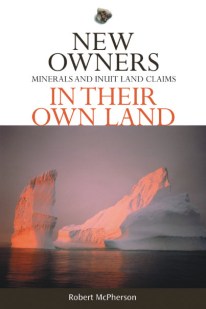
nwOwnersInTheirOwnlandOn the flight to Ottawa, I picked up a copy of the Nunatsiaq News (April 13 edition). There was an interesting opinion piece by Alex Buchan, Vice-President, NWT and Nunavut Chamber of Mines. He reviewed a book by Robert McPherson New Owners in their own land, Minerals and the Inuit Land Claim. “McPherson was a geologist hired by the Inuit Land Claim organization to identify mineral-rich lands that we would eventually select .”

“Another important aspect of our land claim was to successfully negotiate the right to share with the government the resource development in all of Nunavut.”

” This was a very new and unique concept then, for the government to share resource management with us.”

” Co-management has given us a strong environmental protection system, to ensure that any development, not just mining, is done responsibly and in a way that Inuit knowledge is considered in ensuring that our land and waters and wildlife are protected.”

Back Home, it was time to catch up on events in the Valley. The best approach is to go to the Farmers Market in Wolfville on Saturday and to pick up a copy of the Grapevine. In the April 19-May 3 edition, two articles caught my attention.

I noted that Ed Symons, COGS faculty, is giving a talk at Acadia University on ‘Why Annapolis County is probably the most mapped county in the province”. The title of the article by Wendy Elliott MapAnnapolis could turn into MapValley ? (Wednesday 7 pm at the Irving Centre Auditorium).

The second article described a new exhibition of the work of Dick Groot at the Cedar Centre in Windsor (end of April – May 1018). This caught my attention for a number of reasons. Dick in a previous life, worked at ITC, Enschede in the Netherlands. When we were transforming NSLSI to COGS, we would often reference ITC as our European model.

ribbonToTheFutureSo, I checked his website eyeopener2013.com  and found the following quotation about the Ribbon to the Future project (a joint project by Dick Groot and Hannah  Minzloff).

” Ribbon to the Future. Ultimately, we intend to build an interactive website that allows the audience to add their own photography and stories thus creating a public information utility, ribbon to the future”.

Wow, Amazing! Does that not sound like the ‘community information utility?’

I contacted Dick, he explained that  ‘we set out to record photographically the old and the ‘anticipated’ new economy’.  The photo-based installation in Windsor is Closure: a photographer’s eye on an old economy.

Here is the challenge. What has replaced the old manufacturing economy? I also recall that part of the project was to focus on a linear narrative through the Valley. The ‘ribbons’ are the highways; Highway 1, Highway 201, and more recently Highway 101.

Time to go and see the exhibit. Time to think about the interactive website and its geography.

britishPioneersInGeographyWhile in Wolfville, I could not resist stopping at the second-hand bookstore. There, I found a book by Edmund Gilbert British Pioneers in Geography.  This set of essays describes the Oxford School of Geography, going back to the twelfth century. A couple of quotations:

From Carl Sauer, p.18

“a good knowledge of the work of one or more of our major personalities is about as important an induction into Geography as I am able to suggest”.

Or the author, on the decision in 1971 not to build a new London airport near Cublington, p.26 — ‘The defence of the natural beauty of the world’s landscapes is the inescapable duty of the geographer”.

References

Nunatsiaq News. Year 45 Number 3. April 13, 2018. Alex Buchan Required reading: new owners in our own land! Commentary. p.14.

The Grapevine. Issue No. 15.06 April 13 – May 3, 2018. Wendy Elliott. MapAnnapolis could turn into MapValley. p.11 and Mike Butler. Richard Groot’s Photo Finish. p.9.

Edmund W. Gilbert. 1972. British Pioneers in Geography. David & Charles, Newton Abbot, Devon.


Posted in Event Review, Nature

Northern Musings

Everyone returned safely from the four-day dog sledding trip. dogSledCrew
The GARMIN InReach technology worked well, allowing us to track the progress from cabin to cabin. With Edward’s help, I was able to follow their route across the sea ice from Iqaluit and back.screenshot_08_06Apr18 2-21-13 PM
Indirect exposure to this type travel in Winter raised a number of questions or musings.
In Northern latitudes, there is the opportunity to experience the same landscape in very different conditions. In the winter, travel across the sea ice is either by dog team or skimobile. In the Summer, Frobisher Bay is accessible by boat. On the land, the lakes are frozen — a beautiful blue ice, again Winter travel uses the same transportation or skis. Hillsides are rounded out by extensive snow banks. In the summer, it is hiking or canoe.
If this landscape changes so dramatically with the seasons, how does this increased knowledge of the same space, impact our relationship to the land?
There are stories about the land, for all seasons. How will climate change impact the landscape, our travel and hence the narrative?
Meanwhile, back in Iqaluit, I am tucked away, reading some books from England. The current tome is Nicholas Crane’s ‘The Making of the British Landscape‘. Over five hundred pages, describing the changes in Britain from 10,000 BC to the present day. In the frontispiece, Crane comments:
     ‘To care about a place, you must know it’s story’.
In the Inuit oral tradition, these stories extend across the landscape in ALL seasons. Each season offers its own unique version of the landscape.
REFERENCE
Nicholas Crane. 20816. The Making Of the British Landscape. W & N , London.
FOOTNOTE

Nicholas Crane is an author, geographer, cartographic expert. He has presented several acclaimed series on BBC2, among them Map Man, Great British Journeys, Britannia, Town and Coast.  He was elected President of the Royal Geographical Society in 2015.
Posted in Event Review

Landscape and Food: hidden gems of the Creative Rural Economy

Last week, a good friend from England sent me a link to the Oxford Symposium on Food and Cookery. This annual event is a weekend in July at St Catherine’s College, Oxford. The theme for 2017 was Food and Landscape. This was the start of an interesting week of discovery.

With a birthday and Valentine’s Day on February 14th., Heather and I decided to attend the Valentine’s Cookery School at the Flying Apron Inn in Summerville on Highway 215, East Hants, NS.

Before reaching Summerville, we stopped at Avondale to hike the community trails. The four kilometre loop wends through the ridges and sink holes of the gypsum formation. In the Spring, you can discover several species of Lady Slipper orchids (Cypripedium spp.). Avondale is also the home to Avondale Sky Winery and in the Summer, the annual Garlic festival.

The Flying Apron is an Inn, restaurant, Cooking School, post office and second-hand bookstore, all housed within  a refurbished general store. It has several unique qualities:

  1. it is a cooperative marketing venture with Avondale Sky Winery and Meander River Farm and Brewery.
  2. Chef Chris offers a unique Cooking school.
  3. the signature event is ‘Dining on the Ocean Floor”, an outdoor meal served at low tide on the Bay of Fundy shore.
  4. it bring European cuisine to rural Nova Scotia, using local produce.

The Cookery School is an expandable concept. Students arrive to learn how to cook a three course dinner. All the ingredients are provided. The kitchen is well equipped with pots, pans, stoves, oven, refrigerator, and , of course, sharp knives. Chef Chris acts as the mentor. With proper equipment, local ingredients and a methodology, Chris guides the class through the creative process. At the end, there is the opportunity to savour the result, along with local wine or beer.

Take Home Lessons

Imagine we had a community college, with campuses in different landscapes across Nova Scotia. At each campus, we could identify the needs of the community. With a knowledgeable mentor (aka chef) who would bring experiences from other ‘geographies’, students could learn what are the key ingredients, the method, and create a product which they would test and share with members of the wider community. The cooking class could be a model for other crafts, hands-on activities, and even software development. Within the context of the community, students would learn about the landscape, the geology, ecology, heritage, as well as locally available resources.

After a night at the Inn, we continued along the Noel Shore to Maitland before heading back through the Rawdon Hills to Windsor, gateway to the Annapolis Valley. Driving along Highway 215, across the gypsum, in February, we noticed the abundance of red stems of the local species of Cornus (dogwood) in the wet hollows, along the roadside. Another unique quality of this landscape.

Footnotes

In the second-hand bookstore, I found Soul Voyage. This book is a fictional account by Cameron Royce Jess, of Joshua Slocum’s ‘Sailing Alone Around the World”. Slocum was born on a subsistence farm at Mount Hanley. Jess lives with his wife, Linda, in Hall’s Harbour.

On our return, I received an email, from another good friend, on  ‘Evaluating the impact of subsidized food boxes in Nova Scotia’. Another, very different but important, community link between landscape and food. http://flip.it/_EgwY

Please compare this economy with the economy described by Bill Black (see previous blog).

References

Oxford Symposium on Food and Cookery started in 1983. Check Wikipedia or Google.

The Flying Apron Inn and Cookery www.flyingaproncookery.ca

Meander River Farm and Brewery www.meanderriverfarm.ca

Avondale Sky Winery www.avondalesky.com

Cameron Royce Jess. 2004. Soul Voyage. Inscape Publications, Port Williams.NS.

Posted in Event Review

3D workshop: from the real world to the digital world

The Centre of Geographic Sciences (COGS) in Lawrencetown recently hosted a two day workshop on 3D data collection, analysis and visualization. The event was co-sponsored by the Canadian Institute of Geomatics (CIG) and Geomatics Association of Nova Scotia (GANS). The workshop chair was Tim Webster from the Applied Geomatics Research Group (AGRG) at the Nova Scotia Community College (NSCC).
There were over twenty presentations and about two hundred persons in attendance. From my perspective, presentations could be divided into the following categories: technology, measurement science, applications, and implications for society and education.
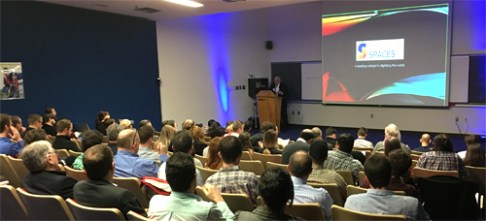
This was the second 3D workshop. In comparison with last year, Tim webster and his team should be congratulated on expanding the presentation roster to diversify both the technologies and the applications. Technologies included LiDAR, UAV, Augmented and Virtual Reality, 3D printing, and Hologram tables. The applications expanded from geology and forestry to palaeontology, oceanography, shipbuilding, city and interior building environments. In terms of measurement science, there was a sub-theme on terrestrial photogrammetry and camera systems. Government agencies at both the provincial and federal level were represented. They described their approach to open access and high volume LiDAR data sets.

As an independent observer, with no institutional affiliation, my interest was captured by the industry speakers  who came from afar to put the technologies and their applications in a global perspective. These included Anders Ekelund from Leica Systems, Sweden, the Skype presentation from Euclideon, Australia and Kevin Lim from Lim Geomatics in Ottawa. The keynote of local interest was given by Hugh MacKay, MLA Nova Scotia.

Keynote 1. Advances in airborne 3D data capture

Anders  Ekelund described the Leica (Hexagon) approach to our changing world: global population growth, migration to the cities and sustainable resource management.

A couple of Anders quotes:

” 90% of all digital data in the world has been created in the last two years ”

” Data is the new OIL”

For more, go to hexagon.com  to view their presentation on ‘The Shape of Potential”.

Keynote 2. Smarter Spaces – SLAM technology.

Colin Gillis described SLAM (Simultaneous Localization and Mapping), LiDAR capture for indoor mapping. Applications include underground structures, stockpiles, buildings, e.g hospitals and shipyards. It leads to Building Information Modeling (BIM). Colin referenced the work at AnyWhere in the UK, as well as research at CSIRO, Australia on GeoSLAM.

On the second day, after an overnight snowstorm, we had a Skype presentation from Euclideon, Australia. Bruce started by quoting Moore’s Law, in terms of the rate of change in CPU power and memory speed. Euclideon has developed efficient 3D search algorithms. They have also designed hologram tables to display these high volume, three dimensional images. The challenge is to develop a better understanding of the ‘use cases’ for this technology.

A second presentation on Day 2 was by Kevin Lim. His company has moved, from LiDAR data collection for advanced forest modelling, into the delivery of large data sets in the cloud within a shared economy. Kevin’s concept of a shared economy included an incentive model, access, quality of data, training and certification. These elements can be viewed within the context of crowd sourcing geographic knowledge (VGI) and, by example, with Open Street Map.

At the Nova Scotia scale, Hugh MacKay was the keynote on Tuesday evening. Hugh emphasized from his experience in the Geomatics industry in Europe and elsewhere, the need for a different collaborative model. In his case, he was looking at the three legged stool: government, industry and academia.

REFLECTIONS

From the two day immersion in 3D data, the following was apparent.|
1) we are seeing multiple technologies for data collection,analysis and visualization
2) the volume of data has increased exponentially.
3) there is a significant need for education and training in both the science and the technologies.
4) we need new models of collaboration.

It is fascinating to be living in rural Nova Scotia, with access to many of these technologies, either at COGS/AGRG or over the Internet. From the workshop, there is evidence of BIG industry (e.g. Leica-Hexagon, JD Irving) and BIG data.

To meet Hugh MacKay’s collaborative challenge and the shared economy described by Kevin Lim, what has to happen at an institution like COGS/AGRG ? Does an Advanced Diploma in Geospatial Data Analytics still make sense ? Or do we need to rethink our educational model ?

Congratulations to Tim Webster and his support team for a very stimulating event. I look forward to seeing the agenda for the next workshop in 2019. Finally, as an ex-COGS instructor, I think that the current generation of technology/science instructors have an awesome, but very scary, challenge in front of them. To do it ‘right’ will require significant investment, creativity, a truly collaborative environment, understanding of the use cases, access to new technology, and fundamental science and technology expertise. In the words of Hugh MacKay: carpe diem. Seize the day.

References

To check out the detailed workshop program, presenters and presentations, go to https://geomatics.one