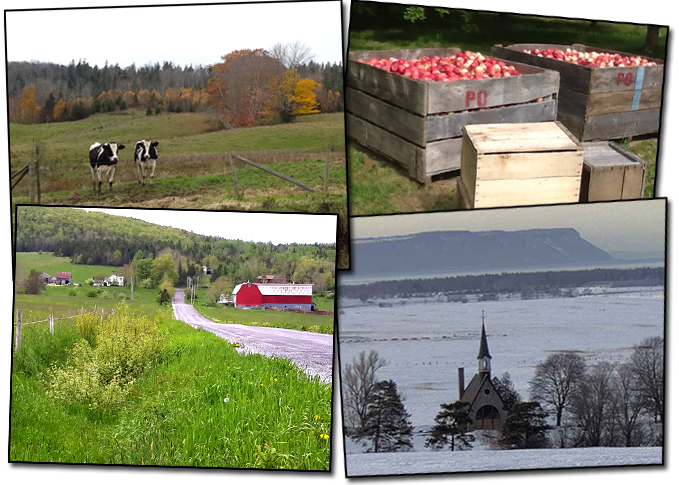
Wendell Berry’s book The Art of the Commonplace is a collection of agrarian essays covering a thirty year period. The first essay, A Native Hill under the section heading: Geobiography, describes Berry’s relationship to the land in Kentucky. As Norman Wirzba writes in the Introduction:
‘Our lives are always rooted in a natural and cultural community, so that to cut ourselves off from these roots, whether that be in the name of progress or human liberation, is to ensure the eventual withering and then death of life‘ (page ix).
Or more directly in Berry’s own words, when talking about his decision to move back to Kentucky from the academic world of New York.
‘Before coming back I had been willing to allow the possibility – which one of my friends insisted upon – that I already knew this place as well as ever I would. But now I began to see the real abundance and richness of it all. It is, I saw inexhaustible in its history, in the details of its life, in its possibilities. I walked over it, looking, listening, smelling, touching, alive to it as never before. I listened to the talk of my kinsmen and neighbours as I never had done, alert to their knowledge of the place, and to the qualities and energies of their speech. I began more seriously than ever to learn the names of things – the wild plants and animals, the natural processes, the local places – and to articulate my observations and memories.’ (page 7).
If one was going to attempt a geobiography of the Annapolis Valley, how might you go about it ? One approach, which occurred to me while I was listening to a CBC podcast ‘Writers and Company with Eleanor Wachtel. It was broadcast on December 1/2017. It was an interview with Richard Holmes reflecting on his life as a Romantic biographer. Holmes was talking about his recent memoir This Long Pursuit.
‘If we have any hope of making a better world, he argues ‘we must understand it both scientifically and imaginatively’.
This offers direction, if we want to describe the Annapolis Valley.
From my personal perspective, I would likely transpose ‘Geobiography ‘, and think in terms of ‘Biogeography’. This feeds back into my unpublished Ph.D thesis, The Nature of Biogeography from the mid seventies.
First, we must define the Annapolis Valley. It is a physiographic unit. It includes both North and South Mountain, the Annapolis River valley, and the Bay of Fundy shore. One of my challenges with the Valley REN (regional enterprise network) is that because of history and municipal politics, it does not include Annapolis County or Annapolis Royal.
I think that a geobiography (biogeography) would focus on stories related to the earth’s surface (land and sea), the qualities of the natural landscape, how they have changed over time, how the different inhabitants have been an integral part of this landscape. It would look at the ecological relationships:plants, animals, geology, soils, climate and the various migrations.
Returning to Wendell Berry, in another book What are People for ?
With reference to Maria Popova Brainpickings site, she has a quotation that I like:
‘Wendell Berry on Solitude, and why Pride and Despair are the two great enemies of Creative Work’
References
Wendell Berry. 2002. The Art of the Commonplace.The Agrarian Essays of Wendell Berry. Counterpoint, Berkeley, California
Wendell Berry. 1990. What are People for ? Counterpoint, Berkeley, California.
Eleanor Wachtel. 2017. CBC Radio. Writers and Company. December 1,2017. Richard Holmes reflects on his life as a ‘Romantic biographer’.
Richard Holmes. 2016. This Long Pursuit. Harper Collins, London.
Robert Maher 1976. The Nature of Biogeography. Unpublished Ph.D thesis. Department of Geography, University of Western Ontario.
 While in BC, and being in the Fraser Valley, I took the opportunity to check out the current work of Hugh Brody. Brody is the Canada Research Chair in Anthropology at the University of the Fraser Valley in Abbotsford. He is likely best known to Geographers for his book Maps and Dreams, published in 1981. From his web site, I noticed that he had recently given a talk at the Audain Gallery, Simon Fraser University. Fortunately, his talk is available as a
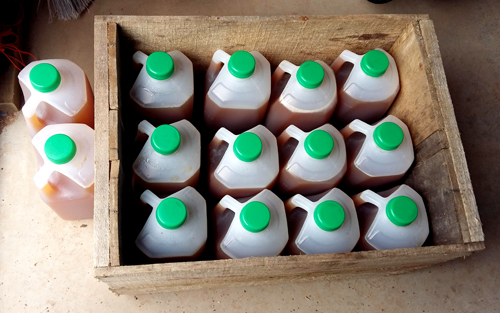
 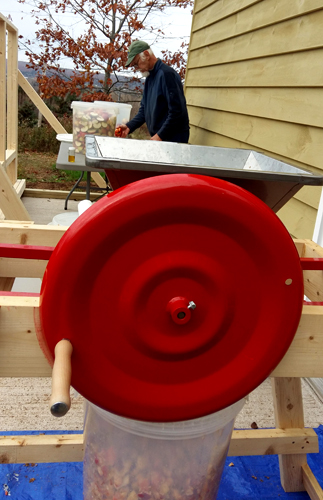 Richard Sennett says it well in the Acknowledgements to his book The Craftsman, “Making is Thinking’. This week, we have been busy pressing apples and making it into sweet cider.


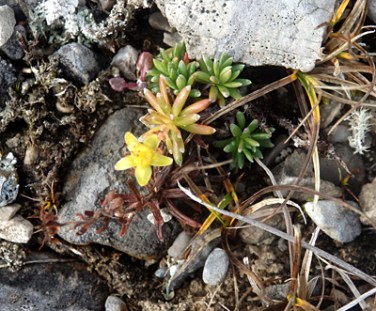 We had many personal realizations. While we had studied the plants in the National Park, visiting the serpentine Tablelands and the barrens on the top of Gros Morne, we had not gone North of the park. Over the last forty years, scientists have rediscovered the geology and biology of the Great Northern peninsula, in particular the uniqueness of the limestone barrens.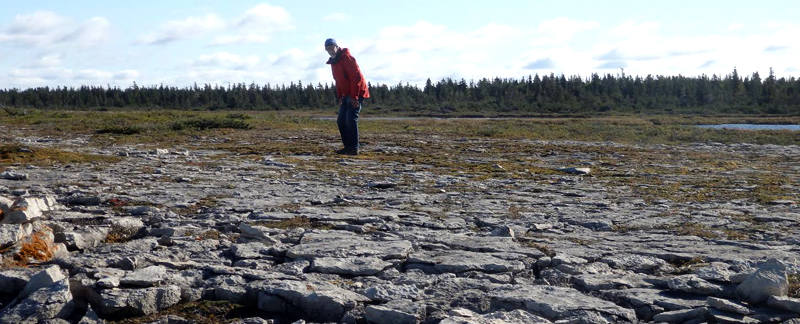
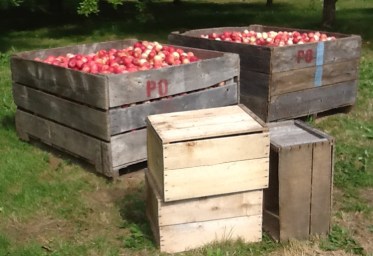 Last year, we picked fourteen bins. It takes eighteen boxes to fill a single bin. The apples come from ninety one trees; four varieties: NovaMac, MacFree, Liberty and NovaSpy — all scab free. We arranged for Brian Boates in Woodville to pick up the fourteen bins on a flat bed, and then to juice the crop. The juice was transported to Ironworks distillery in Lunenburg, where Pierre Guevremont is turning it into apple brandy. It will be another year before we can sample the result.This year, so far, we have picked five bins. It looks like the yield will be less this year. The size of the harvest depends on pruning, pollination and microclimate. This year we pruned the higher branches to make for easier picking. We have had a dry, warm Summer. Less water likely affects the number and size of the apples.
 Future considerations include the addition of organic fertilizer (earthworm castings), drip irrigation in dry years, the addition of beehives for increased pollination. These thoughts are my brain pickings from the orchard.
 First, there was the news that the tenant was moving from Andrew’s farm house across the road. This meant screening a number of possible new tenants. Meanwhile, there was a significant number of ‘to do’ tasks while Heather was away. They included chain sawing several cords of firewood, painting outbuildings, and getting organized for this year’s apple harvest in the orchard. Apple picking demands moving full apple bins with the fork lift on the tractor. Ah yes, this requires fixing the ‘soft’ tire on the tractor.

 ” the business community, not just governments, has a responsibility for turning the region into something more than a region of the mind. Community institutions need to step up and contribute to the region’s economic development.” (July 29/17 Chronicle Herald F3).
 In my neighbourhood on Hwy 201, I see new craft beer company (Lunn’s Mill) and Beavercreek Winery. In Paradise, the Morse Estate (Buckler. The Cruelest Month 1963) has been transformed into Burnbrae Farm and Paradise Inn. The town of Bridgetown has merged with the Municipality of Annapolis County.
 Ernest Blair Experiment