Posted in Book Review

Buffer Zone

Today, Heather rediscovered her copy of the nomination document for the Southwest Nova Biosphere Reserve, dated July 2001.
I was interested in checking the designation of the buffer zone. At that time, the buffer zone included:

55 sq.km within Kejimkujik National Park (zone 3 and 4)

37 sq.km provincial crown land adjoining Kejimkujik National Park

53 km lower portion of the Shelburne River

Nova Scotia Power lands at north end of Lake Rossignol and upper reaches of the Mersey River.

Crown managed lands at Indian Fields, west of Tobeatic Wilderness Area.

Endorsements (i.e. in charge of the management of the buffer zone)

Nova Scotia Minister of Natural Resources, Fisheries and Agriculture

Freeman and Son Ltd

Nova Scotia Power Inc.

Mersey Woodlands

Where are we today, in 2020?

Clearly the description of the buffer zone (in 2001) did not satisfy the ten year UNESCO MAB review.

Today, we need to know :

a) the 2020 definition of the buffer zone. Which lands, where and size?

b) the parties in charge of the management of the buffer zone.

In the 2001 nomination document, there is a description of the values upheld by SNBRA.

“Ultimately the identity and success of the Southwest Nova Biosphere Reserve in addressing issues associated with advancing ecological, cultural and economic sustainability will depend on goodwill and civic spirit of the organization and citizens participating as members of the Association.”
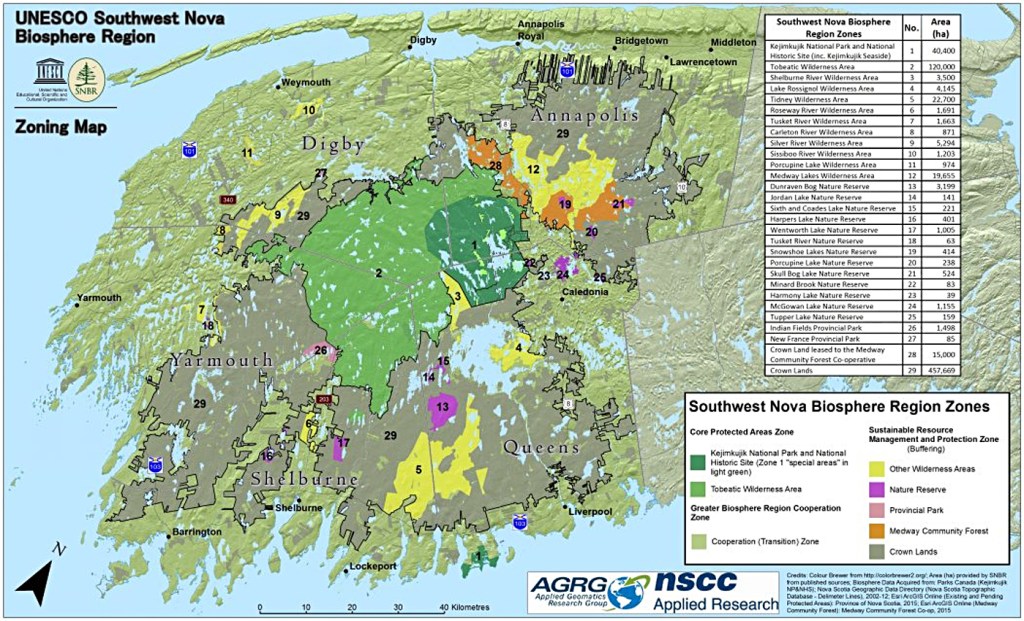
LINK to http://agrgmaps.nscc.ca/SNBRA/

The same is true today.

On Sunday, November 29, 2020 there was an opportunity to watch the TVO documentary, Striking Balance that reaffirms these values. There is also the opportunity to protest the lack of transparency by the provincial government on its management of crown lands.

Acknowledgements

Heather produced the original submission in 2001. Edward added the graphics to this blog.

Reference

SNBRA, July 2001. Biosphere Reserve Nomination. Southwest Nova Biosphere Reserve
(link to 2010 Nomination Overview document)
Posted in Book Review

Bookcase 2, Shelf 6

Brian, my neighbour, was over this morning to fix the bookcases. They had collapsed, likely under the weight of the books. This has given me the opportunity to rediscover a number of books collected in our travels. For example, shelf 6 focuses on Haida Gwaii.

As I try to understand the stand off between the citizens in rural Nova Scotia with their concern for the forested landscape and associated species and the provincial government, intent on clear-cutting and spraying, I wonder whether there are lessons from Lyell Island on Haida Gwaii.

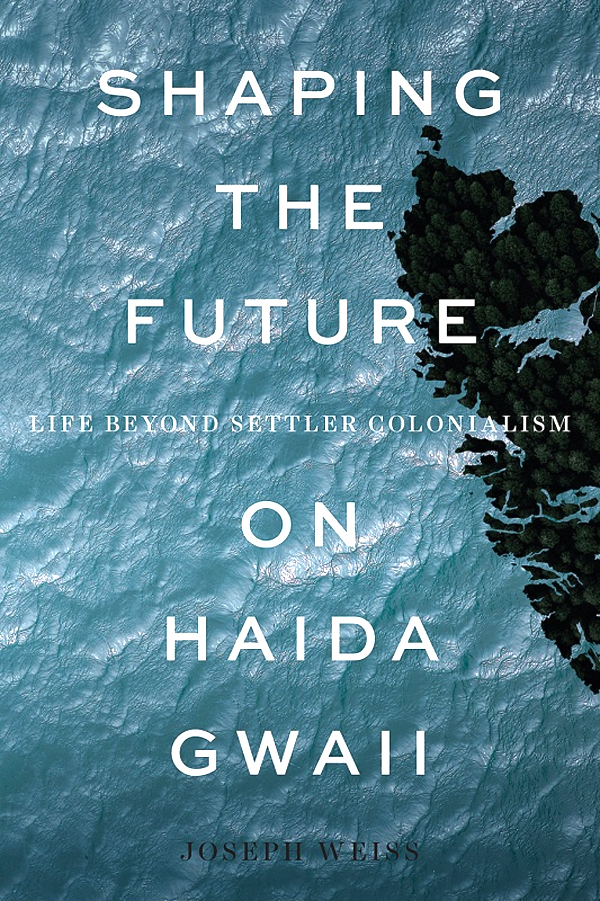
My starting point was the book by Joseph Weiss, Shaping the Future: life beyond settler colonization on Haida Gwaii.

Is there life beyond settler colonization in Nova Scotia?

On the same shelf, I found Islands in the Salish Sea: a community atlas.

Two quotations, from Geographers struck home. In the Preface from Robert Bateman,

“In our global, packaged world we are losing a sense of place. This is a philosophical tragedy. It results in a lack of caring, a lack of sense of community and a neglect of civil responsibility. It is also an environmental and human tragedy. For with the loss of knowledge of and intimacy with our home place, we are losing our sense of spirit.”

In the Foreword, Briony Penn:

“One thing I have learned as a professional geographer is that whoever has the maps in their hand controls the fate of the land. Cartographers have been at the forefront of turning land and nature into polygons of commodities.”

I would also recommend the writings from Robert Bringhurst and Ian Gill. For readers interested in Haida Gwaii, I have provided a list of titles from Shelf 6. Perhaps, at a later date, we can visit other shelves.

Acknowledgements

Heather shared the Haida Gwaii experience. Edward provided the graphics.

References

Joseph Weiss, 2018, Shaping the Future: life beyond settler colonization on Haida Gwaii. UBC Press.

Sheila Harrington and Judi Stevenson (Ed), 2005, Islands in the Salish Sea: a community atlas. The Land Trust Alliance of British Columbia.

Christie Harris, 1992, Raven’s Cry. Douglas and McIntyre.

Ian Gill, 2004, Haida Gwaii Journeys through the Queen Charlotte Islands, Rainforest Books.

Karen Duffek and Charlotte Townsend-Gault (Ed), 2005, Bill Reid and Beyond: expanding on modern native art, Douglas and McIntyre.

Robert Bringhurst (Ed), 2009, Solitary Raven : the essential writings of Bill Reid, Douglas and McIntyre.

Thom Henley, 2017, Raven walks around the World, Harbour Publishing.

Robert Bringhurst, 2012, A Story as Sharp as a Knife. Douglas and McIntyre.

Ian Gill, 2009, All that we say is ours: Guujaaw and the reawakening of the Haida Nation, Douglas and McIntyre.

Dennis Horwood and Tom Parkin, 2006, Haida Gwaii: the Queen Charlotte Islands, Heritage House.

Ruth Kirk, 1986, Wisdom of the Elders: native traditions on the Northwest coast, Douglas and McIntyre.

Christie Harris, 1977, Mouse Woman and the Mischief-maker, McLelland Stewart.

Sean Markey et al., 2005, Second Growth: community economic development in rural British Columbia, UBC Press.

Posted in Book Review

Rereading History

Monday, we headed up to Wolfville. I could not resist a quick stop at the Odd Book. Within minutes, I had found two keepers.

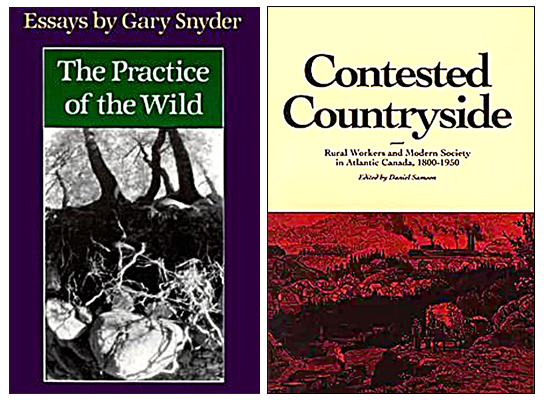
The Practice of the Wild, essays by Gary Snyder. It seemed very appropriate to the battle we face trying to preserve the forested landscape in Nova Scotia. The first essay, The Etiquette of Freedom talks about the words, Nature, Wild and Wilderness. The second essay, The Place, the Region and the Commons covers the world is places, understanding the Commons and Bio-regional perspectives.

The second book published by Gorsebrook Studies in the Political Economy of the Atlantic region, Contested Countryside : rural workers and modern society in Atlantic Canada 1800-1950, edited by Daniel Samson. Within the chapter by Erik Kristiansen, Time, Memory and Rural Transformation: Rereading History in the Fiction of Charles Bruce and Ernest Buckler, it places Buckler into the economic context after the Second World War. Not an easy read, but thought provoking. There is also an Afterword by Daniel Samson Capitalism and Modernization in the Atlantic Canada countryside. With that in mind, move forward to 2020.

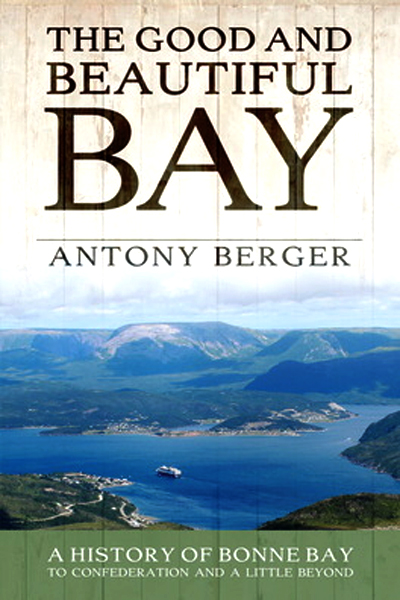
The third book is by Antony Berger and is the biography of his mother, Ella Manuel. This one came from the Lawrencetown library. Heather has snagged it, so this is an indirect review. It describes her life in Western Newfoundland, after the Second World War, a single Mother with young children, and the economic life in Lomond and Bonne Bay. Interestingly, Berger has also written about Bonne Bay: This Good and Beautiful Bay, a History of Bonne Bay to Confederation and a little beyond. Berger now spends his time between Wolfville and Woody Point.


All three books raise the question: what is the impact of the surrounding landscape and rural economy on the writers view of the world?

In the case of Gary Snyder, it is the Yuba River country in the Sierra Nevada of Northern California. For Ernest Buckler, it is the Annapolis Valley. For Ella Manuel and Antony Berger it is Bonne Bay, Western Newfoundland.

I would encourage reading the chapter in Contested Countryside, Rereading of History, by Eric Kristiansen; challenging, but definitely relevant to our times.

Last weekend, we attended the Dave Gunning concert in Bridgetown. We came away with two CDs. This week, I have been listening to ‘These Hands’ and ‘Circle of Boots’.


Finally, I had the chance to drop off some excess books at Endless Shores in Bridgetown and thus obtain a credit. The ones that were not of interest to Jennifer, I took to the Bridgetown post office.

Acknowledgements

The Odd Book in Wolfville, close to the university, is a readers’ goldmine. Jaki at the library obtained the Ella Manuel biography. Heather for her comments on the book. Edward for his graphics.

References

Gary Snyder, 1990. The Practice of the Wild. North Point Press.

David Samson (Ed.), 1994. Contested Countryside. Rural workers and modern society in Atlantic Canada 1880-1950. Acadiensis Press.

Antony Berger, 2014. The Good and Beautiful Bay: A History of Bonne Bay to Confederation and a little beyond. Flanker Press.

Antony Berger, 2020. No Place for a Woman. The life and Newfoundland stories of Ella Manuel. Breakwater Books.

Dave Gunning CDs No more Pennies 2012. Up against the Sky. 2019.

Posted in Book Review

Fall Magazines

Visiting New Glasgow for the Thanksgiving Weekend, I had the opportunity to catch up on the October/November magazines from Saltscapes, Volume 21 #5.

Saltscapes Magazine
“Some would make us just names on a list. But we are people in a place - and resist.” 

This seemed very appropriate at the time of our municipal elections.

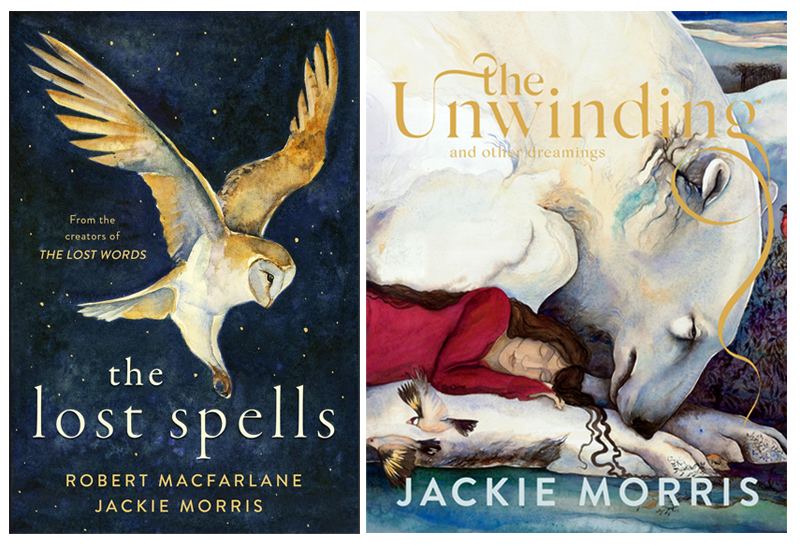
From Walrus, there is notice of a new book by Robert MacFarlane, illustrated by Jackie Morris, published by Anansi Press, The Lost Spells. In the latest Brain Pickings, see too, The Unwinding by Jackie Morris published in July 2020.

From Canadian Geographic, Volume 140 #5, there is a rich trove of articles.

  • Michif Revitalized: How to save an endangered language.
  • Mapping Canada’s biggest islands.
  • How to avoid the sixth extinction.
  • Keeping the inlet wild – Princess Louisa Inlet raised $3m in 3 months .
https://play.google.com/music/listen#/ps/I4q4mklvfb4sd6ho2jv3f55ecbu

Meanwhile online, Emergence Magazine Episode 6. The Power of Revitalization of Language Keepers: The struggle for Indigenous language survival in California. (Podcast link HERE)

From Chelsea Green Publishing, Chris Smaje’s book, A Small Farm Future. ‘Chris Smaje has worked a small farm in Somerset, southwest England for the last seventeen years. Previously, he was a university-based social scientist’.

At resilience.org you can find Podcast from the Prairie: Respecting your tools. A conversation with Wes Jackson, now 84 years old, from the Land Institute.

Acknowledgements

John Stewart for his rich collection of magazines. Heather Stewart and Siqsiq, my travel companions. Sandra Stewart and Don Higgins for the wonderful Thanksgiving Dinner. Edward for searching out the links and associated graphics.

Posted in Book Review, Event Review

Apple Drops

You likely know the saying, “the apple does not fall far from the tree“. With the warm temperatures, rain and wind, I have gained insight into the way different varieties of apple drop from the tree. The MacFree stays on much longer than the NovaMac.

While waiting at the dentist in Bridgetown, I finished reading Gretel Ehrlich’s book on life in Wyoming. The following quotation caught my attention.

“We live in a culture that has lost its memory. Very little in the specific shapes and traditions of our grandparents’ pasts instructs us how to live today, or tells us who we are or what demand will be made on us as members of society.” p.103.

From the essay, ‘To live in two worlds: Crow Fair and a Sun Dance’ p.102-125.

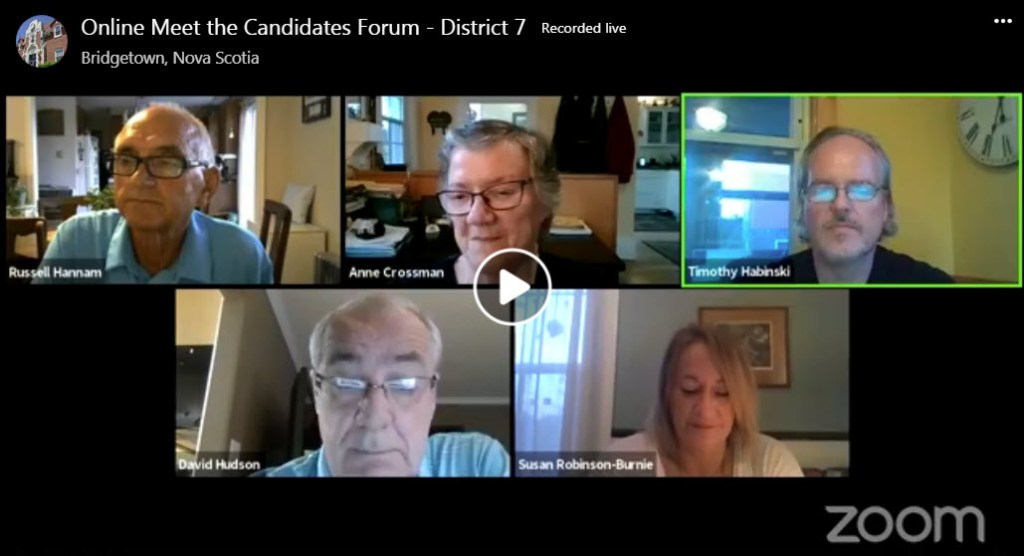
This evening, I was able to watch on Facebook four candidates for District #7: Timothy Habinski, Russell Hannam, David Hudson and Susan Robinson-Burnie (missing was Mike Taylor) answer a series of questions on the Environment, health services, economic development, engaging the next generation and the Bridgetown Town Hall.

Top row, l to r: Russell Hannam, Anne Crossman (moderator), Timothy Habinski
Bottom row, l to r: David Hudson, Susan Robinson-Burnie
(missing: Mike Taylor)

I find it geographically remarkable that the town of Bridgetown is divided into two districts #3 and #7, either side of Highway #1.How does that help us with a ‘sense of community’?

Kudos to Steve Raftery, Andy Kerr and Anne Crossman for putting the event together. It helped my thinking, in a world without newspapers.

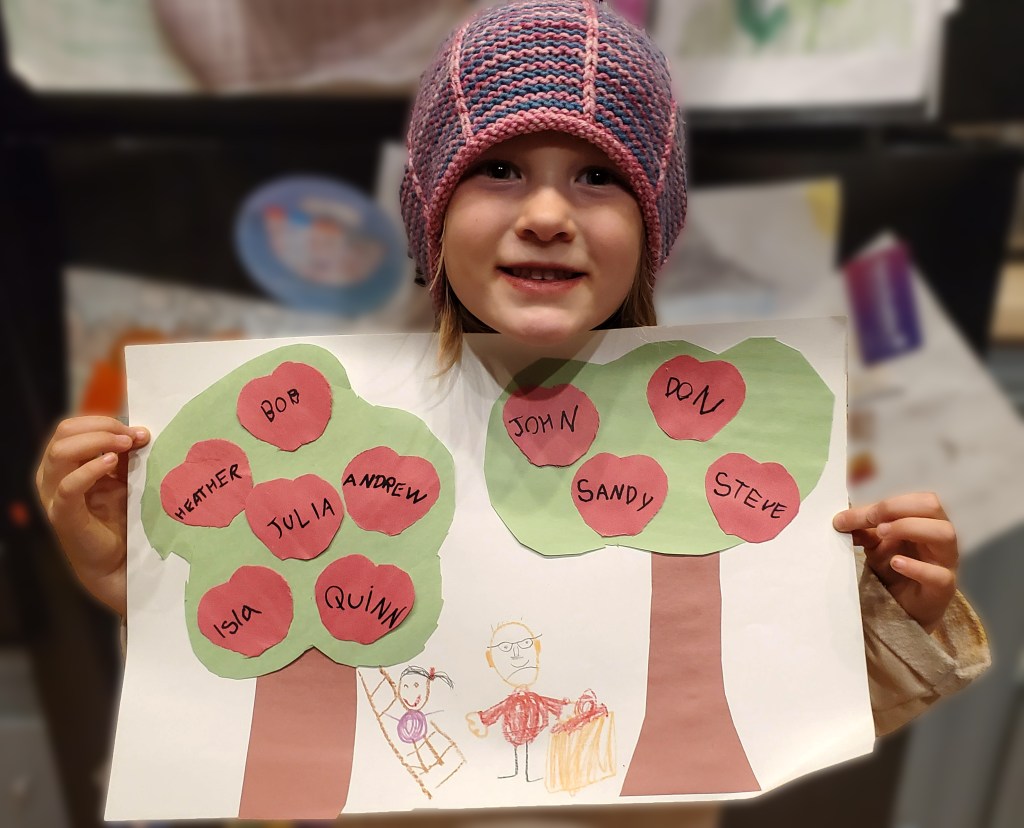
Later, the same evening, I received the following email from Andrew on Baffin Island, entitled ‘Harvest Time’.

“Isla wanted to do a harvest craft of what is happening in Nova Scotia. It’s Bob and Heather doing the picking.”

Here is my reply.
“Yes. We have two types of apple tree: NovaMac and MacFree. The NovaMac produces wonderful sweet, deep red apples.The MacFree is a later apple, stays on the tree longer. It looks more ‘green/orange’. Apparently the two varieties encourage cross-pollination (Raymond Hunter).”

Acknowledgements

Heather and I had a good day in the orchard, picking from the tree, and the ground. Andrew sent us the photograph of Isla Rose. Anne Crossman moderated the all-candidate event.

Reference

Gretel Ehrlich, 1985. The Solace of Open Spaces. Penguin Books.

Postscript

Where’s Stephen?

Posted in Book Review

Press Enter To Continue

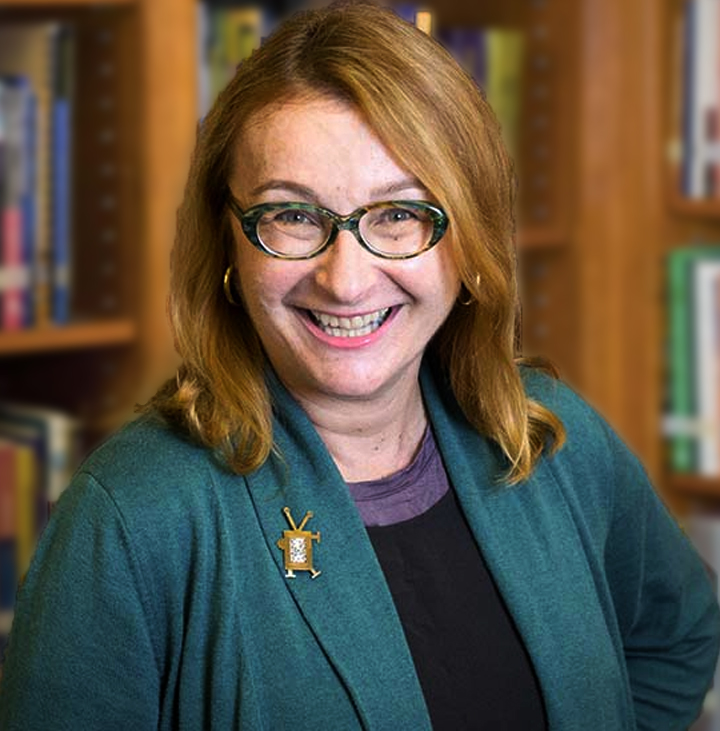
person_joanFrancuzJoan Francuz is now a resident of Annapolis Royal. She has written and self-published a fascinating memoir of her life as a technical writer, within the context of the history of technological change, or in her terms ‘Scribes from Babylon to Silicon’. Many of us have participated in these technological changes throughout our working lives.
Her research reminds us of the long history of technological change from the earlier industrial revolutions. It offers a sobering moment of reflection, as we experience the current pandemic changes.

Somewhere in her book (I have tried to find the page) she references IDRISI.

Ah! Found it.

“Pockets of knowledge existed even outside the universities. King Roger II of Sicily, for example, gathered scholars at his court, including an Arab Muslim geographer named al-IDRISI (1100-1165) who collected information about the known world. The result was a document whose Arab name can be translated as “The delight of one who wishes to traverse the regions of the world.” The world map and 70 secondary maps that al-IDRISI produced would be the most accurate depicting of our planet for the next 300 years.” p.60.

In my earlier days, teaching the application of GIS technology, there was a software product, developed by Geographers at the University of Edinburgh, of that same name.

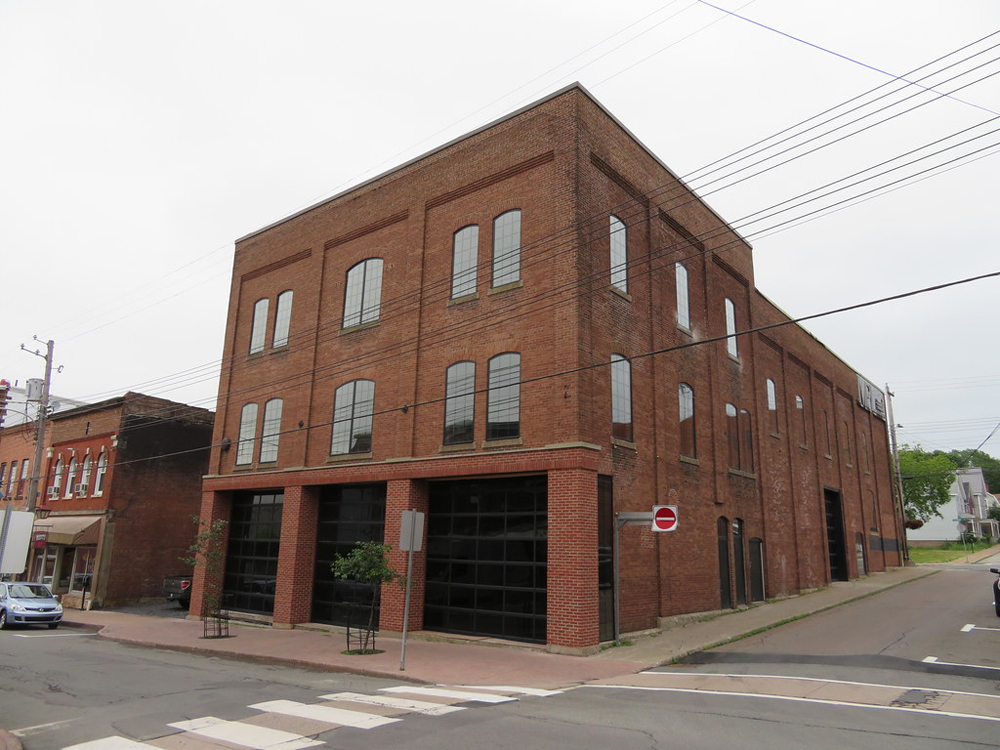
pic_roselandTheatreNewGlasgowThis weekend, we went to New Glasgow. We stopped downtown to look at the renovations to the Roseland Theatre. The building has been restored by James MacGillivray. There are murals by Christian Toth commemorating Viola Desmond. Plus artwork by local citizens, including Heather’s sister – Sandra Stewart.
I was impressed by the number of new business developments in the downtown core.

We had the opportunity to walk in the waters of the Northumberland Strait at Melmerby Beach. Stop for Sunday brunch at Pictou Lodge, before driving along the Blue Cycle Route from Pictou to Truro. Then through the Rawdon Hills from Shubenacadie to Windsor, and home.

Last word to Joan Francuz:

“ So what I tell my grandchildren is this: look out for barbarians, build your agricultural surplus, and everything will be all right in the end.” p.155.

I recommend a trip to Endless Shores Books in Bridgetown, and DO pick up a copy of ‘Press Enter to Continue’.

Acknowledgements

Heather for the companionship on our weekend road trip. Edward for his graphics contribution. Joan Francuz for putting the act of writing into such a rich cultural context.

Reference

Joan Francuz, 2018. Press Enter To Continue: Scribes from Babylon to Silicon. 1920 House Press

Posted in Book Review

Rewilding

In Lunenburg, I picked up George Monbiot’s book Feral.bookCover_feral It has taken me several weeks to read this well-researched work. There are excellent chapters on his travels in the Amazon, South Africa and Indonesia. His adventures off the Welsh coast in a sea kayak. At the time of writing, Monbiot was living in Central Wales. A major concern was the impact of sheep farming on landscape ecology.
‘The National Ecosystem Assessment states that agricultural land occupied some 1.64 m hectares or 79% of Wales in 2008 and that crops now account for only 3% of the agricultural land area’ p.159.

‘According to Kevin Cahill, the author of Who Owns Britain, 69% of the land here is owned by 0.6% of the population’ p.181.

Monbiot includes chapters on Rewilding the Sea, and the potential for Marine Protected Areas.

From a Nova Scotia perspective, it is interesting to speculate on the potential for Rewilding of the land and sea in Southwest Nova Scotia. Would this change our treatment of the landscape?

Feral was written in 2013. To obtain an update, I went online. Monbiot has written two new books. In 2017, How did we get in this mess? And 2018, Out of the Wreckage.

On the web site fivebooks.com he makes some suggested reading, plus: Jeremy Lent The Patterning Instinct and Martin Adams, Land: a new paradigm for a thriving world.banner_fiveBooks

Postscript

Today, at Endless Shores Books in Bridgetown, I found Joan Francuz, Press Enter to Continue. From the back cover, ‘Like Cicero, she believes that if you have a garden and a library, you have everything that you need’.

I look forward to the day when I can check out some of these books through the services of inter-library loan. Meanwhile, the garden is enjoying the latest rain showers.

References

George Monbiot, 2013. Feral: rewilding the land, the sea and human life. University of Chicago Press.
From fivebooks.com Monbiot recommends:
Cormac McCarthy, The Road
Thomas Piketty, Capital
Naomi Klein, The Shock Doctrine
Paul Verhaeghe, What about me?
Kate Raworth, Doughnut Economics

Joan Francuz, 2018. Press Enter to Continue: Scribes from Babylon to Silicon. 1920 House Press.

Posted in biographical sketch, Book Review, Video Review

Heading to the South Shore

banner_nosyCrowFriday, we took a quick trip to the South Shore. In Mahone Bay, we stopped for coffee and a cinnamon bun at the LaHave Bakery. We discovered that it is now The Nosy Crow Bites and Brews. Many of the stores were either for rent or sale; presumably, the impact of COVID-19 on a small community dependent on the Summer tourist trade.

banner_lunenburgBoundBookstoreIn Lunenburg, we stopped at Lunenburg Bound bookstore. I picked up the last copy of George Monbiot’s book Feral, published by Penguin Canada in 2013. Heather found Zach Loeks’ book The Permaculture Market Garden with a Foreword by Joel Salatin, published by New Society in 2017.

‘Most market garden books start with plants, production techniques, marketing protocols and the like. This one dares to address the most basic climatic, topographical even community nuances into the process.’ p.vii.

The Introduction in George Monbiot’s book, Feral, admonishes the environmental plight of Canada.

‘The positive environmentalism I developed in Feral is intended to create a vision of a better place, which we can keep in mind even as we seek to prevent our government from engineering a worse one.

‘I will be happy if this book helps to stimulate new thinking about our place on the living planet and the ways in which we might engage with it. Nowhere, I believe, is in greater need of that than Canada’ p.xix.

That was written seven years ago.

Later, on Friday evening, somewhat inspired by Monbiot, I turned to watch the Netflix Movie ‘Into the Wild’, the film based on Jon Krakauer`s 1996 book of the same name. It tells the story of Christopher McCandless who hiked across North America into the Alaskan Wilderness, in the early 1990s.

This weekend, I continue with my reading of Feral.

Acknowledgements

Heather and Siqsiq were my companions on the trip to the South Shore. Edward, later, added the graphics.

References

George Monbiot, 2013. Feral: rewilding the land, the sea and human life. University of Chicago Press.
Zach Loeks, 2017. The Permaculture Market Garden: a visual guide to a profitable whole-systems farm business. New Society Publishers. Foreword by Joel Salatin.
Netflix movie, 2007. Into the Wild. Produced and Directed by Sean Penn.

Posted in biographical sketch, Book Review

Shelf Life Books

Tuesday, we had to go to town in Kentville. It was time for a car service at Kings County Honda. While waiting, I stopped at Shelf Life Used Books and picked up two items.

bookCover_bikingToBlissvilleFirst, Kent Thompson, Biking to Blissville: A cycling guide to the Maritimes and the Magdalen Islands. Written in 1993, before his book, Getting out of Town by book and bike. It includes two rides of interest to me in Nova Scotia. One was around Great Village, with a nod to Elizabeth Bishop, and a second, around Bridgetown, with a nod to Ernest Buckler and Ken Tolmie.

The second book, A Natural History of Kings County published by The Blomidon Naturalists Society in 1992.

“It would also be appropriate to dedicate the volume to Kings County itself, for it has had an inordinate capacity to nurture naturalists. A geographic area often becomes famous historically because of the endeavours of its people. We often overlook the obvious lesson that it is the terrain that manipulated people and elicits specific capabilities, and not the other way around.”

The book has sections on Geography, History, Habitats and appendices on field trips and naturalists of Kings County.

It makes me wonder about ‘A Natural History of Annapolis County’.

Through email, I have received three interesting notices. From Gregory Heming, I received the link to One Resilient Earth, ‘crafting new narratives for resilient communities in Atlantic Canada.banner_oneResilientEarth

‘A collaboration between the Centre for Local Prosperity and One Resilient Earth to design and facilitate a series of virtual workshops on transformative climate resilience and green recovery’.

‘Following the virtual Thinkers Retreat, the Centre for Local Prosperity will produce a publication compiling the final vision, insights and resources gathered through open dialogue’.

banner_UGuelphTheAtriumFrom Danielle Robinson, a copy of her PhD thesis defended at the University of Guelph Cultural Sustainability and rural Food Tourism in two Canadian Wine Regions. Danielle visited the Annapolis Valley in 2019 (before COVID 19). At four hundred pages, it will take me a while to digest the research results.
banner_sovereignSoil
Link to film trailer HERE

Finally, from Jane Borecky about the Hyland cinema, pay-for-view, NFB presentation Sovereign Soil about farming in the Canadian sub-Arctic.

Happy Birthday to my sister, Maureen. She is 72 years young today (24th).

Acknowledgements

Anne Crossman for remembering the name, Shelf Life. Gregory Heming, Danielle Robinson and Jane Borecky for forwarding the links. Heather for an enjoyable day in town, away from our parched garden. Edward for his Graphics contribution.

References
Kent Thompson, 1993. Biking to Blissville: A cycling guide to the Maritimes and the Magdalen Islands. Goose Lane.
Kent Thompson, 2001. Getting out of town by book and bike. Gaspereau Press.
The Blomidon Naturalist Society, 1992. A Natural History of Kings County. Acadia University.

Posted in Book Review, Opinion

From Here to There

A few years ago, I was Chairperson of the Southwest Nova Biosphere Reserve Association (SNBRA). I have kept in touch with the Bras D’Or Lake Biosphere Reserve Association. banner_braDorLakeBiosphereResearveThis Saturday, I received their quarterly newsletter. I was struck by three contributions.

1) Nature’s Calendar by Annamarie Hatcher
2) The Old Woollen Mill by Corrine Cash
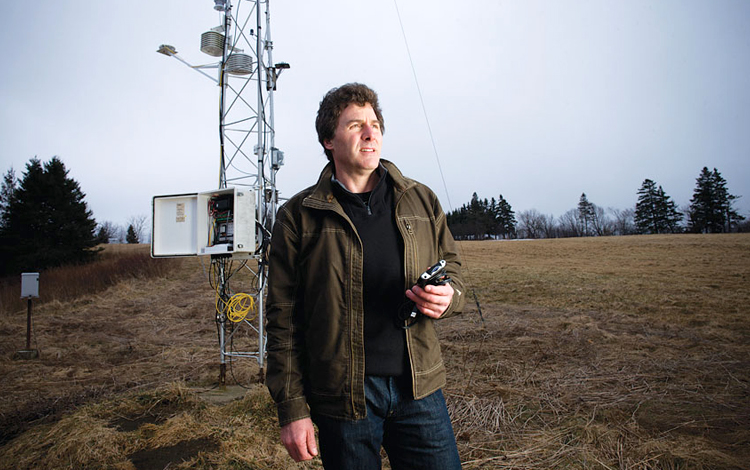
3) Cape Breton Weather Mesonet by Jonathan Buffett

Annamarie Hatcher links the changes in Nature to the Mi’kmaq calendar. Corrine Cash describes the long history of the mills at Irish Cove. Jonathan Buffett is the founder of Cape Breton Mesonet, a network of community-owned Weather stations in Cape Breton and the eastern mainland.

Their solstice newsletter under the slogan ‘Msit No’Kmaq — People and Nature; Better Together — offers a model for SNBRA.

person_DavidColville
David Colville and Southshore weather network

In Southwest Nova, David Colville at COGS has maintained a weather network for over a decade. In this time of climate change, perhaps it is time to consider a ‘community-owned weather station network for Southwest Nova?


As in Cape Breton, we should embrace the slogan: Msit No’Kmaq.

Can we take community ideas from there to here?

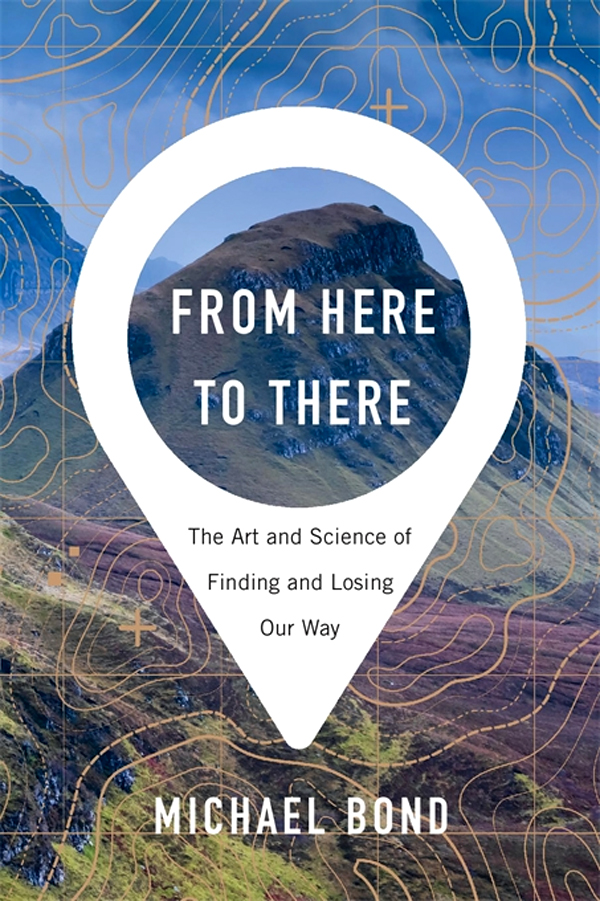
bookCover_fromHereToThere_2This week, Michael Bond’s book From Here to There arrived at the Inside Story. Bond has been Senior Editor at the New Scientist in England.

His book explores ‘the art and science of finding and losing our way’. He reviews the work of Claudio Aporta, Dalhousie University, on Inuit geographic knowledge in the Canadian Arctic. Bond describes the importance of exploration, spatial awareness and self-directed learning. He investigates the latest research from psychologists, neuroscientists.

“ The hippocampus and it’s neighbouring regions seem to have evolved specifically to help us build mental representations of the outside world that we can use to get around and orientate ourselves.” p.71.

In Chapter 8 Bond tells the story of Gerry Largay who is lost and dies on the Appalachian Trail. It includes the Search and Rescue process.

In the final Chapter (10) he looks at Alzheimer’s disease.

The discovery that Alzheimer’s disease disrupts the brain’s spatial system long before the disease takes hold has raised the prospect of using spatial tests to diagnose it.  p.203.

bookCover_gettingLostPostscript

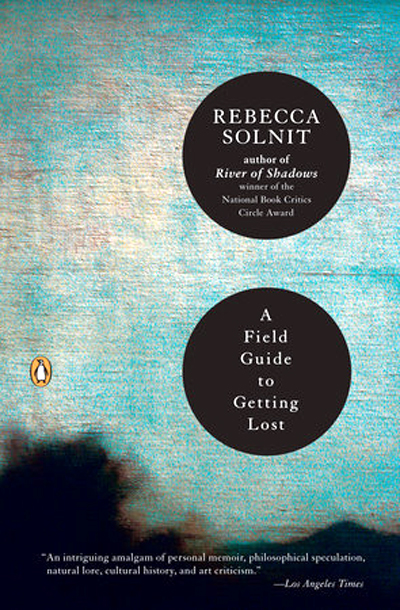
Reading the book by Michael Bond made me pull from the bookshelf, the writing of Rebecca Solnit, in particular, A Field Guide to Getting Lost.

Never to get lost is not to live, not to know how to get lost brings you to destruction, and somewhere in the terra incognita in between lies a life of discovery.  p.14.

Acknowledgements
Edward added the graphics. Heather provided useful feedback.

References

Michael Bond, 2020. From Here to There: the art and science of finding and losing our way: . Belknap Harvard.
Rebecca Solnit, 2005. A Field Guide to Getting Lost. Penguin Books.