As I fly from Ottawa to Iqaluit, I notice my free copy of “Up Here” magazine in the seat pocket in front of me. After a few days, hanging out indoors, waiting for a blizzard to die down, I start to read back issues of the magazine. 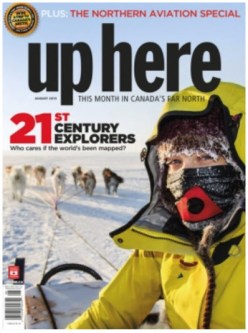 The August 2015 issue had an article by Tim Edwards (p 42-50) entitled ‘From the West to the Wilderness‘.
“Europeans arrived in North America looking for wealth and the Pole. Explorers defied death for glory. What drives today’s adventurers ?”
The article begins with the Franklin Expedition, and then talks about Frederick Cook and Robert Peary “who were welcomed as kings by governors and the public alike, as they stopped In various ports on their way home from the North Pole.”
“Now the world is mapped and the heroes of old are long in their graves. When people go missing in the High Arctic, we consult SPOT trackers, we send out search and rescue missions that last days, not years.”
“Sarah McNair-Landry and Erik Boomer and their dog team spent 120 days circumnavigating Baffin Island. Their goal was to retrace a journey by McNair-Landry’s parents took twenty-five years earlier.”
“Gear and communications are leagues above what it used to be. When Franklin’s ships were lost, other ships were commissioned to follow the route and find the crew – who were stuck in some unknowable corner of the Arctic Archipelago – at their own peril.
Today adventurers have SPOT and InReach devices, satellite phones and helicopters can extricate them from tight spots.”
Today, 2018, with new underwater technology, the wrecks of the Erebus and Terror have been found. Many books have been written on Arctic exploration and its historical context, whether from the European or American point of view. A new history is being written by modern-day adventurers, combining traditional transportation and knowledge, with modern technology, and from a variety of disciplines.
“Whereas early explorers brought European society to the Americas and 20th-century explorers were out to leave a legacy and gain high esteem. Today’s explorers are mostly unknown outside adventure travel circles, looking for not much more than to leave society and experience the world in its natural state.”
REFERENCES
Up Here. The Voice of Canada’s Far North. Published by Canada North Airlines.
Specific back Issue. August 2015. Article by Tim Edwards. From the West to the Wilderness. p. 42-50.
Check Canadian North web site for upnorth.ca
For US perspective,
Michael F. Robinson. 2006. The Coldest Crucible. Arctic Exploration and American Culture. University of Chicago Press.
There are many books written about the European perspective on Arctic exploration and the prevailing European culture.
FOOTNOTE
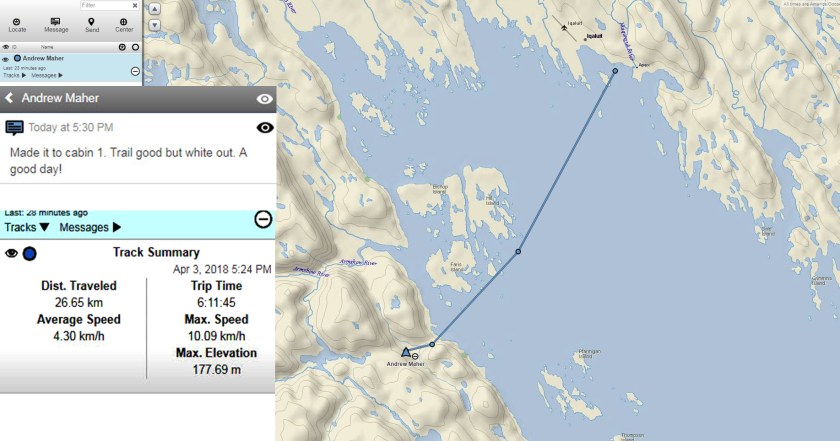
Today, my son headed out for a four-day trip via dogsled team, across sea ice and through a blizzard. Garmin technology allowed him to track and relay his position, average speed, distance traveled, maximum elevation, and time, and send-receive text messages. As I was unable to access these via my computer, I worked with Edward in Nova Scotia to relay that information back to me.
As noted by the Up Here magazine writer, Tim Edwards, “Gear and communications are leagues above what it used to be.“
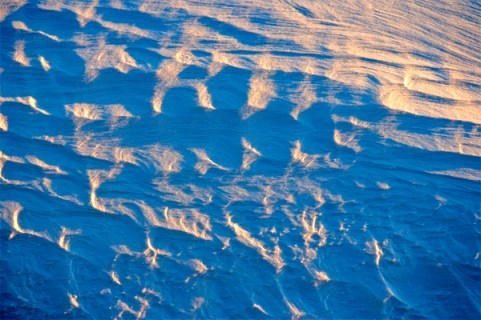
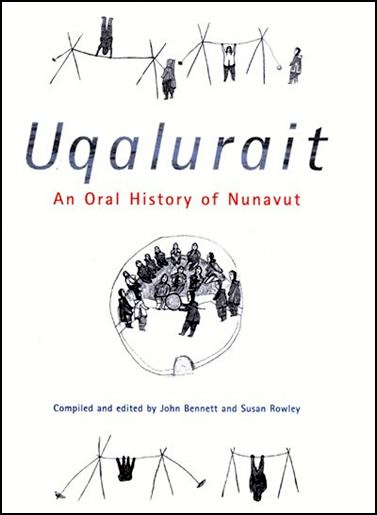 ” During a blizzard, the snowfall is usually soft. A type of snow mound, uluangnaq, is formed. The (prevailing wind) then erodes the mound, thereby forming an uqaluruq – a drift with a tip that resembles a tongue (uqaq) – this is pointed and elevated from the ground – Uqalurait are formed by the uangnaq , (west- northwest wind)” p xxv
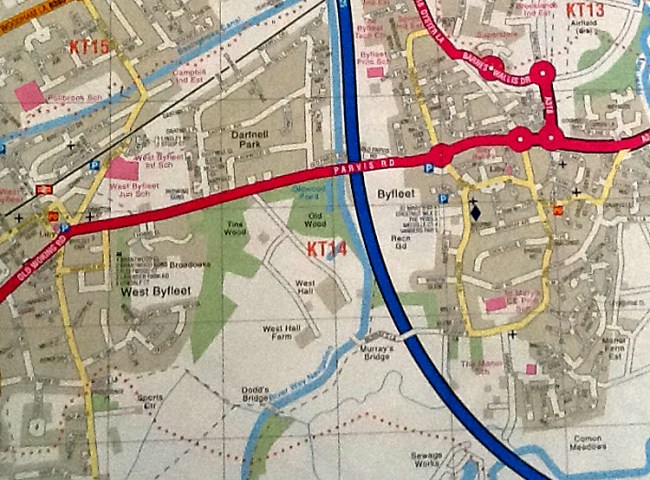 My original intent was to meet my brother for a nostalgic walk throughout our childhood neighbourhood: Twickenham, Whitton, Hounslow, and Hampton. This was abandoned when a winter storm hit England and Europe (the Beast from the East) and he was unable to join me.
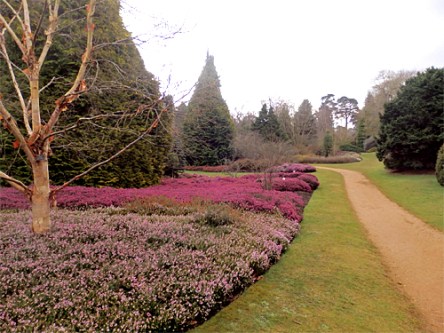 These literary digressions have to be put in the context of my time in England. Most days there was the opportunity to walk through the Surrey landscape. This included Windsor Great Park, Richmond Park, the River Wey Navigations. One trigger for me, was the branding of The Royal Landscape. To park your car and go for a walk through Savill Gardens or the Heather Gardens, you could purchase a membership card to The Royal Landscape. Likewise, if you were a polo player, you could do the same.
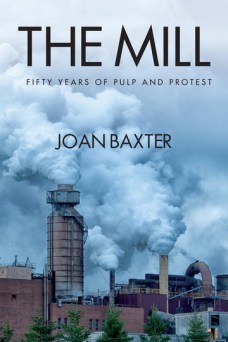 Over Christmas, while in Pictou County, there was the opportunity to read Joan Baxter’s book The Mill. Fifty Years of Pulp and Protest. Baxter provides a detailed and well-researched account of the impact of the Scott Paper Mill at Abercrombie Point, near Pictou. The book paints a sad picture of the relationship between government and the forestry sector and the effect on the local communities and the forest landscape.


