After our field trip to Brier Island, we decided that it was time to revisit the site location for Agalinis neoscotica (see posts, Brier Island and Biogeography). The botanist, Greene, stepped off the train in Middleton and found the species.
A few years ago, we walked through the sports fields by the school, adjacent to the abandoned railway track, and found it. Time to return. We walked past the new Al Peppard recreation centre and looked closely along the woodland edge. We found a few scattered plants in flower (August 8th).
Today, the common name is the Middleton False Foxglove. There are likely few communities in rural Nova Scotia whose name is attached to a unique flowering plant.
Buoyed up by our success, we shared this obscure botanical fact with one of the maintenance team members for the park.
This week, I returned to the Endless Shores Books seeking the other books by Peter Wyman: Iceland and Crossing Thames. No luck! Jennifer Crouse, the owner of the store, told me that the author used to teach English in Annapolis Royal. I look forward to the next consignment of his books.
In 1990, Heather enrolled in the graduate program in Botany at the University of Guelph. Her field of study was Agalinis neoscotica, a diminutive plant growing in Nova Scotia (see blog post Biogeography). One of the sites was Brier Island.
On Sunday, we checked our records. It should be in flower, in early August. Up early, we drove down Digby Neck and took two ferries to Westport, Brier Island. It is a different world to the Annapolis Valley, shrouded in early morning fog and cooler temperatures from the Bay of Fundy.
The first stop was Brier Island Lodge. We needed to pick up a map to negotiate the backroads and trails on the island. It has been thirty years, and we needed help remembering the site locations.
The species of interest here was Eastern Mountain Avens (Geum peckii), an endangered species found only in the White Mountains and on Digby Neck
(photo by Gary Tompkins from Lake Winnipesaukee, New Hampshire, USA).
Afterwards, we took Gull Lake Road to Big Pond, and also the road to Western Light. In both locations, we found Agalinis neoscotica in flower.
Photo by Heather Stewart
We left early, around 7:30 am and we were back home by 3:30 pm. between we had taken two ferries, each way. One surprise, the ferries are free!
If you want to step into a different world, go to Brier Island. At the same time enjoy the story of Joshua Slocum, the first person to sail alone around the world. He has roots in both Mount Hanley and Westport (see blog post Joining the Dots).
Acknowledgements
Heather and I were stunned by the changes to Brier Island, over the last thirty years. Fortunately, the flora has not changed. All photographs are by Heather. Edward added the graphics.
There is something deeply satisfying in watching an orchestra play in concert; even, if only online. Why did I not learn to play an instrument when I was in high school?
From Sandra Barry, I received the link to This is My Music for July 30, 2022 — soprano Susie LeBlanc, with a tip of the cap to Elizabeth Bishop.
Through the mail, I received a copy of the Guardian Weekly, July 29 that included a long opinion piece by Hugh Brody, The Deepest Silence; an adaptation from his recent book Landscapes of Silence, from Childhood to the Arctic. The subject is abuse and suicide in Canada’s North.
From the Best of Boxwood concert (see Musique Royale), Heather returned with a couple of CDs.
With retirement from work, online social media likely moves to ‘second place’.
Acknowledgements
Edward Wedler and Sandra Barry occupy my third place in Nova Scotia. Heather adds her music taste. The Guardian Weekly, North American edition brings home the UK.
Last night was a warm, drizzly evening. We watched CBC News. Colleen Jones interviewed Peter van der Kloet about his efforts to restore the habitat of Monarch butterflies in the Annapolis Valley.
Debby Hebb saw a Monarch butterfly today beside the boardwalk in Annapolis Royal.
On Tuesday, we arrived at Dawn Oman’s Art Gallery in Bridgetown at 7 pm. It is a spectacular venue, combining the restored church with Dawn’s colourful Northern art. Last night, it was the Best of Boxwood, featuring Chris Norman, Catherine McEvoy, Sean Healy, Eamon O’Leary and Janelle Lucyk. It was an excellent, well-attended concert.
I am looking at their schedule for this week: Shelburne, Yarmouth, Bridgetown, Tatamagouche, Iona and Dundee. In my previous blog (Mourning Cloak), I mentioned ‘third place’, neither home nor work. The Oman Art Gallery is a perfect ‘third place’, providing for “the creativity of community“.
Earlier in the day, I had picked up a second Peter Wyman book, “Six Friends“. It is a short story about an attack on Port Royale, in the early eighteenth century, from a Mi’kmaq perspective.
At the concert, I swapped the Wyman’s books with Sandra Barry; for a couple of back issues of The New Yorker. I look forward to her feedback on the two books of short stories.
Meanwhile, from Debby Hebb, I received two photographs of a Monarch butterfly and a blue racer snake.
Here, I believe, is a Blue Racer Snake she saw on the trail a couple weeks ago.
It seems that these ‘third places’ are alive and well in rural Nova Scotia.
Postscript
Just imagine if we had similar venues for our writers, artists and dancers. Musique Royale has been here for thirty-seven years! Here is a sample of two of Musique Royal’s musicians performing (virtually) in Annapolis Royal.
Acknowledgements
Heather joined me at the concert. Sandra Barry shared her literary interests. Debby Hebb forwarded the photographs. Edward added his magic.
References
Musique Royale, A Festival of Music in Historic Nova Scotia, Thirty-Seven Years, Best of Boxwood, 2022, August 2, Bridgetown. Dawn Oman Art Gallery.
Peter B. Wyman, 2021, Six Friends, Cardigan, Little and Crow Publishing, Annapolis Royal
Saturday afternoon, I stopped at Endless Shores Books, Bridgetown. Under local authors, I found two short story collections by Peter B. Wyman, both published by Cardigan, Little and Crow, Annapolis Royal.
I picked up Nymphalis Antiopa (Mourning Cloak) and left Iceland for another day.
It contains seven short stories, set in the region. 168 pages in 6 ½” x 3 ½” format.
A Visit from Mars, Broken Angel, Mourning Cloak, Safe Home, I’d Rather, Gallery St George and Radio Silence.
The reason that I picked out Mourning Cloak is simple, these beautiful butterflies visit our flower garden. It proved to be an excellent choice. Each short story leads the reader back to the history and geography of the region.
I checked online, and asked a few friends but, to date, the author and his publishing company remain a mystery.
On Sunday, I stopped at the Upper Clements picnic park, sat at a table, and enjoyed reading the last two stories, Gallery St. George and Radio Silence.
Other books by Wyman are Six Friends and Crossing Thames.
Postscript
At the Sissiboo Coffee Cafe, Annapolis Royal, I picked up a copy of Edible Maritimes. The Artisan Issue, No. 3 2022. It contains an article, on page 29, For the Locals. Jon and Erin Welch of Sissiboo Coffee Roaster on creativity and community.
From page 30:
“In 1989, Ray Oldenburg published a book called ”The Great Good Place: cafes, coffee shops, bookstores, bars, hair salons, and other hangouts at the heart of a community”. He was concerned with a growing ’problem of place’ – a loss of public spaces and increased isolation. The antidote, he suggested, are ”third places” – those public places where people gather informally, outside of home and work, where everyone is on common ground and conversation is key. In rural communities, these are typically community halls and churches. Throughout the Maritimes, there is a growing resurgence of ’third places’. “
The challenge, as noted by Heather, is access to transportation in these rural areas.
Mexican Sunflowers in our garden. How to grow and care for them HERE.
Acknowledgements
Sunday, Heather joined her Shambala Group in Annapolis Royal. I had the chance to finish reading Mourning Cloak. Edward added the graphics.
References
Peter B. Wyman, 2022, Nymphalis Antiopa (Mourning Cloak), Cardigan, Little and Crow Publishing.
Other short story collections by Wyman: Iceland, Six Friends and Crossing Thames. All self-published by Cardigan, Little and Crow Publishing, Annapolis Royal.
Saturday, we stopped at the Bridgetown library. You can pick up, for free, back issues of magazines. I found the New Scientist. It reminded me of my school days at Chiswick Grammar School for Boys.
In the evening, I shared a beer with John Wightman. We walked down to his neighbour’s dock on the Annapolis River. As we sipped, a river boat came up from Annapolis Royal’s direction and turned round at Jubilee Park.
It reminded me of Summer Institutes at COGS in the 1980s. We would rent a boat for a trip down the river towards Annapolis Royal. Always an enjoyable adventure through the rural landscape, between North Mountain and South Mountain.
This week, Heather and I met Rocky and Debbie Hebb for breakfast at Shakes on Main, in Lawrencetown, run by CRIA, only to discover the restaurant closes for good, Friday this week (29th). Given the Annapolis County Exhibition in August, it is unfortunate for the local economy that both the Wine Makers tavern and the only restaurant in the village are closed.
There was also notice this week that Municipal staff are being relocated from Lawrencetown to Annapolis Royal. Meanwhile, the Centre of Geographic Sciences (COGS) is in Summer mode and looking for student accommodation.
I can recall COGS operating forty-eight weeks per year (three 16-week semesters) and offering a Summer Institute. How things have changed!
From the Marginalian are Beatrix Potter’s little-known scientific discoveries
“Potter soon began conducting her own experiments with spores she germinated herself. She was particularly captivated by lichens, considered at the time ’the poor peasants of the plant world.“
Acknowledgements John Wightman shares my memories of COGS and a good beer. Rocky and Debbie Hebb for our last breakfast at Shakes on Main with Heather, and myself. Edward has been away plein air painting on the South Shore. Hence any delay in the blog post.
Heather and I met Trevor Goward in the late 1970s. It was a time when we were on the West Coast of Newfoundland (Gros Morne National Park) or in Ottawa at the National Herbarium. I was part of the Rare Plants team headed by George Argus. George was a Salix taxonomist. Other taxonomists, at the Museum, included Irwin Brodo (lichens), and Bob Ireland (mosses).
Fast forward to 2022, I am reading Merlin Sheldrake’s book Entangled Life.
’Goward, curator of lichens at UBC, is foremost a lichen obsessive (he has contributed around thirty thousand lichens to the university collection) and is no less a lichen taxonomist (he has named three genera and described thirty-six new lichen species).’ p.79.
’We believe that books on lichens need to answer two questions. The first question is, how does one learn to identify lichens. The second question is, why should one bother? It is this second question, not so much the first which is comparatively easy, that has preoccupied us for the past dozen years.’
From twelve readings on the lichen thallus.
”Lichens, he argues, have relevance far beyond their interest as objects of scientific inquiry. Lichens exist as a doorway, a portal. Look out this doorway in one direction and what you see is an ecosystem – a collection of unrelated species, fungi and alga and bacteria. But look out the same doorway in the other direction, and what you see now is an organism, in a sense no different from any other macroscopic organism.”
“The double status of lichens as organism and ecosystem make them the ideal model entities through which to contemplate a new scientific philosophic and artistic paradigm, now in the process of emerging.”
”In recent years, Trevor has reconfigured his 4 ha. home property, Edgewood Blue, into a not-for-profit place for learning, for naturalists and others committed to a closer relationship with the living world”.
Acknowledgements
Heather first discovered the Entangled Web. This, in turn, led us to the Ways of Enlichenment website. Edward added the graphics. Trevor responded to my email.
Last week, we held a meeting of the Ernest Buckler Literary Event Society (EBLES) committee at Anne Crossman’s, under the linden tree. We discussed plans for the next event, likely in West Dalhousie, 2023.
Jane Borecky returned Roger Deakin’s Waterlog: A Swimmers journey through Britain. Later at home, I checked through the index, and found and re-read #23 Orwell’s Whirlpool. Deakin describes his visit to Jura.
”Whirlpools and wild places are inextricably linked with our capacity for creativity“, as Orwell demonstrated when he chose to come to Jura to write his last novel.
Meanwhile, I had finished reading George Orwell’s Selected Writings. Besides excerpts from his life in Burma, Spain and Marakesh, it includes essays on the English class system, Boys’ Weeklies and Charles Dickens.
”A century after the Group of Seven became famous for an idealized vision of Canadian Nature, contemporary artists are incorporating environmental activism into work that highlights Canada’s disappearing landscapes.”
I forwarded the link to Edward and Anne Wedler. Meanwhile, Patrick emailed me a link to the Radical Landscapes exhibition in Liverpool, UK.
On Saturday, we took a road trip from New Glasgow to South Victoria, through Oxford, Pugwash, Tatamagouche, River John and home.
As we drove from Oxford to South Victoria to Pugwash, we noticed significant changes in land use, both the forestry and even the roadside weeds. It would be a fascinating geographical study to map the changes in the demography and the landscape. Since we had both Heather and John Stewart in the car, we had an ongoing commentary on the changes that have taken place in the last fifty (plus) years.
Eventually, we arrived in River John for Sandy Stewart’s (Heather’s sister) birthday party. Sandy had been busy painting a new sign for the community of Melville.
Here are my questions.
If you are an artist painting landscapes, how do you separate your art from your life?
The same question applies to writers.
How do you separate your writing from your life? This certainly applies to George Orwell. I think the same applies to Roger Deakin. Hence, once back home, I pulled Roger Deakin’s book off the shelf, Notes from Walnut Tree Farm.
Acknowledgements
Heather and John Stewart accompanied me down memory lane. Sandra Stewart provided a painting of her place. Edward and Anne’s planned adventure brought the Group of Seven into focus. Plus a contribution from Patrick Maher (this week) at a conference in Ambleside, the Lake District.
Kings County is large — stretching from the Bay of Fundy and Minas Basin to the deep interior of Nova Scotia. That’s over 2,000 square kilometres of territory.
Beginning in August, artists will be spread out across the county painting landscapes as part of “Brush with Nature” — an inaugural event hosted by King’s County Museum.
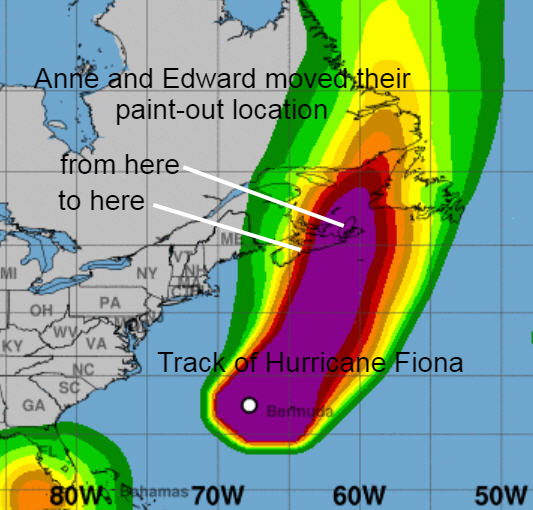
Anne and I have been collaborating with the Museum in the design and operation of this three-week plein air painting event.
The goal is to support both the museum and regional artists while celebrating the natural and historic features of the County. Artwork will be available for sale, auction and draw.
Any time between the 1-18th of August, artists can paint outdoors, anywhere within the County. We call this the “LONG BRUSH”. On Saturday the 20th of August the Museum hosts the “SHORT BRUSH” at Miner’s Marsh in Kentville. This is where artists will congregate to paint in and around the picturesque marshlands within a 2-3 hour window.
An early “Call to Artists” has already attracted some serious local talent.
Anne and I belong to six plein air art groups, three in Nova Scotia (founding two) and three in the USA (co-founding one), and have participated in many plein air events. We believe Kings County Museum and artists in “Brush with Nature” will have a successful and enjoyable event.
The size of Canada’s Northwest Territories dwarfs Kings County. This, I learned, is the location of Canada’s 44th Remote Sensing Symposium, 19-22nd June, 2023.
How time flies. I recall the early days of these RS conferences when conference images were printed out via typewriter overwriting symbols. Now we have hyperspectral imaging from drones (UAVs) and satellites delivered to mobile devices that complement GIS and AI systems (I could deliver a stand-up comedy routine on these changes).
The more I learn about co-chair Chris Hopkinson, professor at the University of Lethbridge and Google Scholar, the more I fathom his teaching and communication skills (he does reveal a sometimes awkward and dry sense of humour). He has built a potent remote sensing program. I could spend (and have spent) hours watching his YouTube Playlists.
I wish Chris Hopkinson, his colleagues and students, along with attendees from across the country, all the best and much success at Canada’s 44th Remote Sensing Symposium.
While this symposium is taking place I will be preparing for my art trek with Anne, Footsteps East, through New Brunswick, Quebec and Ontario.
Bob kindly sent me a reference to nature writer, Richard Mabey’s audiobook, “A Brush with Nature“. This represents 25 years of personal reflections on nature — from observational reflections on nature to questions about its relationship with language, art and life.
Acknowledgements To Bob Maher for his continued encouragement to write about my art experiences and reflections on RS. To Chris Hopkinson for his engaging online videos and promotion of ULethbridge and Canada’s 44th RS Symposium.
This is a favourite book store. The owner’s interests seem well aligned with mine. It includes a section on George Orwell’s books, as well as recent publications from Gaspereau Press.
This time, I found a chapbook from Falling into Place. In 2002, Gaspereau published a groundbreaking geo-memoir by poet and long-time Hamilton resident, John Terpstra. It starts with the phrase.
’I am attached to this piece of Geography.’
A chapbook is a reading sample; in this case, thirty pages, ‘Terpstra’s investigations centre around the Iroquois Bar, a giant glacial sandbar which lies beneath one of Hamilton’s busiest transportation corridors.’
My second find was George Orwell’s Selected Writings, edited by George Bott.
’I have tried to show something of Orwell as a political apologist; something of his remarkable ability to record experience vividly and to argue convincingly; some autobiography, some literary criticism, some satire.’
This selection of George Orwell’s writings is intended mainly for sixth forms, adult classes and training college students.
First published in 1958. Topics include The English Class System, Politics and the English Language, Why I Write, Poetry and the Microphone.
Last night, we were settled in for an evening of British TV on PBS Maine. Around 9 pm, before Doc Martin, we received a call from New Glasgow. Watch the CBC documentary ’Elizabeth Bishop and the Art of Losing’.
We changed the channel and enjoyed an excellent program.
Acknowledgements
The Odd Book has the best-organized collection of second-hand books in the Valley. John Stewart phoned about the CBC documentary. Heather shared the Wolfville market experience. Edward added the graphics.