Posted in Event Review

SwiftWatch and AIRO’s birthday

This week, Heather has been participating in Maritimes SwiftWatch.logo_martimesSwiftWatch

MTRI (Mersey Tobeatic Research Institute) and CARP (Clean Annapolis River project Society) are monitoring the roosting behaviour of chimney swifts at the new chimney at the old Bridgetown High School site. Every evening at dusk the chimney swifts circle and then dive into the chimney to roost for the night. On a clear Summer evening, this natural phenomenon attracts considerable interest from the residents of Bridgetown. It could be considered a tourist attraction. It is certainly an example of citizen science.

logo_localLogicAIROTo catch up with the activities at AIRO (Annapolis Investments in Rural Opportunity), I arranged to meet with Jane Nicholson. I had not realized that it was their third birthday. In their latest newsletter, they describe the types of businesses that they have supported, in line with their 2017 report: Local Logic: how to get there from here. Examples include restaurants, brewery, marina, trades, experiential tourism, retail and many others. There is considerable interest in the AIRO model from other jurisdictions. Jane was also kind enough to loan me a new book by Michael von Hausen,  Small is Big: making the next great small to mid-size downtowns.

logo_writersAndCompanyOn CBC Writers and Company, Annie Proulx was Eleanor Wachtel’s guest. Proulx is best known for her books, The Shipping News and Barkskins. In the interview, she talks about ‘geographic determinism”.

‘I think that where you live dictates who you are, what you do, who you marry, your work, what you eat, how you die, what happens to you afterwards. It’s all place.’

bookCover_biography1984Another item that crossed my desk was from May 24, 2019, The Guardian Weekly. It includes an extract from The Ministry of Truth: a biography of George Orwell’s 1984 by Dorian Lynskey. The following two quotations caught my attention.

‘Orwell felt that he lived in cursed times. He fantasized about another life in which he could spend his days gardening and writing fiction instead of being ‘forced into becoming a pamphleteer’.

‘Central to his honesty was his commitment to constantly working out what he thought and why he thought it and never ceasing to reassess these opinions. To quote Christopher Hitchens, one of Orwell’s most eloquent admirers ‘It matters not what you think, but how you think’.

Acknowledgements

To Heather Stewart for sharing her swift monitoring duties. To Jane Nicholson for sharing the AIRO story. To Edward Wedler for the graphics.

References

Bird Studies Canada. Maritimes SwiftWatch. Check web site www.birdscanada.org/ai

AIRO Annapolis Investments in Rural Opportunities

Michael A. von Hausen. 2018. Small is Big. Making the next great Small to Mid-Size Downtowns. VIU Press.

CBC Writers and Company. From The Shipping News to BrokeBack Mountain, Annie Proulx on the importance of place in her fiction.

The Guardian Weekly. 24 May 2019. The Clock struck 13. p54-57. Extract from The Ministry of Truth: a Biography of George Orwell’s 1984. by Dorian Lynskey

Postscript.

Chronicle Herald. June 1, 2019 Page D2. Don Mills. ‘Regional hubs could cure rural malaise’. An alternative view on rural communities in Nova Scotia.

Posted in Book Review

Jane Jacobs Biography

bookCover_escapeToReality

“If you have a library and a garden, you want for nothing else”: British saying.

From Chapter 4. What we can learn from the British, Mark Cullen and Ben Cullen’s Escape to Reality: how the world is changing gardening and gardening is changing the world.
bookCover_JaneJacobs
I found in the COGS Library Alice Sparberg Alexiou’s biography Jane Jacobs: Urban Visionary.

Chapter 10, Economist without Portfolio, starts with the question ” Why do some places get rich, but not others ?” (p 169).

In ‘On the Mechanics of Economic Development’, Robert Lucas, who would win the Nobel Prize for Economics in 1995, argued that places that thrive do so mostly as a result of what economists call ‘human capital’ (p169). When Lucas was developing his hypothesis, he read Jacob’s 1969 book The Economy of Cities. Her book, Lucas realized, was all about the external effects of human capital, and it helped his ideas take shape (p 170).
“As Jacobs had rightly emphasized and illustrated with hundreds of concrete examples, much of economic life is ‘creative’ in much the same way as ‘art’ or ‘science’ (p 171).

“All economic growth since the industrial revolution is due to ideas,” Lucas says ” But growth theory for years ignored the force of ideas. For Jacobs, this question is the centre of everything’. ” Jacobs, he says “shows that most of the ideas come from the ground, not R & D departments” (p 171).

From Jacobs, ” I think we are misled by universities … into thinking that there actually are separate fields of knowledge. But no, they link up … everything is a seamless web … and its a very functional thing, not just a poetic expression.”

CHruralRenaissanceCombine these observations by Jacobs with the Chronicle Herald article on the new rural economy. The PLACE model of Community Development comes from seven years of research on Fogo Island by Memorial University in partnership with the Shorefast Foundation.

Promote community champions
Link Insiders and Outsiders
Assess local capacities
Convey compelling narratives
Engage both/and thinking

‘It is through a commitment to place, and principles of PLACE, that champions muster the energy, creativity and other resources to renew a community’s economy and sense of purpose.’

Further to my conversations with Brian Arnott (see my earlier blog) Jane Jacobs can be considered both an urban visionary and a rural visionary.

Postscript

This week, we settled on the format for the Local Authors Question and Answer session at the EBLES event on June 29th. Bob Bent, Marilyn Jones and Dianne LeGard, all members of Authors Ink, will discuss their work. They will address the question: Why do I write? What do I like to write about? How is my writing published? How to market my book(s)?

Acknowledgements
Brian Arnott for his thoughts on economic development in rural communities. Edward Wedler for his graphics contribution.

References

Alice Sparberg Alexiou. 2006. Jane Jacobs: Urban Visionary. Harper Collins Publishing.

Mark Cullen and Ben Cullen. 2018. Escape to Reality. How the World is changing Gardening and how Gardening is changing the World. Nimbus Books.

Barbara Dean-Simmons. Chronicle Herald. Friday, May 24,2019. How unexpected ideas are leading to a new rural economy. Part 3. Taking the Past into the Future. p A8-A9.

Posted in biographical sketch

Citizen Advisory

This week, I had two opportunities to discuss citizen advisory committees. The first arose from my conversations with Brian Arnott. Brian and his partner Leslie Wright run an international cultural consulting business, Novita Interpares, from Lunenburg.Screenshot_2019-05-20-09-01-43 We were comparing notes on community development in the Annapolis Valley and along the South Shore. In my previous blog, I had raised questions about technology and education from the perspective of a citizen living in rural Annapolis County. Asking difficult questions, and offering solutions are very different activities.

From Brian, I recognized that small towns are scaled down versions of our larger metropolitan areas. As such their economic development depends upon input from different sectors. This input can be obtained through citizen advisory committees or sectoral interest groups.

The second opportunity was a meeting with Danielle Robinson. Danielle is a Ph.D candidate at the University of Guelph.Screenshot_2019-05-20-09-12-57 Her Ph.D research is a comparative analysis of food tourism in the Okanagan Valley with the Annapolis Valley. As we talked about the structures in Nova Scotia , I realized there is a real difference in both approach and culture between BC and NS. Comparative research can help us redefine our approach to seemingly intractable issues: changing demographics, municipal competition, the relationship between communities and their educational institutions.


While in Lunenburg, Brian introduced me to Alastair Jarvis who runs Woodscamp Technologies Inc. This company is owned by the American Forest Foundation. Their business model is to assist private woodlot owners in several US states. They use a combination of technologies to meet the needs of their clients. Interestingly, their staff has expertise in GIS, cloud computing, as well as gaming technologies. They are able to meet the needs of their American clients from Lunenburg, in rural Nova Scotia.

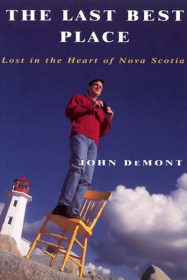
This week, we have started to ramp up the publicity for the Ernest Buckler Literary Event Society (EBLES) bi-ennial event, in support of local writing. This year it will be Saturday, June 29th at the Temple on Queen in Bridgetown. Keynote speakers are Whit Fraser and John Demont. Both bring a reporter’s experience to their writing and understanding of the North, and the Maritimes, respectively.

b52c602a-2817-4905-9c36-9fda35f157e7Tickets for the EBLES event are available at The Endless Shores Books, Bridgetown; Shelf Life Used Books, Kentville; The Inside Story, Greenwood; Mad Hatter Books, Annapolis Royal and the MacDonald Museum, Middleton.

Acknowledgements

To Brian Arnott, Alastair Jarvis and Danielle Robinson for a series of stimulating conversations. To the members of the EBLES team for their ongoing commitment to writing about place: Jane Borecky, Anne Crossman and John Montgomerie. Edward Wedler for his graphics contribution.

References

Woodscamp Technologies Inc. see their web site at woodscamp.com

Whit Fraser 2018. True North Rising. Burnstown Publishing House.

John Demont 2017. The Long Way Home. A personal history of Nova Scotia. Penguin Random House.


Posted in Opinion

Carpe Diem

On Friday, I cycled to COGS to meet with Wayne St-Amour (Principal, Annapolis Valley campus NSCC) and Michael Purcell (Manager, COGS). The chat was about the new residence on the Lawrencetown site. On my way, I noticed the OPEN sign at the WineMakers  Tavern on the corner.Screenshot_2019-05-11-10-35-03 Later in the day, Heather and I stopped there for an inaugural lunch. This opening, combined with the renovations at the Lawrencetown restaurant, shows a real commitment by local business to the community. These investments are complemented by the activities across the river at the BeaverCreek Winery and Lunn’s Mill Beer Company.

This week proved to be a painful transition for me. It was time to start up the ride-on lawn mower, as well as the tractor for the orchard. My enthusiasm was dampened by the need to replace the batteries, but also to switch mental gears. I had to ‘get out of my head’ and ‘get into my hands’. Two very different types of thinking.

This transition coincided with listening to a couple of podcasts on CBC Radio Ideas. This week, Jean Vanier died, aged 91, in Paris. Vanier was the founder of the L’Arche movement. The podcasts, The Rabbit and the Giraffe replayed  interviews with Vanier about his life and philosophy. I was struck by his holistic philosophy, but also his deep sense of community.

As I reflect on the initiatives taking place in the Annapolis Valley, it seems that we must ‘seize the moment’. In my conversation with Wayne and Michael, it appears that not a lot has changed since the early days of COGS (1980’s). We still possess a unique circumstance of a specialized technical institute, located in a diverse, culturally-rich, rural setting. There are however some questions that we need to collectively answer:

What is happening to the high speed Internet for the region?

We have talented elders in the region who are having a difficult time conducting their business because of the continuing poor Internet service; undoubtedly placing some at a competitive disadvantage.

What is happening to Gordonstoun Nova Scotia?

This initiative makes sense, especially if it is coupled with the interests of other post-secondary institutions, like COGS. The underlying values are consistent.

What is the vision and business plan for the new residence  at COGS?

We need to understand the market for the courses that will be offered at this facility so that it will cover the initial investment and annual costs.

From where I sit, on the East Side of Eden, the opportunity to grow ‘the creative rural economy’ remains. Carpe Diem. But we do need answers to these three questions. Within the community, there are elders who can assist in finding these answers.

Postscript.

We went to see Sharkwater Extinction at the Kings Theatre, Annapolis Royal on Friday evening. It is a documentary on the life of film maker and conservationist, Rob Stewart. We were surprised at the low attendance. Perhaps, our marine environment remains under-appreciated by land-based rural residents.

References

CBC Radio Ideas. 2019. Two part series. Remembering Jean Vanier: The Rabbit and the Giraffe. Available as podcast.

Acknowledgements

To Wayne St Amour and Michael Purcell for their willingness to chat. John Wightman and Roger Mosher for their regular Friday afternoon feedback. And Edward Wedler for his remote contribution.

Posted in Event Review, New thinking

COGS celebration and reflections

Last Friday, I attended the 17th Annual COGS Student Success celebration at the Lawrencetown Fire Hall. Approximately fifty awards were handed out to students in the Geographic Sciences. COGSawardsThis included GIS, Remote Sensing, Marine Geomatics, Survey Technology and Technician, Community Planning and Information Technology. Today, the student population is around one hundred and fifty.  In my day (1980-88), we had similar student numbers, divided into three departments: Surveying, Computer Programming, and Cartography/Planning. It will be interesting to speculate on the numbers and disciplinary interests over the next thirty years.

Konrad Dramowicz and Kathleen Stewart, both announced their retirement from the NSCC. We wish them well in the third age.

bookCover_ArtisticApproachesToCulturalMappingA couple of conversations caught my attention. The first was a chat about the conversion of a LiDAR-derived topographic landscape into a hooked rug. This resonated with a new book that I had signed out from the COGS library. Artistic Approaches to Cultural Mapping: activating imaginaries and means of knowing. The second conversation, with Ed Symons, related to my experience at the walk-in clinic in Berwick, looking for a doctor. There, I had picked up a brochure describing the process for 811 registration. Here was my question: why not allow communities to actively engage in the doctor shortage issue. Can we not map citizens who do not have a family doctor from the registry?  Can we not map the communities where doctors are retiring? This would allow individual communities, without government oversight and control, to be more proactive.

logo_WWSCYesterday, Heather and I joined a group of about thirty woodlot owners for a field trip organized by the Western Woodlot Services Cooperative (WWSC) to North Range, Digby County. It started at the Forest Products Mill outside of Barton. Our host was Harold Alexander who has been managing woodlots in the area for over forty years. It was a joy to spend the time in the woods with a knowledgeable person and to appreciate the complexity of the decision process behind woodlot management and to understand the potential for a better alternative through citizen collaboration.

bookCover_UnderlandThis week, I received emails, from my brother and Frank Fox, about the new book by Robert MacFarlane, Underland. On BBC Radio 4 at 9:45 am, each day there was a short podcast from a different chapter. The book looks at landscape features below the ground, especially caves, mines, sewer systems throughout Europe. It reminded me of two occasions in my own life. While at the University of Birmingham, we hitch-hiked to the west coast of Ireland to go caving near Lisdoonvarna and the Burren. A few years later (1970) I joined Derek Ford, Michael Goodchild and others to explore Castleguard Cave in the Canadian Rockies, beneath the Columbia Icefields. Both are a classic example of physical geography in action.

One final reflection. Again beginning with a conversation with Ed Symons,  he gave me the latest issue of Municipal World (May 2019). It includes an article New Uses for Historic Places of Faith. Up near Wolfville, they have converted a church into a local craft brewery. Yesterday I noticed at Plympton, they are deconstructing the church. Only the frame remains standing. What an interesting commentary on society.

Acknowledgements

Ed Symons for the conversations, before and during at the COGS Award Ceremony. Harold Alexander for his in-depth knowledge of the woods in Southwest Nova Scotia. Peter Maher and Frank Fox for forwarding the reviews of Robert McFarlane’s new book. Edward Wedler for his artistic contribution.

References

Nancy Duxbury, WF Garrett-Petts and A. Longley. (ed). 2019. Artistic Approaches to Cultural Mapping: activating imaginaries and means of knowing. Routledge Publishing.

Robert MacFarlane. 2019 Underland: a deep time journey. Hamish Hamilton Publishing.

Footnote

In the Duxbury book, two items caught my eye. There is a reference to Tom van Sant’s  map The Earth – From Space: a Satellite View of the World. Here, right next to my computer, I have a signed copy of this image dated 12-13-90 from my days with Esri, Redlands and meeting Tom at his studio.

The second item is a reference to the work of radical geographer, William Bunge: 1968. Where Detroit’s run over Black Children on the Pointes-Downtown Track map. Bill spent time in the Department of Geography, University of Western Ontario, London, Ontario.


Posted in Event Review, Opinion

COGS awards night 2019

bookCover_storyOfCOGS

I have been invited to hand out four awards on Friday, May 3rd at the Lawrencetown Fire Hall to graduates of COGS. They are two CANMAP awards, and two  Roger F. Tomlinson awards for excellence in GIS; one associated with Esri Redlands and the other with CANMAP. Given this unique opportunity, I thought that I would write a blog to share some of the history behind these relationships. If you are interested in more details, go to the web site thestoryofCOGS.ca

We have to go back to 1980.  At that time, COGS was called the Nova Scotia Land Survey Institute (NSLSI). It was one of only a handful of technical institutes training surveyors in Canada. I arrived, with my young family, to establish a new program in Scientific Computer Programming (SCP) with Bruce Peveril. We purchased a Prime mini-computer. During the 1980’s we designed and delivered new programs in Business Computer Programming, Computer Graphics, GIS, and Remote Sensing. After eight years of contract employment, I was exhausted and we headed for Indonesia and later California.

With access to new digital technology, we were looking for application software. From my previous academic career at Memorial University, I was familiar with the mapping software from the Harvard Lab of Computer Graphics. I was also aware that Scott Morehouse had left Harvard to join Jack Dangermond in California at Esri. By chance, the Esri software Arc/Info and Grid ran on Prime computers.

John Wightman was Vice-Principal at NSLSI. John had previously been a Cartography instructor at NSLSI. John and Jim Doig (Principal) recognized the value of this new technology. He formed CANMAP (Centre for Advanced Numerical Mapping Applications) to apply the new technologies to government and industry projects in Nova Scotia. This was really the predecessor to the Applied Geomatics Research Group (AGRG) and the only mechanism to conduct applied research outside of the teaching environment. CANMAP made a profit. The CANMAP awards come from those funds.

In 1986, NSLSI changed its name to the College of Geographic Sciences (COGS) to better reflect the wider range of technologies in Lawrencetown. At that time, besides our industry relationship with Esri and Esri Canada, we had similar relationships with Geobase (Strings), TYDAC (Spans), Dipix and PCI.

When John instigated the name change, he consulted with his friend, and mentor, from Acadia University days, Roger Tomlinson. Roger taught Physical Geography at Acadia and John was his teaching assistant. Roger was running a Consulting Geographers business in Ottawa, called Tomlinson Associates.

Besides Roger’s fundamental role in the Canadian Geographic Information System (CGIS), he advised governments and industry on the implementation of GIS. Associates of Tomlinson included Ray Boyle (inventor of the digitizing table), Michael Goodchild (champion of Geographic Information Science) and myself (instructor at COGS). I worked with Roger on a number of GIS systems implementation for the New Brunswick government, the Nova Scotia government and the City of Ottawa.

In the 1980s diploma programs were three sixteen week semesters. The third semester was dedicated to a cooperative project with government or industry. When Alex Miller left MMM and formed Esri Canada he recruited from the SCP program: David Roscoe, John Houwelling and Eric Melanson. Almost all new Esri Canada installations hired COGS graduates to run their systems. David MacLean started his career with Alan Brackley at JD Irving in New Brunswick. We also started to send our graduates down to Redlands, California.

There is still a connection today. Current instructors: David MacLean, David Colville, Jim Verran all followed this pathway from the SCP program. Other graduates include Tim Webster, Kathleen Stewart, Joy Brown and Konrad Dramowicz. Many graduates find their first job with Esri or an Esri Canada customer.

Transition

Eventually, COGS became part of the NSCC (Nova Scotia Community College) system. It was renamed the Centre of Geographic Sciences.

Today and beyond.

This year, the NSCC has announced a new $9M expansion of the Lawrencetown campus. How will that impact the curriculum, the instructors, the relationship between industry/government and community? Will we see a new relationship with the elders? There are over a dozen ex-COGS instructors living within a one hour drive of the campus. Will we follow Albert Marshall, Mi’kmaq concept and adopt ‘two-eyed seeing’? Will we see the residences used for international students? In the 1980’s we modelled ourselves on the ITC in the Netherlands. We worked with the Environmental Management Development Indonesia (EMDI) program at Dalhousie University. Today, we have a joint Masters degree in Applied Geomatics with Acadia University. There is a program at BIOTROP in Indonesia following the original COGS curriculum. What is their status today? Valerie Thomas and Stephen Rawlinson, both COGS graduates, went there as instructors for a year, to help with the technology transfer.

Will we continue to recruit both local instructors and instructors from the global market? What is the difference between research at AGRG, and research at COGS? What is the new equivalent company to Esri today? Is there a new Roger Tomlinson? Could it be Jon Murphy who is organizing the GeoIgnite conference in Ottawa next month? Jon is a COGS graduate.

Acknowledgements

Thanks to John Wightman and David MacLean for suggesting my name to present these four awards. I look forward to meeting the next generation of Geographic Scientists. I hope you enjoy this snapshot of history. Ted MacKinnon curates the storyofcogs.ca site on my behalf. Edward Wedler, another ex-COGS instructor brings both his Remote Sensing teaching expertise and graphics skills to this blog. In memory of Pat Castel and Bill Power, both SCP instructors at COGS.


Posted in Book Review

Returning Home

map_easternCanada_2bAfter five weeks in the North, what has changed on the home front? First, Dr Mackinnon has retired. This means no family doctor. Make sure that you have registered on the 811 list; not an encouraging sign, especially given the recent video that went viral on a young cancer patient. Second, Highway #201 is still full of logging trucks removing trees from the remaining forests of Southwest Nova Scotia. Third, no news on the Gordonstoun build outside of Bridgetown. It does make you wonder whether we need a change in our political leadership. or are most of our woes related to the performance of the civil service? In which case, we need a ‘change in the culture’.

bookCover_WonderWithinYouOn a more positive note, courtesy of Amazon, I returned to find two new books by David Manners. You may recall from an earlier blog, that he wrote a novel in the 1940s about rural living in Centrelea. In The Wonder within You, David Morgan-Jones gives a useful biographical introduction to Manners’ life. Manners was born in Halifax in 1900. After going to the University of Toronto to study Forestry, while there, he started his acting career. In the 1930’s he was a Hollywood film star. He dropped out, and moved to Yucca Loma where he wrote two novels: Convenient Season (1941) and Under Running Laughter (1943). He shared his life with Bill Mercer (1948-1978) in both Yucca Loma and Santa Barbara. Manners died in 1998. Awakening from the Dream of Me (1987) was described as ‘a unique collection of aphorisms from an American sage‘. The Wonder within You (2005), edited by Morgan-Jones, was published after his death. It contains a selection of quotation from both his newsletters and journals. For example,

‘No tools, no money, no travel, no teacher, no group, no organization is needed. The ultimate is here, and it is free and open to everyone. No identification card is needed, no scroll of great deeds or list of failures. Come as you are, naked of the world’s judgements.’

From the past, this month, I have received emails from students who were in Lawrencetown in the 1980s. Bill Castel and his mother, Pat, were both students at NSLSI in the Scientific Computer programming program. Sidey Timmins and his sister, Ann, were both students in the new GIS program from the mid-eighties. I have also been in contact with Danielle Robinson. She is PhD candidate at the University of Guelph looking at food sustainability and rural tourism.  She is making a comparison between the Okanagan Valley, BC and the Annapolis Valley, NS. I look forward to her visit to Nova Scotia next month.

bookCover_NovaScotiasLostCommunitiesMy last piece of reading, I picked up this week, at my father-in-law’s house in New Glasgow. The book is by Joan Dawson Nova Scotia’s Lost Communities: the early settlements that helped build the provinceBesides raising questions about the historical exploitation of the Nova Scotian landscape, whether saw mills, shipbuilding or mining, it offers us a reminder that the current overexploitation of our resources will again pass into history. However, it does beg the question: will we ever learn? To do things differently?

Acknowledgements

To those friends and relatives who believe that ‘there must be a better way’ without exploiting people and the planet. To Heather Stewart and Edward Wedler, fellow travellers.

Postscript

After five weeks away, I have five issues of The Guardian Weekly to digest. Just imagine.     In the April 19th. edition, there is a promising book review of Outpost by Dan Richards. Alex Preston, the reviewer compares the writing to the work of Robert MacFarlane. Time to use the services of inter-library loan in Lawrencetown.


References

David Manners.1987. Awakening from the Dream of Me. Non-stop Books.

David Morgan-Jones. (ed).2005. The Wonder within You. From the Metaphysical journals of David Manners. Trafford Publishing.

Joan Dawson. 2018. Nova Scotia’s Lost Communities: The Early Settlements that helped Build the Province. Nimbus Publishing.

Posted in biographical sketch

Reading to Grandchildren

One of the real pleasures of visiting grandchildren is the opportunity to read bedtime stories. Reading to Quinn brings back memories of Birmingham University in the 1960’s: Manfred Mann and ‘The Mighty Quinn’, and the Spencer Davis Group. Quinn the Eskimo, or was it Anthony Quinn, in Zorba the Greek.

Recent books include Halifax ABCStephen Hawking Little People, Big Dreams, and Stories for Boys Who Dare to be Different.

bookCovers_halifaxHawkingBoysThe Halifax ABC was picked up at Woozles in Halifax. It has excellent artwork. Stories for Boys who dare to be different, provides one-page biographies, from Patch Adams to Benjamin Zephaniah and includes such luminaries as Stephen Hawking and Nelson Mandela. For each person, Quinn always asks ‘what age were they when they died ?’ The Stephen Hawking book gives more details on his life.

For those interested in walking, my brother sent me a review in the Guardian of a new book by a Norwegian author, Walking: one step at a time

As I prepared to leave Iqaluit, I stopped for one last time at Arctic Ventures. I picked up Nick Newbery’s autobiography Never a Dull Moment. It describes his forty years in Education in Canada’s North. He lived in  , Taloyoak and Iqaluit.

Today, we expected to watch the dog sled races. However, this may be delayed by a search and rescue mission. Reflecting, both the uncertainty of the North, as well as the level of community support and spirit.

From Newbery, p190.

”The North isn’t just a place, it’s a lifestyle, the small-town lifestyle that is the glue to Nunavut’s character personified by Inuit and their culture, a people different from qallunaat but not that different any more, just different enough to get one to think about one’s own culture and priorities and perhaps do some adjusting”

Postscript

Neil Christopher. 2015. On the Shoulder of a Giant. An Inuit folktale. Inhabit Media.

Acknowledgements

To Quinn and Isla Rose for sharing ‘story time’. To the authors who share their experiences of the Arctic. To Peter for the links to the Guardian. Edward for his graphics skills.

References

Ben Brooks. 2018. Stories for Boys who dare to be different. RP Kids, Philadelphia.
Isabel Vergara. Stephen Hawking. Little People, Big Dreams. Frances Lincoln Children’s Books.
Nick Newbery. 2019. Never a Dull Moment. Nortext Publishing Corp.
Yolanda Poplawska. 2009. A Halifax ABC. Published by Nimbus.

Erling Kagge. 2019. Walking: one step at a time. Penguin Books.


Posted in Event Review

Memory and Place

On Tuesday, I went to hear Wayne Johnston at the Unikkaarvik Visitors Centre in Iqaluit. The Centre also houses the Library. In preparation, I had signed out The Navigator of New York. I was surprised to learn that there are two Wayne Johnstons; same name, same birthdate.bookCover_navigatorOfNewYork

Last night it was Wayne Johnston, performing artist and librarian who showed up. His literary performance was entitled Ten Cities: the past is presentHe selected ten cities where he had lived. He was returning to each city, seeking to understand the effect of memory on place. It was twenty years since he was last in Iqaluit. While in town,  he planned to visit ten different locations that he recalled from the past.

Wayne organized his presentation in alphabetic order, from  A to Z, Accra to Zagreb. In between, we visited Geneva, Kathmandu, London, New York, Ottawa, Toronto. Each city and individual locations triggered recollections, new observations, writing and painting. These memories were organized by place. They included a collage of events that happened over a life span.

After the presentation, I inquired about access to his collection of memories. In time, the memoir will be available in both book form and online.Ten Cities

This format raised a number of interesting questions about how you organize your thoughts in space/time. It reminded me of the work of my brother who had developed a series of videos about his life; in his case, organized chronologically. To organize events by place leads to thoughts about maps and geography. Often, when discussing ideas, I am led to putting things into context: Where were we living there? and when?

Wayne started his presentation with a quotation from Dylan Trigg from The Memory of Place.bookCover_memoryOfPlace

My sense of place for Iqaluit reflects a number of visits over almost eight years. Each time, there is the opportunity to observe the community, changes in a growing family, and changes in myself (with age).

The alphabetic organization, A-Z, perhaps reflects the influence of Wayne’s career as a librarian. The painting and the writing showed us the performance artist.

My final thought relates to identity. Unless you are there, at the same time and place, you will not know who shows up. Or you can be there, at the same time and place, and still, you do not show up.

Acknowledgements

Wayne Johnston for his presence in Iqaluit. Jane Borecky who asked me to forward a note to Wayne Johnston.

References
Dylan Trigg. The Memory of Place
Wayne Johnston. The Navigator of New York
Wayne Johnston. Ten Cities: the past is present. Presentation on April 16, 2019.
Peter Maher. The DAD videos. produced by Jason Maher.


Posted in Opinion

Toonik Tyme

This weekend, it is the start of Toonik Tyme, a celebration of the start of Spring in the North.


It includes outdoor events: ski, snowmobile and dogsled races and the sharing of traditional food and crafts.

Last night, at the Visitors Centre, we went to see two classic NFB films, Land of the Long Day (1952) and People of the Ice (2003). The latter featured Sheila Watt-Cloutier and is a documentary on the effects of global warming on the Arctic environment and the Inuit culture. The film is now sixteen years old, pre-dating the argument in her book, The Right to be Cold.

Next week, Wayne Johnston comes to town. He will talk on Ten Cities: the past becomes the present. He will look at the relationship between place and memory through writing and drawing. In preparation, I picked up his novel, The Navigator of New York at the Iqaluit library.

banner_BBChereBeDragonsFrom my brother, I received another BBC podcast, Here be DragonsIt explores the relationship between poetry and maps. The most obscure was the idea of using a city map of Havana to navigate the landscape of the Isle of Angelsey.

I did manage to finish Rubinstein’s book Born to Walk. While I enjoyed the chapter on Creativity, I found the book overall, very uneven.

COGSexpansionThis week, I received an email about the expansion of the COGS campus. While the additional infrastructure will provide a short term economic boost to the village of Lawrencetown. There were no details on the impact on the curriculum, research and teaching, or the relationship to the larger community, and rural economic development. It continues to amaze me at the lack of connectivity with place.

In a different context, to quote Sheila Watt-Cloutier:

“A great disconnect has grown between our communities, our economies and our environment. This has resulted in rapid climate change that now spirals out of control and fundamentally threatens the world. Those who have traditionally lived closest to the land, and who today maintain the strongest connections to nature, are now at risk of becoming just a footnote in the history of globalization.” p.323.

I would add that we need to demonstrate much more holistic, inclusive thinking, especially from our educational institutions.

Acknowledgements

To Heather and Edward willing participants in the journey.