 April 1st. Twenty years ago, Nunavut was created as a separate territory from Canada’s NWT.
In the weekly Nunatsiaq News, there was a special 20th-anniversary supplement. It includes the following articles, in both Inuktitut and English.
- Don’t forget Nunavut’s rural and remote regions
- Has Nunavut’s economic boom left the small communities behind?
- Learning our own language
- Nunavut high performers: twenty years up on stage
- The connected territory? Nunavut still waits (high-speed Internet)
- After 165 years Inuit knowledge leads to Franklin’s wrecks
- The big thaw: climate change
- Nunavut’s protected areas for wilderness and wildlife
It would be interesting if our politicians in Nova Scotia could develop a relationship with Nunavut, and see how different jurisdictions address the same issues.
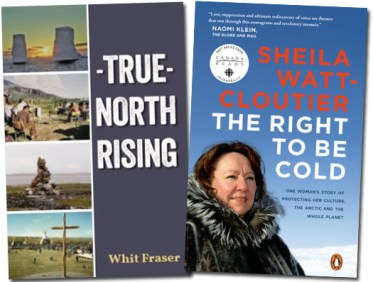 This week, I visited one of the book/craft stores in Iqaluit and purchased two new books: True North Rising by Whit Fraser (book launch video) and The Right to be Cold by Sheila Watt Cloutier (presentation video). Both are biographical in nature. It was fun to read Whit’s book which starts with his employment at the CBC Northern Service in 1967, while I was looking out across the sea ice on Frobisher Bay. Both books provide a model for ‘life as an elder’.
There are also connections. Whit describes his association with Fred Roots, through Students on Ice. I recall Fred from the UNESCO MAB program. Heather and I were shepherding the nomination document for the Southwest Nova Biosphere Reserve through the bureaucratic process. Another connection, going back even further, was to Trevor and Hugh Lloyd, Geographers. I remember meeting them at the McGill SubArctic Research Lab in Schefferville, Quebec in 1964/65.
Whit is a keynote speaker at the EBLES event at the Temple on Queen Street, Bridgetown on June 29th. The other keynote is John Demont, who also comes from the reporting tradition, at the Chronicle Herald.
On Saturday night, we attended a concert at the Iqaluit High School. It was a high energy performance by the Jerry Cans. What was most surprising, was the audience demographic. Young Inuit families. Such a contrast to the Kings Theatre.
Another point of reference is the Iqaluit Centennial Library. This was a chance to catch up on lost gems. I found Robert McGhee’s book The Last Imaginary Place. A Human History of the Arctic World and Edward Said’s Culture and Imperialism.
 A final note. There is now a beer store in Iqaluit. Twenty-four Sleeman Silver Creek lager cost me $86. BTW the new snow has created excellent conditions for cross country skiing.
Acknowledgements
Thanks to Andrew and Julia for their hospitality. Edward for his support.
References
Nunatsiag News Nunatsiaq News
The Jerry Cans The Jerry Cans
Whit Fraser. 2018. True North Rising. Burnstown Publishing.
Sheila Watt-Cloutier. 2015. The Right to be Cold. Penguin Books.
Robert McGhee. 2004. The Last Imaginary Place. Key Porter.
Edward Said. 1993. Culture and Imperialism. Alfred Knopf.
 Click on any numbered site to see details of when paint-out is/was scheduled.
 They mentioned the following objectives:
 In an earlier blog post (
 The next step in my David Manners research has been to track down his writing, after he moved to California, after the second world war. Fortunately, courtesy of Amazon, I am able to order David Morgan Jones (ed) The Wonder within You: From the Metaphysical Journals of David Manners and Awakening from the Dream of Me.
 Manners died in Santa Barbara, aged ninety-eight in 1998. I hope to find them in my mailbox when we return from Iqaluit.
 Yesterday, we held a meeting of the Ernest Buckler Literary Events Society (EBLES) board over on the Bay of Fundy shore. In preparation for the program design for June 29th, it was necessary to read some of the related literature.
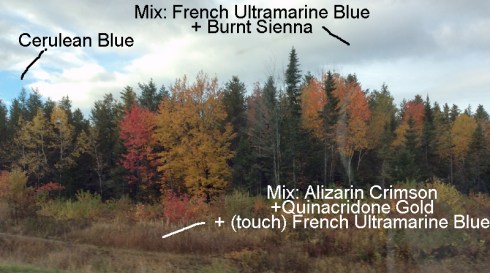 The sky wasn’t just overcast or sunny. The sky was a mix of Burnt Sienna with a touch of French Ultramarine Blue or was a variegated wash from Cerulean Blue to Cadmium Yellow. We were not just engulfed in fall foliage of colours. Hills became brushstrokes of Alizarin Crimson, Quinacridone Gold (I love that colour) and Prussian Blue.
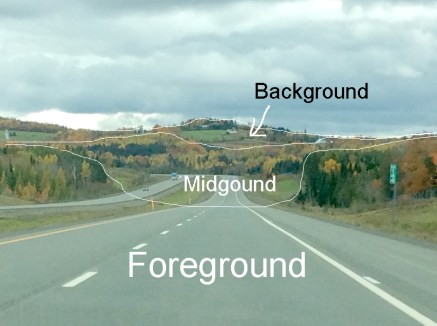 We divided the landscape into zones (foregrounds, mid-grounds, and backgrounds) and described how we would paint aerial perspective, “treat edges” and change tonal contrasts, to give a sense of distance.
 Many times we would identify a focal point in the landscape (almost with “eye-spy-with-my-little-eye enthusiasm) and would suggest ways to direct viewers’ eyes to that point. Would it be the slope of the hills, the line of our winding road, edges of forest stands or the illumination of light breaking through the clouds? How would our favourite artists, or The Group Of Seven treat that focal point?
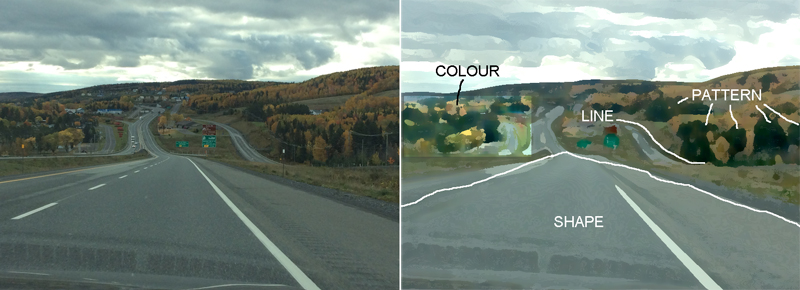 As we drove, we unpacked our landscape NOT in terms of “things” (such as houses, fence rows, barns, silos or cows) but in terms of shape, line, colour, patterns, gradation and composition. We became exhilarated, as artists, to not only view the landscape but to offer ways to interpret the landscape — whether it be as a realist, impressionist or abstract artist — in oils, acrylics, watercolours or inks.
 POSTSCRIPT:
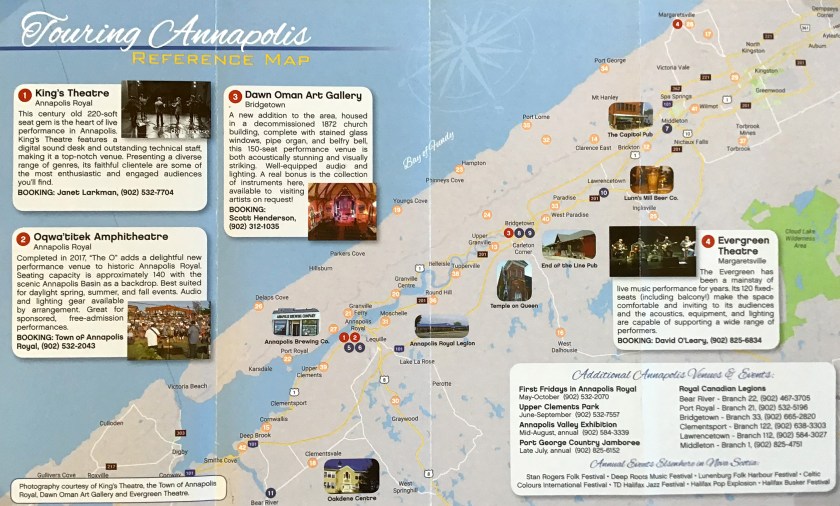 There are several examples of positive outcomes from this relationship e.g. MapAnnapolis, as well as local innovations. This week, I received a copy of Touring Annapolis, Venue guide for Artists produced by
 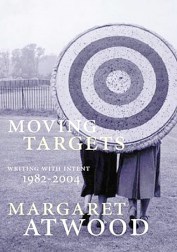 On the Ernest Buckler front, I want to share a couple of books that crossed my desk this week. Margaret Atwood published Moving Targets, Writing with Intent 1982-2004. It includes two essays that struck a chord.
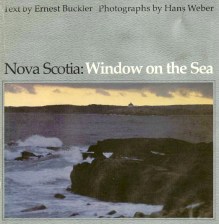 The second book is Nova Scotia: Window on the Sea. It combines a text by Buckler with photographs by Hans Weber. While the text and photography can stand alone, it would be interesting to see a map of the photo locations. The book was published in 1973 – forty-six years ago. Perhaps we need an updated photographic version for the fiftieth anniversary.
 Number #99 was by George Orwell Some Thoughts on the Common Toad. It contained eight essays, including a defence of PG Wodehouse, an examination of Gullivers Travels, and a commentary on Tolstoy and William Shakespeare.
 The Orwell essays complemented my reading of Ernest Buckler. I had the opportunity to read Glance in the Mirror. This quotation caught my eye.

 Last night at the Centrelea Cinema, there was a showing of
 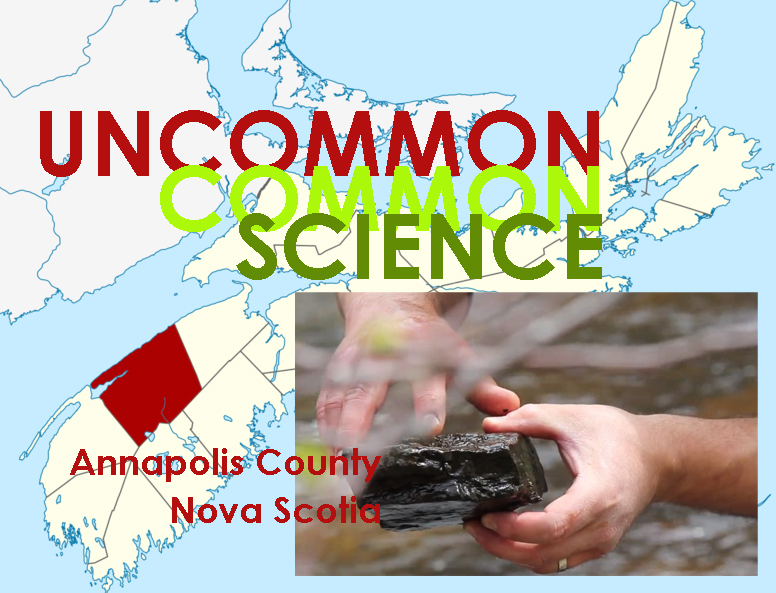 Here is a suggested list of Uncommon Common Science stops in Annapolis County.
